
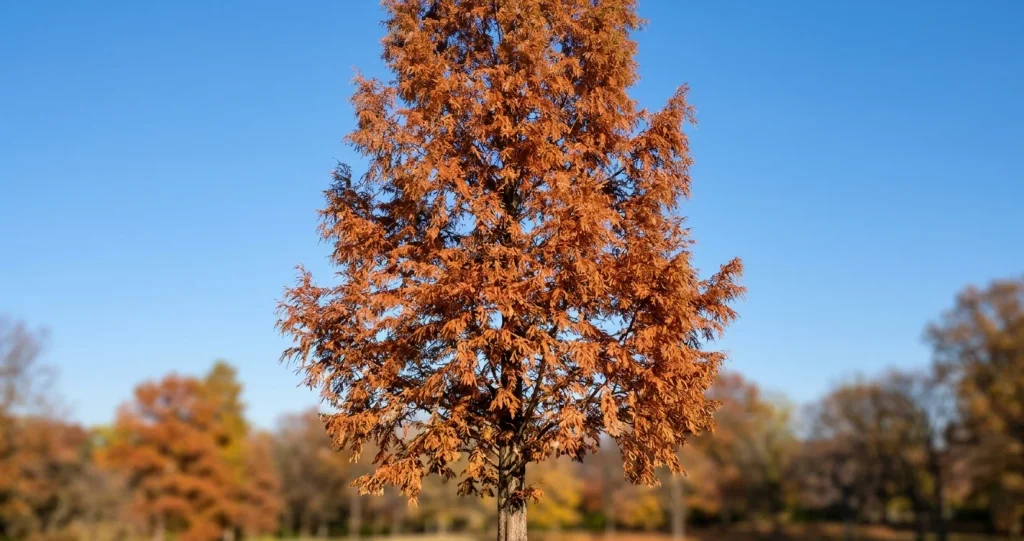
Imagine walking past a towering conifer in late autumn and discovering that its soft, feathery needles have turned copper-orange. A few weeks later, the branches are almost bare, and the ground beneath the tree is covered with delicate, rusty-colored foliage.
For many gardeners, the sight might suggest that something has gone terribly wrong.
But for the dawn redwood, losing its needles is completely natural.
This remarkable tree, known scientifically as Metasequoia glyptostroboides, belongs to an ancient lineage once known to scientists primarily through fossils. Unlike most familiar evergreen conifers, it sheds its foliage every autumn and grows a fresh green canopy in spring.
Its story combines prehistoric forests, an extraordinary botanical discovery, and a seasonal transformation that continues to surprise gardeners across America.
Table Of Contents
- The Dawn Redwood: A Living Fossil in Modern Gardens
- Why Is the Dawn Redwood Called a Living Fossil?
- Why the Dawn Redwood Sheds Its Needles Every Fall
- How to Identify a Dawn Redwood
- Dawn Redwood vs. Bald Cypress: Understanding the Differences
- How Tall Can a Dawn Redwood Grow?
- Where Dawn Redwoods Grow Best in the United States
- Is a Dawn Redwood Dying When Its Needles Turn Brown?
- The Ecological and Conservation Importance of Dawn Redwood
- In Your Own Yard: Growing a Healthy Dawn Redwood
- Frequently Asked Questions
The Dawn Redwood: A Living Fossil in Modern Gardens
The dawn redwood is one of the most fascinating trees found in botanical gardens, parks, and spacious residential landscapes.
At first glance, it resembles a traditional evergreen conifer. Its tall, straight trunk, pyramidal crown, and delicate needle-like leaves create an appearance reminiscent of other members of the cypress family.
Yet its annual cycle is different.
During spring and summer, the tree carries soft, bright green foliage. As temperatures cool and daylight decreases, those needles change to shades of bronze, copper, and reddish brown before falling.
The tree remains leafless throughout winter.
When spring returns, fresh green shoots emerge along its branches, beginning the cycle again.
An ancient lineage with a modern presence
The dawn redwood belongs to a group of conifers with a long fossil history.
Fossils of Metasequoia and closely related ancient forms have been found across parts of the Northern Hemisphere, revealing that these trees once occupied a much wider geographical range.
Today, Metasequoia glyptostroboides is the only living species in its genus.
Its survival offers an unusual connection between ancient forest ecosystems and modern landscapes.
Why Is the Dawn Redwood Called a Living Fossil?
The phrase living fossil is often used to describe an organism belonging to a lineage with a remarkably long evolutionary history.
It does not mean that the organism has remained completely unchanged for millions of years.
In the dawn redwood’s case, the description reflects the relationship between fossil discoveries and the identification of living trees.
A tree first recognized from fossils
Scientists formally described the genus Metasequoia from fossil material during the 1940s.
Around the same period, living trees in China attracted botanical attention. Subsequent investigation established that these living specimens belonged to the genus previously recognized from fossils.
This was an extraordinary discovery because the lineage had been known to science through ancient remains.
The surviving species was formally described as Metasequoia glyptostroboides.
Rediscovery and worldwide cultivation
The living dawn redwood was documented in central China, where naturally occurring populations survived.
Botanical investigations and seed collections helped introduce the species into cultivation outside China during the late 1940s.
Since then, it has become a valued specimen tree in botanical collections and suitable landscapes around the world.
Its survival is especially significant because its native populations occupy a relatively restricted natural range.
Although the species is widely cultivated, conservation of its wild populations and their genetic diversity remains important.
Why the Dawn Redwood Sheds Its Needles Every Fall
One of the dawn redwood’s most distinctive features is its deciduous growth habit.
Most people associate needle-bearing trees with evergreen foliage. Pines, spruces, and many other conifers retain functioning needles through winter, replacing them gradually rather than losing an entire seasonal canopy.
The dawn redwood follows a different strategy.
Deciduous conifers are not unusual mistakes
The term deciduous describes plants that shed their leaves seasonally.
A conifer is defined by its reproductive characteristics and evolutionary relationships, not by whether it retains foliage year-round.
Therefore, a tree can be both a conifer and deciduous.
Dawn redwoods, bald cypresses, and larches are familiar examples of conifers that naturally lose their foliage during the colder part of the year.
The science behind autumn needle drop
As autumn approaches, shorter days and changing temperatures help trigger seasonal changes in the tree.
Chlorophyll, the green pigment involved in photosynthesis, breaks down as the foliage ages.
As green coloration fades, other pigments become more visible, contributing to the tree’s golden, bronze, and copper tones.
At the same time, the tree begins recovering useful nutrients from its aging foliage.
These resources can be stored in living tissues and used during future growth.
The tree also develops separation zones associated with leaf shedding.
Eventually, the foliage detaches and falls.
This process is known as abscission.
Why losing foliage can be useful
Seasonal leaf loss can help deciduous trees avoid maintaining vulnerable photosynthetic tissues through periods when environmental conditions make photosynthesis less productive.
In cold climates, frozen soil, low temperatures, and reduced daylight can limit water uptake and photosynthetic activity.
Dropping foliage reduces the exposed leaf area during winter.
However, this does not mean that deciduous growth is universally better than evergreen growth.
Both strategies involve evolutionary trade-offs involving energy, nutrients, water, and seasonal conditions.
For the dawn redwood, deciduous foliage is a normal part of its biology rather than evidence of declining health.
How to Identify a Dawn Redwood
Recognizing a dawn redwood becomes easier once you know which details to examine.
Soft, feathery foliage
The tree produces flattened sprays of short, soft, needle-like leaves.
During the growing season, these leaves are typically bright to medium green.
Unlike the stiff needles of many pines and spruces, dawn redwood foliage feels relatively delicate.
Opposite leaf arrangement
One of its most useful identification features is the arrangement of leaves and small branchlets.
Dawn redwood leaves generally occur in opposite pairs along the shoots.
The small leafy branchlets also tend to have an opposite arrangement.
This helps distinguish the species from the similar-looking bald cypress, whose foliage is generally arranged alternately.
Reddish-brown bark
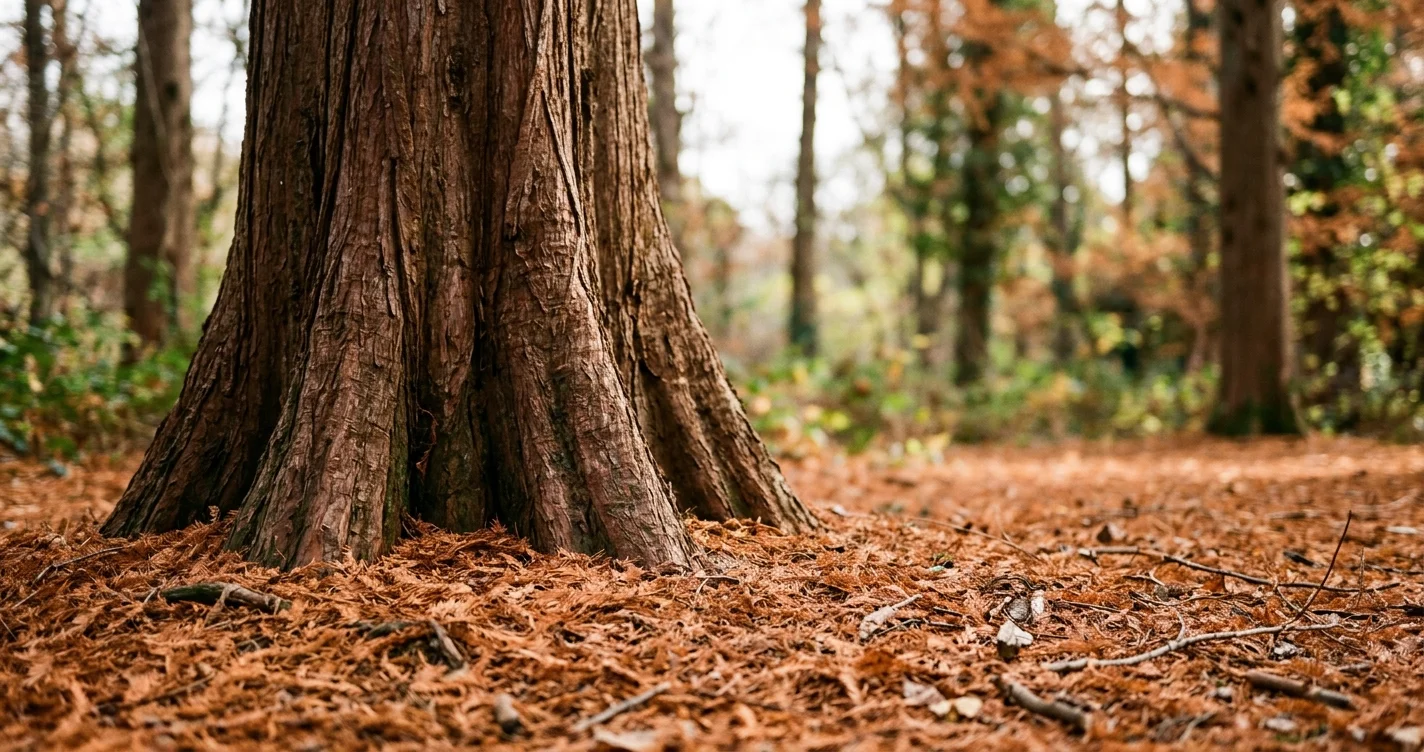
Mature dawn redwoods develop reddish-brown to grayish bark with fibrous texture and vertical ridges.
The trunk may become strongly buttressed near its base as the tree matures.
Small woody cones
As a conifer, the dawn redwood produces cones rather than flowers resembling those of broadleaf flowering trees.
Its small, rounded to oval woody seed cones contain seeds that can be dispersed after maturation.
These reproductive structures provide another useful identification feature.
Dawn Redwood vs. Bald Cypress: Understanding the Differences
Dawn redwood and bald cypress (Taxodium distichum) are frequently confused.
Both are deciduous conifers with feathery foliage and attractive autumn color.
However, they differ in several important ways.
| Feature | Dawn redwood | Bald cypress |
|---|---|---|
| Scientific name | Metasequoia glyptostroboides | Taxodium distichum |
| Native range | China | Southeastern United States |
| Leaf arrangement | Generally opposite | Generally alternate |
| Autumn foliage | Copper to reddish brown | Rusty orange to brown |
| Growth habit | Tall, pyramidal | Often pyramidal when young |
| Wet-site tolerance | Prefers moist, well-drained conditions | Often tolerates prolonged flooding |
Bald cypress is especially associated with wetlands, floodplains, and swamp forests in parts of the southeastern United States.
Dawn redwood also appreciates consistent moisture, but it should not automatically be treated as a substitute for bald cypress in permanently flooded sites.
For gardeners, examining leaf arrangement is often one of the simplest ways to tell the two species apart.
How Tall Can a Dawn Redwood Grow?
Dawn redwood is not a small ornamental tree.
Under favorable conditions, it can develop into a substantial landscape specimen with a tall trunk and broadening crown.
Mature cultivated trees commonly reach impressive heights, and suitable sites may support trees exceeding 100 feet over time.
Growth rate varies with climate, soil, moisture, age, and growing conditions.
Young trees may grow relatively quickly when established in favorable locations.
However, rapid growth should not be mistaken for a guarantee that a newly planted tree will reach a particular height within a fixed number of years.
Give the tree room
A dawn redwood can eventually occupy considerably more space than it does when purchased from a nursery.
Its mature height, root development, and crown spread make site selection especially important.
Planting too close to buildings, overhead wires, or confined paved areas can create avoidable problems as the tree grows.
Where Dawn Redwoods Grow Best in the United States
Dawn redwoods are cultivated in many parts of the United States, particularly where winters are cool and growing-season moisture is reasonably dependable.
They generally perform best in full sun and soils that retain moisture without remaining continuously waterlogged.
Sunlight
A sunny location usually supports strong growth and a well-developed crown.
Young trees may tolerate some limited shade, but heavily shaded sites are generally less suitable.
Soil and moisture
Moist, fertile, reasonably well-drained soil is ideal.
Established trees can tolerate some variation in soil conditions, but prolonged drought can cause stress.
Young trees are especially vulnerable when their developing root systems cannot access sufficient moisture.
Mulching the root zone can help moderate soil temperature and reduce surface evaporation.
Climate considerations
Dawn redwoods are often recommended for approximately USDA Hardiness Zones 5–8, although suitability depends on local conditions and cultivar.
Cold tolerance, summer heat, soil moisture, and exposure all influence performance.
USDA hardiness zones describe average annual extreme minimum temperatures. They do not account for every factor affecting tree survival.
Gardeners should therefore consider regional extension guidance before planting.
Is a Dawn Redwood Dying When Its Needles Turn Brown?
One of the most common concerns among new dawn redwood owners is autumn browning.
A healthy tree may change from green to copper-brown and then shed nearly all its foliage.
This is normal.
Signs of ordinary seasonal change
Natural autumn needle drop typically occurs across much of the canopy as the growing season ends.
The foliage changes color gradually, and the tree enters winter with bare branches.
Fresh buds and new growth should appear when suitable spring conditions return.
When browning may indicate a problem
Brown foliage during spring or summer deserves closer attention.
Potential causes include drought stress, root damage, poor drainage, transplant shock, or other environmental problems.
Sudden dieback affecting individual branches may also require investigation.
The timing, distribution, and severity of symptoms matter.
Rather than assuming every brown needle indicates disease, examine the tree’s growing conditions and seasonal stage.
If major dieback occurs, a qualified arborist or local extension specialist can help identify the cause.
The Ecological and Conservation Importance of Dawn Redwood
Dawn redwood has value beyond its appearance in ornamental landscapes.
Its survival provides scientists with an opportunity to study a lineage that was once geographically widespread.
Living trees can help researchers investigate plant evolution, adaptation, reproductive biology, and genetic diversity.
Protecting wild populations
Although dawn redwood is planted internationally, naturally occurring populations remain geographically limited.
Habitat changes and other pressures can affect the long-term security of these populations.
Conservation therefore involves more than planting ornamental specimens.
Protecting natural habitat, maintaining genetic diversity, and supporting responsible botanical conservation programs are also important.
Wildlife in cultivated landscapes
A mature dawn redwood can contribute shade, structural diversity, and seasonal habitat in a landscape.
Birds and other animals may use its branches for resting or shelter.
However, its ecological role varies by region.
Because it is not native to North America, it should not be assumed to support the same specialized wildlife relationships as locally native trees.
Combining suitable ornamental specimens with native plants can help create more diverse landscapes.
In Your Own Yard: Growing a Healthy Dawn Redwood
A dawn redwood can be a beautiful addition to a spacious yard, but successful cultivation begins with choosing the right location.
Choose a suitable planting site
Select an area with adequate sunlight and enough space for the tree’s mature size.
Avoid locations directly beneath utility lines or immediately beside buildings.
Check for underground utilities before digging.
Plant at the correct depth
Place the root flare at or slightly above the surrounding finished soil level, according to site conditions.
Avoid burying the trunk beneath excess soil.
Backfill using appropriate native soil and water thoroughly after planting.
Maintain consistent moisture
During establishment, monitor soil moisture carefully.
Water deeply when needed, allowing conditions to guide frequency rather than following a rigid schedule.
Avoid both severe drying and persistent saturation.
Apply mulch properly
Spread an appropriate layer of organic mulch over the root zone, keeping it away from direct contact with the trunk.
Mulch can reduce moisture loss, moderate soil temperatures, and limit competition from weeds.
Avoid unnecessary pruning
Dawn redwoods naturally develop an attractive pyramidal form.
Routine heavy pruning is generally unnecessary.
Remove damaged, dead, or hazardous branches when appropriate, and seek professional help for large-tree work.
Enjoy the seasonal transformation
Observe the tree through the year.
Spring brings delicate green foliage, summer creates a soft canopy, autumn produces warm copper tones, and winter reveals the branching structure.
Understanding this cycle prevents the common mistake of treating natural autumn needle drop as a disease.
Frequently Asked Questions
Is the dawn redwood an evergreen tree?
No. The dawn redwood is a deciduous conifer. It produces needle-like foliage during the growing season, changes color in autumn, and sheds its needles before winter. This is a normal part of its annual growth cycle.
How fast does a dawn redwood grow?
Dawn redwoods can grow relatively quickly under favorable conditions, especially when young. Actual growth depends on soil, sunlight, moisture, climate, and establishment. They should be planted with enough space for their substantial mature size.
Can I grow a dawn redwood in a small backyard?
Usually, a standard dawn redwood is better suited to a spacious landscape because it can become a very large tree. Some compact cultivars may be appropriate for smaller sites, but their expected mature dimensions and local growing conditions should be checked before planting.
Conclusion
The sight of a towering conifer dropping its needles may seem surprising, especially when nearby pines and spruces remain green.
But for the dawn redwood, autumn leaf loss is part of an ancient and remarkably successful seasonal strategy.
This living representative of a once-widespread lineage combines a fascinating fossil history with the changing beauty of a deciduous tree.
Its copper-colored autumn foliage, bare winter branches, and fresh spring growth remind us that a tree can appear to lose everything while simply preparing for another season.
The next time a dawn redwood turns rusty orange, there is no need to assume the worst.
It may simply be displaying one of the most extraordinary transformations in the conifer world.
External Sources
1. NC State Extension — Dawn Redwood Covers identification, needle loss, autumn color, growing conditions, mature size, and soil preferences, North Carolina Extension Gardener Plant Toolbox.
2. Harvard Arnold Arboretum — Dawn Redwood
Explains the living fossil discovery, the tree’s history in China, its introduction to North America, and its deciduous nature.
3. Harvard Arnold Arboretum — Conifer Collection
Specifically confirms that dawn redwood is a deciduous conifer that loses its needles each autumn and grows new foliage in spring.