
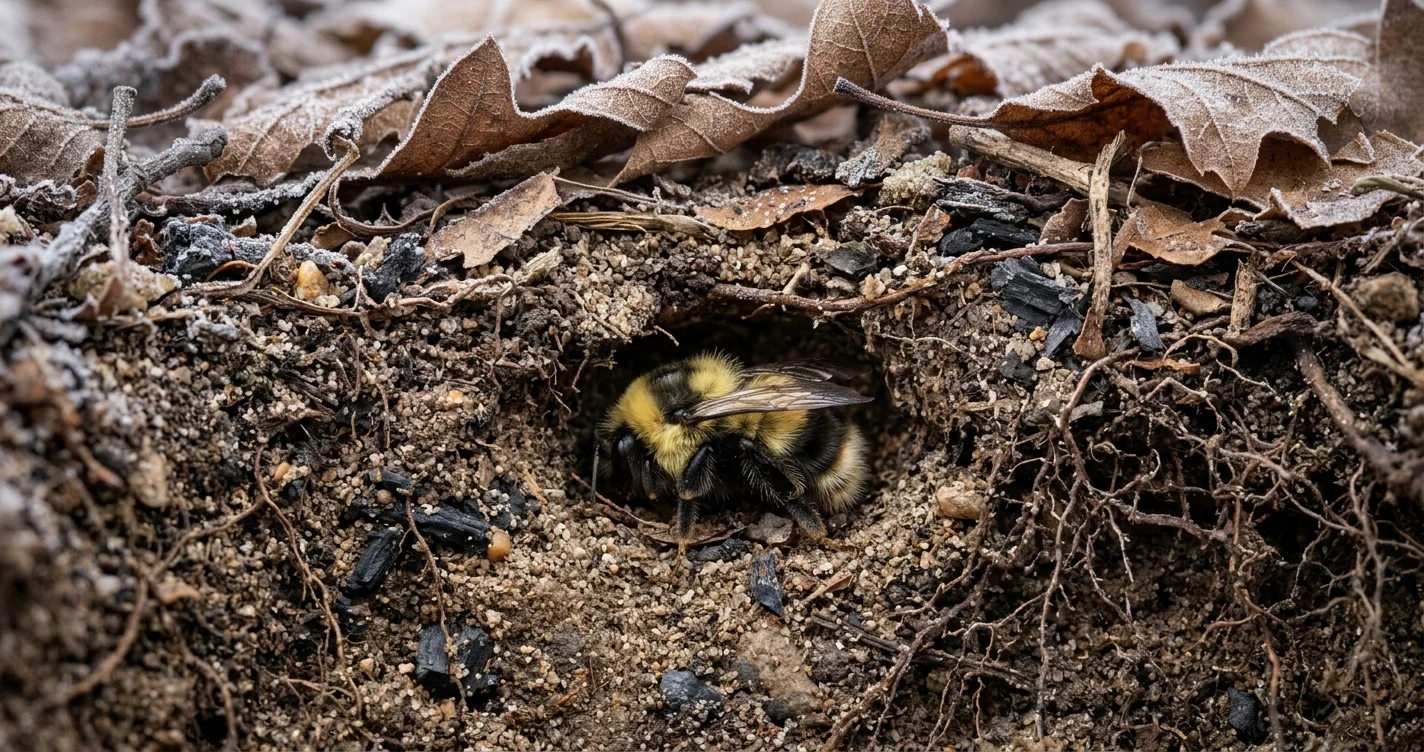
An autumn garden can look almost empty. The flowers are fading, leaves are gathering beneath the trees, and the familiar buzzing of summer has nearly disappeared. Yet beneath that quiet surface, the next generation of bumblebee colonies may already be waiting.
The story of how bumblebee queens survive winter is one of nature’s remarkable seasonal transformations. While most members of a colony disappear as temperatures fall, newly mated queens can spend the cold months hidden in protected places, conserving the energy they will need to begin again in spring.
Their survival connects the fading flowers of autumn to the first blossoms of the following year. It also reveals why an ordinary backyard, including its soil, fallen leaves, and undisturbed corners, can be important wildlife habitat.
Table Of Contents
- The Hidden Bees Beneath an Autumn Garden
- What Happens to Bumblebee Colonies in Fall?
- Why Bumblebee Queens Survive When Colonies Disappear
- Where Do Bumblebee Queens Spend the Winter?
- The Science of Bumblebee Winter Dormancy
- What Happens When Spring Arrives?
- Why Fallen Leaves Matter to Backyard Wildlife
- Common Mistakes That Disturb Overwintering Pollinators
- In Your Own Yard: Creating a Safer Winter Habitat
- Frequently Asked Questions
The Hidden Bees Beneath an Autumn Garden
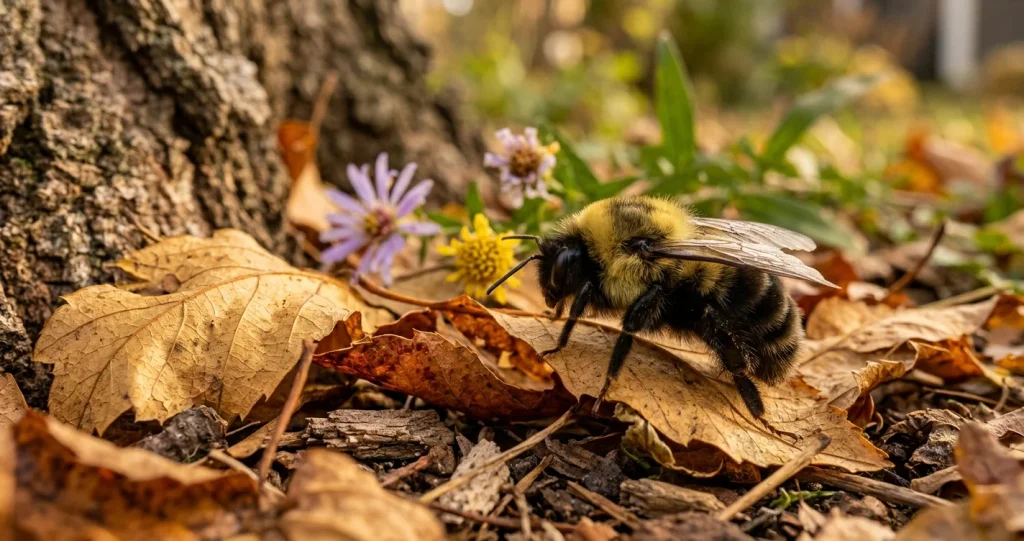
During summer, a flowering garden may be filled with bumblebees visiting lavender, coneflowers, clover, and other nectar-rich plants. Their movements seem constant as workers collect food for a growing colony.
By autumn, that activity gradually changes.
Many flowers finish blooming. Days become shorter, and established colonies approach the end of their natural life cycle. Workers become less numerous, and the familiar traffic around nesting entrances begins to fade.
But the disappearance of a colony does not necessarily mean the disappearance of its next generation.
Somewhere nearby, newly mated queens may be searching for protected places to spend the winter.
These hidden shelters are easy to overlook. They may be beneath the soil surface, within sheltered banks, or in other suitable locations that provide protection from harsh environmental conditions.
What looks like an inactive garden can therefore contain an important stage of the bumblebee life cycle.
What Happens to Bumblebee Colonies in Fall?
Most bumblebee species living in temperate North America have annual colonies. Unlike honeybee colonies, which can survive winter as organized groups, typical temperate bumblebee colonies do not continue year after year.
The final generation of a colony
A bumblebee colony usually begins when a queen establishes a nest in spring.
She lays eggs, raises her first workers, and gradually develops a colony supported by those workers. Throughout summer, workers gather nectar and pollen while the queen continues producing offspring.
As the colony matures, it may begin producing reproductive males and new queens.
These individuals have a different role from the workers.
Males leave the nest to seek mates. New queens eventually mate and prepare for the next stage of their lives.
The colony’s natural decline
As autumn approaches, the original queen, workers, and males generally die.
The old nest is usually abandoned rather than reused as a functioning colony the following spring.
However, the newly mated queens may survive.
Each successful queen carries the potential to establish a new colony, making her survival especially important to the continuation of the local population.
The timing varies with species, climate, elevation, and seasonal conditions.
Why Bumblebee Queens Survive When Colonies Disappear
A newly mated bumblebee queen is biologically different from a worker.
She has the reproductive capacity to establish a colony, and before entering winter dormancy, she generally builds energy reserves that help sustain her through months without regular feeding.
Workers spend their lives supporting the existing colony. A new queen’s role extends beyond it.
After mating, she must find a suitable overwintering location, survive unfavorable conditions, emerge when the season becomes suitable, and locate a place to nest.
This makes the queen a critical link between generations.
Her survival is not guaranteed. Cold exposure, flooding, unsuitable moisture conditions, depleted energy reserves, pathogens, and other hazards can affect overwintering success.
Even so, this seasonal strategy allows many bumblebee species to persist in regions where winter conditions make year-round colony activity impractical.
A single surviving queen may eventually become the founder of an entirely new colony.
Where Do Bumblebee Queens Spend the Winter?
The question of where bumblebees go in winter has a more complicated answer than simply saying they sleep beneath fallen leaves.
Many queens overwinter underground, often in small cavities or sheltered locations where soil conditions help moderate exposure to the weather.
Underground shelters
Suitable overwintering locations may include loose or relatively well-drained soil, sheltered slopes, and protected ground near vegetation.
Some queens may occupy shallow underground spaces, while others may use deeper or differently structured sites.
Researchers have documented variation in overwintering behavior, and the exact preferences of many species remain incompletely understood.
Soil texture, drainage, moisture, and local climate can all influence the suitability of a location.
The role of fallen leaves
Leaf litter can help create a more buffered environment at the soil surface.
A layer of leaves may reduce abrupt temperature fluctuations, limit exposure to drying conditions, and protect the ground from direct weather impacts.
However, this does not mean every bumblebee queen nests directly within leaves.
For many species, the actual overwintering chamber is in the soil beneath or near vegetated ground.
Winter shelters are not spring nests
An important distinction is that a queen’s overwintering location is not necessarily the place where she will raise her offspring.
After emerging in spring, she often searches for a separate nesting site.
Depending on the species, suitable nest locations may include abandoned rodent burrows, cavities beneath vegetation, or other protected spaces.
Preserving different kinds of habitat can therefore be valuable throughout the year.
The Science of Bumblebee Winter Dormancy
To understand bumblebee queen hibernation, it helps to look at what happens inside the insect’s body.
The queen is not simply sleeping in the same way a mammal sleeps at night.
Instead, many temperate bumblebee queens enter a specialized period of dormancy known as diapause.
What is diapause?
Diapause is a regulated physiological state that helps an organism survive an unfavorable season.
In bumblebee queens, it is associated with greatly reduced activity and metabolism.
Rather than spending the winter flying between flowers, the queen remains largely inactive in a protected location.
Her body uses stored resources to maintain essential functions.
This reduction in activity allows her to conserve energy during a period when flowers and other food resources may be unavailable.
Energy reserves before winter
Before entering dormancy, newly mated queens generally accumulate energy reserves.
These stored resources are essential because overwintering queens usually do not forage during diapause.
The amount of energy available, the length of dormancy, and environmental conditions can all influence whether a queen survives until spring.
A queen emerging from winter must also retain enough resources to begin foraging and searching for a nest.
Survival therefore depends on more than simply avoiding freezing temperatures.
Temperature and moisture matter
Underground environments can be more stable than exposed surfaces.
Soil, vegetation, and natural ground cover can moderate temperature changes, although conditions vary greatly by location.
Moisture also matters.
Extremely dry conditions can increase water-loss risks, while waterlogged or flooded shelters may create other hazards.
A sheltered location that is suitable in one region may not provide the same protection elsewhere.
This is one reason scientists avoid describing a single ideal overwintering temperature or soil depth for every bumblebee species.
Bumblebees and honeybees use different strategies
Bumblebee overwintering is often confused with honeybee winter survival.
Honeybees typically remain together in a colony, forming a winter cluster and using stored honey to sustain themselves.
By contrast, newly mated queens of most temperate bumblebee species overwinter individually.
They are not surrounded by a colony of workers, and they do not maintain a winter hive filled with honey.
The two groups are both important pollinators, but their seasonal survival strategies are fundamentally different.
What Happens When Spring Arrives?
As conditions become suitable, surviving bumblebee queens emerge from dormancy.
The timing varies by species and geography. In warmer regions, some queens may appear relatively early, while colder locations may experience later emergence.
The first flowers become essential
A newly emerged queen needs energy.
She may visit early-blooming flowers to obtain nectar and pollen. Suitable flowering trees, shrubs, and herbaceous plants can provide important resources during this period.
Willows and other early-flowering native plants can be valuable in appropriate regions.
The availability of flowers matters because queens must replenish energy while preparing to establish a colony.
Searching for a new nest
After emerging, a queen may spend considerable time investigating possible nesting locations.
She may fly close to the ground, explore vegetation, or inspect small openings.
Once she finds a suitable site, she begins constructing the first structures needed for brood development.
She lays eggs and provides food for the developing larvae.
The first workers eventually emerge and begin helping with foraging and colony maintenance.
At that point, the colony can grow beyond the queen’s initial efforts.
The transition from one overwintering insect to an active summer colony is one of the most extraordinary stages of the bumblebee life cycle.
Why Fallen Leaves Matter to Backyard Wildlife
Fallen leaves are often treated as garden waste, but they are also part of a functioning ecosystem.
As leaves accumulate and decompose, they influence soil conditions and provide shelter for numerous small organisms.
Some insects overwinter within leaf litter. Others shelter in stems, beneath bark, or underground.
Spiders, beetles, moths, and many other invertebrates use these habitats in different ways.
Leaf litter also supports decomposers that help break down organic material and return nutrients to the soil.
For bumblebee queens, undisturbed ground beneath or near leaf-covered areas may provide suitable conditions in some habitats.
The popular gardening advice to leave the leaves is therefore about more than one insect.
It encourages homeowners to preserve natural habitat features that support a wider community of wildlife.
Leaves alone cannot guarantee pollinator survival, but retaining suitable natural ground cover can be part of responsible backyard pollinator conservation.
Common Mistakes That Disturb Overwintering Pollinators
Many routine garden activities are harmless when performed carefully. Others can unintentionally disturb insects spending the colder months in protected habitats.
Removing every fallen leaf
Clearing all leaves from garden beds and natural corners can reduce shelter for some overwintering invertebrates.
Leaves should still be removed where they create safety problems, block drainage, or damage sensitive turf.
The goal is selective management rather than abandoning all garden maintenance.
Unnecessary winter digging
Deep digging, soil turning, and major landscaping can disturb underground organisms.
When practical, postponing nonessential soil disturbance in suitable habitat areas may reduce these risks.
Cutting back every plant
Standing stems and natural vegetation can provide shelter or structural habitat for different insects.
Leaving some suitable vegetation until later in spring may benefit wildlife, although the needs of individual species vary.
Unnecessary pesticide applications
Insecticides can affect beneficial insects as well as pests.
Reducing unnecessary pesticide use and following integrated pest management principles can help protect pollinators and other garden wildlife.
In Your Own Yard: Creating a Safer Winter Habitat
Supporting pollinator winter habitat does not require turning an entire backyard into wilderness.
A few carefully managed areas can preserve useful habitat while keeping the garden attractive and functional.
Keep some leaves in garden beds
Allow suitable fallen leaves to remain beneath shrubs, around established plants, or in naturalized areas.
Avoid thick, compacted layers where they may smother sensitive plants.
Protect undisturbed soil
Retain a few patches of ground that are not repeatedly cultivated or compacted.
Sheltered areas near native vegetation may offer habitat opportunities for ground-associated insects.
Preserve native plants
Native flowering plants can support bumblebees and other pollinators throughout the growing season.
Choose species appropriate for your region, soil, and available sunlight.
Provide flowers across the seasons
Early spring flowers are especially useful for emerging queens, while summer and autumn blooms help support developing colonies and reproductive individuals.
Aim for overlapping flowering periods rather than relying on a single plant species.
Reduce unnecessary disturbance
Avoid digging into suspected overwintering sites or attempting to uncover dormant queens.
Observation from a distance is safer for wildlife.
These practices cannot guarantee that bumblebees will establish colonies in a particular yard.
They can, however, help maintain the variety of resources and sheltered habitats that pollinators need throughout their life cycles.
Frequently Asked Questions
Do all bumblebees die in winter?
No. In most temperate bumblebee species, workers, males, and the original colony queen generally die as the season ends. Newly mated queens may survive winter in dormancy and establish new colonies the following spring. Some species in milder climates have different seasonal patterns.
Do bumblebee queens sleep under fallen leaves?
Some queens may overwinter in soil beneath or near leaf-covered ground, but not all queens use the same habitat. Many overwinter underground in sheltered cavities. Fallen leaves may help buffer conditions at the soil surface, but they are not a universal overwintering location.
When do bumblebee queens emerge in spring?
Emergence depends on the species, regional climate, and seasonal weather. Some queens become active during early spring, while others emerge later. The availability of suitable flowering plants is important once they begin foraging.
Conclusion
The next time an autumn garden seems quiet, remember that the story of its pollinators may be continuing out of sight.
Beneath the soil, a newly mated queen may be passing through months of dormancy, conserving the energy needed to begin a new colony.
Understanding how bumblebee queens survive winter reveals why the smallest habitat features deserve attention.
A patch of undisturbed ground, a layer of fallen leaves, or a stand of native flowers may seem ordinary. Together, these features can help create a landscape where pollinators have opportunities to survive, emerge, and begin again.
The buzzing of next spring may depend, in part, on the quiet places we protect today.
External Sources
- Texas Parks and Wildlife — Bumble Bee Life Cycle Explains reproductive queens, autumn colony decline, and overwintering. TPWD
- U.S. Fish & Wildlife Service — Yellow-Banded Bumble Bee Provides species-specific information on overwintering, spring emergence, and colony establishment. U.S. Fish & Wildlife Service