
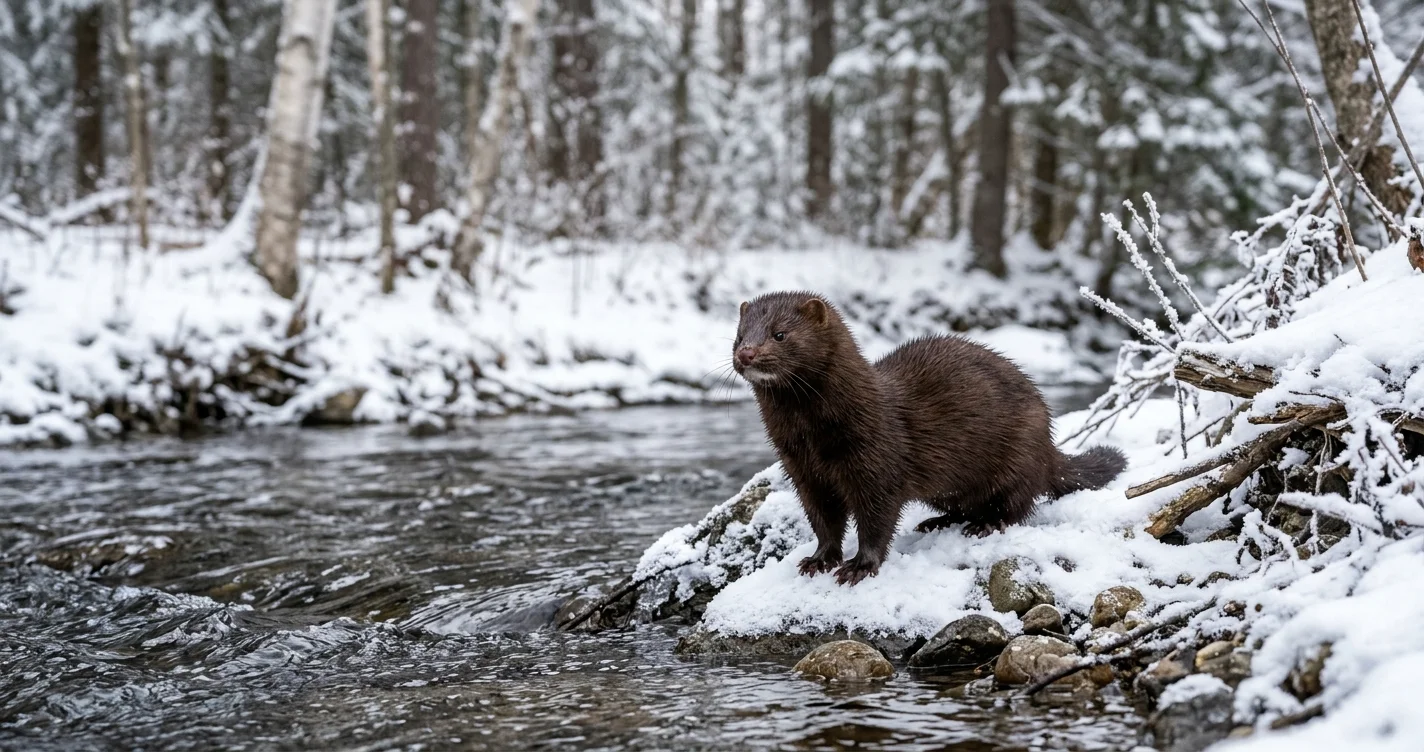
A narrow trail of paw prints crosses a snowy riverbank, disappears beneath a tangle of frozen roots, and reappears beside a patch of open water. Whatever made those tracks seems remarkably comfortable in a landscape where most small mammals would rather stay hidden.
Then a dark, sleek animal slips out of the reeds and dives into the icy stream.
It is an American mink (Neogale vison), one of North America’s most adaptable semi-aquatic predators.
Unlike bears, mink do not hibernate. Unlike many migratory birds, they do not escape winter by traveling south. Instead, they remain active, hunting along rivers, marshes, ponds, and lakes even when snow covers the ground.
Their survival depends on a fascinating combination of dense fur, flexible hunting behavior, sheltered resting places, and an ability to move between land and water.
But cold water creates challenges even for an animal built to swim. Understanding how mink cope with winter reveals the delicate balance between staying warm and finding enough food to survive.
Table of contents
- What Is an American Mink?
- Why Winter Is Challenging for Mink
- American Mink Winter Survival: How Their Bodies and Behavior Work
- What Do American Mink Eat During Winter?
- How American Mink Hunt Beneath Ice and Snow
- Do American Mink Hibernate in Winter?
- Where American Mink Find Winter Shelter
- The American Mink’s Role in Winter Wetland Ecosystems
- What Threatens American Mink During Winter?
- In Your Own Yard: Supporting Healthy Mink Habitat
- Frequently Asked Questions
What Is an American Mink?
The American mink is a small carnivorous mammal native to North America. It belongs to the weasel family, Mustelidae, alongside otters, martens, ferrets, and several other long-bodied predators.
Mink are closely associated with water, but they are not exclusively aquatic animals. They travel, hunt, and rest on land as well.
How to Recognize an American Mink
American mink have long, slender bodies, short legs, rounded ears, and relatively long, furry tails.
Their fur is usually rich dark brown, sometimes appearing nearly black. Many individuals have a small white patch on the chin or throat, although the markings vary.
Their streamlined shape allows them to move through dense vegetation, narrow burrows, and water.
They are often mistaken for river otters, but mink are considerably smaller and generally have a more delicate build.
Where American Mink Live
American mink inhabit a wide range of aquatic environments across much of North America.
They may be found near freshwater streams, rivers, marshes, lakeshores, and coastal wetlands.
Suitable habitat typically provides access to prey, shoreline cover, and protected places to rest.
Mink can also occupy waterways near farms, suburban neighborhoods, and other human-modified landscapes.
Are American Mink Solitary?
American mink are generally solitary outside mating periods and interactions between mothers and young.
Individuals often maintain home ranges that follow waterways or other productive hunting habitats.
The size and arrangement of these ranges vary according to sex, food availability, habitat quality, and population density.
Why Winter Is Challenging for Mink
Winter transforms the environments mink depend on.
Streams may freeze along their edges. Wetlands can become covered in snow. Small mammals retreat beneath the snowpack, and some aquatic prey becomes harder to reach.
For a relatively small predator, these changes create important challenges.
Small Bodies Lose Heat Quickly
Small mammals generally have a higher surface-area-to-volume ratio than larger animals.
This means they can lose body heat relatively quickly, especially in cold or wet conditions.
Mink must balance the energy gained from food against the energy needed for movement and temperature regulation.
Cold Water Increases Heat Loss
Water conducts heat away from the body much more efficiently than still air.
Even with insulating fur, prolonged exposure to cold water can be energetically expensive.
Mink therefore benefit from hunting efficiently and returning to sheltered areas between periods of activity.
Food Availability Changes
Some prey animals become less active or more difficult to locate during winter.
Others remain available beneath snow, in unfrozen water, or within shoreline vegetation.
A mink’s ability to switch between prey types can be especially valuable when conditions change.
American Mink Winter Survival: How Their Bodies and Behavior Work
The American mink survives winter through several complementary adaptations. No single feature makes it immune to cold. Instead, its fur, body shape, behavior, and hunting flexibility work together.
1. Dense Fur Helps Trap Warm Air
Mink have two important layers of fur.
The outer coat contains longer guard hairs that help protect the underlying fur from moisture and wear.
Beneath those hairs is a dense layer of shorter underfur that traps air close to the skin.
This trapped air reduces heat loss and provides insulation.
A mink’s coat is particularly important when it enters cold water, although diving and wetting can still reduce the effectiveness of insulation.
2. Natural Oils Help Protect the Coat
Mink groom their fur to maintain its condition.
Natural skin oils and the arrangement of guard hairs help the coat resist wetting.
However, mink fur is not an impenetrable waterproof barrier.
Cold-water exposure can still carry significant thermal costs, especially during repeated or extended dives.
3. A Streamlined Body Supports Swimming
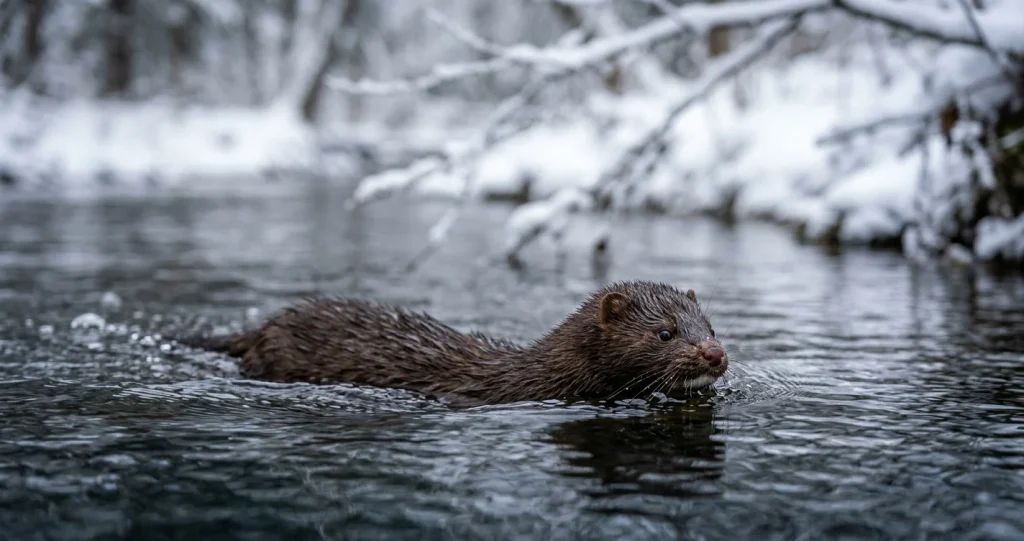
The mink’s long, flexible body allows it to move efficiently through narrow spaces and aquatic vegetation.
Its feet have some webbing between the toes, supporting swimming.
Unlike animals specialized for long-distance underwater travel, mink regularly alternate between swimming, diving, walking, and running along shorelines.
This versatility allows them to exploit different habitats within a relatively small area.
4. Sheltered Dens Reduce Exposure
Mink use protected resting sites such as hollow logs, cavities among roots, rock crevices, and abandoned burrows.
They may also shelter beneath dense vegetation or other shoreline structures.
These locations provide protection from wind, precipitation, and some predators.
Mink may use several resting sites within their home ranges rather than relying on a single permanent den.
5. Flexible Hunting Helps Maintain Energy
A mink’s winter diet depends heavily on what is locally available.
In some habitats, fish and aquatic animals remain important.
Elsewhere, small mammals, birds, or other prey may become more significant.
This dietary flexibility helps mink respond to changing conditions.
6. Activity Patterns Can Change
Mink can be active during daylight, twilight, or darkness.
Their activity patterns may shift according to prey behavior, disturbance, temperature, and local conditions.
During winter, individuals may concentrate their movements around productive feeding areas or sheltered routes.
These adjustments can reduce unnecessary travel, although the exact patterns vary among individuals.
What Do American Mink Eat During Winter?
Mink are opportunistic carnivores, meaning they consume a variety of animal prey rather than depending on one food source.
Their winter diet can vary substantially between inland wetlands, rivers, and coastal environments.
Fish in Open Water
Fish are an important food source in many aquatic habitats.
Mink may hunt in shallow water, around stream edges, or near places where fish are accessible.
They can dive to capture prey, but they are not as specialized for extended underwater pursuit as river otters.
Small Mammals Beneath the Snow
Voles, mice, and other small mammals may remain active in tunnels beneath snow.
Mink can investigate shoreline vegetation, burrows, and sheltered spaces where these animals occur.
In some locations, small mammals provide a significant share of the winter diet.
Crayfish and Other Aquatic Animals
Crayfish and other aquatic invertebrates can be important prey when available.
Their accessibility changes with water temperature, habitat, and seasonal behavior.
Mink may also consume amphibians and other aquatic animals, depending on local conditions.
Birds and Eggs
Mink sometimes prey on waterbirds and other birds.
Eggs are more relevant during nesting seasons than during midwinter.
Winter bird prey may include vulnerable individuals encountered along shorelines or in wetland vegetation.
Why Variety Matters
A predator that relies on only one prey species may struggle when that food becomes scarce.
Mink can shift among several prey categories, giving them options when waterways freeze or small-mammal populations fluctuate.
However, flexibility does not eliminate the need for productive habitat.
How American Mink Hunt Beneath Ice and Snow
A frozen wetland may appear almost lifeless from above, but activity continues beneath its surface.
Mink are capable of exploiting some of these hidden food resources.
Searching Along Ice Edges
Open water near ice margins can provide access to aquatic prey.
Mink may investigate these areas while traveling along shorelines.
The availability of open water depends on temperature, current, depth, and local conditions.
Exploring Shoreline Cover
Root systems, fallen branches, and dense vegetation create small protected spaces.
These features can shelter prey and provide mink with concealed hunting routes.
A mink may repeatedly investigate promising locations as it travels.
Hunting in Snowy Vegetation
Snow can hide small mammals, but it may also reveal tracks and movement patterns.
Mink use their senses to investigate potential prey locations.
They can enter narrow spaces beneath vegetation or around burrows that would be inaccessible to larger predators.
Are Mink Able to Dive Under Ice?
Mink can dive and swim beneath the surface, including in cold conditions.
They may enter water through openings in ice.
However, extensive ice cover limits access to air and can make underwater travel dangerous.
It is more accurate to describe mink as adaptable cold-water hunters than as animals that routinely travel long distances beneath solid ice.
Do American Mink Hibernate in Winter?
American mink do not hibernate.
They remain active throughout winter, although their movement patterns can change.
Why They Continue Hunting
Mink need a continuing supply of energy to maintain normal body functions.
Unlike animals that rely on extended seasonal dormancy, they must keep obtaining food.
They may rest in sheltered dens between hunting periods.
What Happens During Severe Weather?
During storms or particularly cold periods, mink may spend more time in protected locations.
However, they still need to resume feeding.
Their behavior depends on food availability, individual condition, and weather.
Do Mink Store Food?
Mink may cache surplus prey under certain conditions.
Food caching can provide access to resources later, although it is not necessarily a reliable or consistent winter strategy for every individual.
The importance of stored food varies among habitats and circumstances.
Where American Mink Find Winter Shelter
Shelter is essential for an animal that regularly moves between cold water and exposed land.
Hollow Logs and Tree Roots
Fallen trees and exposed root systems can provide protected cavities.
These structures often occur near water, making them convenient resting locations.
Rock Crevices and Burrows
Mink may use spaces among rocks or occupy burrows originally created by other animals.
Such sites can reduce exposure to wind and precipitation.
Dense Wetland Vegetation
Thick shoreline vegetation provides cover during movement and rest.
Even dead winter stems can create useful shelter.
Why Natural Shorelines Matter
Shorelines with fallen wood, roots, rocks, and native vegetation offer more structural diversity than heavily cleared banks.
This diversity can benefit mink and many other wildlife species.
The American Mink’s Role in Winter Wetland Ecosystems
Mink are predators that connect aquatic and terrestrial food webs.
Their movements between water and land allow them to exploit prey from both environments.
Controlling Prey Populations
Mink consume fish, small mammals, crustaceans, and birds.
Their predation can influence local prey populations, although the effects depend on habitat, prey abundance, and other predators.
Feeding Larger Predators
Mink themselves may be preyed upon by larger carnivores and birds of prey.
They are therefore both hunters and potential prey within wetland ecosystems.
Connecting Land and Water
Because mink hunt across habitat boundaries, they participate in energy transfers between aquatic and terrestrial environments.
This makes them an interesting example of how wetland ecosystems function as interconnected systems.
Native and Introduced Populations
American mink are native to North America.
However, populations established outside their native range can create serious conservation concerns.
In parts of Europe and elsewhere, introduced American mink have affected vulnerable native wildlife.
Their ecological role therefore depends strongly on geographic context.
What Threatens American Mink During Winter?
American mink are adaptable, but they still depend on functioning aquatic habitats.
Habitat Loss and Fragmentation
Wetland drainage, shoreline development, and stream modification can reduce suitable hunting and shelter areas.
Fragmented habitats may also make movement between feeding locations more difficult.
Water Pollution
Contaminants can enter aquatic food webs and accumulate in predators.
Mink may be exposed to pollutants through their prey.
The severity of these effects depends on contaminant type, concentration, and local environmental conditions.
Changes in Water Levels
Drought, flooding, and altered water management can change prey availability and shoreline access.
Rapid changes may make familiar feeding areas less productive.
Human-Wildlife Conflict
Mink sometimes enter areas containing domestic poultry or other small captive animals.
Conflict can occur when enclosures are not adequately secured.
Preventing access to vulnerable animals is generally preferable to attempting to attract, handle, or relocate wild mink.
Road Mortality
Roads crossing wetlands and waterways can create hazards for traveling wildlife.
Maintaining connected habitat and appropriate wildlife crossings can help reduce risks in some landscapes.
In Your Own Yard: Supporting Healthy Mink Habitat
Most homeowners will never see a wild mink in their backyard.
However, people living near streams, ponds, wetlands, or natural drainage areas may be able to support the broader ecosystems mink depend on.
Protect Native Shoreline Vegetation
Native grasses, sedges, shrubs, and other plants can help stabilize soil and provide cover.
Vegetated shorelines also support insects, amphibians, and other organisms that contribute to wetland food webs.
Choose plants suited to your region and local moisture conditions.
Reduce Chemical Runoff
Avoid unnecessary pesticide and fertilizer applications near waterways.
Follow product labels and local guidance.
Reducing runoff can help protect aquatic organisms and water quality.
Leave Some Natural Cover
Where safe and appropriate, retain fallen logs, brush, and natural shoreline structures.
These features can provide shelter for small mammals, amphibians, and other wildlife.
Do not create artificial mink dens or attempt to lure mink toward residential areas.
Secure Backyard Poultry
If you keep chickens, ducks, or other small domestic animals, use sturdy enclosures.
Pay attention to gaps near doors, fencing, and foundations.
Mink are slender and can enter surprisingly small openings.
Preventing access protects domestic animals while reducing the likelihood of conflict with wildlife.
Avoid Feeding Wild Mink
Do not offer fish, meat, or pet food to mink.
Artificial feeding can encourage animals to approach people and may increase conflict or disease risks.
Observing natural behavior from a distance is a better approach.
Support Local Wetland Conservation
Watershed restoration, native vegetation planting, and water-quality monitoring can benefit many species.
Even small actions upstream may contribute to healthier habitats downstream.
Frequently Asked Questions
1. How do American mink stay warm in icy water?
American mink rely heavily on dense fur that traps insulating air near the skin.
Their outer guard hairs help protect the underfur, while grooming maintains coat condition.
However, cold-water exposure still causes heat loss, so efficient hunting and access to shelter remain important.
2. Do American mink turn white during winter?
No. Wild American mink generally retain their dark brown coloration throughout the year.
Their coat condition and density can change seasonally, but they do not normally develop the white winter camouflage seen in some other members of the weasel family.
3. Are American mink active during winter?
Yes. American mink remain active throughout winter rather than hibernating.
They continue hunting fish, small mammals, and other available prey.
Their activity patterns may change with temperature, weather, food availability, and habitat conditions.
Conclusion
Those narrow tracks along a frozen riverbank tell a story of persistence.
The American mink does not survive winter by escaping the cold or sleeping through the season.
Instead, it relies on insulating fur, flexible hunting strategies, sheltered resting places, and an ability to move between aquatic and terrestrial habitats.
Its success depends on more than physical adaptations. Healthy waterways, productive prey populations, and natural shoreline cover all contribute to its survival.
Protecting these habitats helps sustain not only mink but also the many fish, birds, amphibians, and small mammals that share their environment.
The next time you notice a dark shape slipping beneath the edge of an icy stream, remember that winter has not silenced the wetland.
External Sources
1. Woodland Wildlife Spotlight: American Mink
Explains swimming adaptations, seasonal diet changes, winter reliance on small mammals, and denning behavior. University of Maryland Extension
2. American Mink Species Review
Provides detailed scientific information about seasonal food availability, aquatic and terrestrial prey, and differences between regions. research.fs.usda.gov
Describes mink traveling across frozen marshes, investigating muskrat houses, and depending on aquatic habitats. dnr.state.mn.us