
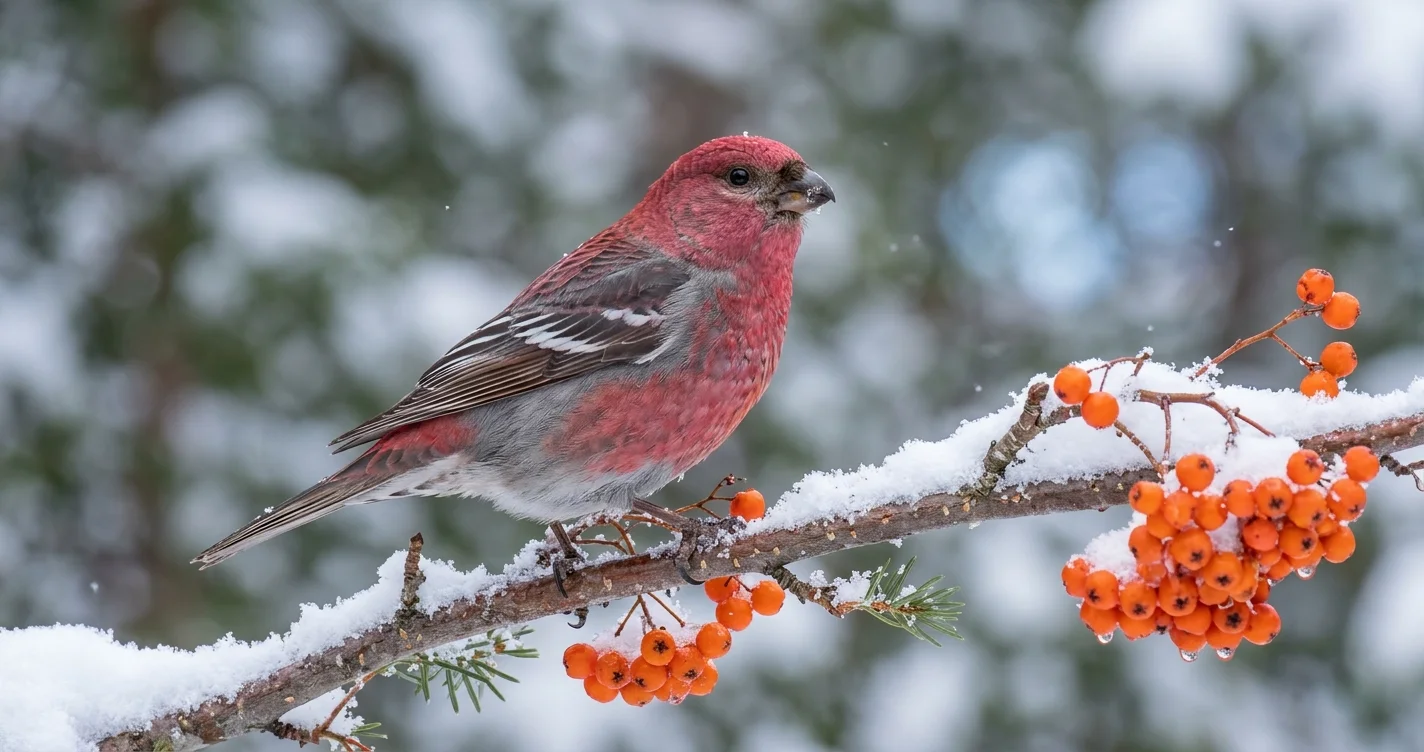
Imagine stepping outside on a freezing winter morning and discovering a large, rosy-red bird calmly eating berries from a snow-covered tree. You move a little closer, expecting it to fly away. Instead, it continues feeding, seemingly unconcerned by your presence.
This unusually relaxed visitor could be a pine grosbeak (Pinicola enucleator), one of the most captivating winter finches of northern North America.
Unlike many small songbirds that dart away at the slightest movement, pine grosbeaks often appear remarkably tolerant of quiet human observers. Their gentle behavior has earned them a reputation as some of the tamest wild finches.
But their winter visits are about more than colorful feathers and friendly appearances.
These birds follow changing food supplies, travel through snowy forests, and sometimes appear in towns where ornamental trees hold berries or fruits long after autumn has ended.
Understanding their winter behavior reveals a fascinating relationship between northern forests, seasonal food shortages, and the trees that sustain wildlife through the coldest months.
Table Of Contents
- What Is a Pine Grosbeak?
- Why Pine Grosbeaks Visit Berry Trees in Winter
- Pine Grosbeak Winter Survival: How They Handle the Cold
- Why Are Pine Grosbeaks So Tame?
- What Is a Pine Grosbeak Irruption?
- How Pine Grosbeaks Feed on Winter Fruits
- Pine Grosbeaks vs. Other Winter Finches
- What Threatens Pine Grosbeaks?
- In Your Own Yard: Helping Winter Finches
- Frequently Asked Questions
What Is a Pine Grosbeak?
The pine grosbeak is a large finch belonging to the family Fringillidae.
It is among the largest finches regularly found in North America and is especially associated with northern coniferous forests.
Its thick bill, rounded body, and relatively long tail give it a distinctive appearance.
How to Identify a Male Pine Grosbeak
Adult males often display beautiful shades of rose-red or crimson across the head, breast, and upper body.
Their wings are darker, usually marked with pale wing bars.
Their tails are also dark, creating a strong contrast with the reddish plumage.
The exact intensity of red coloration varies among individuals, ages, and populations.
What Female Pine Grosbeaks Look Like
Females generally lack the bright red plumage of adult males.
Instead, they often show combinations of gray, olive-yellow, and warm yellowish tones, especially around the head and rump.
Young birds may resemble females before developing more mature coloration.
Because plumage varies, identification should consider body shape, bill structure, wing markings, and behavior together.
Where Pine Grosbeaks Live
Pine grosbeaks inhabit northern forests across parts of North America, Europe, and Asia.
In North America, they breed in boreal and subalpine forests, including areas of Canada, Alaska, and some northern or mountainous regions of the United States.
They are closely associated with forests containing spruce, fir, pine, and other northern trees.
During winter, their movements can bring them into more open habitats, including woodland edges, parks, and towns.
Why Pine Grosbeaks Visit Berry Trees in Winter
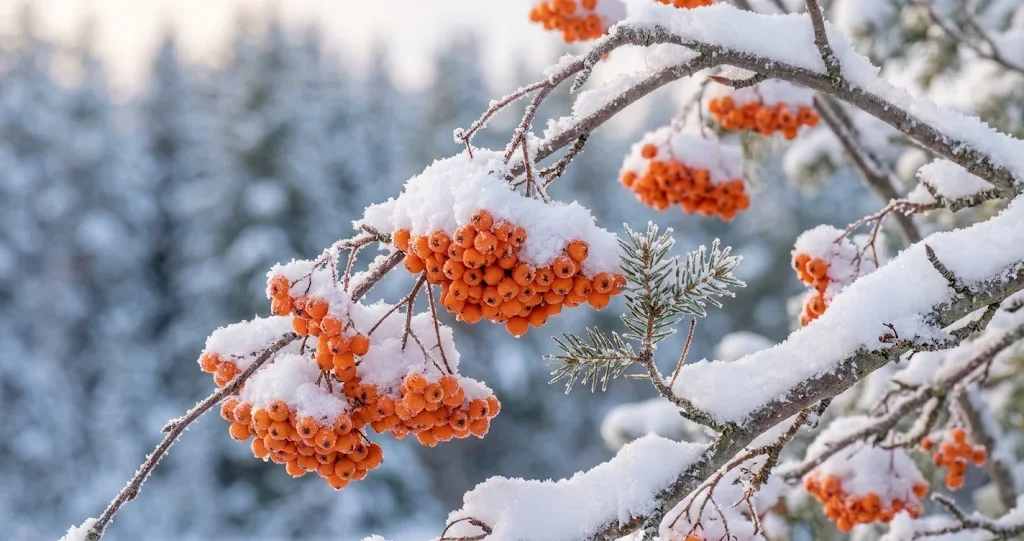
One of the most memorable things about pine grosbeaks is their attraction to fruiting trees.
When berries and small fruits remain available during winter, these trees can become important feeding locations.
Mountain Ash and Rowan Trees
Mountain ash trees, also called rowans, produce clusters of colorful fruits that may persist into winter.
Pine grosbeaks are well known for visiting these trees when food is available.
The birds may spend considerable time feeding within the branches, sometimes allowing people to observe them from surprisingly close distances.
Crabapple Trees
Crabapples are another valuable winter food source.
Some varieties retain small fruits after the leaves have fallen.
Pine grosbeaks may visit these trees to feed on the fruits or their seeds.
Their presence depends on the bird’s geographic range, local food availability, and winter movements.
Other Fruits and Seeds
Pine grosbeaks also consume buds, seeds, and other plant materials.
Their diet is not limited to berries.
In fact, their strong bills allow them to process a variety of plant foods, including seeds contained within fleshy fruits.
Why Winter Fruit Matters
Winter fruit can provide energy when other foods are scarce or difficult to reach.
However, the nutritional value of different fruits varies.
Some provide carbohydrates, while seeds may contribute additional nutrients.
For pine grosbeaks, the availability of suitable food can influence where they spend time during winter.
Pine Grosbeak Winter Survival: How They Handle the Cold
A pine grosbeak perched in a snowy tree may look almost motionless, but its body is actively maintaining a stable internal temperature.
Surviving northern winters requires a combination of physical adaptations and behavioral flexibility.
1. Dense Feathers Provide Insulation
Like other birds living in cold climates, pine grosbeaks rely on feathers to reduce heat loss.
Their plumage traps layers of air close to the body.
This insulating air helps separate the bird’s warm skin from the colder surrounding environment.
When temperatures fall, a pine grosbeak may fluff its feathers, increasing the volume of trapped air.
This can make the bird appear noticeably rounder.
2. A Compact Body Helps Conserve Heat
Pine grosbeaks are relatively large and robust compared with many smaller finches.
A larger body generally has less surface area relative to its volume than a smaller body.
This can reduce the rate of heat loss relative to body mass.
However, body size alone does not guarantee cold tolerance.
Feather insulation, metabolism, shelter, and food availability are also essential.
3. Food Fuels Internal Heat Production
Birds maintain body temperature through metabolic processes.
During cold weather, they must obtain enough energy to support normal activity and thermoregulation.
Feeding on fruits, seeds, and buds helps provide that energy.
A bird that cannot find sufficient food may struggle even if its feathers provide excellent insulation.
4. Sheltered Perches Reduce Exposure
Pine grosbeaks may use dense branches and other protected locations when resting.
Coniferous trees can provide some shelter from wind and precipitation.
The benefits depend on tree structure, weather, and the bird’s position.
5. Behavior Changes With Conditions
Pine grosbeaks can adjust their activity according to food availability and weather.
They may spend long periods feeding in productive trees or move between nearby food sources.
During harsh conditions, reducing unnecessary movement may help conserve energy.
However, their exact activity patterns vary among individuals and environments.
6. Northern Adaptations Work Together
No single adaptation explains how pine grosbeaks survive winter.
Their success depends on insulation, energy intake, body size, habitat selection, and behavioral adjustments.
Together, these features allow them to remain active in environments where temperatures may stay below freezing for extended periods.
Why Are Pine Grosbeaks So Tame?
One of the species’ most unusual characteristics is its apparent tolerance of people.
Birdwatchers sometimes describe pine grosbeaks as exceptionally approachable.
Their Calm Feeding Behavior
When feeding in fruiting trees, pine grosbeaks may remain perched while people observe nearby.
They often move deliberately through branches rather than making rapid, nervous flights.
This behavior can make them seem unusually trusting.
Does Tame Mean Domesticated?
No.
Pine grosbeaks are fully wild birds.
Their apparent tameness does not mean they are accustomed to handling or that approaching them closely is harmless.
Individual responses vary, and birds may become stressed or leave feeding areas when disturbed.
Why Some Individuals Tolerate People
Several factors may contribute to the behavior.
Birds living in relatively remote northern habitats may have different experiences with human activity than birds in heavily populated regions.
Feeding motivation and individual temperament can also influence their reactions.
However, the precise causes of their apparent tameness are not fully established.
It is better to describe the behavior as relatively low wariness in some situations rather than assuming the birds lack fear.
How to Observe Them Responsibly
Use binoculars or a camera with a telephoto lens.
Approach slowly and avoid surrounding feeding birds.
If a bird stops feeding, repeatedly looks toward you, or moves away, increase your distance.
What Is a Pine Grosbeak Irruption?
Pine grosbeaks do not follow exactly the same winter migration pattern every year.
Some winters, they remain largely within northern habitats.
In other years, greater numbers move farther south.
These irregular movements are known as irruptions.
Irruptions Are Different From Regular Migration
Many migratory birds travel between broadly predictable seasonal ranges.
Irruptive species show greater variation in how far they move during winter.
Pine grosbeaks may appear in places where they are uncommon during most years.
Food Availability Influences Movements
Changes in northern food supplies are an important factor in winter finch movements.
When certain food resources become limited, some birds may travel farther in search of suitable feeding areas.
However, irruptions are complex and can reflect conditions across large geographic regions.
Why Berry Trees Become Important
During an irruption, fruiting trees in towns and parks may attract visiting pine grosbeaks.
Mountain ash and crabapple trees can provide accessible food.
This is why a tree that seems ordinary during summer may become a birdwatching attraction in winter.
Not Every Winter Brings an Irruption
Pine grosbeaks do not necessarily appear farther south every year.
Their winter distribution varies.
Local sightings should therefore be interpreted in the context of regional bird movements rather than assuming that every cold winter will bring more grosbeaks.
How Pine Grosbeaks Feed on Winter Fruits
A Strong Bill for Plant Foods
Pine grosbeaks have thick, sturdy bills adapted for handling seeds and other plant materials.
They can manipulate fruits and extract edible parts.
This makes them effective feeders on certain winter fruiting trees.
Eating Fruit and Seeds
Pine grosbeaks may consume fleshy fruit material, but they are also capable of processing seeds within fruits.
Their feeding behavior differs from birds that swallow entire berries primarily for the pulp.
The amount of fruit flesh and seed material consumed varies with the food source.
Feeding in Small Groups
Pine grosbeaks are often observed in small flocks outside the breeding season.
Several birds may feed in the same tree when fruits are abundant.
Their social behavior can make winter sightings especially memorable.
What Happens When a Tree Is Stripped of Fruit?
When a productive tree has little food remaining, birds may move to another feeding area.
They can travel among fruiting trees and other suitable habitats.
The timing of these movements depends on food supply and local conditions.
Pine Grosbeaks vs. Other Winter Finches
Several northern finches may appear in similar habitats during winter.
Knowing their differences makes identification easier.
Pine Grosbeak vs. Purple Finch
Purple finches are generally smaller and have a different body shape.
Male purple finches may also show reddish plumage, but their overall proportions and markings differ.
Pine grosbeaks have a heavier appearance and a distinctive thick bill.
Pine Grosbeak vs. House Finch
House finches are common around residential areas in many parts of North America.
They are considerably smaller than pine grosbeaks.
Male house finches often show red or orange-red coloration concentrated on the head and breast.
Pine grosbeaks have a bulkier build and are more strongly associated with northern forest habitats.
Pine Grosbeak vs. Evening Grosbeak
Evening grosbeaks are also large finches, but their coloration and bill structure differ.
Adult male evening grosbeaks display yellow, black, and white plumage.
Their bills are especially large and pale.
Pine grosbeaks generally have softer red or gray-and-yellow coloration.
Quick Identification Table
| Species | Typical appearance | Common winter food |
|---|---|---|
| Pine grosbeak | Large, rounded finch; red males, gray-and-yellow females | Fruits, seeds, buds |
| Purple finch | Smaller finch; reddish males | Seeds, buds, fruits |
| House finch | Small finch; variable red or orange males | Seeds, buds, fruits |
| Evening grosbeak | Large finch; yellow, black, and white males | Seeds, tree buds, fruits |
What Threatens Pine Grosbeaks?
Pine grosbeaks depend on northern forests and the food resources those habitats provide.
Changes in Boreal Forest Habitat
Forestry practices, development, and other land-use changes can alter forest structure.
The consequences for pine grosbeaks depend on the location, scale, and type of habitat change.
Climate Change
Warming temperatures can influence northern forests, snow conditions, and the distribution of plants.
These changes may affect the availability of food and suitable habitat.
However, long-term effects on pine grosbeak populations are complex and may differ across regions.
Window Collisions
Like many birds, pine grosbeaks can be vulnerable to collisions with glass.
Reflective windows near feeding trees may create hazards.
Reducing reflections and making glass more visible to birds can help.
Loss of Winter Food Trees
Removing fruiting trees and shrubs may reduce local food opportunities.
The importance of any particular tree depends on the surrounding habitat and the species present.
In Your Own Yard: Helping Winter Finches
Even if pine grosbeaks rarely visit your region, a wildlife-friendly yard can support many other winter birds.
Plant Regionally Appropriate Fruiting Trees
Native fruiting trees and shrubs can provide food for birds.
Depending on your region, suitable options may include native mountain ash species, serviceberries, and other locally appropriate plants.
Some crabapple varieties also retain fruits into winter.
Choose plants based on local climate, available space, and ecological suitability.
Leave Some Fruits on Trees
Not every fallen or persistent fruit needs to be removed immediately.
Where safe and practical, leaving some fruits on trees can provide food for wildlife.
Avoid allowing large amounts of rotting fruit to create hazards around walkways.
Protect Native Evergreens
Conifers can provide shelter from wind and precipitation.
Maintaining native evergreens may improve habitat for winter birds.
Make Windows Safer
Apply bird-safe window treatments to glass near feeding areas.
Exterior patterns or other proven visibility treatments can help reduce collisions.
Provide Clean Water
A clean, properly maintained water source can benefit birds when natural water is frozen.
If using a heated birdbath, follow electrical safety recommendations and clean it regularly.
Observe Without Disturbing
Enjoy visiting birds from a comfortable distance.
Avoid handling wild birds or encouraging them to approach people.
Wildlife-friendly gardening works best when animals can maintain their natural behaviors.
Frequently Asked Questions
1. What do pine grosbeaks eat in winter?
Pine grosbeaks eat fruits, seeds, and buds during winter.
They are especially known for visiting mountain ash and crabapple trees.
Their diet varies according to local food availability and seasonal conditions.
2. Why do pine grosbeaks sometimes appear far south of their usual range?
Pine grosbeaks occasionally make irregular winter movements called irruptions.
These movements are often associated with changes in northern food availability.
The distance and number of birds involved vary between years.
3. Are pine grosbeaks friendly toward humans?
Pine grosbeaks sometimes tolerate people at relatively close distances, especially while feeding.
However, they are wild birds rather than domesticated animals.
Observers should give them space and avoid disturbing their feeding behavior.
Conclusion
That rosy-red bird calmly feeding in a snow-covered berry tree is more than a beautiful winter visitor.
The pine grosbeak represents a remarkable connection between northern forests, seasonal food supplies, and the trees that hold fruit through winter.
Its thick bill, insulating plumage, flexible feeding habits, and irregular winter movements help it survive in challenging environments.
And while its apparent tameness makes it especially memorable, the best way to appreciate this wild finch is to observe it without interfering.
By protecting native vegetation, maintaining winter food resources, and creating safer spaces for birds, gardeners can support wildlife through the coldest months.
The next time a quiet winter tree suddenly fills with soft red and gray birds, look closely.
You may be witnessing one of the northern forest’s most unexpected seasonal visitors.
External Sources
Cornell explains how pine grosbeaks feed on fruits, seeds, and tree buds, including mountain ash and crabapple. It also describes how food availability influences their winter movements. Cornell University, All About Birds
Audubon describes the species’ low wariness around people, slow feeding behavior, and preference for northern forests and winter fruiting trees. Audubon Field Guide.
3. Winter Finch Forecast 2026–2027
The network’s September 2026 forecast explains how mountain ash fruit availability influences pine grosbeak movements. It anticipates relatively limited southward movement in winter 2026–2027 because food supplies are favorable across much of the northern range. This is a forecast, rather than a confirmed seasonal outcome. INCH RESEARCH NETWORK