
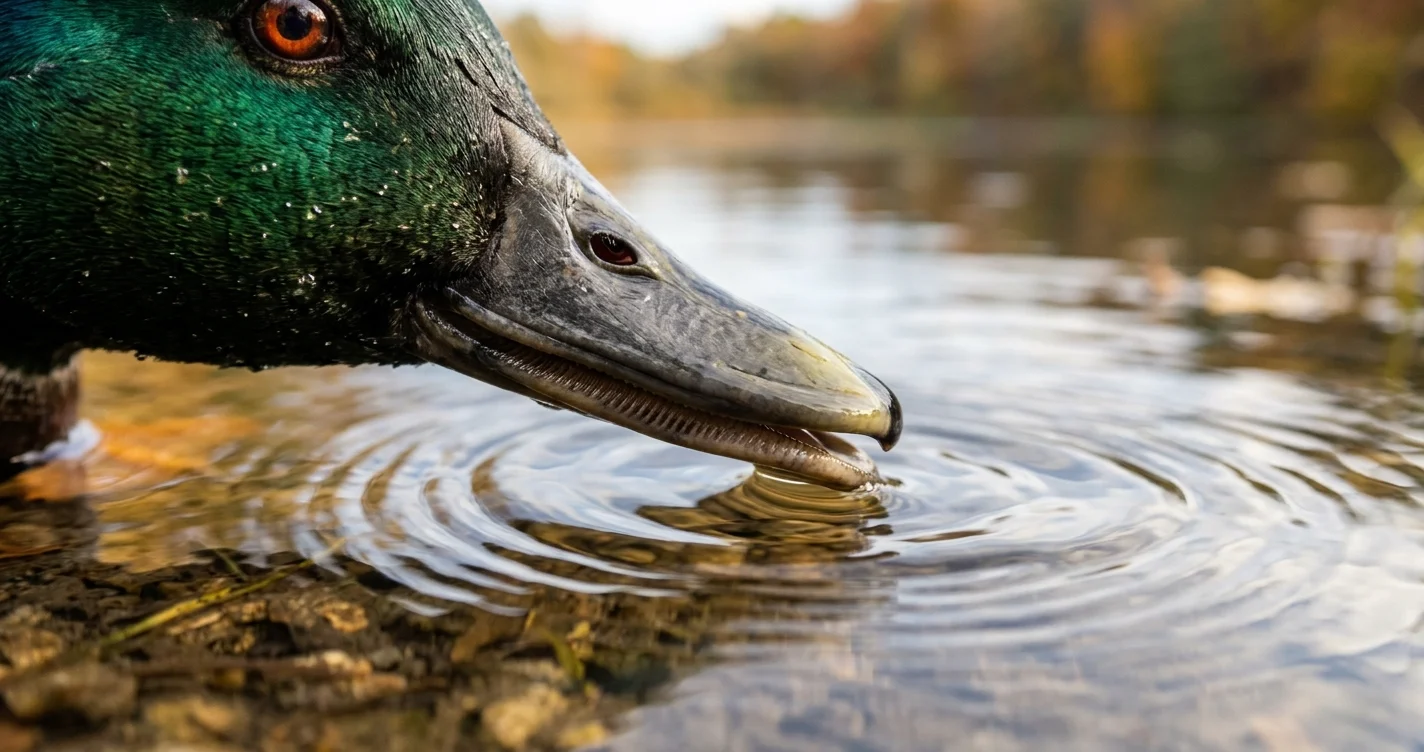
A duck opens its bill, and suddenly its mouth looks surprisingly toothy. Along the edges are tiny ridges that resemble a row of miniature teeth. Inside, the tongue may have pointed projections, while the tip of the bill carries a firm, nail-like structure.
It’s easy to see why people wonder: do ducks have teeth?
The surprising answer is that modern ducks have no true teeth. Instead, their bills contain specialized structures that help them collect food, strain water, manipulate slippery prey, and explore their surroundings.
These structures include lamellae, tongue papillae, and the bill nail. Each serves a different purpose, and together they make a duck’s mouth a remarkably versatile feeding tool.
From dabbling mallards to fish-catching mergansers, duck bills reveal how evolution has shaped different ways of finding food.
Table of Contents
- Do Ducks Have Teeth? The Surprising Answer
- What Are Lamellae on a Duck’s Bill?
- Duck Tongue Papillae: The Hidden Structures Inside the Mouth
- What Is the Nail on a Duck’s Bill?
- How Duck Bills Work: The Science Behind Feeding
- Why Different Ducks Have Different Bills
- Can Ducks Bite Without Teeth?
- How Ducklings Learn to Use Their Bills
- In Your Own Yard: Supporting Ducks Naturally
- Frequently Asked Questions
Do Ducks Have Teeth? The Surprising Answer
Despite their toothlike appearance, modern ducks do not possess true teeth.
True teeth contain specialized dental tissues, including dentin, and in many animals, enamel. Ducks lack these structures.
Instead, their bills are covered in keratin, the same general type of structural protein found in human fingernails and bird claws.
Along the edges of many duck bills are rows of small ridges called lamellae. These can look remarkably similar to teeth, especially when a duck opens its mouth.
However, lamellae are not designed to chew food in the way mammalian teeth do.
They primarily help ducks handle and separate food from water or sediment, depending on the species.
Why Duck Bills Look Toothy
A duck’s bill is more complex than a simple flattened beak.
Its upper and lower sections contain specialized edges, sensory structures, and surfaces that interact during feeding.
When a duck closes its bill, the lamellae can help retain food while water escapes.
In some species, these structures are fine and closely spaced. In others, they are larger and more prominent.
This variation helps explain why certain ducks appear to have tiny combs inside their mouths, while others seem to have pointed teeth.
The appearance is convincing, but the anatomy tells a different story.
What Are Lamellae on a Duck’s Bill?
Lamellae are small, regularly arranged projections found along the edges of the bills of many ducks and other waterfowl.
They are part of the bill’s keratinized covering.
Their arrangement and shape vary among species, reflecting differences in feeding behavior.
Nature’s Built-In Food Filter
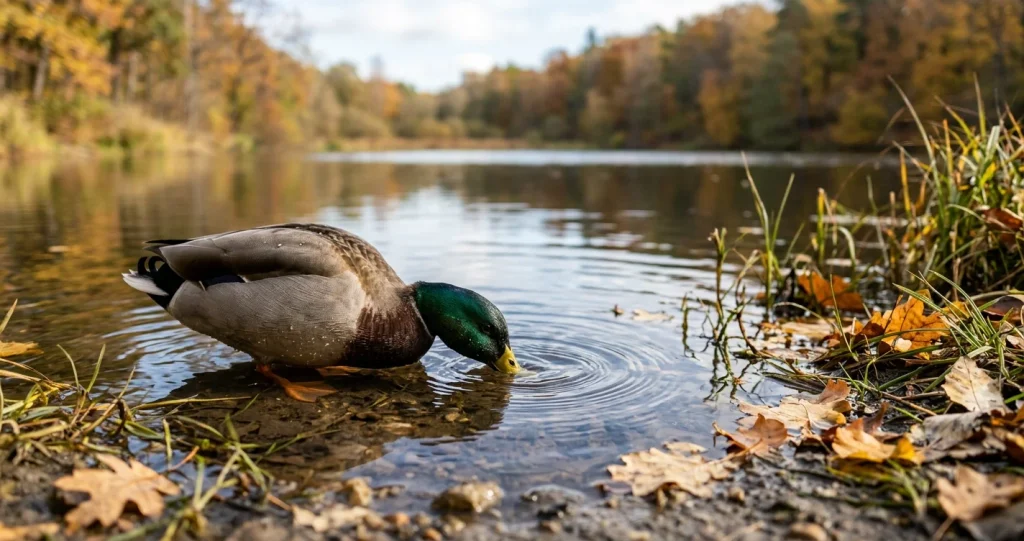
Many dabbling ducks feed by moving their bills through shallow water, mud, or submerged vegetation.
As they take in water containing small food particles, the lamellae help retain edible material while allowing water and finer sediment to pass out.
This process resembles filtration, although the mechanics differ among species and feeding conditions.
A mallard, for example, may use its bill to collect seeds, aquatic invertebrates, and other small food items.
The lamellae help the bird separate useful material from the surrounding water.
Why Some Lamellae Look Like Serrated Teeth
Not every duck uses its bill primarily for filtering.
Mergansers, which are diving ducks that frequently catch fish, have narrow bills with conspicuous serrated edges.
These toothlike projections help them grip slippery prey.
They are sometimes described as sawtooth bills, which explains why mergansers have earned nicknames such as sawbills.
Even these sharp-looking structures are not true teeth.
They are specialized features of the bill’s keratinized surface.
Lamellae Are Not Identical Across Duck Species
The spacing, number, and shape of lamellae can differ substantially.
Species that collect small food particles may have relatively fine filtering structures.
Species that catch fish or handle larger prey may have more pronounced gripping edges.
These differences illustrate an important principle of bird evolution: similar basic anatomical structures can be modified for different diets.
Duck Tongue Papillae: The Hidden Structures Inside the Mouth
The tongue is another fascinating part of a duck’s feeding system.
Unlike the soft, highly flexible human tongue, a duck’s tongue contains specialized surfaces adapted to its feeding habits.
Some ducks have pointed projections called papillae along portions of the tongue.
These structures can resemble small teeth or backward-facing spikes.
What Are Tongue Papillae?
Papillae are small projections on the surface or margins of the tongue.
In ducks, certain papillae are keratinized and may help manipulate food or direct material toward the throat.
Their exact shape and arrangement vary among species.
Some projections are particularly noticeable toward the back of the tongue, where they may help guide food during swallowing.
They are not teeth, and they do not function like the chewing surfaces of mammalian molars.
Why a Duck’s Tongue Looks Unusual
A duck’s tongue works inside a bill designed for collecting food from water.
It may help move food particles, control material inside the mouth, and assist with swallowing.
In filter-feeding ducks, tongue movements can contribute to the movement of water and food through the bill.
The tongue therefore works together with the lamellae rather than operating as a separate feeding tool.
Do Ducks Have Taste Buds?
Ducks can detect tastes, although their taste system differs from that of humans.
Birds generally have fewer taste buds than people, and their distribution varies among species.
Taste is only one part of how ducks evaluate food.
Touch sensitivity within the bill can be especially important when they search for edible material in murky water.
What Is the Nail on a Duck’s Bill?
Look closely at the tip of a duck’s upper bill, and you may notice a distinct, firmer area.
This structure is commonly called the bill nail.
Despite its name, it is not a separate fingernail attached to the bill.
It is a specialized keratinized region near the tip of the upper bill.
A Useful Tool for Foraging
The bill nail can help ducks investigate and manipulate food.
In many dabbling ducks, it assists with probing, picking up, or working through soft material.
A mallard searching along a muddy shoreline may use the tip of its bill while investigating seeds, aquatic organisms, and other edible items.
The nail’s shape and prominence vary among species.
Why the Bill Nail Is Different From Lamellae
Although both are associated with the bill’s keratinized covering, they occupy different locations and serve different roles.
Lamellae form repeated projections along the bill margins.
The nail is a localized structure near the bill tip.
These differences become easier to recognize when observing a duck from the side.
The nail may appear as a small, rounded or slightly contrasting patch at the end of the upper bill.
How Duck Bills Work: The Science Behind Feeding
The most remarkable feature of a duck’s bill is not any single structure.
It’s how the bill margins, tongue, muscles, and sensory system work together.
A duck’s mouth is both a feeding tool and a sophisticated sensory organ.
Step 1: Finding Food Through Touch
Many ducks forage in water where visibility is limited.
Instead of relying entirely on sight, they can use specialized touch receptors within their bills.
Waterfowl bills contain sensory structures associated with mechanoreception, the detection of physical pressure and movement.
These receptors help birds explore their surroundings and identify objects through contact.
This ability is particularly useful when a duck searches through muddy water or soft sediment.
Step 2: Taking Water and Food Into the Bill
A dabbling duck may open its bill while moving its head through shallow water.
Water, sediment, and potential food items enter the mouth.
The duck then uses coordinated bill and tongue movements to manipulate the mixture.
The exact sequence depends on the species and the type of food being collected.
Step 3: Separating Food From Water
As water moves through the mouth, the lamellae help retain selected particles.
Their comb-like arrangement can reduce the loss of food while water and unwanted material escape.
The tongue contributes to this process through movement and contact with the bill surfaces.
This is why lamellae and tongue anatomy are often discussed together.
Neither structure works entirely independently during feeding.
Step 4: Moving Food Toward the Throat
Once food is retained, the tongue helps manipulate it toward the back of the mouth.
Keratinized papillae may assist with controlling the direction of food movement.
Ducks generally swallow food without chewing it into small pieces using teeth.
Further mechanical and chemical processing occurs within the digestive system, including the muscular gizzard.
Step 5: Processing Food After Swallowing
A duck’s gizzard helps grind and process swallowed material.
Depending on the diet and species, grit may contribute to mechanical breakdown.
This internal processing helps compensate for the absence of chewing teeth.
The overall system allows ducks to exploit food sources that would be difficult to handle using a simple, unspecialized beak.
Why Different Ducks Have Different Bills
The word duck describes a diverse group of waterfowl with different feeding strategies.
A broad, flattened bill is common, but not universal in its exact form.
Comparing a few familiar species reveals how strongly bill anatomy relates to diet.
Mallards: Versatile Dabbling Ducks
Mallards are among the most recognizable ducks in North America.
They commonly feed in shallow water, wetlands, agricultural areas, and ponds.
Their relatively broad bills allow them to collect a variety of foods, including seeds, aquatic plants, and small invertebrates.
Lamellae help with food handling and separation during dabbling.
Northern Shovelers: Specialized Filter Feeders
The northern shoveler has one of the most distinctive bills among North American ducks.
Its broad, spatula-shaped bill contains numerous fine lamellae suited to filtering small food items from water.
Shovelers often feed by sweeping their bills through shallow water.
They may also move in circles while foraging, sometimes in groups.
Their unusual bill shape is closely associated with their filtering behavior.
Mergansers: Built for Catching Fish
Mergansers have long, relatively narrow bills with serrated margins.
These structures help them hold slippery fish.
Unlike dabbling ducks that collect many small particles from shallow water, mergansers frequently dive and pursue aquatic prey.
Their bills demonstrate how a shared waterfowl body plan can be adapted to a very different feeding strategy.
Can Ducks Bite Without Teeth?
Yes. A duck can pinch or grip with its bill even though it lacks true teeth.
The force and sensation depend on the duck’s size, bill shape, and behavior.
Some ducks may nip when frightened, handled, or competing for food.
A bite from a typical domestic duck is usually more like a firm pinch than a mammalian bite involving sharp teeth.
However, larger waterfowl and birds with strongly serrated bill edges can cause discomfort or minor injury.
Wild ducks are best observed without handling them.
Giving them space also reduces stress and allows natural feeding behavior to continue.
How Ducklings Learn to Use Their Bills
Ducklings hatch with functional bills and begin exploring their surroundings soon after leaving the nest.
In many species, young ducks can feed themselves shortly after hatching, although they still depend on their mother for protection and guidance.
Their early diet may include small aquatic invertebrates and other suitable foods.
As they grow, their feeding abilities develop alongside changes in body size and bill proportions.
The basic structures needed for feeding are present early, but experience helps young birds become more effective at finding and handling food.
Watching ducklings investigate shallow water offers a glimpse of how important the bill is from the beginning of life.
In Your Own Yard: Supporting Ducks Naturally
A backyard pond or nearby wetland can provide opportunities to observe ducks using their remarkable bills.
Supporting them responsibly means maintaining suitable habitat and allowing natural feeding behavior.
Provide Clean, Accessible Water
If your property includes a pond, maintaining good water quality can benefit visiting waterfowl and other wildlife.
Gently sloping banks allow birds to enter and leave the water more easily.
Native aquatic and shoreline vegetation can also support the small organisms that many ducks eat.
Grow Native Plants Around Water
Native sedges, rushes, grasses, and wetland plants can provide habitat for aquatic invertebrates.
These organisms form part of the food web used by many duck species.
Choose plants suited to your region and the moisture conditions of your property.
Local Cooperative Extension offices and native plant organizations can help identify appropriate species.
Let Ducks Find Their Natural Food
Wild ducks are adapted to finding seeds, aquatic plants, insects, and other natural foods.
Feeding bread is discouraged because it provides limited nutritional value and can contribute to crowding and water-quality problems.
In most cases, the best approach is to observe ducks foraging naturally rather than encouraging them to depend on handouts.
Keep Wildlife Areas Safe
Avoid unnecessary pesticide use near ponds and wetlands.
Prevent fishing line, plastic debris, and other litter from entering the water.
Keep pets at a respectful distance from nesting and feeding birds.
During breeding season, allow ducks and ducklings plenty of room to move without disturbance.
A healthy shoreline supports far more than ducks. It can also provide habitat for dragonflies, amphibians, native plants, and other wildlife.
Frequently Asked Questions
1. Do ducks have teeth on their tongues?
No. Ducks do not have true teeth on their tongues.
Some species possess pointed, keratinized tongue papillae that resemble tiny spikes.
These projections help manipulate food and assist with swallowing, but they are anatomically different from teeth.
2. Are the serrated edges of a duck’s bill sharp?
Some duck species have more pronounced bill serrations than others.
Mergansers, for example, possess toothlike edges that help them grip slippery fish.
These projections can feel firm or pointed, but they are made from the bill’s keratinized covering rather than dental tissue.
3. Why do ducks have a nail at the end of their bills?
The bill nail is a specialized area near the tip of the upper bill.
It can help ducks probe, investigate, and manipulate food during foraging.
Its appearance varies among species, and it works alongside the other structures of the bill.
Conclusion
A duck’s bill may look simple from a distance, but a closer look reveals a fascinating collection of specialized feeding structures.
Lamellae help many ducks separate food from water, tongue papillae assist with food manipulation, and the bill nail provides a useful contact surface for exploring and handling material.
Together with sensitive touch receptors and coordinated tongue movements, these features allow ducks to feed in environments ranging from shallow muddy ponds to deeper lakes and rivers.
So, do ducks have teeth? Modern ducks do not have true teeth, but their toothlike bill structures can perform some surprisingly useful tasks.
The next time you watch a duck dipping its bill beneath the surface, remember that you’re seeing more than a bird searching for food. You’re watching a specialized feeding system shaped by millions of years of evolution.
And those tiny ridges that first looked like teeth are only the beginning of the story.
External Sources
1. Do Ducks Have Teeth? and What Is the Nail on a Duck’s Bill ? Explain why ducks appear to have teeth, how lamellae filter food, and what the nail at the bill tip does. Ducks Unlimited, Read the source.
2. How Duck Bills Work: The Science Behind Feeding Explain how bill shape, lamellae, and feeding techniques differ between dabbling ducks, diving ducks, and mergansers. Ducks Unlimited, Read the source
3. Northern Shovelers: Specialized Filter Feeders Support the explanation of how northern shovelers use comb-like lamellae to filter small crustaceans, aquatic invertebrates, and seeds from water. Cornell Lab of Ornithology — All About Birds, Read the source
4. Lamellae Are Not Identical Across Duck Species Provide another scientific example of closely spaced lamellae helping ducks capture tiny aquatic invertebrates. Cornell Lab of Ornithology — All About Birds, Read the source