
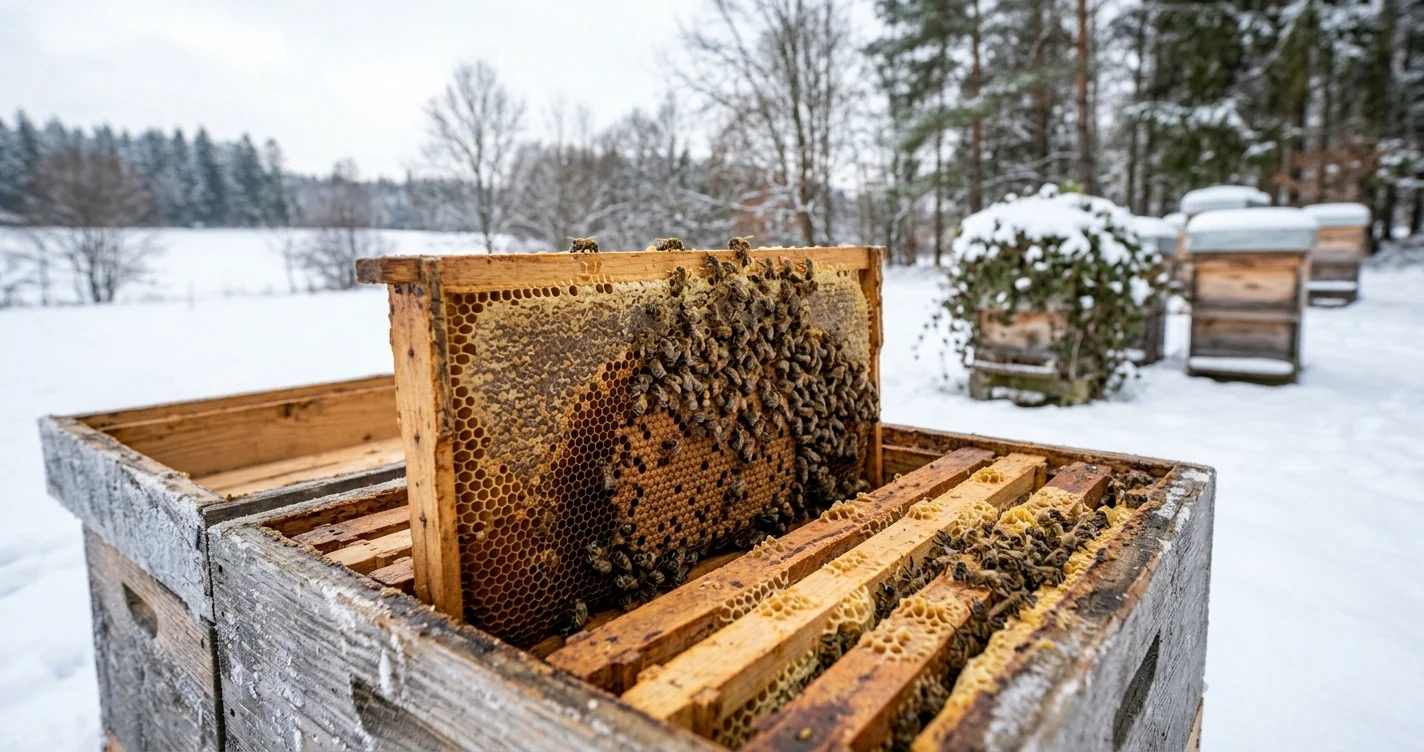
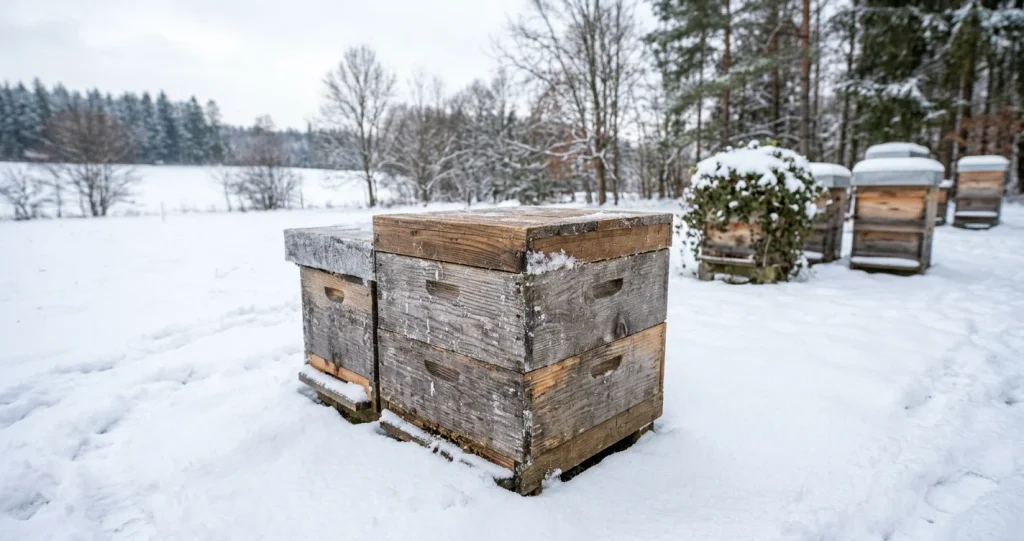
On a freezing winter morning, a honey bee hive can appear completely lifeless. No bees are buzzing around the entrance, no workers are visiting flowers, and the familiar activity of summer has disappeared.
Yet inside, thousands of bees may be performing one of nature’s most remarkable survival strategies.
Instead of migrating south or entering true hibernation, honey bees gather into a living ball of warmth. This formation, known as the honey bee winter cluster, allows the colony to survive cold weather by generating heat, conserving energy, and working together.
Even when the surrounding air falls below freezing, the bees inside the hive can maintain conditions that allow the colony to survive.
Their secret isn’t thick fur, a heated nest, or constant flight. It’s teamwork, powered by tiny flight muscles.
Table of Contents
- What Is a Honey Bee Winter Cluster?
- Why Honey Bees Stay Together During Winter
- How the Honey Bee Winter Cluster Generates and Conserves Heat
- What Happens Inside the Hive During Winter?
- How Honey Bees Find Food Without Flying
- Do Honey Bees Hibernate?
- What Can Threaten a Winter Bee Colony?
- In Your Own Yard: Helping Honey Bees Through Winter
- Frequently Asked Questions
- A Living Furnace Hidden Inside the Hive
What Is a Honey Bee Winter Cluster?
A winter cluster is a tightly packed group of honey bees that forms inside a hive when temperatures become cold enough to limit normal activity.
Unlike many solitary insects that survive winter in a dormant state, honey bees remain active within their colony.
The cluster typically forms around the queen, with worker bees surrounding her in a roughly spherical arrangement.
The bees don’t stay perfectly still. They adjust their positions, generate heat when needed, and respond to changing conditions inside the hive.
The result is a remarkable living structure that helps protect the colony from dangerous cold.
A Colony That Survives as a Team
A single honey bee exposed to freezing temperatures for too long may become immobilized and eventually die.
A healthy colony, however, has a major advantage: thousands of individuals can cooperate.
By gathering closely together, workers reduce the amount of body surface exposed to cold air. Bees near the outside help form an insulating layer, while bees deeper inside contribute to warmth.
The cluster’s size and shape can change as temperatures rise and fall.
This cooperation is one reason honey bees can survive winters that would be extremely difficult for isolated individuals.
Not Every Honey Bee Experiences the Same Winter
Winter behavior varies with climate, colony condition, and the type of honey bee.
In much of the northern United States, colonies may spend extended periods clustered during cold weather.
In warmer regions, including parts of the southern United States, bees may continue flying and foraging during suitable winter conditions.
The familiar winter cluster is especially important for colonies experiencing prolonged periods of low temperatures.
Why Honey Bees Stay Together During Winter
Honey bees are small animals with limited individual heat reserves.
Unlike mammals and birds, they cannot rely on internally regulated body temperature in quite the same way. However, honey bees can produce heat through muscular activity.
When the weather becomes too cold for ordinary flight, workers gather inside the hive rather than continuing to forage.
Their collective behavior creates a warmer environment than any one bee could maintain alone.
The Advantage of a Compact Shape
A tight cluster reduces heat loss.
As the bees pack together, less of their combined body surface is exposed to the surrounding cold air.
The cluster can become more compact as conditions grow colder and loosen when temperatures become milder.
This flexibility helps the colony balance heat conservation with access to food and movement.
The bees are not simply piling together at random. Their behavior responds to temperature and the needs of the colony.
Protecting the Queen
The queen is essential to the colony’s future because she produces the eggs that will become new workers.
During winter, workers generally keep her within the protected interior of the cluster.
Although egg laying may slow considerably or pause during colder periods, the queen must survive for the colony to rebuild its population as spring approaches.
The winter cluster therefore protects more than the bees currently alive. It also helps preserve the colony’s ability to grow again.
How the Honey Bee Winter Cluster Generates and Conserves Heat
The most extraordinary part of a honey bee winter cluster is that the bees create warmth without needing to fly.
Honey bees possess powerful flight muscles inside their thoraxes. These muscles normally drive their wings during flight.
But they can also generate heat while the wings remain largely still.
This ability allows bees to warm themselves and their surroundings without leaving the hive.
Tiny Flight Muscles Become Heaters
When workers need to generate heat, they activate their flight muscles.
Muscular activity consumes energy and releases heat.
Instead of producing normal wingbeats for flight, the bees use these muscles in a way that raises thoracic temperature.
This is sometimes described as shivering thermogenesis, although the process is different from the visible shivering people experience.
A worker bee can therefore act as a tiny biological heater.
Multiply that ability across many workers, and the colony gains a powerful method of temperature regulation.
The bees don’t need every individual to produce maximum heat continuously. Heat production changes according to conditions and the colony’s needs.
The Outer Layer Helps Hold Warmth Inside
The winter cluster has different thermal zones.
Bees near its outer surface often pack closely together, forming a relatively dense insulating layer.
Deeper inside, bees generally have more room to move, and temperatures can remain substantially warmer.
The outer layer helps reduce heat loss, while heat-producing workers contribute to the cluster’s internal temperature.
This arrangement is sometimes compared to insulation surrounding a heated room.
However, unlike a building, the cluster is alive and constantly adjusting.
The Cluster Expands and Contracts
On particularly cold days, bees may pack more tightly together.
When the weather becomes milder, the cluster can loosen.
These changes help the colony manage its energy use.
Maintaining warmth requires food, so unnecessary heat production would consume valuable winter reserves.
The bees’ ability to adjust their behavior helps them survive long periods when nectar is unavailable.
The Center Is Not Always the Same Temperature
The temperature inside a winter cluster depends partly on whether the colony is raising brood.
When brood is present, workers maintain a much warmer environment around developing young, often near 93–95°F (34–35°C).
When the colony is broodless, the cluster’s interior may be considerably cooler.
This distinction matters because honey bees do not necessarily heat the entire hive to a constant summer-like temperature.
Instead, they concentrate warmth where it is needed.
The hive’s empty spaces may remain quite cold while the clustered bees stay warm enough to survive.
What Happens Inside the Hive During Winter?
Although a hive may look inactive from the outside, winter life continues within.
Workers maintain contact with one another, respond to temperature changes, and consume stored food.
The queen remains protected within the group, and the colony’s activity depends on its condition and the weather.
Winter Bees Are Different From Summer Workers
Honey bee colonies often produce a generation of longer-lived workers as autumn approaches.
These are commonly called winter bees.
Summer workers may live only several weeks during periods of intense foraging, while winter bees can survive for several months under favorable conditions.
Winter bees typically develop physiological characteristics that help support extended survival and the colony’s needs during the cold season.
Their longer lives are especially important because the colony cannot always replace workers quickly during winter.
A Winter Hive Is Not Completely Silent
A clustered colony may produce faint buzzing or humming sounds.
These sounds can arise from muscular activity and movement within the cluster.
Beekeepers sometimes listen to colonies as one way of checking for signs of life, although sound alone cannot establish whether a colony is healthy.
A quiet-looking hive can still contain thousands of living bees.
How Honey Bees Find Food Without Flying
Heat production requires energy.
For honey bees, that energy comes largely from carbohydrates stored in honey.
During spring, summer, and fall, workers collect nectar and process it into honey, creating reserves that can sustain the colony when flowers are scarce.
Winter survival depends heavily on access to those stores.
Honey Is Winter Fuel
Honey provides sugars that workers metabolize to support their activity and heat production.
A colony with adequate food reserves is better equipped to endure prolonged cold weather.
However, the amount of honey needed varies considerably with climate, colony size, winter length, and management conditions.
This is why beekeepers in different regions may prepare colonies differently.
The Cluster Moves Toward Stored Honey
Bees do not necessarily remain in one position all winter.
As accessible honey is consumed, the cluster may gradually shift through the comb toward additional food.
Movement can become difficult during severe cold, particularly if the colony is small or food stores are poorly positioned.
In some cases, a colony may starve even when honey remains elsewhere in the hive.
The problem is not always a complete absence of food. Sometimes the bees cannot reach it safely.
Warm Winter Days Bring Brief Activity
During suitable mild weather, honey bees may leave the hive for short flights.
These are often called cleansing flights.
Honey bees generally avoid defecating inside the hive, so they can use warmer winter days to eliminate accumulated waste.
In some regions, workers may also collect pollen or nectar from winter-blooming plants.
But during extended cold spells, the colony depends primarily on the resources already stored inside.
Do Honey Bees Hibernate?
Not in the usual sense.
Hibernation generally involves substantial physiological changes that reduce activity and energy use for extended periods.
Honey bee colonies remain metabolically active during winter.
Workers continue consuming food, producing heat, and responding to their surroundings.
This makes their winter strategy different from that of many other insects.
Honey Bees Versus Bumble Bees
The distinction becomes clearer when comparing honey bees with bumble bees.
In many temperate bumble bee species, the old colony dies off as winter approaches, while newly mated queens survive in sheltered overwintering sites.
A honey bee colony, by contrast, usually attempts to survive as a functioning social group.
Its workers and queen remain together, relying on stored food and collective temperature regulation.
Both strategies can be successful, but they represent very different solutions to the same seasonal challenge.
What Can Threaten a Winter Bee Colony?
A winter cluster is an impressive adaptation, but it does not guarantee survival.
Several factors can weaken a colony before or during winter.
Varroa Mites and Disease
One major threat to managed honey bee colonies in the United States is the parasitic mite Varroa destructor.
These mites feed on honey bees and can transmit damaging viruses.
Heavy infestations during late summer and fall may reduce the health and longevity of the bees needed for winter survival.
Even a colony with sufficient honey may struggle if its winter bee population has been severely weakened.
Insufficient Food Reserves
Colonies need accessible carbohydrate stores to fuel their winter activity.
A shortage of food can become dangerous during prolonged cold periods.
Small colonies may face additional challenges because they have fewer workers available to form an effective cluster.
Moisture and Poor Hive Conditions
Moisture management is another important consideration.
Water vapor produced through respiration can condense on cold surfaces inside the hive.
If cold condensation drips onto clustered bees, it may contribute to dangerous chilling.
Hive design, insulation, ventilation, and local weather conditions all influence how moisture behaves.
There is no single hive-management approach that works equally well in every climate.
Sudden Weather Changes
Unusually warm periods followed by severe cold can complicate winter survival.
The colony may expand its activity during mild weather and then need to contract again when temperatures drop.
The consequences depend on food availability, brood production, colony strength, and the severity of the weather.
In Your Own Yard: Helping Honey Bees Through Winter
You don’t need to own a beehive to make your yard more supportive of bees.
Thoughtful gardening can provide food and habitat across the growing season, helping pollinators prepare for colder months.
Plant flowers that bloom at different times.
Choose a variety of flowering plants suited to your region, including species that bloom in early spring and late fall.
Late-season flowers can provide nectar and pollen when other resources are declining.
Asters and goldenrods are valuable examples in many parts of the United States, although suitable species vary by region.
Leave some natural shelter.
Avoid removing every fallen leaf, hollow stem, and patch of undisturbed vegetation.
These materials can provide overwintering habitat for many native insects, including solitary bees and other beneficial species.
Honey bees generally overwinter in their colonies rather than in hollow garden stems, but a less intensively cleaned yard can support broader insect biodiversity.
Reduce unnecessary pesticide exposure.
Avoid applying insecticides to blooming plants visited by pollinators.
Use integrated pest management, identify pests before treating them, and follow product labels carefully when treatment is necessary.
Provide water during suitable weather.
A shallow water source with stones or other landing surfaces can help visiting bees during warmer periods.
Keep it clean and prevent standing water from becoming a mosquito breeding site.
Bees generally won’t use an exposed water source during freezing weather.
Support responsible local beekeeping.
If you keep honey bees, winter preparation involves more than providing a warm hive.
Monitoring colony health, managing Varroa mites, checking food reserves, and following regionally appropriate guidance are important.
Your local Cooperative Extension service or experienced beekeeping association can offer advice suited to your climate.
Remember that supporting native bees is also important. Honey bees are managed, introduced pollinators in North America, while many native species have very different nesting and overwintering needs.
Frequently Asked Questions
1. How cold can a honey bee winter cluster survive?
Healthy honey bee colonies can survive extended periods of below-freezing weather when they have adequate food, sufficient workers, and suitable hive conditions.
The exact limits vary considerably. Colony strength, disease pressure, moisture, insulation, and access to stored honey all influence survival.
The bees do not need to warm the entire hive to survive. They concentrate heat within their cluster.
2. Do honey bees take turns staying on the outside of the cluster?
Workers can change positions within the winter cluster, and the arrangement is not completely fixed.
However, the movement is more complex than a perfectly organized rotation in which every bee takes an equal turn.
Temperature, activity, and the colony’s changing needs influence how individuals move.
3. Can honey bees fly during winter?
Yes, when conditions are warm enough.
Honey bees may leave the hive during mild winter weather for cleansing flights and, where flowers are available, occasional foraging.
They generally remain inside during freezing or otherwise unsuitable flying conditions.
Winter flight activity varies substantially by region and weather.
A Living Furnace Hidden Inside the Hive
Return to that silent hive on a freezing morning.
From the outside, there may be no movement at all. The entrance is quiet, the flowers are gone, and the garden seems to be sleeping.
But inside, thousands of tiny bodies may be working together to maintain a pocket of warmth.
The honey bee winter cluster is a remarkable example of collective survival. By combining muscular heat production, tight clustering, stored honey, and coordinated behavior, bees can endure conditions that would overwhelm an isolated worker.
The next time you pass a quiet hive in winter, remember that silence doesn’t necessarily mean inactivity.
Sometimes, an entire colony is keeping warm just beneath the surface.
Conclusion
A quiet beehive in winter is far from lifeless. Inside, thousands of honey bees work together to survive freezing temperatures through one of nature’s most fascinating examples of cooperation.
The honey bee winter cluster allows workers to conserve warmth, generate heat using their flight muscles, and protect the queen while relying on stored honey for energy. As temperatures change, the cluster adjusts, helping the colony endure the coldest months until warmer weather returns.
This remarkable survival strategy reminds us that even the smallest creatures can accomplish extraordinary things through teamwork. By planting pollinator-friendly flowers, protecting natural habitats, and supporting healthy bee populations, we can help create environments where these essential insects thrive.
The next time you see a silent hive on a cold winter morning, remember that beneath its quiet exterior, an entire colony may be working together to stay alive until spring.
External Sources
Explain how winter behavior changes by climate, with northern colonies clustering and some colonies in warmer regions continuing to forage, USDA Agricultural Research Service.
Support the distinction between honey bee colonies that overwinter together and bumble bee colonies whose newly mated queens overwinter separately. University of Minnesota Extension
4. Metabolic Pathway in Honey Bees Discovered With Strong Connections to Winter Colony Losses
Add scientific evidence about winter cold stress, energy allocation, and the relationship between colony health and winter losses, USDA Agricultural Research Service.