
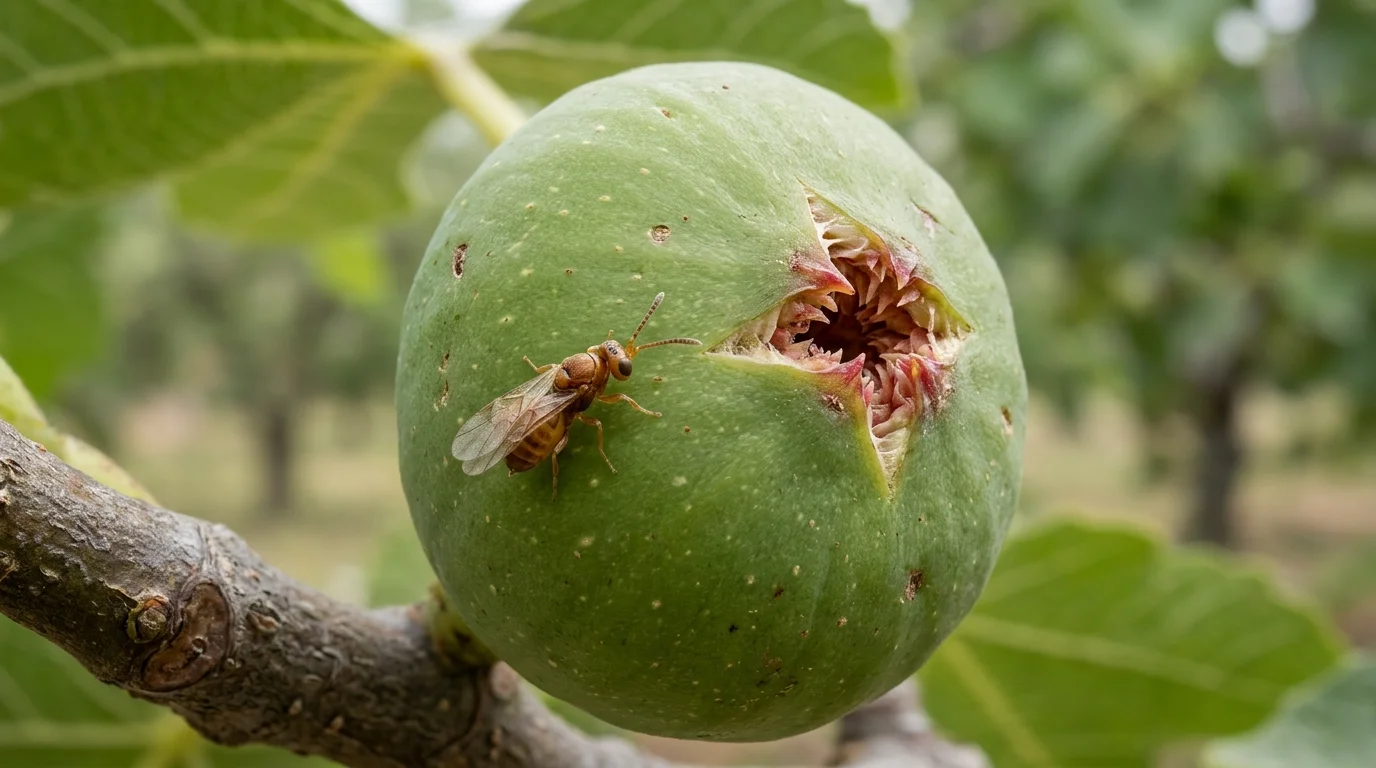
Imagine biting into a ripe fig and discovering that the fruit’s story began with a tiny insect entering a hidden chamber filled with flowers.
Most flowering plants display their blossoms openly, inviting bees, butterflies, and other pollinators to visit. Fig trees do something extraordinary: they hide their flowers inside a fleshy, enclosed structure.
Understanding how fig wasps pollinate figs reveals one of nature’s most remarkable partnerships. In many fig species, a tiny wasp must enter this enclosed structure to deliver pollen. In return, the fig provides a place where the wasp’s offspring can develop.
This relationship has evolved over millions of years, connecting two very different organisms through a highly specialized reproductive cycle.
But there is an important surprise for gardeners: not every fig needs a wasp to produce the sweet fruit we enjoy. Many familiar backyard fig varieties develop edible figs without pollination.
The complete story is even more fascinating than the popular myths surrounding these unusual insects.
Table of Contents
- What Are Fig Wasps?
- Why Figs Have Flowers Hidden Inside
- How Fig Wasps Pollinate Figs: The Complete Life Cycle
- The Extraordinary Partnership Between Figs and Wasps
- Do All Figs Need Fig Wasps?
- Are There Dead Wasps Inside the Figs We Eat?
- Where Fig Wasps Live
- Why Fig Wasps Matter to Ecosystems
- Threats to the Fig–Wasp Relationship
- In Your Own Yard: Growing Figs and Supporting Pollinators
- Frequently Asked Questions
What Are Fig Wasps?
Fig wasps are tiny insects associated with fig trees belonging to the genus Ficus.
The term includes specialized pollinating wasps and numerous other wasps that use figs without pollinating them.
Most pollinating fig wasps belong to the family Agaonidae, although the taxonomy of fig-associated wasps is complex.
These insects are often only a few millimeters long, making them easy to overlook.
Tiny insects with a remarkable job
Female pollinating fig wasps are adapted to enter the narrow opening of a developing fig.
Their small bodies and specialized structures help them navigate this confined passage.
In many species, females have wings and can travel between fig trees, while males are wingless or have greatly reduced wings.
The males generally spend their short lives inside the fig where they developed.
Not every fig wasp is a pollinator
Many other wasps are associated with figs.
Some lay eggs in fig tissues without entering the central chamber, while others develop as parasites or predators of fig-associated insects.
These nonpollinating fig wasps participate in complex ecological relationships.
The famous mutualism, however, involves the pollinating species that transport pollen between compatible fig flowers.
Why Figs Have Flowers Hidden Inside
A fig looks like a fruit, but botanically it begins as a specialized structure called a syconium.
The syconium is a fleshy, hollow receptacle lined internally with numerous tiny flowers.
A garden of flowers turned inward
Imagine taking a cluster of flowers and folding the surrounding structure inward until the blossoms face a central cavity.
That is a useful way to visualize the arrangement inside a fig.
The flowers are protected within the enclosed structure rather than exposed on an ordinary flowering stem.
As the fig matures, the fleshy receptacle develops into the familiar edible structure.
The ostiole: a hidden entrance
At the end of a developing fig is a small opening called the ostiole.
This opening is guarded by overlapping bracts.
A compatible female pollinating wasp can squeeze through it to reach the flowers inside.
The passage is extremely narrow, and entering may damage the wasp’s wings or antennae.
Different flowers serve different roles
Depending on the fig species and its reproductive system, the flowers inside a syconium may develop into seeds or support wasp larvae.
Some fig species have separate male and female trees, while others produce different flower types within the same individual.
These differences strongly influence the relationship between figs and their pollinators.
How Fig Wasps Pollinate Figs: The Complete Life Cycle
The fig–wasp partnership is a classic example of mutualism, an ecological relationship in which both participants can benefit.
The fig receives pollen needed for sexual reproduction, while the pollinating wasp gains a protected environment for reproduction.
The details vary among species, but the following sequence describes a common pattern.
Step 1: A female wasp emerges carrying pollen
The cycle begins inside a mature fig structure where a new generation of wasps has developed.
Female wasps emerge from their developmental chambers and collect pollen from the fig’s male flowers.
In some species, they actively gather pollen into specialized pockets.
In others, pollen is transported more passively on their bodies.
The exact method depends on the fig and wasp species.
Step 2: The female searches for a receptive fig
After leaving her birthplace, the female must find a suitable fig at the correct developmental stage.
Receptive figs release volatile chemical compounds that help attract their pollinating wasps.
These chemical signals are often highly specific.
A wasp that reaches an unsuitable fig species or developmental stage may be unable to reproduce successfully.
Because adult females generally have short lives, locating an appropriate fig is especially important.
Step 3: She enters through the ostiole
When the female finds a receptive fig, she approaches its small opening.
She squeezes between the overlapping bracts and enters the internal flower chamber.
This passage can be physically demanding.
In many species, the female loses parts of her wings or antennae during entry.
Once inside, she generally cannot leave through the same opening.
Her reproductive effort will take place within that single fig.
Step 4: Pollen reaches the internal flowers
Inside the syconium, the wasp moves among the tiny flowers.
As she contacts receptive stigmas, pollen can be transferred.
In species with active pollination, the female deliberately deposits pollen using specialized movements.
In species with passive pollination, pollen carried on the body reaches flowers through contact.
Successful pollination allows fertilized flowers to develop seeds.
This is the essential service the wasp provides to the fig tree.
Step 5: The wasp lays her eggs
The female also attempts to lay eggs in suitable flowers.
Using her ovipositor, she places eggs into the tissues of flowers that can support larval development.
Not every flower is accessible or suitable.
Flower structure, style length, and the wasp’s anatomy influence where eggs can be deposited.
In many monoecious fig species, some flowers develop seeds while others support wasp larvae.
Step 6: Seeds and larvae develop
As the fig develops, pollinated flowers can produce seeds.
Meanwhile, wasp larvae feed and grow inside modified floral tissues, often described as galls.
The fig therefore becomes a shared developmental environment.
Some flowers contribute to the next generation of fig trees, while others support the next generation of pollinating wasps.
The balance varies among species and reproductive systems.
Step 7: Male wasps emerge first
In many pollinating fig wasp species, males emerge before females.
They often have reduced wings or are wingless.
The males locate females that are still developing within their chambers and mate with them.
In some species, males also help create exit passages through the fig wall.
Their lives are usually spent almost entirely inside the syconium.
Step 8: New females collect pollen and leave
As the fig reaches the appropriate stage, newly emerged females obtain pollen from the male flowers.
They then escape through an opening, sometimes assisted by tunnels created by males.
The females disperse in search of receptive figs.
Once they enter another suitable fig, the reproductive cycle begins again.
Step 9: The original female completes her life
The female that entered the fig generally dies inside it after pollinating and attempting to lay eggs.
Her role in the reproductive cycle is complete.
The fig continues developing, and its seeds or wasp offspring mature according to the species involved.
This unusual life cycle has inspired many popular stories, but it is important to distinguish the biology of wild pollinated figs from that of common cultivated varieties.
The Extraordinary Partnership Between Figs and Wasps
The fig–wasp relationship is remarkable because it combines specialization, cooperation, and evolutionary conflict.
A highly specialized relationship
Many fig species are associated with one primary pollinating wasp species.
However, this is not an absolute rule.
Some figs have multiple pollinator species, and certain wasps can pollinate more than one fig species.
Research has revealed a more flexible evolutionary history than the traditional one-fig, one-wasp description suggests.
Mutualism with competing interests
The fig benefits when its flowers are pollinated and seeds develop.
The wasp benefits when some flowers support her offspring.
These interests overlap but are not identical.
A wasp investing heavily in egg-laying may reduce the number of flowers available for seed production.
The relationship persists through biological mechanisms that influence this balance.
Fig trees can influence reproductive outcomes
Studies of some fig species suggest that reproductive success of pollinating wasps can depend on whether they provide adequate pollination.
In certain systems, figs that receive insufficient pollen may be more likely to abort or provide poorer conditions for developing larvae.
These effects are sometimes described as sanctions against ineffective pollinators.
They are not universal across all fig species.
An ancient evolutionary association
Figs and their pollinating wasps have a long evolutionary history.
Molecular and fossil evidence indicates that their association extends back tens of millions of years.
Their diversification has involved both shared evolutionary changes and episodes of host switching.
This makes them important subjects for studying coevolution.
Do All Figs Need Fig Wasps?
No. This is one of the most important facts for home gardeners.
Common figs often develop without pollination
Many varieties of the common edible fig, Ficus carica, are parthenocarpic.
This means their edible fig structures can develop without fertilization.
Popular garden varieties such as ‘Brown Turkey’ and ‘Celeste’ generally do not require fig wasps to produce a crop.
For many American gardeners, this makes fig cultivation possible even where the appropriate pollinating wasp is absent.
Smyrna-type figs need pollination
Smyrna-type figs generally require pollination for their main crop to develop successfully.
Without it, immature figs may drop rather than mature.
Commercial production of these varieties depends on suitable pollination conditions.
San Pedro-type figs have different crop requirements
San Pedro-type figs commonly produce a first crop that develops without pollination.
Their later main crop typically requires pollination.
This distinction is important when selecting cultivars.
Caprifigs support the pollinating wasp
In the common fig system, caprifigs play a central role in maintaining populations of the pollinating wasp Blastophaga psenes.
Their internal flowers provide suitable sites for wasp reproduction.
Pollen-carrying females can then pollinate receptive edible figs of types that require pollination.
The process of using caprifigs to provide pollinating wasps is called caprification.
Are There Dead Wasps Inside the Figs We Eat?
This is probably the most famous question about fig wasps.
The answer depends on the fig variety and how it developed.
Many supermarket figs never needed a wasp
Common parthenocarpic fig varieties can mature without pollination.
These figs do not require a female wasp to enter them.
Therefore, the claim that every edible fig contains a dead wasp is false.
Pollinated figs have a different history
In fig species that depend on wasp pollination, the founding female often dies inside the syconium.
Her body can be broken down as the fig develops.
Enzymes, microbial processes, and other biological changes contribute to decomposition, although the details should not be oversimplified.
The role of ficin
Figs contain proteolytic enzymes, including ficin, that can break down proteins.
However, it is inaccurate to suggest that every wasp disappears instantly or that ficin alone explains all decomposition.
The presence and activity of enzymes vary with tissue and developmental stage.
The crunchy texture comes largely from seeds
The small crunchy structures in ripe edible figs are primarily the fruitlets and their seeds.
They are not evidence of wasp bodies.
For consumers, the key distinction is between fig varieties that require pollination and those that develop without it.
Where Fig Wasps Live
Fig wasps occur wherever suitable host figs and environmental conditions allow them to survive.
Tropical forests
The greatest diversity of fig trees occurs in tropical and subtropical regions.
Many tropical fig species depend on specialized pollinating wasps.
These relationships support complex forest ecosystems.
Mediterranean climates
The common fig and its pollinating wasp have a long association with Mediterranean environments.
The wasp Blastophaga psenes has also become established in certain regions where common figs are cultivated.
Fig-growing regions of the United States
In the United States, fig cultivation is particularly common in warm regions.
The appropriate pollinating wasp occurs in some areas, including parts of California.
However, its presence should not be assumed in every American garden.
Many home gardeners grow parthenocarpic figs successfully without it.
Why Fig Wasps Matter to Ecosystems
Fig wasps are tiny, but their ecological influence can be enormous.
Fig trees feed wildlife
Figs provide food for numerous birds, bats, primates, and other animals.
In tropical forests, some fig species produce fruit at times when other food sources are limited.
This makes figs important resources within many ecological communities.
Pollination supports seed production
In fig species that depend on wasps, successful pollination is necessary for producing viable seeds.
Without suitable pollinators, those fig populations may struggle to reproduce sexually.
The wasps therefore help maintain the next generation of fig trees.
Fig trees support food webs
Fig trees provide food and habitat for many organisms beyond their pollinators.
Their fruits attract vertebrates, while their leaves, bark, and associated insects contribute to broader ecological networks.
The fig–wasp relationship is one part of this larger system.
Threats to the Fig–Wasp Relationship
Specialized ecological partnerships can be vulnerable when environmental conditions change.
Habitat loss
Deforestation and habitat fragmentation can separate fig trees from suitable pollinator populations.
This may reduce opportunities for successful pollination.
Changes in flowering and fruiting timing
Fig wasps must locate receptive figs during their brief adult lives.
If environmental changes disrupt the timing of fig development, pollinator survival and reproduction may be affected.
The consequences vary among species and regions.
Climate change
Temperature and humidity influence insect activity, development, and survival.
Climate change may alter the geographic ranges and seasonal timing of some fig–wasp relationships.
However, outcomes are not uniform across species.
Pesticide exposure
Insecticides can affect beneficial insects, including pollinators.
Avoiding unnecessary pesticide applications around flowering and fruiting plants is a useful general conservation practice.
In Your Own Yard: Growing Figs and Supporting Pollinators
You do not need a tropical forest to appreciate the fig–wasp relationship.
A backyard fig tree can provide a fascinating introduction to plant reproduction.
Choose a self-fruiting variety
For most American home gardeners, a common-type fig that does not require pollination is the simplest option.
‘Celeste’, ‘Brown Turkey’, and other locally recommended cultivars can produce fruit without fig wasps.
Choose varieties suited to your USDA hardiness zone and growing conditions.
Provide sunlight and drainage
Fig trees generally perform best in a sunny location with well-drained soil.
They can tolerate some drought once established, but consistent moisture is helpful during establishment and fruit development.
Avoid prolonged waterlogging.
Protect young trees in cold climates
Common figs vary in cold tolerance.
In colder regions, gardeners may grow figs in containers or provide winter protection.
Local Extension recommendations can help determine suitable varieties and management practices.
Observe the fruiting cycle
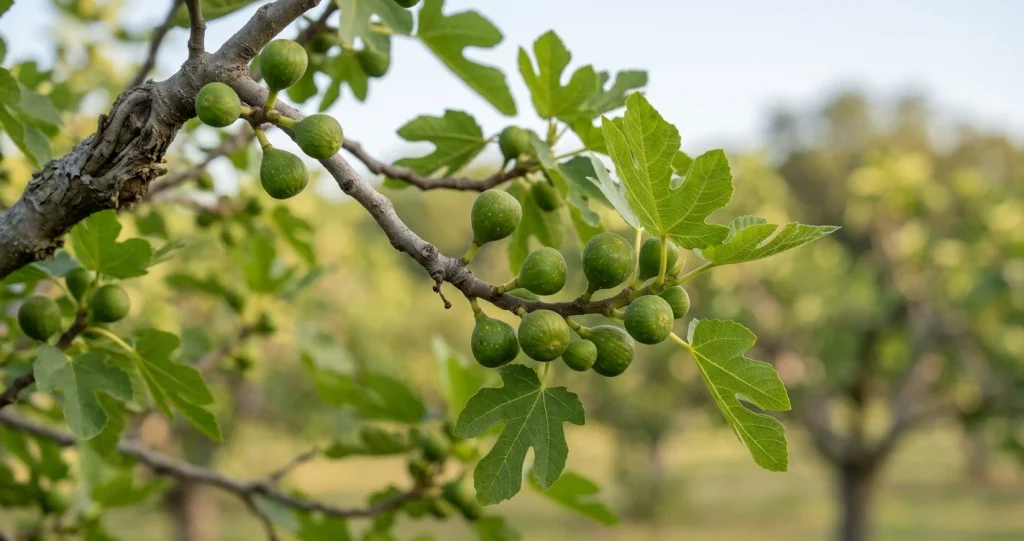
Watch how small figs develop along the branches.
Unlike familiar blossoms, the fig’s flowers remain enclosed inside the developing structure.
This makes fig trees excellent subjects for learning about unusual plant reproductive strategies.
Support local biodiversity
Grow a variety of regionally appropriate flowering plants to support native bees, butterflies, and other insects.
Reduce unnecessary pesticide use and maintain diverse garden habitats.
These practices benefit local pollinators, even when fig wasps are not present.
Avoid introducing nonnative insects
Do not attempt to import or release fig wasps to improve fruit production.
Moving insects between regions can create ecological and regulatory problems.
For home gardens, choosing varieties that fruit without pollination is usually the practical solution.
Frequently Asked Questions
1. Do fig wasps sting humans?
Pollinating fig wasps are extremely small and are not considered a stinging threat to people. Their specialized biology centers on entering figs and reproducing inside them. They should not be confused with larger social wasps that defend nests.
2. Can a fig tree produce fruit without fig wasps?
Yes. Many common edible fig cultivars produce figs parthenocarpically, without pollination. However, Smyrna-type figs generally require pollination for their main crop, and San Pedro-type figs have different requirements for their first and later crops.
3. Are all fig species pollinated by the same wasp?
No. Many fig species have specialized relationships with particular pollinating wasps. Some figs have more than one pollinator species, and certain wasps can use multiple hosts. The common edible fig is associated with Blastophaga psenes where pollination occurs.
Conclusion
Return to that ripe fig, with its sweet flesh and tiny crunchy seeds.
Its unusual structure hides a reproductive system unlike that of most familiar garden plants.
Understanding how fig wasps pollinate figs reveals a partnership built around hidden flowers, chemical signals, specialized insects, and carefully timed life cycles.
In many wild fig species, the wasp’s journey into the fig allows both organisms to reproduce. In common backyard fig varieties, fruit can often develop without that journey.
Either way, the fig remains an extraordinary example of botanical evolution.
What appears to be a simple fruit is actually a miniature world of flowers, ecological relationships, and evolutionary history.
And in many forests, that hidden world begins with an insect small enough to fit through an opening barely visible to the human eye.
External Sources
1. Fig Pollination and the Fig–Wasp Partnership Explain the specialized relationship between fig trees and their pollinating wasps, including the insects’ reproduction and their role in pollination.
Encyclopaedia Britannica, https://www.britannica.com/animal/fig-wasp
3. Growing Edible Figs Without Pollination Support the explanation of common edible fig varieties, cultivation requirements, and the distinction between figs that require pollination and those that develop without it.
Clemson Cooperative Extension — Home & Garden Information Center https://hgic.clemson.edu/factsheet/fig/