
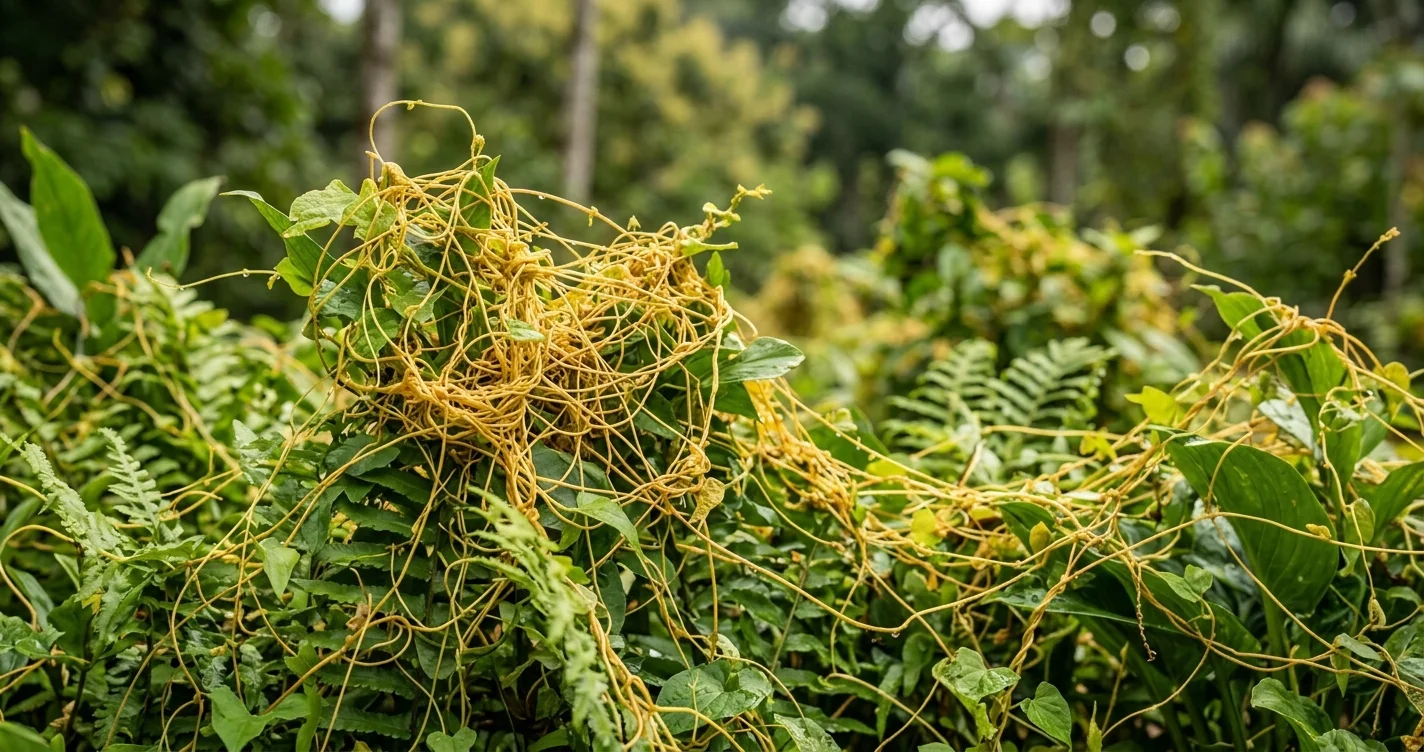
Imagine walking into your garden and discovering a tangle of bright orange threads wrapped around your tomatoes, flowers, or shrubs. The strands look almost like someone dropped a handful of spaghetti over the plants. They have no obvious leaves, and they seem to be growing directly from the plants beneath them.
This unusual invader may be the dodder parasitic plant, one of the most fascinating—and potentially troublesome—vines in the botanical world.
Unlike ordinary climbing plants, dodder does not simply use another plant for support. It develops specialized structures that connect to the host’s tissues, allowing it to obtain water and nutrients. Some species can seriously weaken garden plants and agricultural crops.
Yet dodder is also a remarkable example of plant evolution. Its unusual lifestyle raises intriguing questions about how plants locate hosts, communicate chemically, and survive with little or no independent photosynthesis.
Understanding how dodder works is the first step toward recognizing it early and managing it effectively.
Table of Contents
- What Is Dodder?
- How to Identify Dodder in Your Garden
- Dodder Parasitic Plant: How It Attaches and Steals Resources
- How Dodder Finds Its Host
- Which Plants Are Most Vulnerable?
- Why Dodder Can Be Difficult to Control
- How to Control Dodder in Your Garden
- Preventing Dodder From Returning
- Dodder’s Role in Natural Ecosystems
- In Your Own Yard: A Practical Dodder Management Plan
- Common Mistakes to Avoid
- Frequently Asked Questions
What Is Dodder?
Dodder is the common name for a group of parasitic flowering plants belonging primarily to the genus Cuscuta, in the morning glory family, Convolvulaceae.
These plants occur in many parts of the world, including North America. Some species are native to the United States, while others have been introduced.
Dodder is often called strangleweed, love vine, or goldthread, although common names vary by region and can refer to other plants.
Its most recognizable feature is its mass of slender, threadlike stems, which may be yellow, orange, reddish, or occasionally greenish.
A vine with almost no visible leaves
Most dodder species have extremely reduced, scale-like leaves rather than the broad green leaves familiar to gardeners.
This is why dodder is commonly described as leafless.
Many species also contain little chlorophyll and depend heavily on their hosts for nourishment. However, the degree of photosynthetic ability varies among species, so describing every dodder plant as completely incapable of photosynthesis would be inaccurate.
Instead of producing a substantial leafy canopy, dodder invests in rapid stem growth and connections to other plants.
Dodder is a flowering plant
Despite its strange appearance, dodder produces flowers and seeds.
Its small flowers may be white, cream, pinkish, or another pale shade, depending on the species.
The flowers are often clustered along the stems.
After pollination, dodder can produce seed capsules containing seeds that may remain viable in soil for years.
This persistent seed bank is one reason established infestations can be difficult to eliminate.
Is dodder a weed or a native wildflower?
The answer depends on the species and location.
Some dodder species are native components of American ecosystems and interact with native plant communities.
Others can become serious agricultural or horticultural pests.
A dodder vine growing naturally in an undisturbed habitat should not automatically be treated the same way as one spreading through a vegetable garden or commercial crop.
Accurate identification and local context matter.
How to Identify Dodder in Your Garden
Dodder looks unlike most familiar garden weeds.
Its unusual structure makes identification relatively straightforward at the genus level, although distinguishing individual species can require botanical expertise.
Thin, tangled stems
The most obvious sign is a network of fine, stringlike stems wrapped around other plants.
These strands may resemble orange fishing line or tangled thread.
Unlike ordinary vines, dodder does not rely on large leaves or sturdy stems to collect sunlight.
It often forms dense mats that spread from one host stem to another.
No normal root system after attachment
A young dodder seedling initially produces a short-lived rootlike structure that helps it establish contact with the environment.
Once it finds a suitable host and forms functional connections, that initial connection to the soil usually degenerates.
The mature parasite then relies largely on its host.
This is one of the major differences between dodder and conventional climbing vines.
Small flowers along the threads
Flower clusters can help confirm an identification.
The flowers are often tiny and may be overlooked unless examined closely.
Their shape and arrangement are important for identifying particular Cuscuta species.
Host plants may appear weakened
Heavily parasitized plants can show reduced vigor, stunted growth, or lower yields.
However, these symptoms are not unique to dodder.
Drought, nutrient deficiencies, root problems, and other pests can produce similar effects.
The presence of characteristic dodder stems and attachment points provides stronger evidence.
Dodder Parasitic Plant: How It Attaches and Steals Resources
The most remarkable part of dodder’s biology is hidden where its stems touch another plant.
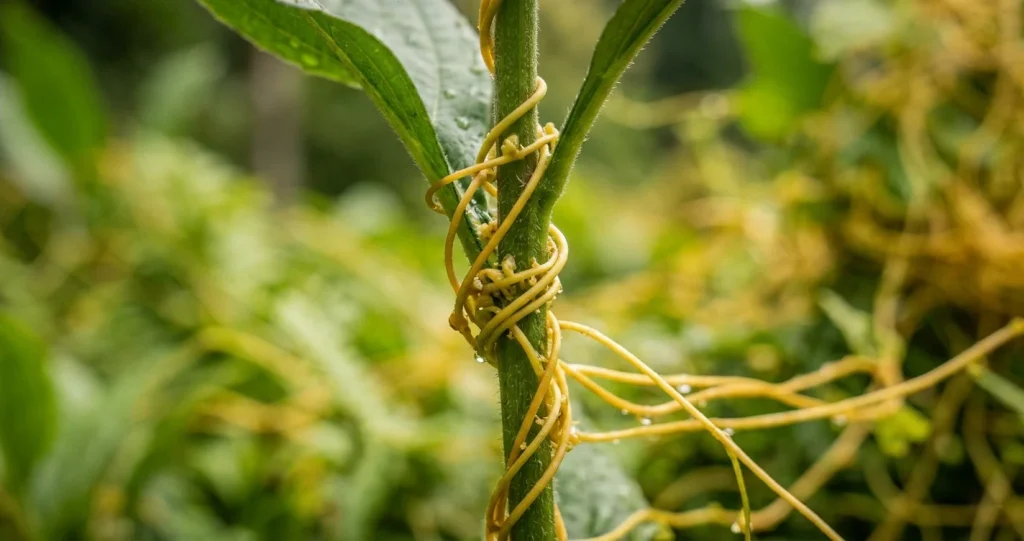
The parasite develops specialized structures called haustoria, which penetrate host tissues and establish connections that allow resources to move between the two plants.
This process is more complex than a vine simply wrapping around a stem.
Step 1: A seed germinates near a potential host
Dodder begins life as a seed.
When conditions are suitable, a seed germinates and produces a slender shoot.
At this early stage, the seedling has limited stored energy and must establish contact with a compatible host within a relatively short period.
The exact time available varies by species and growing conditions.
A seedling that fails to reach a suitable host generally cannot continue growing indefinitely.
This makes host location a critical part of dodder’s life cycle.
Step 2: The young vine searches for support
As the seedling grows, its stem moves and explores the surrounding space.
Dodder seedlings can respond to environmental signals that help guide their growth.
Studies have shown that certain species can respond to volatile chemicals released by nearby plants.
Light conditions and physical contact also influence development.
When the seedling encounters a suitable host, it begins wrapping around the host’s stem.
Step 3: The vine coils around the host
The dodder stem forms coils that hold it close to the host surface.
This physical contact helps position the parasite for attachment.
The process may involve several turns around the host stem.
However, wrapping alone does not provide nutrition.
The parasite must form specialized internal connections before it can obtain substantial resources.
Step 4: Haustoria develop
At points of contact, dodder produces haustoria.
These structures grow toward and into the host’s tissues.
They are not ordinary roots, although they perform a resource-acquiring function.
Haustorial development involves coordinated growth and biochemical interactions between the parasite and host.
The parasite must cross protective barriers and reach tissues involved in transport.
Step 5: The parasite connects to transport tissues
Plants contain vascular tissues that distribute water, minerals, and sugars.
The xylem primarily carries water and dissolved mineral nutrients, while the phloem transports sugars and other organic substances.
Dodder haustoria can establish connections with these systems.
Once functional connections form, resources can move from the host into the parasite.
This allows dodder to grow rapidly without relying on an extensive independent root system.
Step 6: Dodder expands to additional stems
After becoming established, dodder may produce more shoots that extend toward neighboring stems or plants.
These new shoots can coil around additional suitable hosts and form further haustorial connections.
A single established plant may therefore spread across several host stems.
Dense infestations can create a web of parasite growth connecting multiple plants.
This ability contributes to both the ecological importance and management difficulty of dodder.
Step 7: Flowering and seed production continue the cycle
Once mature, dodder produces flowers and eventually seeds.
If those seeds reach the soil, they can contribute to future infestations.
Some dodder seeds have hard seed coats that allow them to remain dormant for extended periods.
Seed persistence varies among species and environmental conditions, but it makes preventing seed production a central management goal.
How Dodder Finds Its Host
Dodder does not have eyes, a nose, or a nervous system.
Yet its seedlings can respond to signals associated with nearby plants.
This ability has attracted considerable scientific interest.
Chemical cues from neighboring plants
Plants release volatile organic compounds into the surrounding air.
Some dodder species can respond to these compounds during early growth.
A well-known experimental study demonstrated that dodder seedlings could orient their growth toward certain host-associated volatile cues.
This does not mean that dodder consciously smells its host.
Rather, chemical signals influence plant growth through physiological responses.
Light and physical contact
Dodder growth can also respond to light and touch.
Once a seedling contacts a potential host, mechanical and chemical cues can contribute to coiling and haustorial development.
The relative importance of these signals depends on the species and experimental conditions.
Not every plant is an equally suitable host
Dodder species differ in their host ranges.
Some can parasitize a wide variety of plants, while others are more selective.
Even when dodder wraps around a plant, successful attachment is not guaranteed.
Host defenses and tissue compatibility influence whether the parasite establishes functional connections.
Which Plants Are Most Vulnerable?
Dodder can affect a broad range of herbaceous plants, shrubs, and agricultural crops.
The exact host range depends on the dodder species.
Vegetable crops
Certain dodder species can parasitize crops such as tomatoes and other vegetables.
Heavy infestations may reduce growth and productivity.
However, susceptibility differs among crops and varieties, and not every Cuscuta species attacks the same vegetables.
Ornamental plants
Dodder may establish on susceptible ornamental flowers and shrubs.
Garden beds containing closely spaced host plants can provide opportunities for the parasite to spread between stems.
Agricultural crops
Dodder is an important pest in some forage and seed-production systems, including alfalfa.
In these settings, the parasite can interfere with crop growth and complicate harvesting.
Agricultural management may require strategies different from those used in a small home garden.
Native vegetation
Native dodder species can also parasitize native plants in natural habitats.
These relationships are part of local ecological systems.
Their presence does not automatically justify removal unless there is a specific management objective.
Why Dodder Can Be Difficult to Control
Dodder presents several challenges that distinguish it from ordinary weeds.
It is physically connected to the host
Once haustoria form, the parasite is attached directly to living host tissues.
Pulling off the visible strands may leave attached fragments behind.
Those fragments can sometimes support regrowth.
Removing the parasite without damaging the host may therefore be difficult.
Seeds can remain dormant
Some dodder seeds persist in the soil for several years.
Even after visible plants are removed, new seedlings may emerge in later growing seasons.
The duration of seed viability depends on species and conditions.
It can spread between plants
Dodder shoots can extend from one host to another.
This allows an infestation to spread through closely spaced vegetation.
Prompt detection is particularly valuable before a dense network develops.
Control options depend on the host crop
A treatment that is suitable for one crop may damage another.
Chemical herbicides can be especially challenging because dodder and its host are both plants.
Products must be selected according to the specific host, dodder species, and legally approved use.
How to Control Dodder in Your Garden
Successful management usually combines early detection, physical removal, sanitation, and prevention of seed production.
There is no universal treatment that safely removes every dodder infestation from every host.
1. Remove young seedlings before attachment
The easiest stage to manage is often before dodder establishes a connection with a host.
If you notice unattached dodder seedlings emerging from the soil, remove them promptly.
Because young seedlings have limited reserves, preventing host attachment can stop establishment.
Dispose of the material carefully.
2. Remove infested plant portions
When dodder has already attached, cutting away infested host stems may be more effective than simply pulling off the orange threads.
Prune below the attachment points where practical.
Inspect the remaining plant carefully for additional strands.
For small, heavily infested annual plants, removing the entire host may be the most reliable option.
The appropriate approach depends on the host plant’s value, growth habit, and extent of infestation.
3. Prevent flowering and seed production
This is one of the most important long-term steps.
Remove dodder before seeds mature whenever possible.
Allowing an infestation to produce seeds can create problems for future seasons.
Continue monitoring the area after initial removal.
4. Dispose of infested material carefully
Collect removed dodder and affected plant material so fragments and seeds are not spread around the garden.
Bagging the material for disposal is often a practical choice.
Avoid adding mature seed-bearing dodder to ordinary backyard compost, where temperatures may be insufficient to destroy viable seeds.
Local disposal rules should be followed.
5. Use mulch as a preventive tool
In some garden settings, an adequately thick layer of suitable mulch can help suppress dodder seedling emergence.
However, mulch is not a guaranteed solution.
Dodder seedlings may still emerge through gaps or establish near exposed host stems.
Mulching works best as part of an integrated strategy rather than a stand-alone treatment.
6. Manage weeds that serve as hosts
Dodder may survive on susceptible weeds growing near valuable garden plants.
Removing these alternative hosts can reduce opportunities for establishment and spread.
Be careful to distinguish problematic weeds from desirable native vegetation.
7. Consider herbicides only when appropriate
Some preemergence herbicides are labeled for dodder management in particular crops or landscape settings.
Postemergence control can be more difficult because attached dodder is closely associated with its host.
Herbicide effectiveness and crop safety depend on the product, timing, host species, and application method.
Always follow the current product label and consult local Cooperative Extension guidance.
Never assume a treatment recommended for alfalfa or commercial agriculture is suitable for vegetables or ornamental plants.
Preventing Dodder From Returning
Long-term prevention focuses on reducing new introductions and limiting the seed bank.
Inspect new plants
Examine nursery plants and transplants before introducing them to your garden.
Look for unusual threadlike stems wrapped around the foliage.
Avoid moving visibly infested plants into clean areas.
Use reliable planting materials
Purchase seeds and planting materials from reputable suppliers.
Contaminated crop seed has historically been one pathway for spreading certain dodder species.
Seed-quality standards and cleaning practices help reduce this risk.
Clean gardening equipment
After working in an infested area, remove attached plant fragments and soil from tools and equipment before moving elsewhere.
This is particularly important if dodder has already produced seeds.
Monitor previously infested beds
Inspect affected areas regularly during the growing season.
New seedlings may emerge from seeds remaining in the soil.
Early removal can prevent another cycle of attachment and seed production.
Rotate susceptible crops where useful
In agricultural systems, crop rotation with nonhost species may help manage certain dodder infestations.
However, this strategy requires knowledge of the local dodder species and its host range.
Because some species parasitize many different plants, rotating crops does not always provide reliable control.
Dodder’s Role in Natural Ecosystems
Dodder is not simply a botanical villain.
In natural ecosystems, native parasitic plants can influence competition, plant community structure, and interactions among species.
Parasitism is a natural ecological relationship
Parasitism occurs when one organism obtains resources from another, generally at a cost to the host.
Dodder is one example of this widespread ecological strategy.
Other parasitic plants include mistletoes and broomrapes, although their anatomy and host relationships differ.
Effects on plant communities
By drawing resources from host plants, dodder can alter their growth and competitive ability.
In some ecosystems, parasitic plants may influence which species become dominant.
The ecological consequences depend on the parasite, host community, and environmental conditions.
Connections beyond water and nutrients
Research has demonstrated that dodder can serve as a physical connection between host plants.
Through these connections, certain signaling molecules and other substances may move between plants under experimental conditions.
This does not mean dodder deliberately helps plants communicate.
Instead, its vascular connections can create pathways that affect biological interactions.
Native species deserve careful consideration
Some American dodder species are native and occur naturally in wetlands, prairies, or other habitats.
Removing them indiscriminately from wild areas could disrupt existing ecological relationships.
Management should distinguish between protecting a cultivated garden and conserving natural biodiversity.
In Your Own Yard: A Practical Dodder Management Plan
If you discover a suspicious orange tangle in your garden, a calm, systematic response is more useful than immediately applying a chemical treatment.
Step 1: Confirm the identification
Examine the plant for slender, leafless-looking stems that coil around host vegetation.
Look for attachment points and, if present, small flower clusters.
Photograph the suspected dodder.
Your local Cooperative Extension office may be able to help identify the species.
Step 2: Assess the infestation
Determine whether the dodder is limited to a few stems or has spread across multiple plants.
Check nearby weeds and ornamentals.
Look for flowers or seed capsules, since these affect how urgently seed containment is needed.
Step 3: Remove affected material
For small infestations, carefully cut and remove affected host portions below visible attachment sites.
If an annual plant is heavily infested, consider removing the entire plant.
Avoid scattering dodder fragments through the bed.
Step 4: Protect surrounding plants
Inspect nearby vegetation for early attachment.
Remove unattached seedlings promptly.
Manage susceptible weeds where appropriate and maintain suitable mulch around garden plants.
Step 5: Monitor through the season
Return to the area regularly.
Dodder may reappear from missed fragments or newly germinating seeds.
Continue removing plants before they produce mature seeds.
Step 6: Plan for future seasons
Keep records of where the infestation occurred.
Monitor the same locations in subsequent years.
If the problem is extensive, seek region-specific advice from a university Extension specialist before using herbicides.
Common Mistakes to Avoid
Pulling off the visible threads and assuming the problem is solved
Dodder can remain attached through haustorial connections.
Removing only the loose strands may leave viable parasite tissue behind.
Thorough inspection and removal of affected host tissue are often necessary.
Waiting until seeds are mature
Delaying control allows the parasite to replenish the soil seed bank.
Preventing seed production is one of the most effective long-term strategies.
Composting seed-bearing material without proper treatment
Ordinary backyard composting may not reliably kill dodder seeds.
Bagging and disposing of heavily infested material is often safer.
Applying an unverified home remedy
Salt, concentrated vinegar, and other improvised treatments can damage garden soil and desirable plants.
They may also fail to eliminate attached dodder.
Use established horticultural practices instead.
Treating every dodder species as an invasive weed
Some dodder species are native components of American ecosystems.
Control decisions should consider species identity, location, and whether the plant is actually causing a problem.
Frequently Asked Questions
1. Can dodder survive without a host plant?
A newly germinated dodder seedling can survive briefly using stored reserves, but most species must attach to a suitable host to continue developing. Once established, the parasite usually depends heavily on the host for water and nutrients. The exact degree of dependence varies among species.
2. Will cutting dodder off a plant kill it?
Removing visible strands may not eliminate an established infestation because haustorial attachments or viable fragments can remain. Cutting away affected host stems below the attachment points, or removing heavily infested annual plants, is often more reliable. Follow-up monitoring is important.
3. Is dodder harmful to humans or pets?
Dodder is primarily a plant parasite, not an organism that attacks people or animals. However, individual plant species and any contaminated plant material should not be assumed safe for consumption. Avoid using unidentified dodder as food, medicine, or pet forage.
Conclusion
Return to that tangled orange mass draped over a garden plant.
What looks like a collection of lifeless threads is actually a highly specialized flowering plant that has evolved an extraordinary way of obtaining resources.
The dodder parasitic plant finds suitable hosts, wraps around their stems, develops haustoria, and connects to their internal transport tissues.
For gardeners, the most effective response is early identification, careful removal, prevention of seed production, and continued monitoring.
For nature enthusiasts, dodder offers something equally valuable: a reminder that plants have evolved many different ways to survive, including strategies that challenge our usual ideas about roots, leaves, and independence.
Sometimes the most unusual organism in a garden is not the one with the brightest flowers or largest leaves, but the thin orange vine quietly growing through its neighbors.
External Sources
1. University of California IPM — Dodder. A detailed guide to dodder identification, host plants, life cycle, sanitation, physical removal, and long-term management. UC IPM
2. University of Florida IFAS — Biology and Management of Dodder. Explains dodder biology and control methods for ornamental crops and landscapes, including pruning infested host tissue and selecting nonhost plants. Ask IFAS
3. Runyon, Mescher and De Moraes (2006) — Volatile Chemical Cues Guide Host Location and Host Selection by Parasitic Plants. Peer-reviewed research demonstrating that Cuscuta pentagona seedlings can respond to airborne chemicals from potential host plants. PubMed
4. USDA Forest Service — Plant Host Finding by Parasitic Plants. Discusses chemical cues and their role in host location by parasitic vines. research.fs.usda.gov