
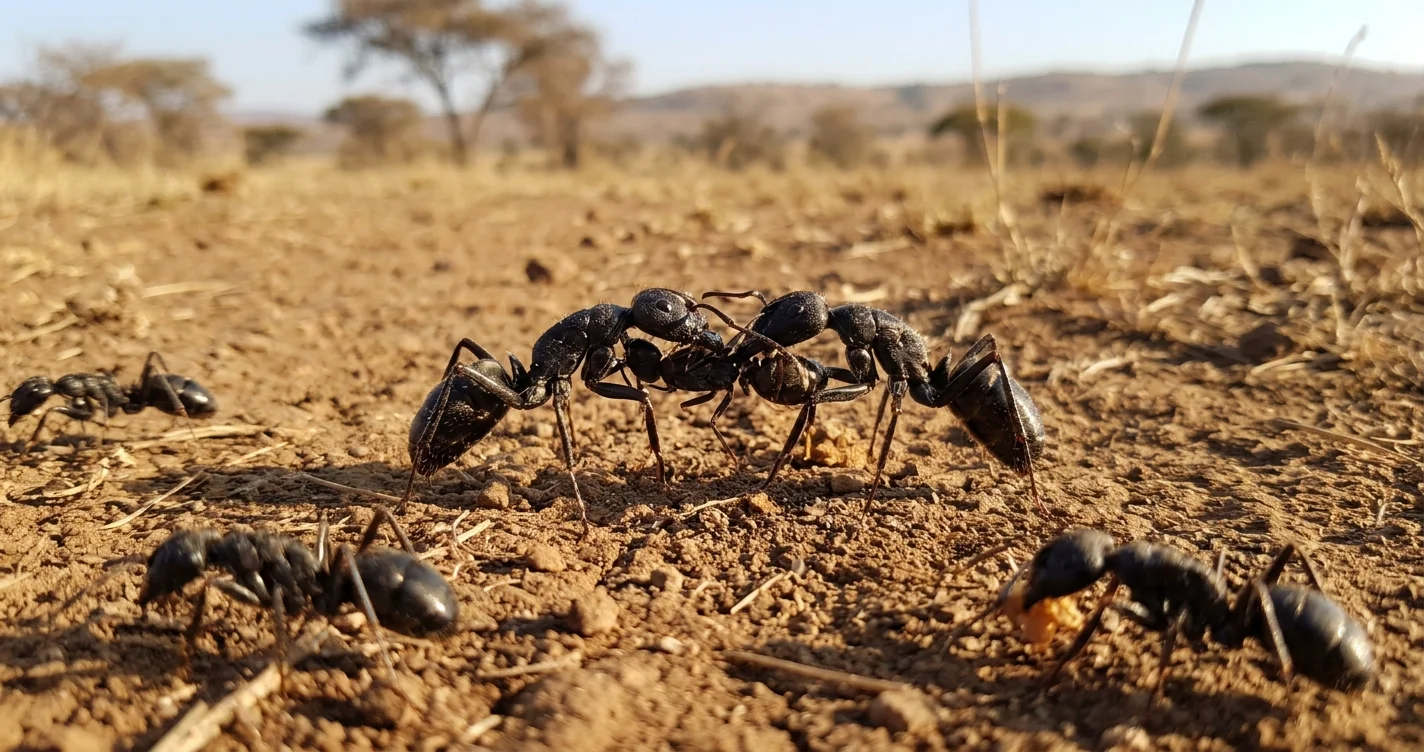
Imagine a battlefield where injured soldiers are carried to safety, their wounds examined, and infections treated with substances that help them survive. Now imagine that the rescuers and patients are ants.
In the African savannas, Matabele ants perform behaviors that sound remarkably similar to emergency rescue and medical care. These termite-hunting insects can retrieve injured nestmates, clean their wounds, and apply antimicrobial secretions when infections develop.
The science behind matabele ants wound care is especially fascinating because it reveals how sophisticated social behavior can evolve in insects with tiny brains.
Their actions are not human medicine in miniature. Instead, they are specialized biological adaptations that help colonies survive dangerous hunting expeditions.
Table of Contents
- Meet the Matabele Ant
- Why Termite Hunting Is So Dangerous
- Matabele Ants Wound Care: How Rescue and Treatment Work
- How Ants Recognize Injured Nestmates
- The Science of Antimicrobial Wound Treatment
- Why Caring for Injured Ants Benefits the Colony
- What Makes This Behavior Unusual
- In Your Own Yard: Understanding Ant Behavior
- Common Misconceptions About Matabele Ants
- Frequently Asked Questions
Meet the Matabele Ant
Matabele ants, scientifically known as Megaponera analis, are predatory ants native to sub-Saharan Africa. They are particularly well known for organizing coordinated raids against termites.
Unlike ants that collect a wide variety of foods, these insects specialize in hunting termites. Workers leave their nests, locate termite-foraging sites, and attack in organized groups.
The raids can be dramatic. Ants travel in columns, enter termite feeding areas, capture prey, and return to their colony carrying termites.
However, the termites are far from defenseless.
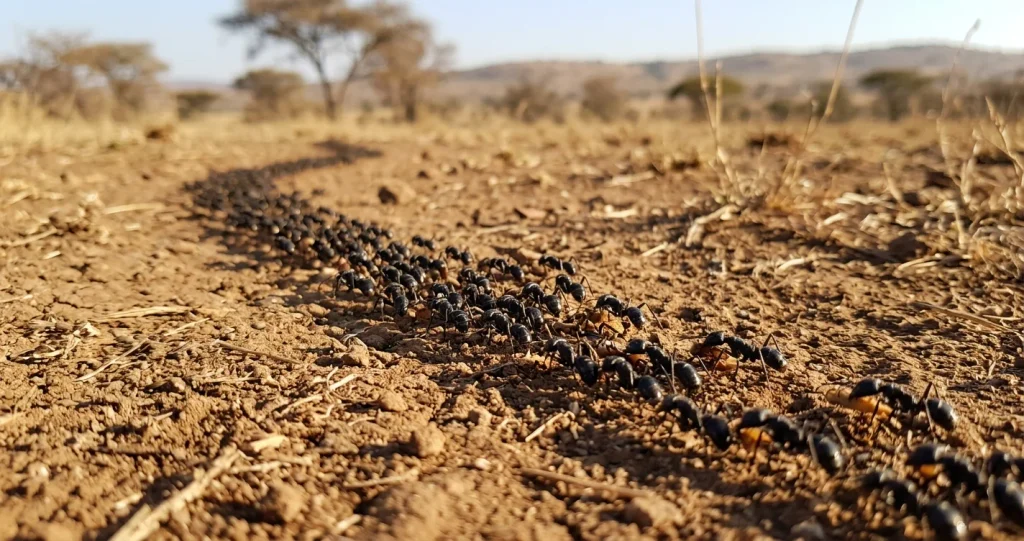
A specialized termite hunter
Matabele ants belong to a group of ants whose biology is closely connected to termite predation.
Their workers have powerful mandibles, and their colonies coordinate hunting activities through chemical communication.
When scouts locate suitable termite prey, they can recruit nestmates to participate in raids.
This collective behavior allows the ants to capture prey more effectively than isolated individuals.
Yet the same strategy exposes many workers to danger.
Life in the African savanna
These ants inhabit parts of tropical and subtropical Africa, including savanna environments where termites are abundant.
Their nests are generally underground, and workers travel across the soil surface during foraging expeditions.
The presence of termites shapes much of their daily activity.
Temperature, humidity, local habitat, and prey availability can influence when raids occur.
The extraordinary wound-care behavior described by researchers has been studied in particular populations of Megaponera analis. Not every ant species exhibits the same responses.
Why Termite Hunting Is So Dangerous
Termites are often imagined as soft-bodied insects that quietly consume wood or plant material.
But termite colonies include specialized soldiers equipped to defend their nestmates.
Some termite soldiers have powerful jaws capable of gripping attackers.
When Matabele ants raid termite groups, these defenders can inflict serious injuries.
Termite soldiers fight back
During a raid, termite soldiers may bite attacking ants and hold onto their legs.
The resulting injuries can include damaged or missing limbs.
Some ants return from hunting with termite soldiers still attached to their bodies.
Others become unable to move normally.
An injured ant left behind faces considerable danger, especially when it cannot return to the nest independently.
Injuries are only part of the problem
An open wound creates another risk: infection.
Microorganisms from the environment can enter damaged tissues, and certain bacterial infections may become life-threatening.
For social insects that repeatedly engage in dangerous encounters, the ability to recover injured workers can have important consequences.
Matabele ants have evolved a remarkable combination of rescue behavior and wound treatment that addresses these risks.
Matabele Ants Wound Care: How Rescue and Treatment Work
The most striking aspect of Matabele ant behavior is that rescue does not necessarily end when an injured worker reaches the nest.
Researchers have documented a sequence of responses involving injury recognition, transportation, wound cleaning, and, in certain cases, antimicrobial treatment.
These behaviors work together, but they are not identical.
Step 1: Injured ants signal for help
During raids, injured Matabele ants can release chemical signals that attract nestmates.
Research has identified compounds associated with the mandibular glands that contribute to this rescue response.
The signals help nearby workers locate injured individuals.
This is particularly important when a wounded ant has lost mobility or cannot keep pace with the returning hunting column.
Rather than relying on a visual assessment alone, rescuers respond to chemical information.
Chemical communication is fundamental to ant societies, and this rescue behavior is a specialized example of that broader ability.
Step 2: Nestmates carry injured workers home
When an injured ant is suitable for rescue, another worker may pick it up and carry it toward the nest.
The rescued individual can remain relatively still during transportation, allowing the carrier to move efficiently.
Observations show that ants with certain injuries, such as missing legs, can be transported successfully.
However, rescue is not universal.
Severely injured ants may behave differently from lightly injured individuals, and their responses can influence whether nestmates carry them.
Researchers have documented that ants with injuries so severe that recovery is unlikely may resist transportation.
This distinction suggests that the rescue system is influenced by both the rescuer’s behavior and the condition of the injured ant.
Step 3: Workers clean wounds
Once injured ants return to the nest, nestmates may inspect and groom their wounds.
Workers use their mouthparts to clean affected areas.
This behavior can help remove debris and may reduce microbial contamination.
Wound cleaning was among the first forms of medical-like care documented in Matabele ants.
Researchers studying injured individuals found that receiving care substantially improved survival compared with certain experimentally isolated conditions.
The findings provided evidence that social treatment can have measurable biological benefits.
Step 4: Ants detect infected wounds
More recent research revealed another layer of sophistication.
Matabele ants can respond differently to infected and uninfected wounds.
In controlled experiments, workers were able to distinguish wound conditions associated with infection.
The evidence suggests that changes in chemical profiles help nestmates identify infected individuals.
This is not equivalent to a human understanding of bacteria or disease.
Instead, the ants respond to chemical cues produced by physiological changes in the injured worker.
Step 5: Antimicrobial secretions are applied
Researchers have documented workers applying secretions from their metapleural glands to infected wounds.
Metapleural glands are specialized structures found in many ants and are associated with antimicrobial defense.
In Matabele ants, workers can collect glandular secretions and transfer them to an injured nestmate.
The secretions contain substances with antimicrobial activity.
This behavior is particularly significant because it goes beyond simply grooming an injured individual.
It represents targeted treatment associated with wound infection.
Step 6: Treated ants have a better chance of surviving
Experimental research has found that antimicrobial treatment can substantially reduce mortality associated with infected wounds.
One widely reported study found that untreated infected ants experienced mortality of approximately 90%, while treatment reduced mortality by about 90% relative to that untreated condition.
These figures describe particular experimental conditions, not the survival rate of every injured Matabele ant in nature.
The broader conclusion is that targeted social treatment can significantly improve outcomes for infected individuals.
That is a remarkable evolutionary achievement for an insect society.
How Ants Recognize Injured Nestmates
Ants rely heavily on chemical communication.
Their antennae detect chemical compounds that provide information about nestmates, food, danger, and colony membership.
Matabele ants use this sensory system in their rescue and wound-care behavior.
Chemical signals during rescue
Injured ants can release compounds that encourage nearby workers to approach and assist.
These signals function within the context of a raid, where other workers are already moving together.
The chemical information helps rescuers respond quickly.
However, researchers distinguish between signaling for rescue and recognizing an infected wound.
They are related aspects of social care but involve different biological circumstances.
Infection changes chemical information
When a wound becomes infected, the injured ant’s chemical profile may change.
Researchers have investigated changes in cuticular hydrocarbons, compounds present on the insect’s outer surface.
These chemical differences can provide information about the condition of an injured nestmate.
Workers appear able to use such cues when deciding how to treat a wound.
The precise sensory and decision-making mechanisms remain areas of scientific investigation.
The Science of Antimicrobial Wound Treatment
Antimicrobial substances are widespread in nature.
Many organisms produce chemicals that inhibit the growth of bacteria, fungi, or other microorganisms.
Ants are particularly interesting because their dense colonies create opportunities for pathogens to spread.
The metapleural gland
The metapleural gland is a specialized exocrine gland found in many ant lineages.
Its secretions can contain antimicrobial compounds that help protect individuals or colonies.
In Matabele ants, researchers identified numerous chemical components in glandular secretions associated with wound treatment.
The biological activity of these secretions helps explain why applying them to infected wounds can improve survival.
Not all ant species have identical glands or produce the same compounds.
Treatment is not random grooming
The important discovery is that Matabele ants do more than clean wounds indiscriminately.
Workers have been observed directing antimicrobial treatment toward wounds associated with infection.
That selective response makes the behavior especially notable.
It suggests that the ants’ social-care system can distinguish between different wound conditions and respond accordingly.
Still, terms such as diagnosis, medicine, and surgery should be understood as analogies rather than literal descriptions of human clinical practice.
Could these secretions inspire medicine?
Natural antimicrobial compounds are important subjects of biological and pharmaceutical research.
The chemicals used by Matabele ants offer interesting opportunities for studying antimicrobial defense.
However, a substance that helps an ant survive infection is not automatically suitable for treating human disease.
Potential medical applications would require extensive investigation into effectiveness, toxicity, mechanisms of action, and safety.
The scientific value of the discovery lies first in understanding insect behavior and natural antimicrobial systems.
Why Caring for Injured Ants Benefits the Colony
At first glance, carrying an injured worker home seems costly.
A rescuer must spend time transporting another ant rather than collecting termites.
Yet workers are valuable resources for a colony.
Experienced hunters can return to work
An ant that loses a leg may still recover enough to participate in future activities.
Research has shown that some rescued Matabele ants can return to hunting after recovery.
Preserving experienced workers may therefore provide long-term benefits.
Instead of replacing every injured hunter through reproduction and development, the colony can retain individuals that remain capable of useful work.
Cooperation changes the cost of injury
In a solitary animal, a severe injury may mean the immediate loss of access to food and shelter.
Social insects have another possibility: nestmates can provide assistance.
In Matabele ants, rescue and wound care can reduce the consequences of injuries associated with termite hunting.
This illustrates how collective behavior can influence survival.
Evolution favors effective colony behavior
Ant colonies function as highly integrated social systems.
Worker behavior often contributes to colony survival and reproductive success rather than directly benefiting the individual worker’s reproduction.
Rescue and wound treatment can be understood within that evolutionary framework.
The behavior does not require human-like compassion or conscious medical knowledge.
Natural selection can favor effective responses when they improve the performance and persistence of the colony.
What Makes This Behavior Unusual
Social insects exhibit many forms of cooperation.
Honey bees regulate hive temperature, termites construct elaborate nests, and numerous ants defend or feed their nestmates.
But Matabele ants stand out for the documented combination of battlefield rescue, wound cleaning, infection recognition, and targeted antimicrobial application.
Rescue from a dangerous hunting raid
The rescue behavior occurs in a context where injury is a recurring consequence of obtaining food.
This makes it different from ordinary grooming inside a colony.
Treatment matched to wound condition
The ability to distinguish infected wounds from other injuries adds an important level of specificity.
It demonstrates that social insect care can involve more than a single automatic response.
A reminder that insect behavior is complex
An ant’s brain is tiny compared with that of a mammal.
Yet social insects can perform sophisticated tasks using sensory cues, inherited behavioral programs, learning, and collective organization.
Matabele ants are a powerful example of how biological complexity does not always require a large brain.
In Your Own Yard: Understanding Ant Behavior
Matabele ants are native to Africa, so gardeners in the United States should not expect to find them in their yards.
However, local ants provide plenty of opportunities to observe insect communication and cooperation.
Watch how ants recruit nestmates
Observe a trail of ants moving between a nest and a food source.
You may notice workers following similar routes.
Many species use chemical trails to coordinate movement and recruitment.
Different species rely on different combinations of chemical and environmental cues.
Look for cooperative transport
Some ants work together to move food items that are too large for a single worker.
This can reveal how individuals respond to nestmates and adjust their movements during a shared task.
Observe without disturbing the colony.
Notice grooming behavior
Ants frequently clean themselves and their nestmates.
Grooming helps maintain the body surface and can contribute to hygiene.
However, ordinary grooming should not be confused with the specialized infected-wound treatment documented in Matabele ants.
Support a healthy garden ecosystem
Ants are important participants in many terrestrial ecosystems.
Depending on the species, they may help disperse seeds, move soil, consume other invertebrates, or serve as food for wildlife.
Gardeners can support insect diversity by maintaining varied vegetation, protecting suitable habitat, and minimizing unnecessary pesticide applications.
Some ants can also become household pests or protect plant-feeding insects, so management decisions should be based on the species and actual problem.
Observe safely and respectfully
Avoid handling unfamiliar ants, disturbing nests, or encouraging stinging insects to climb onto your skin.
A simple magnifying glass and patient observation can reveal interesting behaviors without interfering with the colony.
Common Misconceptions About Matabele Ants
They have human-style hospitals
Matabele ants do not construct hospitals in the human sense.
Their colonies contain workers that perform specialized care behaviors, but these are biological adaptations rather than organized medical institutions.
Every injured ant receives treatment
Research shows that the response depends on the injury and the individual’s condition.
Some severely injured ants are not rescued.
Treatment also varies according to whether a wound is infected.
All ants can treat infections this way
Ants exhibit diverse hygiene and antimicrobial behaviors, but the specific system described in Matabele ants should not be attributed to every ant species.
Different species have different ecological pressures, anatomy, and social behaviors.
Ant secretions are ready-made human antibiotics
Antimicrobial activity in laboratory or insect experiments does not establish that a substance is safe or effective for human use.
The findings are scientifically promising as a research subject, not as a home remedy.
Frequently Asked Questions
1. Do Matabele ants really carry wounded ants back to their nests?
Yes. Researchers have documented Matabele ants retrieving injured nestmates after termite raids. Workers can carry individuals that are unable to travel normally, although severely injured ants may not be rescued.
2. How do Matabele ants know when a wound is infected?
Experimental evidence indicates that infected wounds are associated with chemical changes that other ants can detect. Changes in cuticular hydrocarbon profiles appear to contribute to recognition, allowing workers to direct antimicrobial treatment toward infected individuals.
3. Can Matabele ant wound care help scientists develop new medicines?
Possibly, but any medical application remains a research question. Their glandular secretions contain antimicrobial substances that are interesting to scientists. Turning such compounds into safe human treatments would require substantial additional testing.
Conclusion
Return to that surprising scene: a wounded hunter lies on the ground after a dangerous encounter with termites.
Instead of being abandoned, the injured ant may be carried home, cleaned, and treated by its nestmates.
The discoveries surrounding matabele ants wound care reveal how natural selection can produce remarkably specialized forms of cooperation.
These insects do not practice medicine as humans understand it. Their behavior is driven by evolved responses to chemical cues, injury, and infection.
Yet the outcome is extraordinary: a social system in which helping an injured worker can improve survival and preserve valuable members of the colony.
In the African savanna, one of nature’s most fascinating rescue systems operates almost entirely out of sight, carried out by creatures small enough to fit on a fingertip.
External Sources
1. Frank et al. (2017), Science Advances, Saving the Injured: Rescue Behavior in the Termite-Hunting Ant Megaponera analis. Documents rescue after termite raids and identifies chemical compounds involved in attracting rescuers. PubMed Central (PMC)
2. Frank et al. (2018), Proceedings of the Royal Society B. Wound Treatment and Selective Help in a Termite-Hunting Ant. Examines wound grooming, selective assistance, and the survival benefits of receiving care. PubMed Central (PMC)
3. Frank et al. (2023), Nature Communications. Targeted Treatment of Injured Nestmates With Antimicrobial Compounds in an Ant Society. Demonstrates infection-associated chemical changes, antimicrobial treatment using metapleural gland secretions, and reduced mortality in experimentally infected ants. Nature
4. Frank et al. (2017), Communicative & Integrative Biology. Saving the Injured: Evolution and Mechanisms. Explores the evolutionary conditions that favor rescue behavior in social insects. PubMed Central (PMC)