
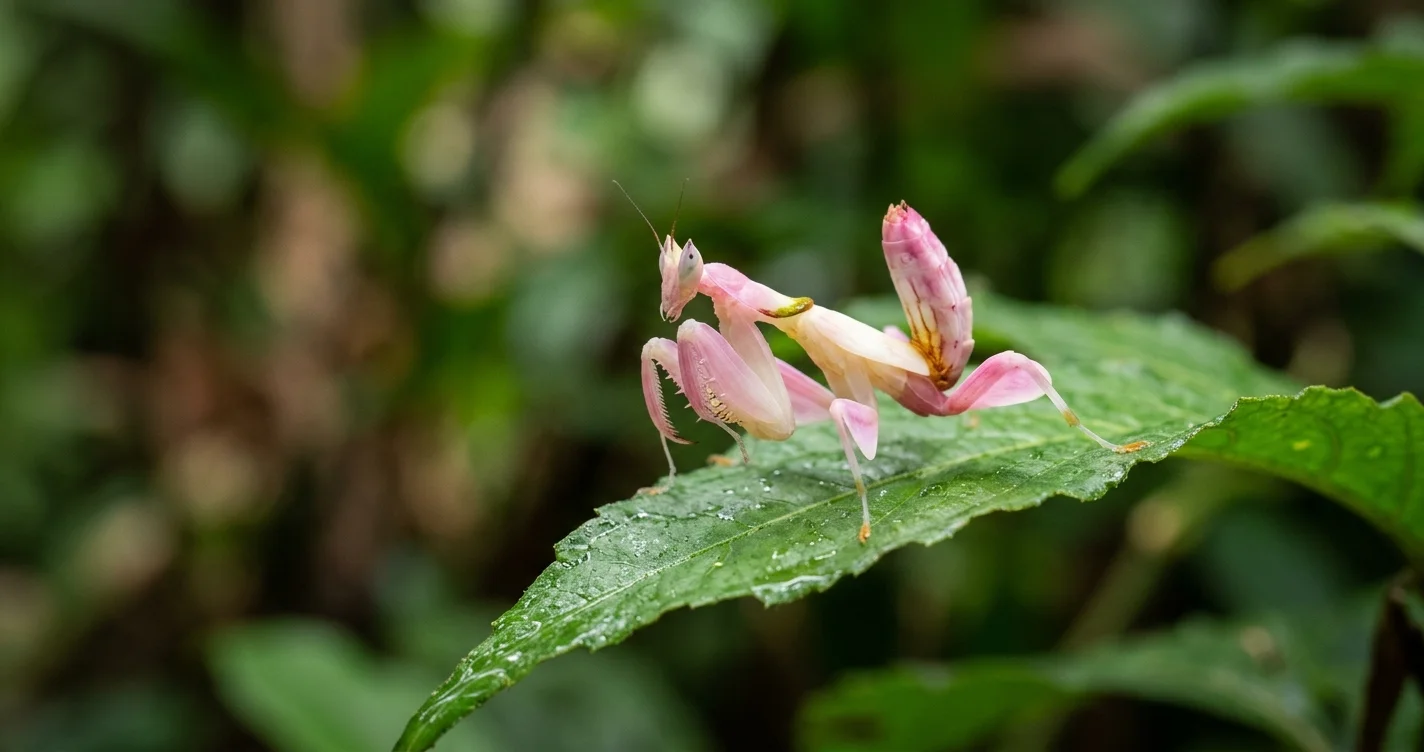
Imagine walking through a tropical forest and noticing what appears to be a delicate pink-and-white flower resting among green leaves. Its soft, petal-like shapes seem perfectly suited to the surrounding vegetation. Then, without warning, the flower moves.
It has eyes, six legs, and a pair of powerful hunting limbs.
You’ve just encountered one of nature’s most extraordinary examples of disguise: the orchid mantis.
Known scientifically as Hymenopus coronatus, this remarkable insect resembles a flower so convincingly that it can attract the attention of other insects. Yet beneath its beautiful appearance is a highly specialized predator capable of capturing unsuspecting prey.
The orchid mantis offers a fascinating glimpse into the relationship between appearance, behavior, and survival. Its unusual body shape raises an intriguing question about evolution: how can an animal benefit from looking like something entirely different?
The answer involves camouflage, visual signals, insect behavior, and millions of years of natural selection.
Table of Contents
- Meet the Orchid Mantis
- How the Orchid Mantis Uses Flower Mimicry to Hunt
- Does the Orchid Mantis Really Look Like an Orchid?
- What Do Orchid Mantises Eat?
- The Orchid Mantis Life Cycle
- Natural Predators and Survival Strategies
- The Orchid Mantis and Its Role in Tropical Ecosystems
- In Your Own Yard: Supporting Beneficial Insects
- Frequently Asked Questions
Meet the Orchid Mantis
The orchid mantis is a species of praying mantis native to parts of Southeast Asia. It belongs to the family Hymenopodidae, a group that includes several visually unusual mantises.
Unlike many familiar green or brown mantises, the orchid mantis has a striking combination of pale colors, flattened leg extensions, and a body shape that resembles flower petals.
Its appearance is especially remarkable in females, which are considerably larger than males.
Although its beauty attracts photographers and insect enthusiasts, the orchid mantis is a wild predator with specialized adaptations for catching other insects.
Where Orchid Mantises Live
Orchid mantises inhabit tropical environments in Southeast Asia, including areas of Malaysia, Indonesia, and neighboring regions.
These habitats provide warm temperatures, vegetation, and abundant insect life.
The species is often associated with tropical forest vegetation, although its exact habitat use can vary by location and life stage.
Rather than depending on a single orchid species, it can use its flower-like appearance among different kinds of vegetation.
This distinction is important because its common name sometimes creates the impression that the insect lives exclusively on orchids.
What Makes Them Look Like Flowers?
The orchid mantis has several distinctive physical features.
Its body is often white, pale pink, or cream-colored, sometimes with additional markings. The middle and hind legs have broad, flattened extensions that resemble petals.
Its abdomen can also contribute to the overall floral appearance.
These structures create a recognizable flower-like silhouette, particularly when the mantis holds its body in certain positions.
The resemblance is not merely decorative. Research suggests that its appearance can influence how potential prey responds to it.
How the Orchid Mantis Uses Flower Mimicry to Hunt
The orchid mantis is often described as a master of camouflage. However, its hunting strategy involves something more sophisticated than simply disappearing into the background.
In some circumstances, its flower-like appearance may actually make it more noticeable to visiting insects.
That apparent contradiction is one of the most fascinating aspects of its biology.
Petal-Like Legs and Body Shape
A flower’s appearance is created by the arrangement of petals, colors, and other visual features.
The orchid mantis produces a similar visual impression using its own anatomy.
Broad extensions on its legs resemble petals, while its pale body contributes to a floral outline.
These structures are part of the insect itself, rather than pieces of vegetation attached to its body.
From a distance, the overall shape can suggest a flower even though the details are not identical to any particular plant.
This is an example of biological mimicry, in which an organism resembles another object or living thing in ways that may improve its chances of survival.
Colors That Attract Attention
Many flowers use visual signals to attract pollinating insects.
The orchid mantis has evolved a color pattern that can also be visually attractive to certain insect visitors.
Research on the species has found evidence that its appearance can attract pollinators, supporting the idea that it uses aggressive mimicry.
Aggressive mimicry occurs when a predator resembles something that attracts its prey.
Instead of looking like a dangerous hunter, the mantis presents a flower-like signal that may encourage an insect to approach.
However, the effect depends on factors such as lighting, background, and the visual abilities of the insect observing it.
The orchid mantis does not necessarily fool every species in the same way.
The Art of Remaining Still
An orchid mantis often waits in a suitable position with its grasping forelegs folded.
Its stillness helps prevent potential prey from recognizing it as a moving predator.
The insect may also make subtle body movements, although its behavior varies with circumstances.
Unlike predators that pursue prey over long distances, mantises generally rely on positioning, timing, and rapid strikes.
Their large compound eyes help them detect movement and judge the location of nearby insects.
For an orchid mantis, visual disguise and careful positioning work together.
A Lightning-Fast Strike
When prey comes within reach, the mantis extends its specialized front legs.
These raptorial forelegs are equipped with spines that help secure struggling insects.
The strike can happen extremely quickly, allowing the mantis to capture prey before it escapes.
Once the prey is restrained, the mantis begins feeding with its chewing mouthparts.
Despite its delicate appearance, the orchid mantis is an effective insect predator.
Its hunting equipment is fundamentally similar to that of other praying mantises, even though its external appearance is unusually elaborate.
Why Flower Mimicry Works
The orchid mantis demonstrates how natural selection can favor features that influence another animal’s behavior.
Insects searching for nectar or pollen often respond to visual characteristics associated with flowers.
If a predator’s appearance causes suitable prey to approach more closely, that resemblance can offer a feeding advantage.
Over many generations, inherited traits that improve hunting success may become more common in a population.
The result can be a highly specialized appearance that seems almost artistic.
Importantly, scientists distinguish between a mantis being difficult to detect and a mantis actively attracting prey.
The orchid mantis is especially interesting because experimental research supports the latter possibility.
Its appearance can function as a lure rather than merely as concealment.
Does the Orchid Mantis Really Look Like an Orchid?
The name suggests an insect that imitates a specific orchid flower, but the reality is more nuanced.
The orchid mantis resembles a generalized flower-like structure rather than perfectly copying one particular orchid species.
Its pale coloration and petal-like legs create the impression of a blossom.
However, researchers have found that it can attract pollinating insects without sitting on a matching flower.
This suggests that its appearance may work as a broad floral signal.
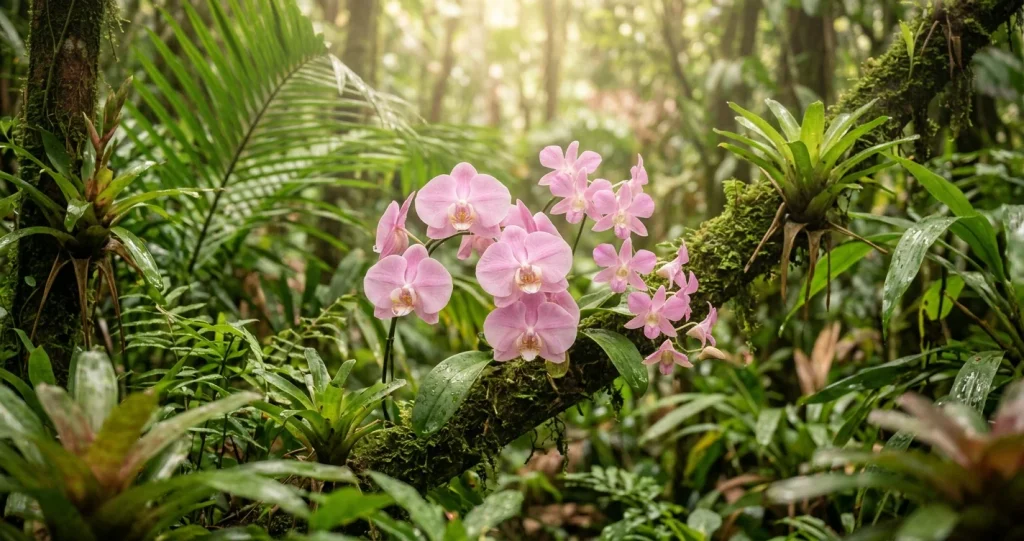
The distinction matters because popular illustrations sometimes show orchid mantises blending seamlessly into orchid blooms.
Such images can be beautiful, but they may exaggerate how precisely the insect matches an actual flower.
Its extraordinary adaptation is impressive enough without assuming perfect imitation.
What Do Orchid Mantises Eat?
Orchid mantises are carnivorous insects.
Their diet can include flies, bees, butterflies, moths, and other arthropods that are small enough to capture.
The exact prey taken depends on the mantis’s size, location, and available insects.
Hunting Flying Insects
Flying insects are especially relevant to the orchid mantis’s flower-like appearance.
Some insects approaching what they perceive as a floral object may come within striking distance.
The mantis then uses its front legs to capture them.
However, not every insect that approaches becomes prey, and mantises do not rely exclusively on flower mimicry for feeding.
An Opportunistic Predator
Like many mantises, orchid mantises can capture different kinds of suitable prey.
They do not feed on nectar or pollen as their primary food source.
Their flower-like appearance is therefore part of a predatory lifestyle, not evidence that they behave like flowers biologically.
This contrast between appearance and feeding behavior is central to what makes the species so unusual.
The Orchid Mantis Life Cycle
The orchid mantis undergoes incomplete metamorphosis.
Unlike butterflies, which develop through a distinct caterpillar and pupal stage, mantises grow through a series of molts.
Their life cycle includes eggs, nymphs, and adults.
Eggs and Newly Hatched Nymphs
Female mantises produce egg cases called oothecae.
These protective structures contain developing eggs.
When the young emerge, they resemble miniature mantises rather than caterpillars.
Early orchid mantis nymphs can look dramatically different from adults, often displaying dark and reddish coloration.
This appearance has been compared with certain warning-colored insects, although the ecological significance of juvenile coloration is still a subject of scientific interest.
Growing Through Molting
As the nymph grows, its external skeleton becomes too restrictive.
It must shed that skeleton through a process called molting.
After each molt, the mantis has a new, larger exoskeleton that gradually hardens.
Its appearance can change considerably during development.
The pale, flower-like characteristics associated with older orchid mantises become more apparent as they mature.
Successful molting is essential because an insect’s rigid outer skeleton cannot expand indefinitely.
Adult Males and Females
One of the most striking features of the orchid mantis is sexual size dimorphism.
Adult females are substantially larger and more robust than males.
Females may reach approximately 6–7 centimeters in body length, while males are often much smaller, though measurements vary.
Males also tend to be more slender and mobile.
These differences are important for understanding the species because photographs of large females may give an inaccurate impression of the size of every orchid mantis.
As with other mantises, mating behavior can be complex, and cannibalism may occur under certain conditions. However, it should not be assumed that every mating encounter ends this way.
Natural Predators and Survival Strategies
Although the orchid mantis is a skilled hunter, it is not immune to predation.
In tropical ecosystems, insect-eating birds, reptiles, and other predators may threaten mantises.
Its survival depends on a combination of appearance, behavior, and suitable habitat.
Staying Difficult to Recognize
The orchid mantis’s unusual outline may make it harder for some predators to identify it as an insect.
Its colors can also blend with pale vegetation or floral surroundings.
However, the effectiveness of camouflage depends on the observer and background.
An appearance that attracts one insect might be less effective at hiding the mantis from another animal.
Movement and Positioning
Remaining motionless can reduce the chance of attracting unwanted attention.
Mantises can also adjust their position when disturbed.
Their grasping forelegs, which are highly effective for catching prey, may help defend them during close encounters.
Still, these adaptations do not guarantee protection against larger predators.
The Orchid Mantis and Its Role in Tropical Ecosystems
The orchid mantis is part of a complex tropical food web.
As a predator, it consumes other insects and helps transfer energy through the ecosystem.
At the same time, it can become food for larger animals.
Its relationship with pollinating insects is especially interesting because it illustrates that flower visitors face risks beyond ordinary competition for nectar.
Predators Among Pollinators
Pollinating insects are essential to many flowering plants.
However, they are also prey for spiders, mantises, birds, and other predators.
The orchid mantis exploits aspects of the visual signals that insects use while searching for flowers.
This makes it a compelling example of how communication between plants and pollinators can influence the evolution of other organisms.
Why Tropical Habitat Matters
Tropical forests contain enormous biological diversity, including many insects with specialized adaptations.
Changes in habitat structure, vegetation, and local insect communities can affect the ecological relationships on which predators depend.
Protecting native habitats helps preserve these interactions, even when the conservation status of a particular insect is not fully understood.
The orchid mantis reminds us that biodiversity includes not only species, but also the relationships between them.
In Your Own Yard: Supporting Beneficial Insects
Most American gardeners will never encounter a wild orchid mantis because the species is native to Southeast Asia.
However, the principles behind its ecology can inspire practical ways to support native insects in a backyard or community garden.
Grow Native Flowering Plants
Native flowers provide food and habitat for pollinators and other beneficial insects.
Choose plants appropriate to your region and growing conditions.
A variety of flower shapes and bloom times can support different insect species throughout the growing season.
Create Diverse Garden Habitats
A garden with shrubs, grasses, flowering plants, and natural ground cover offers more ecological opportunities than a uniform lawn.
These features provide shelter, hunting locations, and overwintering habitat for many small animals.
Leaving some plant stems and leaf litter in suitable areas can benefit insects that use them for protection.
Reduce Unnecessary Pesticide Use
Broad-spectrum insecticides can affect beneficial insects as well as pests.
Use integrated pest management practices, including careful monitoring, correct identification, and targeted interventions when necessary.
Healthy gardens depend on a balance of organisms rather than the complete elimination of insects.
Appreciate Native Mantises
North America has its own mantis species, including the Carolina mantis (Stagmomantis carolina).
Observing native mantises can reveal many of the same fascinating behaviors seen in tropical species.
Avoid releasing exotic mantises, including orchid mantises, into the environment.
Supporting native wildlife is generally a better approach than introducing unfamiliar predators.
Frequently Asked Questions
1. Is the orchid mantis a real insect or a flower?
The orchid mantis is a real predatory insect belonging to the praying mantis group. Its flower-like appearance comes from its coloration, body shape, and flattened leg extensions. These features can help attract potential insect prey.
2. Can an orchid mantis change its color?
Orchid mantises can show differences in coloration depending on development and individual circumstances. Their appearance changes as they grow through successive molts. However, they do not instantly switch colors like a fictional shape-shifting creature.
3. Are orchid mantises dangerous to humans?
Orchid mantises are not considered dangerous to humans. They are predators of other small animals and may attempt to defend themselves if handled. As with any wild insect, observing without unnecessary handling is the safest approach.
Conclusion
At first glance, an orchid mantis may seem like a delicate blossom suspended among tropical leaves.
Look more closely, and the illusion reveals something extraordinary: a patient predator equipped with specialized hunting legs, sharp vision, and an appearance that can attract unsuspecting insects.
Its flower-like body demonstrates how evolution can produce surprising solutions to the challenges of finding food and surviving in a competitive environment.
The orchid mantis is not simply an insect disguised as a flower. It is an example of how appearance can become part of a sophisticated hunting strategy.
And somewhere in a Southeast Asian forest, what looks like a beautiful pink-and-white blossom may already be watching its next meal approach.
Internal Sources
1. Praying Mantises: The Silent Garden Hunters That Help Control Pests Naturally
Help readers understand how praying mantises capture prey and their role as insect predators. Best placement: In Your Own Yard: Supporting Beneficial Insects. Secrets of the Green Garden, Praying Mantises — Silent Garden Hunters
2. Praying Mantis Cannibalistic Mating
Provide additional information about mantis mating behavior and sexual cannibalism. Best placement: The Orchid Mantis Life Cycle — Adult Males and Females. Secrets of the Green Garden, Praying Mantis Cannibalistic Mating
External sources
1. Pollinator Deception in the Orchid Mantis
Support your explanation of how orchid mantises resemble flowers and attract pollinating insects as prey. This is the strongest reference for the article’s main topic. O’Hanlon, Holwell & Herberstein (2014), The American Naturalist. RCNi Company Limited. Read the scientific study.
2. Predatory Pollinator Deception: Does the Orchid Mantis Resemble a Model Species?
Explain why orchid mantises do not need to copy one particular orchid flower to attract prey. Ideal for the section Does the Orchid Mantis Really Look Like an Orchid? O’Hanlon, Holwell & Herberstein (2014), Current Zoology, Oxford Academic. OUP Academic, Read the research article.