
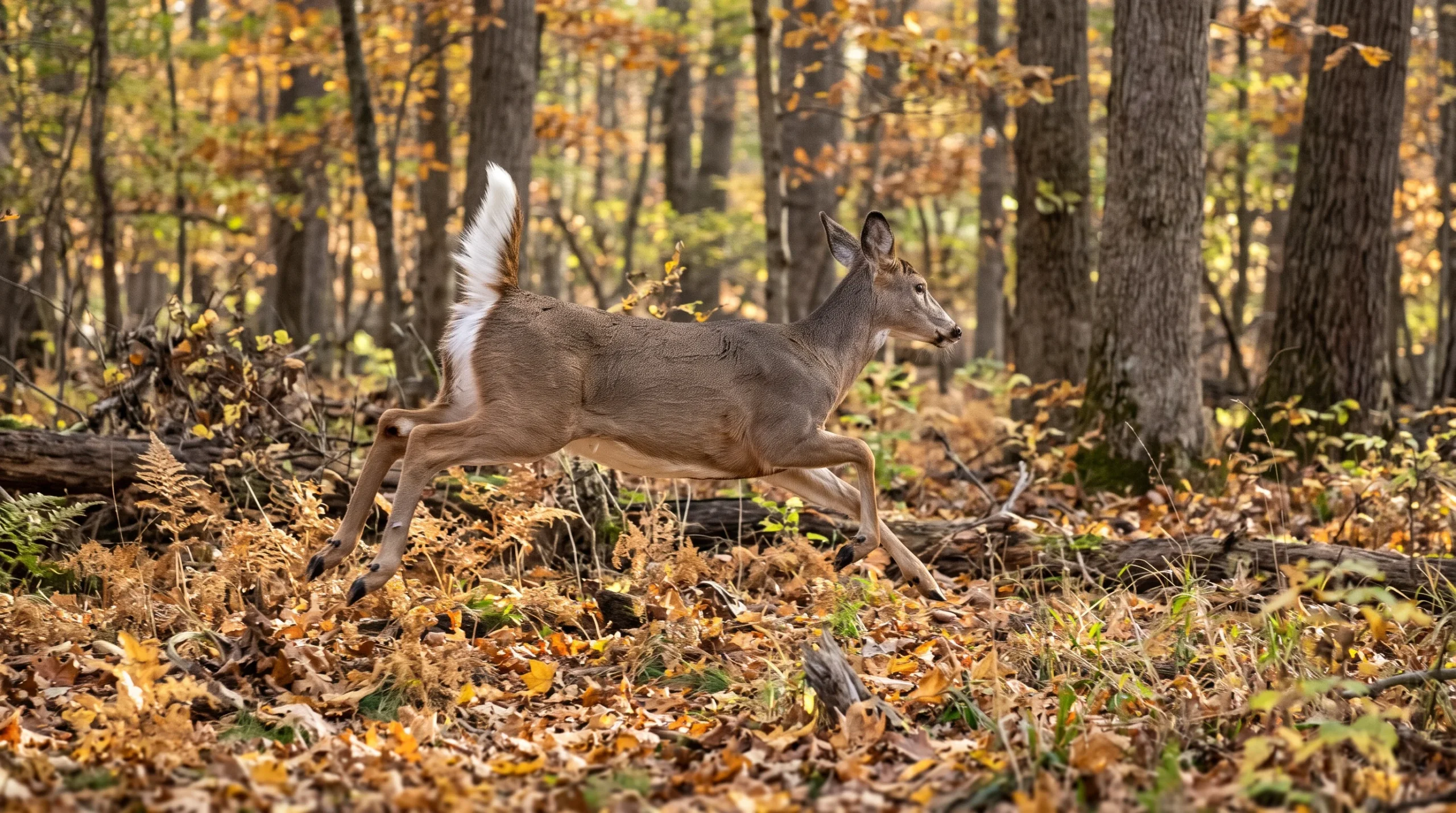
A white-tailed deer standing quietly at the edge of a woodland may appear perfectly still, yet its ears, eyes, tail, and posture can reveal a great deal about its surroundings. Deer are observant animals that respond to changes in their environment through a combination of visible movements, sounds, and scent signals.
Understanding deer body language helps wildlife enthusiasts recognize common behaviors, from relaxed feeding to heightened alertness and defensive displays. A raised tail, sudden pause, or change in ear position may provide clues about what an animal is experiencing.
However, deer behavior is rarely explained by a single movement. The same posture can have different meanings depending on the situation, season, and individual animal.
Table of Contents
- Understanding Deer Communication
- Signal 1: Relaxed Deer
- Signal 2: Alert Deer
- Signal 3: Alarmed Deer
- Signal 4: Cautious Deer
- Signal 5: Aggressive Deer
- Signal 6: Fleeing Deer
- How Deer Communicate Through Sounds and Scents
- Deer Body Language Comparison Chart
- Common Mistakes When Reading Deer Behavior
- Tips for Observing Deer in the Wild
- Frequently Asked Questions
Understanding Deer Communication
White-tailed deer communicate through several channels. Their movements and postures provide visible information, while vocalizations and scent marking allow them to communicate in situations where visual signals may be less useful.
For example, a deer may raise its head and direct its ears toward an unfamiliar sound. If it detects a possible threat, it may become motionless, stamp a hoof, or produce an alarm snort.
Social communication also changes throughout the year. During the breeding season, bucks may display more conspicuous postures and scent-marking behavior. Does communicate with their fawns through sounds and close-range interactions.
Many of these behaviors involve specialized physical features. The existing guide to deer anatomy adaptations provides additional background on the structures deer use to interact with their environment.
The most important principle is that individual signals should be interpreted together. Ear position, tail movement, posture, and surrounding circumstances often provide more information collectively than any one movement alone.
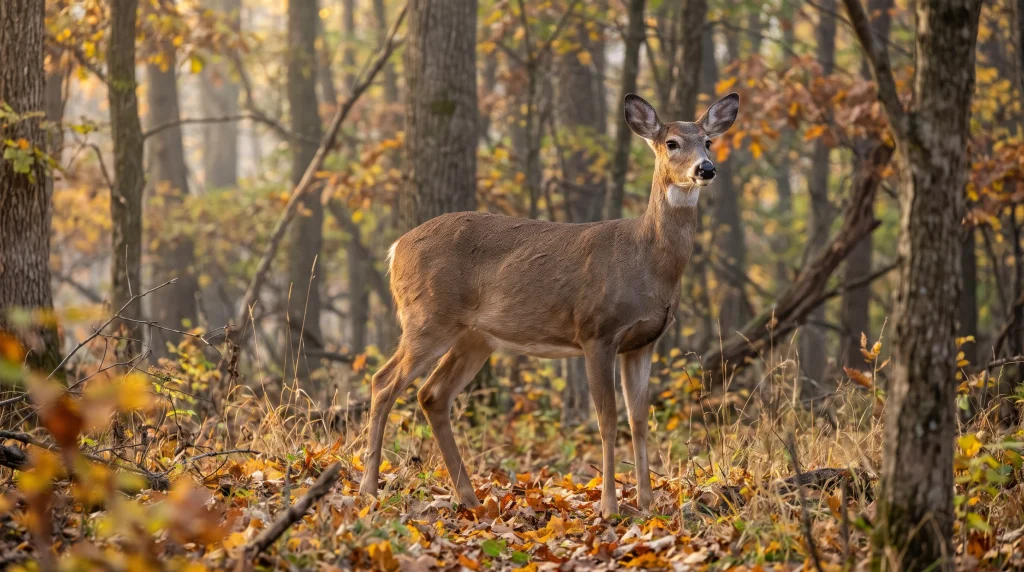
Signal 1: Relaxed Deer
Loose Posture and Natural Movements
A relaxed deer often moves slowly while grazing, browsing, or traveling through familiar surroundings.
Common signs include a lowered head during feeding, an unhurried walking pace, and a tail resting naturally against the body.
Its ears may rotate independently as it monitors nearby sounds. This does not necessarily indicate distress; deer remain attentive even during ordinary activities.
What Relaxed Behavior Can Tell Observers
A deer feeding steadily in an open meadow may have detected no immediate danger. Nearby animals may also continue feeding or resting.
However, relaxed behavior does not mean the animal has stopped monitoring its environment.
A deer can shift from grazing to alertness within seconds. For this reason, observers should watch the animal’s overall behavior rather than assuming that a lowered head always means complete comfort.
Signal 2: Alert Deer
Raised Head and Focused Ears
An alert deer typically raises its head, lengthens its neck, and directs its ears toward a particular sound or movement.
Its body may become more upright as it concentrates on the source of interest.
Sometimes the deer looks directly toward an unfamiliar object. At other times, it turns its ears while keeping its body relatively still.
These behaviors help the animal gather information before deciding what to do next.
Why Deer Suddenly Freeze
Remaining motionless can help a deer assess its surroundings while limiting unnecessary movement.
During a pause, the animal may listen, watch, and sample airborne scents.
A frozen deer is not necessarily terrified. It may simply be investigating something unfamiliar.
The distinction becomes clearer when the observer considers additional signs, such as repeated stamping, alarm snorts, or an abrupt retreat.
Signal 3: Alarmed Deer
The Meaning of a Raised White Tail
One of the most recognizable white-tailed deer behaviors is tail flagging.
When the tail rises, its bright white underside becomes highly visible against darker vegetation.
This display commonly occurs during alarm or escape. Researchers have proposed several possible communication functions, including signaling to other deer or conveying information about the animal’s awareness of danger.
However, tail flagging should not be reduced to one universal explanation. Its meaning may depend on the circumstances.
Hoof Stamping and Alarm Snorts
An alarmed deer may stamp a front hoof, repeatedly focus on a suspicious area, or produce a sharp snorting sound.
These behaviors often accompany heightened vigilance.
A deer may stamp while investigating a possible threat before deciding whether to retreat.
Alarm snorts can also be heard when deer are disturbed. Such sounds may alert nearby animals, although the exact response varies with context.
Observers should interpret these signs as reasons to maintain distance and avoid additional disturbance.
Signal 4: Cautious Deer
Slow Steps and Frequent Pauses
Cautious deer often move with deliberate steps, pausing repeatedly to assess unfamiliar surroundings.
A deer approaching a new object may extend its neck, stop briefly, and shift its head or ears.
Unlike an animal already fleeing, a cautious deer may remain interested in the area while deciding whether it is safe to continue.
How Deer Assess Their Surroundings
Deer combine information from sight, hearing, and smell.
A deer investigating an unfamiliar scent may pause, change direction, or move toward a position where the wind provides additional information.
Cautious behavior can gradually develop into relaxed movement if the animal detects no immediate danger.
Alternatively, it may become alarmed and retreat.
This illustrates why deer communication is best understood as a changing sequence of behaviors rather than a collection of fixed poses.
Signal 5: Aggressive Deer
Flattened Ears and Tense Posture
Aggressive deer may display stiff movements, backward-held ears, a lowered or extended head, and a tense body posture.
In some situations, the hair along parts of the body may appear raised.
These signs are most informative when they occur together during a confrontation.
Backward-facing ears alone are not sufficient evidence of aggression because deer regularly move their ears to monitor sounds.
Aggressive Communication During the Rut
During the autumn breeding season, known as the rut, bucks may compete for access to receptive females.
Their interactions can include threatening postures, parallel walking, antler displays, and physical clashes.
Not every encounter becomes a fight. Displays may allow competing animals to assess one another before escalating.
Does can also show defensive or aggressive behavior, particularly during social disputes or when protecting young.
Wild deer should never be approached, challenged, or encouraged to interact with people. Even animals that appear calm can react unpredictably.
Signal 6: Fleeing Deer
Rapid Acceleration and Bounding
When a deer decides to escape, its behavior changes dramatically.
It may accelerate rapidly, make powerful bounds, and change direction while moving toward protective cover.
The route depends on the terrain, nearby vegetation, and the location of the perceived threat.
Some deer flee immediately, while others pause briefly before moving.
Why Deer Raise Their Tails While Running
White-tailed deer frequently expose the white underside of their tails during escape.
The conspicuous display may convey information to other deer, but scientists have investigated multiple possible functions.
Not every fleeing deer raises its tail, and the display does not always occur in the same way.
For wildlife observers, the most useful interpretation is practical: rapid movement combined with an elevated tail often indicates that the animal is responding to a disturbance.
Maintaining distance helps reduce the likelihood of repeated escape behavior.
How Deer Communicate Through Sounds and Scents
Visible movements are only part of deer communication. White-tailed deer also exchange information through vocalizations and chemical signals.
Vocal Communication
Deer produce several recognizable sounds.
Alarm snorts are forceful sounds commonly associated with perceived danger. They may occur alongside stamping, staring, and other vigilance behaviors.
Grunts are used during social interactions. Bucks may grunt while following does during the breeding season, while other grunts serve different communication purposes.
Bleats are especially associated with does and fawns. Young deer may vocalize to maintain contact with their mothers or when distressed.
Bucks can also produce snort-wheezes during threatening encounters with other males.
The Missouri Department of Conservation’s guide to deer communication describes these vocalizations alongside visual displays and scent signals. Missouri Department of Conservation
Scent Communication
Deer rely heavily on chemical communication, particularly during the breeding season.
Several scent-producing structures contribute to this behavior:
- Tarsal glands: Located on the hind legs, these are involved in scent communication, especially during breeding-season rub-urination.
- Preorbital glands: Found near the eyes, these can contribute scent during contact with vegetation.
- Forehead glands: Bucks deposit scent when rubbing their heads and antlers against trees.
- Scrapes: Bucks paw the ground and may deposit urine and glandular secretions at locations visited by other deer.
These signals can communicate information related to individual identity, reproductive condition, and social activity.
Scent communication also allows information to remain in an area after the animal has moved away.
Deer Body Language Comparison Chart
The following chart summarizes six commonly observed behavioral states. These are useful descriptions rather than rigid categories, and deer may show several signals simultaneously.
| Signal | Visible Behavior | Possible Interpretation |
|---|---|---|
| Relaxed | Loose posture, steady grazing, natural walking | No immediate threat detected |
| Alert | Raised head, focused ears, sudden stillness | Investigating an unfamiliar stimulus |
| Alarmed | Raised tail, hoof stamping, snorting | Responding to possible danger |
| Cautious | Slow steps, frequent pauses, attentive posture | Assessing unfamiliar surroundings |
| Aggressive | Stiff posture, backward ears, threatening movements | Social competition or defensive behavior |
| Fleeing | Rapid running, bounding, movement toward cover | Escaping a perceived threat |
Important: Individual deer may behave differently depending on their age, experience, surroundings, and social situation. A single gesture should never be treated as definitive proof of a particular emotional state.
Common Mistakes When Reading Deer Behavior
1. Assuming Every Raised Tail Means Immediate Escape
A raised tail frequently accompanies alarm, but it does not guarantee that a deer will flee immediately.
Tail position can change as the animal assesses a situation. Research also indicates that tail flagging may serve more than one communication function. journals.uchicago.edu
2. Treating Every Motionless Deer as Frightened
Deer sometimes freeze to investigate unfamiliar sounds or movements.
Remaining still may help them gather information before deciding whether to continue feeding or move away.
3. Confusing Cautious Behavior With Aggression
Slow movement, an extended neck, and frequent pauses may indicate investigation rather than hostility.
Aggressive behavior is more convincingly suggested by combinations of threatening postures and direct social confrontation.
4. Interpreting Ear Position Alone
Deer rotate their ears constantly.
Backward-facing ears can occur during ordinary listening as well as during tense interactions. Observers should consider the entire body posture.
5. Assuming All Deer Behave Identically
Behavior varies with age, season, habitat, social relationships, and previous experiences.
A doe accompanied by fawns may react differently from a solitary buck. Deer accustomed to human activity may also respond differently from animals in remote habitats.
Recognizing these differences helps prevent oversimplified interpretations.
Tips for Observing Deer in the Wild
Observing deer responsibly allows people to appreciate their behavior while minimizing disturbance.
Maintain a respectful distance. Use binoculars or a telephoto lens instead of approaching for a closer photograph.
Remain quiet and predictable. Sudden movements and unexpected noises may interrupt feeding or resting behavior.
Watch for changes in posture. Repeated staring, stamping, or retreating can indicate that an animal is responding to your presence.
Give deer room to move. Avoid blocking trails, escape routes, or access to protective vegetation.
Keep pets under control. Dogs can disturb wildlife even when they appear playful or friendly.
Respect sensitive seasons. Give additional space to does with fawns and to deer engaged in breeding-season interactions.
Follow local regulations. Wildlife-viewing rules vary among parks, refuges, and other protected areas.
The National Park Service wildlife-watching guidelines recommend observing animals from a distance and using binoculars or zoom lenses. An animal changing its behavior because of an observer is a useful indication that additional distance is needed. National Park Service
Frequently Asked Questions
What does it mean when a deer raises its tail?
When a white-tailed deer raises its tail, the bright white underside becomes conspicuous. This commonly occurs during alarm or escape. The display may communicate information to nearby deer or serve other antipredator functions. Researchers have proposed several explanations, so the meaning should be interpreted alongside the animal’s movements and surrounding circumstances.
Why do deer stomp their feet?
Deer may stamp a front hoof when investigating a suspicious sound, scent, or movement. Stamping often accompanies heightened vigilance and may occur with staring, head movements, or snorting. It can provide information to nearby deer, but the behavior does not always indicate that the animal is about to flee.
What does it mean when a deer stares at you?
A deer staring directly toward a person may be trying to identify an unfamiliar presence. It may remain motionless while gathering visual, auditory, and scent information. Staring alone does not establish whether the animal is frightened, curious, or preparing to escape. Additional behavioral signals provide a more reliable interpretation.
How can you tell when a deer is relaxed?
Relaxed deer commonly display loose posture, steady feeding, unhurried walking, and naturally positioned tails. Their ears may continue rotating as they monitor nearby sounds. These behaviors suggest that no immediate threat has been detected, although deer remain attentive to their surroundings even while grazing or resting.
Why do deer flatten their ears?
Backward-held or flattened ears may appear during threatening social encounters, especially when accompanied by stiff posture and confrontational movements. However, deer also move their ears to locate sounds. Ear position alone is therefore an unreliable indicator of aggression. Observers should evaluate the animal’s posture, movement, and social context.
How do deer communicate with each other?
White-tailed deer communicate through visual displays, vocalizations, scent marking, and physical interactions. Tail movements and body posture can provide visible signals, while grunts, bleats, and snorts occur in different social situations. Scent deposits also communicate information, particularly during breeding-season activity. These methods often work together.
Why do deer freeze when they detect movement?
Freezing allows a deer to remain relatively inconspicuous while assessing an unfamiliar stimulus. During this pause, it may direct its ears, watch for additional movement, and gather scent information. The animal may eventually resume normal activity, investigate further, or retreat, depending on what it detects.
Conclusion
Understanding deer body language provides a valuable perspective on the everyday lives of white-tailed deer.
Relaxed feeding, alert postures, alarm displays, cautious movements, aggressive interactions, and rapid escape behaviors all reveal aspects of the way deer respond to their surroundings.
Yet these six behavioral states should not be interpreted as a fixed dictionary. The meaning of a raised tail, a sudden pause, or a backward ear position depends on the circumstances and the other signals displayed.
Deer also communicate through vocalizations and scent marking, creating a complex system that supports social interactions and responses to potential danger.
For wildlife enthusiasts, patient observation is the most useful approach. Watching from a respectful distance makes it easier to recognize natural behavior while allowing deer to continue their activities without unnecessary disturbance.
External Sources
- Missouri Department of Conservation — Deer Dialogue. An overview of visual communication, vocalizations, and scent-marking behavior in white-tailed deer.
- Missouri Department of Conservation — Ways of the Whitetail. Educational information about deer sounds, scent communication, tail movements, and behavior.
- Keith L. Bildstein (1983) — Why White-Tailed Deer Flag Their Tails. The American Naturalist, 121(5), 709–715. Peer-reviewed research examining hypotheses about tail-flagging behavior.