
Naked Mole-Rat Without Oxygen: How It Survives 18 Minutes
How can a naked mole-rat without oxygen survive for 18 minutes when most mammals cannot? In a remarkable laboratory experiment published in Science in 2017, researchers discovered that naked mole-rats can survive temporary oxygen deprivation through unusual metabolic adaptations.
Unlike most mammals, naked mole-rats can use a specialized fructose-based pathway to help vital tissues produce limited energy when oxygen disappears. Their bodies also dramatically reduce physiological activity, helping them survive until oxygen returns.
This extraordinary ability has attracted scientific attention because it reveals a previously underappreciated survival strategy in mammals. Understanding how naked mole-rats tolerate oxygen deprivation may also provide valuable insights into cellular metabolism and tissue protection.
Table of contents
- The Naked Mole-Rat
- How Long Can a Naked Mole-Rat Survive Without Oxygen?
- The Extraordinary Secret: Fructose Metabolism
- Life Underground: An Environment With Limited Oxygen
- Five More Extraordinary Naked Mole-Rat Adaptations
- Naked Mole-Rat vs. Ordinary Mammals
- Frequently Asked Questions
- Conclusion
The Naked Mole-Rat
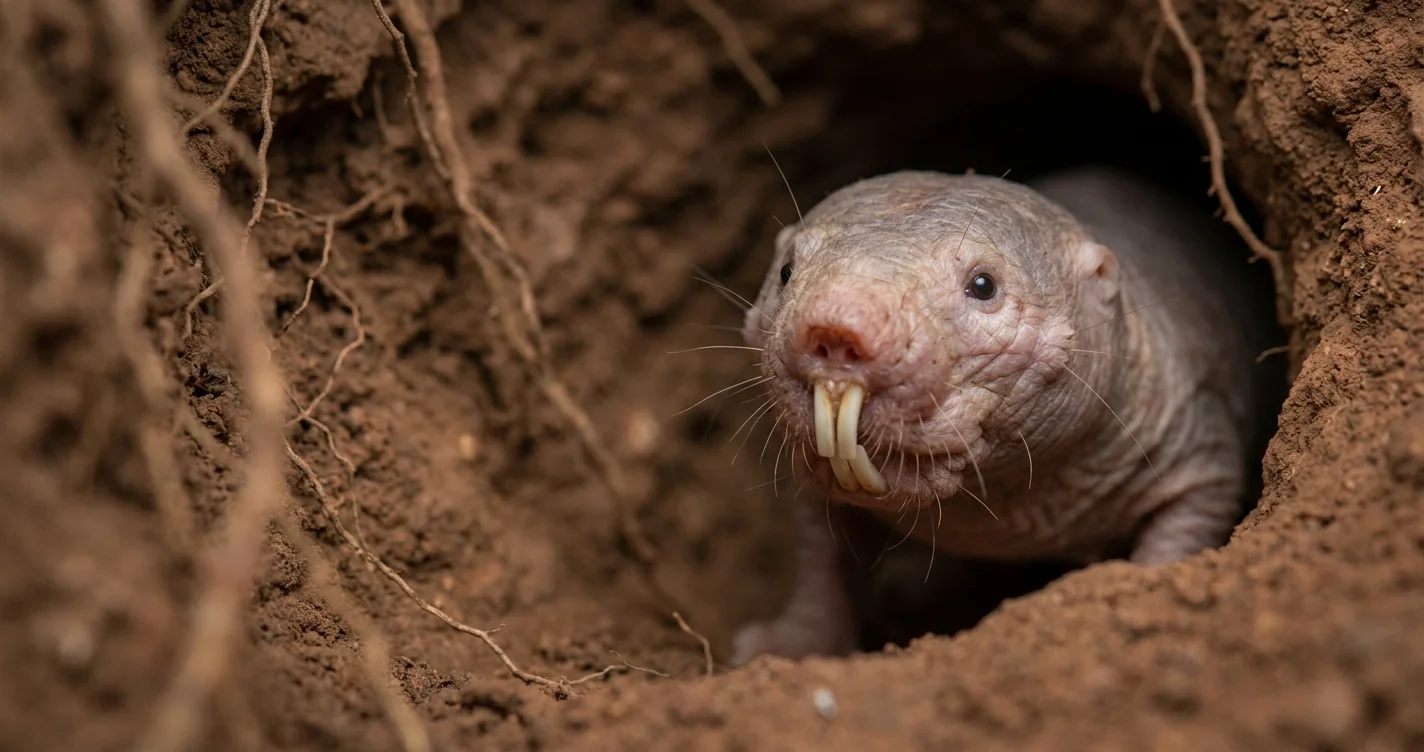
The naked mole-rat (Heterocephalus glaber) is a small subterranean rodent native to East Africa, including parts of Ethiopia, Kenya, and Somalia.
Despite its name, it is neither completely naked nor closely related to ordinary rats. Its pinkish-gray skin carries scattered sensory hairs, and its unusual body shape reflects a life spent almost entirely underground.
Its most recognizable features include powerful protruding incisors, tiny eyes, short legs, and a cylindrical body. The teeth are particularly important: naked mole-rats use them to excavate tunnels through compacted soil.
Their lips can close behind the incisors, helping keep dirt out of the mouth while digging.
Naked mole-rats are famous for their highly organized colonies.
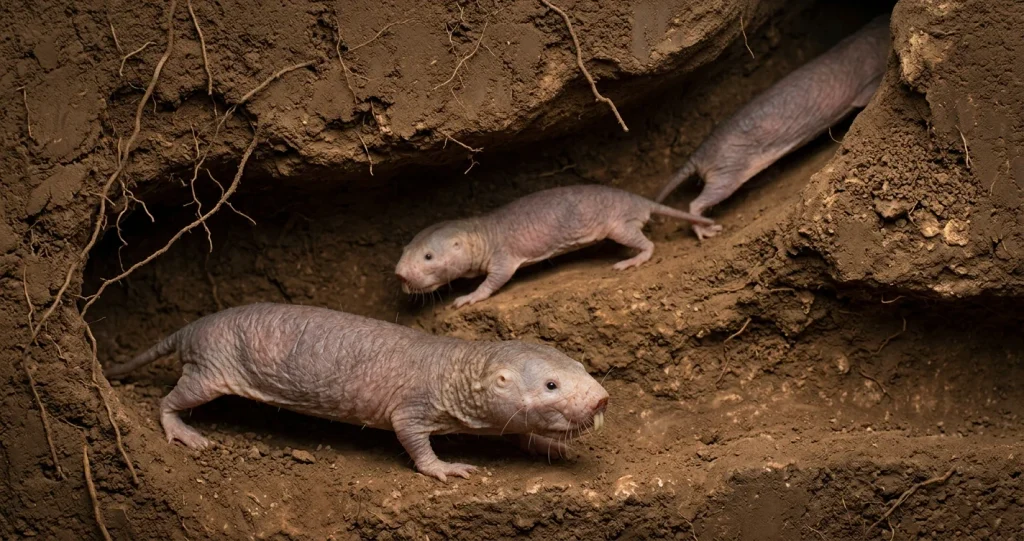
A colony generally contains one primary breeding female, commonly called the queen, along with breeding males and numerous nonbreeding members. Other colony members participate in digging, gathering food, maintaining tunnels, and defending the group.
This reproductive division of labor is often described as eusociality, a form of social organization more commonly associated with ants, bees, and termites.
Their underground networks contain interconnected passages, nesting areas, and food-storage spaces. Colonies feed mainly on underground plant parts, particularly roots and tubers.
Living in large groups inside enclosed tunnels creates a special physiological challenge: maintaining adequate oxygen while carbon dioxide accumulates.
That challenge helps explain the extraordinary adaptations scientists have discovered in these animals.
How Long Can a Naked Mole-Rat Survive Without Oxygen?
The famous 18-minute finding comes from a study led by Thomas Park and colleagues, published in Science in April 2017.
Researchers compared naked mole-rats with laboratory mice under experimentally controlled oxygen conditions.
The results were striking.
Naked mole-rats tolerated an atmosphere containing just 5% oxygen for five hours under the reported experimental conditions. Ordinary laboratory mice exposed to this severe hypoxia died much sooner.
The researchers also investigated complete oxygen deprivation, known as anoxia.
When oxygen was removed entirely, naked mole-rats rapidly lost consciousness and their physiological activity became profoundly suppressed. Nevertheless, animals exposed for 18 minutes recovered after oxygen was restored.
The comparison mice could not survive even much shorter periods of complete anoxia under the study conditions.
Hypoxia vs. Anoxia: An Important Difference
These terms describe different physiological situations.
Hypoxia means oxygen is present but insufficient for normal tissue requirements. It can occur at high altitude, in poorly ventilated environments, or during certain medical conditions.
Anoxia refers to the absence of available oxygen.
Both conditions threaten animals that depend heavily on oxygen-driven energy production, but complete anoxia presents a particularly severe challenge.
The 18-minute result therefore demonstrates an extraordinary short-term survival capacity. It does not establish that naked mole-rats can remain conscious, active, or healthy indefinitely without oxygen.
Their ability to recover is what makes the experiment so important.
The Extraordinary Secret: Fructose Metabolism
The naked mole-rat’s oxygen tolerance is not explained by a single unusual organ.
Instead, researchers discovered an important difference in the way its cells can process energy.
How Most Mammals Produce Energy
Most mammalian cells depend heavily on oxygen to generate large amounts of adenosine triphosphate, or ATP.
ATP is the molecule that powers essential cellular processes, including muscle contraction, nerve signaling, and the maintenance of electrical gradients across cell membranes.
Under normal conditions, cells break down glucose through glycolysis and additional metabolic reactions. Mitochondria then use oxygen to support highly efficient ATP production.
When oxygen becomes unavailable, mitochondrial energy production is severely disrupted.
Cells can still obtain some ATP through anaerobic glycolysis, but the amount is limited. As metabolic conditions change, conventional glucose metabolism can become increasingly constrained.
The brain and heart are especially vulnerable because they require a continuous energy supply to maintain normal function.
Without adequate ATP, essential cellular processes begin to fail. Prolonged deprivation can cause irreversible injury.
How Naked Mole-Rats Use Fructose
The 2017 study identified an unusual alternative.
Under anoxic conditions, naked mole-rats can increase their use of fructose-driven glycolysis, allowing certain tissues to maintain limited energy production.
Fructose is a simple sugar commonly associated with fruit, but its importance here has little to do with the animal’s diet.
Instead, the discovery concerns how fructose can enter cellular metabolic pathways.
The researchers identified two particularly important molecular features: the fructose transporter GLUT5 and the enzyme ketohexokinase.
GLUT5 helps transport fructose into cells, while ketohexokinase participates in its metabolism.
In naked mole-rats, the distribution and activity of this machinery help support fructose utilization in tissues where it is especially important during oxygen deprivation.
Crucially, fructose metabolism can bypass a regulatory bottleneck involving phosphofructokinase, an enzyme that normally helps control glucose-based glycolysis.
This alternative route allows glycolytic ATP production to continue under conditions that would severely compromise ordinary mammalian tissues.
The researchers also found evidence of fructose accumulation and conversion into lactate in the brain during anoxia.
What Happens to the Brain and Heart?
Surviving without oxygen requires more than finding an alternative fuel.
The animal must also reduce its energy demands.
During complete anoxia, naked mole-rats enter a profoundly suppressed physiological state. Normal activity ceases, and cardiac function slows dramatically.
This reduction in energy demand is important because fructose-driven anaerobic metabolism cannot produce the same amount of ATP as normal oxygen-dependent respiration.
The brain and heart therefore benefit from two complementary responses: reduced energy consumption and continued limited energy production.
Laboratory investigations of naked mole-rat tissues support the importance of fructose metabolism in protecting these oxygen-sensitive organs.
However, scientists are still investigating how these processes interact, how long protection can be maintained, and which mechanisms are most important under different conditions.
The animal’s unusual survival ability is better understood as a coordinated physiological response than as a simple switch from one sugar to another.
Life Underground: An Environment With Limited Oxygen
Naked mole-rats spend their lives in underground tunnel systems where fresh air circulation can be restricted.
Unlike surface-dwelling mammals, they cannot simply move into open air whenever atmospheric conditions become unfavorable.
Large colonies consume oxygen through respiration while releasing carbon dioxide. Soil composition, tunnel structure, ventilation, and colony activity all influence the conditions inside burrows.
As a result, underground environments can present episodes of reduced oxygen availability and elevated carbon dioxide concentrations.
Over evolutionary time, these conditions have helped shape naked mole-rat physiology.
Their adaptations include a comparatively low metabolic rate, unusual responses to oxygen deprivation, and tolerance of conditions that would be stressful for many surface-dwelling rodents.
The species also possesses distinctive sensory and behavioral adaptations suited to darkness, underground movement, and group living.
However, an important distinction remains: the 18-minute anoxia experiment does not mean naked mole-rats routinely experience 18 minutes of zero oxygen in their natural burrows.
The laboratory study tested the limits of their physiology. Their actual underground environment is variable, and extreme laboratory conditions should not automatically be treated as normal wild conditions.
Five More Extraordinary Naked Mole-Rat Adaptations
Surviving oxygen deprivation is only one part of the naked mole-rat’s remarkable biology. Scientists also study these rodents because they display several unusual traits involving aging, reproduction, pain perception, temperature regulation, and cancer resistance.
1. They Can Live for More Than 30 Years
For a mouse-sized rodent, a lifespan exceeding three decades is extraordinary.
A 2018 study published in eLife examined historical records from more than 3,000 naked mole-rats. Researchers found that their observed mortality risk did not increase with age in the familiar pattern seen in many other mammals.
This challenged conventional expectations about mammalian aging.
However, the findings do not prove that naked mole-rats never age. Scientists have questioned how confidently the available data can establish mortality patterns at the oldest ages.
The strongest conclusion is that naked mole-rats are exceptionally long-lived rodents with unusually slow or delayed age-associated changes.
2. Their Colonies Have Queens and Workers
Naked mole-rats exhibit one of the most unusual social systems among mammals.
Typically, one dominant female produces most of the colony’s offspring, while other members remain nonbreeding.
Workers cooperate in maintaining tunnels, obtaining food, and defending the colony.
This organization resembles certain social insects, although naked mole-rat societies have their own distinctive biological and behavioral characteristics.
Their reproductive system is flexible: nonbreeding individuals can become breeders when social conditions change.
3. They Respond Differently to Certain Painful Stimuli
Naked mole-rats are sometimes described as animals that cannot feel pain, but this is inaccurate.
Research shows that they have reduced sensitivity to certain chemical stimuli, including acid and capsaicin, the compound responsible for the burning sensation of chili peppers.
They also lack some forms of heat-pain sensitization associated with inflammation.
A 2016 study identified unusual signaling properties of their TrkA receptor, which helps explain this reduced sensitivity.
Nevertheless, naked mole-rats respond to other potentially harmful stimuli. They are not universally pain-free.
4. They Regulate Body Temperature Unusually
Most mammals maintain a relatively stable internal temperature across a broad range of environmental conditions.
Naked mole-rats have a more limited ability to do so.
Their sparse fur, relatively low metabolic rate, and dependence on warm underground environments influence how they manage body heat.
They also use behavioral strategies, including gathering together in groups, to reduce heat loss.
Their thermoregulation is more complex than simply describing them as cold-blooded. They possess mammalian heat-producing mechanisms but regulate temperature effectively over a narrower environmental range than many other mammals.
5. Their Cells Show Unusual Cancer Resistance
Naked mole-rats have attracted considerable attention because cancer appears to be uncommon in this species.
In 2013, researchers reported that naked mole-rat tissues contain unusually large molecules of hyaluronan, a substance involved in the extracellular matrix surrounding cells.
Experiments suggested that this high-molecular-mass hyaluronan contributes to resistance against certain forms of cellular transformation associated with cancer.
However, naked mole-rats are not completely immune to cancer. Cases have been documented, and researchers continue investigating the different mechanisms involved in their apparent resistance.
Their biology offers valuable research opportunities, but it does not provide a ready-made cancer treatment.
Naked Mole-Rat vs. Ordinary Mammals
The following comparison highlights how naked mole-rats differ from many familiar surface-dwelling rodents. Mammalian physiology varies considerably among species.
| Biological feature | Naked mole-rat | Typical laboratory mouse |
|---|---|---|
| Oxygen tolerance | Survived 18 minutes of anoxia in laboratory experiments | Could not survive comparable prolonged anoxia |
| Energy metabolism | Can use specialized fructose-driven glycolysis during anoxia | Primarily relies on conventional glucose-based pathways |
| Habitat | Underground colonies in East Africa | Surface and sheltered terrestrial habitats |
| Thermoregulation | Limited temperature regulation over a broad ambient range | Maintains body temperature across a wider range |
| Longevity | Can exceed 30 years | Usually lives only a few years |
These differences reflect distinct evolutionary adaptations rather than a simple hierarchy of biological superiority.
Frequently Asked Questions
1. Can naked mole-rats really survive without oxygen?
Yes. Controlled laboratory experiments demonstrated that naked mole-rats can survive a temporary period of complete oxygen deprivation. Their survival involves profound physiological suppression and specialized metabolic responses. They cannot live permanently without oxygen.
2. How long can a naked mole-rat survive without oxygen?
The widely reported finding is 18 minutes of complete anoxia, documented in a 2017 study. The animals recovered when oxygen was restored. This result describes specific experimental conditions, not a guaranteed survival limit in every situation.
3. How do naked mole-rats use fructose?
They possess specialized metabolic machinery that allows fructose to enter energy-producing pathways. During anoxia, fructose-driven glycolysis helps certain tissues maintain limited ATP production despite the absence of oxygen.
4. Can naked mole-rats breathe underground?
Yes. Naked mole-rats breathe air using lungs, like other mammals. Their tunnel systems contain air, although oxygen levels can become reduced and carbon dioxide can accumulate. They possess physiological adaptations that help them tolerate these challenging conditions.
5. Are naked mole-rats immune to cancer?
No. Naked mole-rats display unusual resistance to cancer, but they are not completely immune. Research has identified several potentially protective cellular mechanisms, including high-molecular-mass hyaluronan.
6. Could naked mole-rat research help human medicine?
Potentially. Their unusual metabolism, longevity, and resistance to certain forms of cellular damage provide valuable research models. However, discoveries in naked mole-rats require extensive additional investigation before they can inform safe and effective human treatments.
Conclusion:
The naked mole-rat may appear unusual because of its nearly hairless skin, protruding teeth, and underground lifestyle. Yet its most extraordinary features are hidden inside its cells.
In controlled experiments, this small East African rodent survived 18 minutes without oxygen, recovering through a combination of physiological suppression and unusual energy metabolism.
Its ability to use fructose during anoxia reveals how evolution can reshape fundamental biological processes to meet the demands of extreme environments.
Combined with exceptional longevity, specialized sensory responses, and remarkable social behavior, this makes the naked mole-rat one of the most fascinating mammals studied by modern biology.
Its greatest scientific lesson is not that mammals can live without oxygen. It is that the limits of mammalian survival are more diverse than scientists once imagined.