
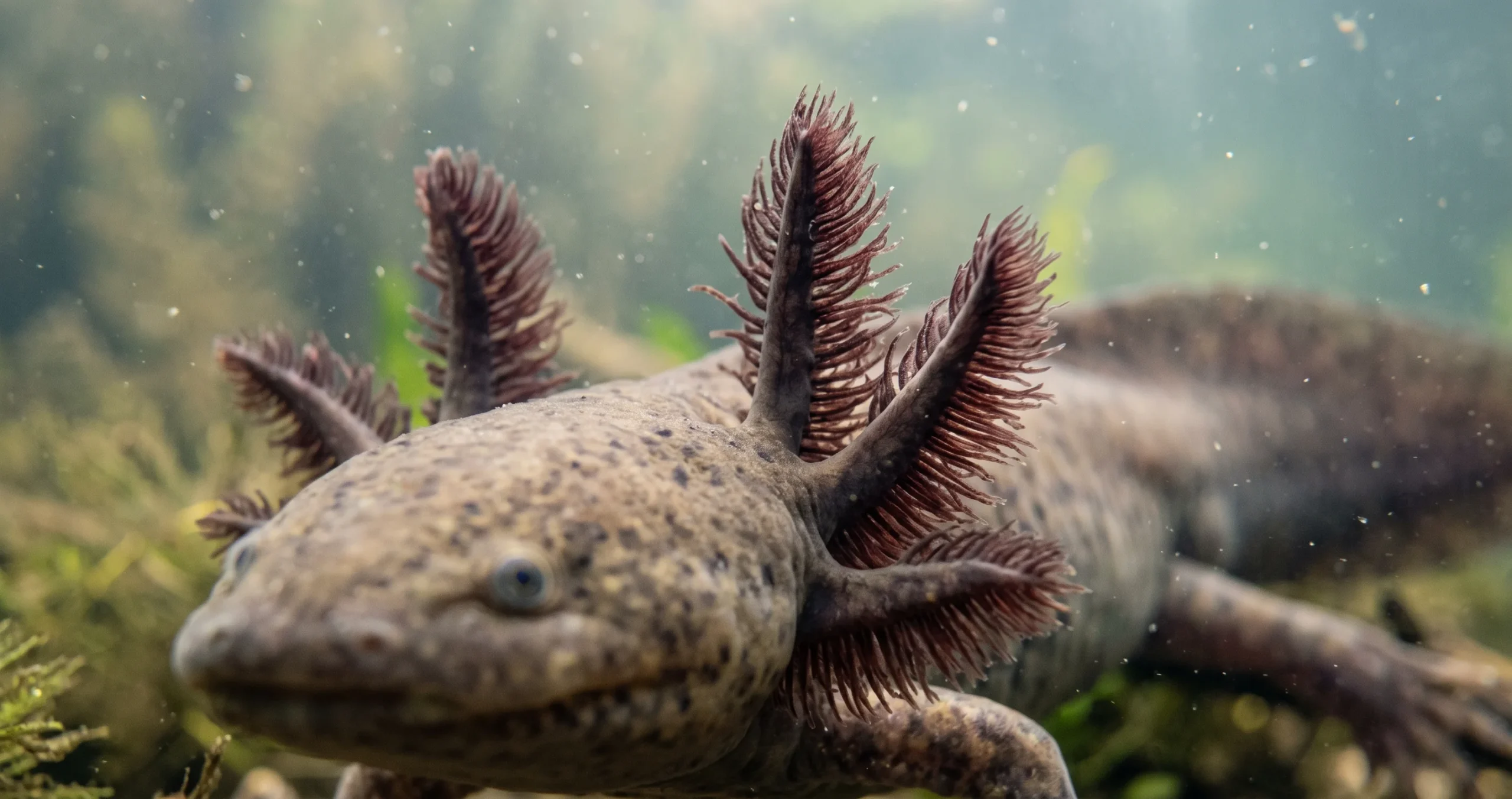
Most salamanders begin life in water with gills and later transform into adults better equipped for life on land. Mudpuppies take a very different path. The striking mudpuppy external gills visible behind the head remain throughout the animal’s entire life, giving adults an appearance that resembles an oversized salamander larva.
This is not a developmental mistake. Mudpuppies (Necturus maculosus) are permanently aquatic salamanders whose biology is adapted to life underwater. Their feathery, reddish gills provide a large respiratory surface for exchanging gases with the surrounding water. Even as mudpuppies become sexually mature adults, they retain several characteristics associated with aquatic juvenile salamanders.
Scientists describe this retention of juvenile traits into adulthood as paedomorphosis, with neoteny commonly used when discussing the persistence of larval characteristics. The result is one of North America’s most distinctive freshwater amphibians.
Table of Contents
- What Is a Mudpuppy?
- Why Mudpuppies Keep Their Gills
- What Neoteny Means in Amphibians
- How Mudpuppy External Gills Work
- Why the Gills Look Like Feathery Branches
- Do Mudpuppies Have Lungs?
- Why Permanent Aquatic Life Can Be an Advantage
- How Evolution Shaped the Mudpuppy
- Where Mudpuppies Live
- What Mudpuppies Eat
- Reproduction and Life Cycle
- Mudpuppies and Freshwater Ecosystems
- Threats and Conservation
- Frequently Asked Questions
- Conclusion
What Is a Mudpuppy?
The common mudpuppy, Necturus maculosus, is a large aquatic salamander native to North America.
Unlike many familiar salamanders, mudpuppies do not spend part of their adult lives walking through forests or hiding beneath terrestrial logs.
They remain underwater.
Mudpuppies inhabit freshwater environments including rivers, streams, lakes, and some ponds. They often shelter beneath rocks, logs, vegetation, or other underwater cover during the day.
Adults commonly reach around 8 to 13 inches in length, although larger individuals occur.
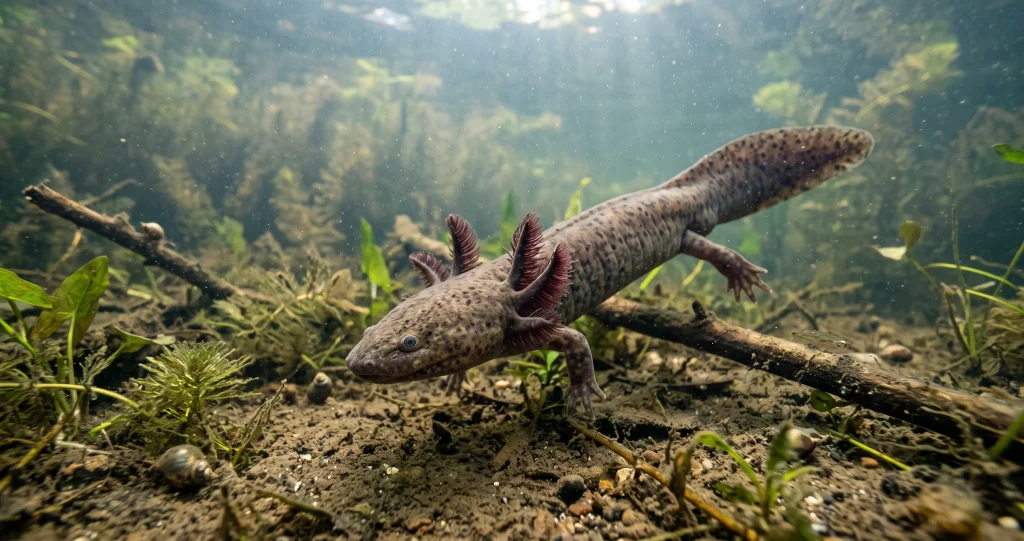
Their bodies are generally brownish, grayish, or rusty with darker spots. They possess relatively small eyes, four toes on each foot, a laterally compressed swimming tail, and their most recognizable feature: large reddish gills projecting from either side of the head.
Those gills are not temporary.
They stay.
Why Mudpuppies Keep Their Gills
To understand the unusual mudpuppy external gills, it helps to compare a mudpuppy with a more typical amphibian life cycle.
Many salamanders hatch as aquatic larvae.
The larvae possess external gills that extract oxygen from water. During metamorphosis, their bodies change dramatically. The gills may disappear, the skin and respiratory system change, and the animal becomes capable of living primarily or partly on land.
Mudpuppies follow a different developmental pathway.
Members of the family Proteidae remain paedomorphic and fully aquatic as adults. They do not undergo the same complete metamorphosis that eliminates the larval external gills in many other salamanders.
The mudpuppy grows larger.
It becomes sexually mature.
It reproduces.
But it retains its aquatic body plan.
The adult therefore looks somewhat like a giant salamander larva even though it is a fully mature animal.
What Neoteny Means in Amphibians
The term neoteny is often used to explain animals such as mudpuppies and axolotls.
More broadly, biologists use paedomorphosis to describe adults that retain characteristics associated with an ancestral juvenile stage.
Neoteny is technically one developmental mechanism that can produce paedomorphosis, involving slower development of certain physical traits relative to reproductive maturation.
For a general wildlife audience, the important idea is straightforward:
The mudpuppy becomes an adult without losing several larval features.
External gills are the most obvious example.
The tail also remains adapted for swimming, reinforcing the mudpuppy’s permanently aquatic lifestyle.
This differs dramatically from salamanders that undergo metamorphosis and move between aquatic and terrestrial environments.
Mudpuppies never need to abandon their underwater respiratory equipment because they never abandon the water.
How Mudpuppy External Gills Work
The feathery structures beside a mudpuppy’s head are respiratory organs.
Each gill contains numerous branching filaments.
That branching arrangement increases the amount of surface area exposed to water.
This matters because respiratory gas exchange occurs across these surfaces.
Water contains dissolved oxygen. As water contacts the gills, oxygen can move into the mudpuppy’s blood while carbon dioxide moves in the opposite direction.
Blood flowing through the gills transports oxygen to tissues throughout the body.
The principle is similar to aquatic respiration in many other animals, although the anatomy differs considerably among species.
A mudpuppy therefore does not need to repeatedly leave the water to breathe in the same way an air-dependent aquatic animal might.
Its respiratory anatomy is built around remaining submerged.
Why the Gills Look Like Feathery Branches
The dramatic appearance of mudpuppy external gills is directly related to their function.
A smooth stalk would offer relatively little surface area.
Branching the structure into many thin filaments dramatically increases the area where water and blood can come into close contact.
More respiratory surface means greater opportunity for gas exchange.
The gills are richly supplied with blood, which also helps explain their reddish or maroon appearance.
Interestingly, gill size can vary with environmental conditions.
Mudpuppies living in colder, well-oxygenated water may have shorter gills than individuals inhabiting water where oxygen availability is lower.
That makes biological sense.
Where extracting oxygen is more challenging, increased respiratory surface can be advantageous.
Do Mudpuppies Have Lungs?
This is where mudpuppy biology becomes even more interesting.
Common mudpuppies do possess lungs, but they rely heavily on their external gills and other respiratory surfaces while living underwater. U.S. Fish & Wildlife Service research material describes the mudpuppy as fully aquatic and notes that, although it has lungs, respiration relies mainly on external gills.
Amphibians can also exchange gases through their skin.
This ability is known as cutaneous respiration.
Mudpuppies therefore have more than one potential respiratory surface, but their large external gills are particularly conspicuous adaptations to their aquatic existence.
The presence of lungs does not mean they are preparing to become terrestrial adults.
They remain aquatic throughout life.
Why Permanent Aquatic Life Can Be an Advantage
At first glance, failing to complete the familiar salamander transformation might sound limiting.
Evolution does not work toward a predetermined goal, however.
A developmental pathway persists when it functions successfully enough within the ecological conditions experienced by a population.
For mudpuppies, remaining aquatic provides access to an environment filled with shelter and prey.
A mudpuppy does not need to transform into a terrestrial salamander if its entire life cycle can be completed underwater.
Adults feed underwater.
Courtship occurs underwater.
Eggs are laid underwater.
Young develop underwater.
There is no required terrestrial phase.
Maintaining aquatic adaptations therefore makes ecological sense.
Why Did Mudpuppy External Gills Persist Through Evolution?
It is tempting to ask why evolution did not “finish” the mudpuppy’s metamorphosis.
That framing misunderstands evolution.
Evolution has no final adult design that every salamander is supposed to reach.
Mudpuppies belong to a lineage in which paedomorphic, permanently aquatic characteristics became established.
If animals can survive and reproduce successfully while retaining external gills, natural selection does not require those structures to disappear simply because other salamanders lose theirs.
The mudpuppy’s body represents a successful alternative life-history strategy.
Instead of dividing life between water and land, it specializes in freshwater.
Its respiratory system, sensory biology, feeding behavior, reproduction, and movement all operate within that aquatic world.
Mudpuppies Are Built for the Bottom
Mudpuppies spend much of their time near the bottoms of lakes, rivers, and streams.
They commonly walk along the substrate using their four limbs rather than continuously swimming through open water.
When swimming is necessary, the flattened tail helps propel the body.
During daylight hours, they often remain hidden beneath rocks, logs, weeds, or submerged structures.
They become more active when searching for prey.
Mudpuppies are generally considered nocturnal, although activity patterns can vary depending on water conditions.
Their relatively small eyes are accompanied by other sensory systems useful underwater.
They can detect water movement and pressure changes, helping them navigate a world where vision may be limited by depth, darkness, vegetation, or sediment.
Where Do Mudpuppies Live?
The common mudpuppy occurs across a broad portion of eastern and central North America.
Its range extends through parts of southern Canada and the United States.
Mudpuppies occupy:
- Rivers
- Streams
- Large lakes
- Ponds in some regions
- Rocky underwater habitats
- Areas containing submerged logs and other cover
Good shelter is important.
Large flat rocks can provide hiding places and reproductive sites. Wisconsin wildlife officials specifically identify large flat-rock microhabitats, riprap, and submerged riverbank cavities among places used by mudpuppies.
Season also influences where individuals are found.
They may use different water depths at different times of year.
Unlike many amphibians in colder regions, mudpuppies can remain active during winter.
What Do Mudpuppies Eat?
Mudpuppies are carnivorous predators.
They feed on a variety of aquatic animals, including crayfish, aquatic insect larvae, worms, snails, small fish, fish eggs, and occasionally other amphibians.
Crayfish can form an important part of their diet.
Rather than being dangerous monsters of the lake bottom, mudpuppies occupy the middle of an aquatic food web.
They consume smaller organisms while also serving as prey for larger predators.
Large fish, water snakes, and wading birds can prey on them.
Their tendency to hide beneath rocks and logs provides both daytime shelter and protection from predators.
Reproduction Happens Entirely Underwater
The mudpuppy’s reproductive cycle provides another demonstration of how thoroughly adapted it is to aquatic life.
Courtship generally takes place underwater, often during fall or winter depending on the population.
The male deposits a packet of sperm called a spermatophore, which the female takes into her cloaca.
Females can store sperm before fertilization and egg laying.
In spring, a female typically uses a sheltered underwater nest site beneath a rock, log, or similar structure.
Eggs are attached to the underside of the shelter.
The female remains with the eggs during development, providing a form of parental care unusual enough to make this secretive salamander even more interesting.
After hatching, the young remain aquatic.
There is never a point when they must leave the water to complete the life cycle.
A Slow-Growing, Long-Lived Salamander
Mudpuppies do not follow a rapid life-history strategy.
They can take several years to reach sexual maturity and can live for decades.
U.S. Fish & Wildlife Service assessment material describes them as long-lived, slow-growing amphibians, characteristics that also make populations useful for studying freshwater ecosystem health.
Long life has advantages, but slow reproduction can create conservation concerns.
A population that declines rapidly may not recover as quickly as a short-lived species that produces new generations at a much faster rate.
That makes protecting suitable habitat particularly important.
Mudpuppies Have an Unexpected Ecological Partner
One of the strangest relationships involving mudpuppies concerns a freshwater mussel.
The salamander mussel (Simpsonaias ambigua) has a larval stage called a glochidium.
Many freshwater mussels require a vertebrate host during this stage, typically a fish.
The salamander mussel is unusual.
Its known host is the mudpuppy.
The larvae temporarily attach to the mudpuppy’s gills before completing development and dropping into the substrate.
That means the distinctive mudpuppy external gills support not only the salamander’s respiration but also part of another species’ life cycle.
Wisconsin wildlife officials warn that loss of mudpuppies could therefore have serious consequences for the endangered salamander mussel.
It is a striking reminder that conserving one species can protect ecological relationships that are easy to overlook.
Mudpuppies and Freshwater Ecosystem Health
Amphibians can be sensitive to environmental change.
Their permeable skin places them in unusually close physiological contact with their surroundings.
Mudpuppies spend their entire lives in water, potentially exposing them continuously to changes in water quality.
This has led researchers to examine mudpuppies as potential bioindicators of aquatic ecosystem condition.
A U.S. Fish & Wildlife Service assessment in the St. Clair-Detroit River system notes that their fully aquatic lifestyle and longevity make mudpuppies useful organisms for studying water quality and broader ecosystem health.
A healthy mudpuppy population does not provide a complete water-quality test by itself.
But changes in populations can contribute valuable information when combined with chemical monitoring and studies of other organisms.
Threats Facing Mudpuppies
The common mudpuppy remains widespread, but populations face pressures in parts of their range.
Important threats can include:
Water Pollution
Because mudpuppies remain aquatic and possess permeable skin, contaminants entering waterways can create problems.
Sedimentation
Excess sediment can alter the spaces beneath rocks and other structures that mudpuppies use for shelter and reproduction.
Sediment can also affect aquatic prey communities and water quality.
Habitat Modification
Changes to shorelines, river channels, dams, development, and removal of underwater cover can alter suitable habitat.
Accidental Capture
Mudpuppies are sometimes caught by anglers.
Unfortunately, myths have historically caused some people to kill them unnecessarily.
Mudpuppies are not poisonous, and there is no good reason to treat an accidentally caught animal as a threat.
Conserving Mudpuppies Means Protecting Waterways
Protecting mudpuppies is closely connected to protecting freshwater habitat.
Healthy rivers and lakes need more than clean-looking water.
They require appropriate oxygen conditions, natural substrate, underwater shelter, functioning food webs, and protection from excessive pollution and sediment.
Conservation agencies monitor mudpuppy populations in several regions.
Wisconsin, for example, has encouraged the public to report observations to improve knowledge of the species’ distribution.
Mudpuppies are secretive animals, making population trends difficult to detect without dedicated surveys.
Better information helps biologists identify where populations remain healthy and where declines may require closer attention.
Frequently Asked Questions
Why do mudpuppies have external gills?
Mudpuppy external gills allow these permanently aquatic salamanders to extract dissolved oxygen directly from surrounding water. Their branching filaments create a large surface area for gas exchange.
Do mudpuppies lose their gills when they become adults?
No.
Mudpuppies retain external gills throughout life. They become reproductively mature without undergoing the complete metamorphosis that causes many other salamanders to lose their larval gills.
Is a mudpuppy an axolotl?
No.
Both are paedomorphic aquatic salamanders that retain external gills as adults, but they belong to different families and evolutionary lineages.
The common mudpuppy is Necturus maculosus, while the axolotl is Ambystoma mexicanum.
Can mudpuppies breathe air?
Common mudpuppies possess lungs, but they are fully aquatic and rely heavily on external gills for respiration. Gas exchange can also occur across amphibian skin.
Can mudpuppies live on land?
Mudpuppies are permanently aquatic salamanders.
Their normal life cycle takes place underwater, and they should not be treated like terrestrial salamanders.
Are mudpuppies dangerous?
No.
Mudpuppies are not poisonous and pose no meaningful threat to people.
How long do mudpuppies live?
They are relatively long-lived amphibians. Research and wildlife assessments indicate that mudpuppies can survive for decades under suitable conditions.
Where can mudpuppies be found?
Common mudpuppies occur in freshwater habitats across parts of central and eastern North America, including areas of Canada and the United States. They inhabit lakes, rivers, streams, and some ponds with suitable underwater cover.
Conclusion
The permanent mudpuppy external gills are not evidence of an animal that failed to finish developing. They are part of a successful evolutionary strategy built around an entirely aquatic life.
Mudpuppies reach adulthood and reproduce while retaining characteristics associated with aquatic salamander larvae. This phenomenon is part of paedomorphosis, often discussed through the concept of neoteny.
Their feathery external gills provide a large respiratory surface that allows oxygen dissolved in water to enter the bloodstream. Because mudpuppies spend their entire lives underwater, retaining this respiratory equipment remains highly useful.
Their unusual biology also connects them closely to the health of North American waterways. Mudpuppies depend on suitable water quality, underwater shelter, prey communities, and intact freshwater habitats. Their gills even support the larval stage of the salamander mussel, demonstrating how one unusual adaptation can become part of a larger ecological relationship.
Protecting mudpuppies therefore means protecting more than a strange-looking salamander.
It means protecting the rivers, lakes, and freshwater communities that allow one of North America’s most distinctive amphibians to spend its entire life breathing beneath the surface.
For another remarkable animal adaptation, read our internal article How Mountain Goats Climb Cliffs That Look Impossible on Secrets of the Green Garden.