
Gardeners spend a surprising amount of time moving organic matter around. We pull plants, carry them to a compost pile, wait for decomposition, then haul the finished compost back to the garden.
Chop and drop mulching offers a simpler alternative. Instead of removing healthy plant material, you cut it into manageable pieces and leave it directly on the soil surface. There, leaves and stems gradually decompose, protect the soil, and return some of their nutrients and carbon to the garden.
It is not a complete replacement for composting, and it is not appropriate for every plant. Used carefully, however, it can turn routine pruning and garden cleanup into an easy soil-building practice.
Table of Contents
- What Is Chop-and-Drop Mulching?
- How It Mimics Natural Nutrient Cycling
- Benefits for Garden Soil
- The Best Plants to Chop and Drop
- Materials You Should Leave Out
- Chop-and-Drop Mulching vs. Traditional Composting
- The Best Time to Chop and Drop
- How to Layer Materials Correctly
- Common Mistakes to Avoid
- Common Myths
- Frequently Asked Questions
- Conclusion
What Is Chop and Drop Mulching?
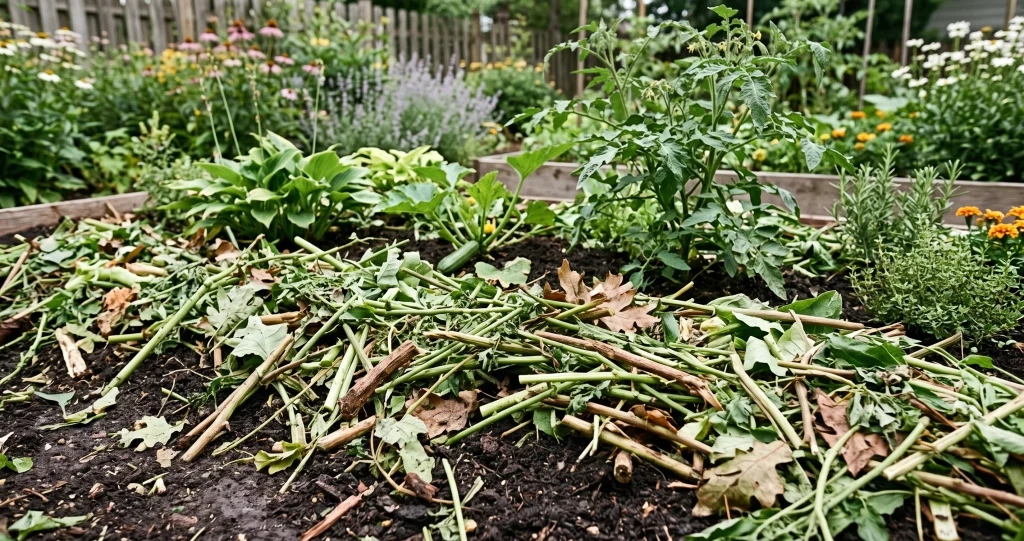
Chop-and-drop is almost exactly what its name suggests. A gardener cuts leaves, stems, cover crops, weeds, or pruned herbaceous growth into smaller pieces and drops the material onto the soil around plants.
Rather than digging the material into the ground, it generally remains on the surface as an organic mulch. Soil organisms, fungi, insects, and other decomposers gradually process it.
This creates two useful effects at once.
First, the material physically covers bare soil. Second, it slowly becomes part of the soil’s organic-matter cycle as decomposition progresses.
Research-based extension guidance supports many of these broader benefits of organic mulching. Organic mulch can conserve moisture, moderate soil temperature, suppress weeds, reduce erosion, and contribute organic matter as it decomposes.
How Chop and Drop Mulching Mimics Nature
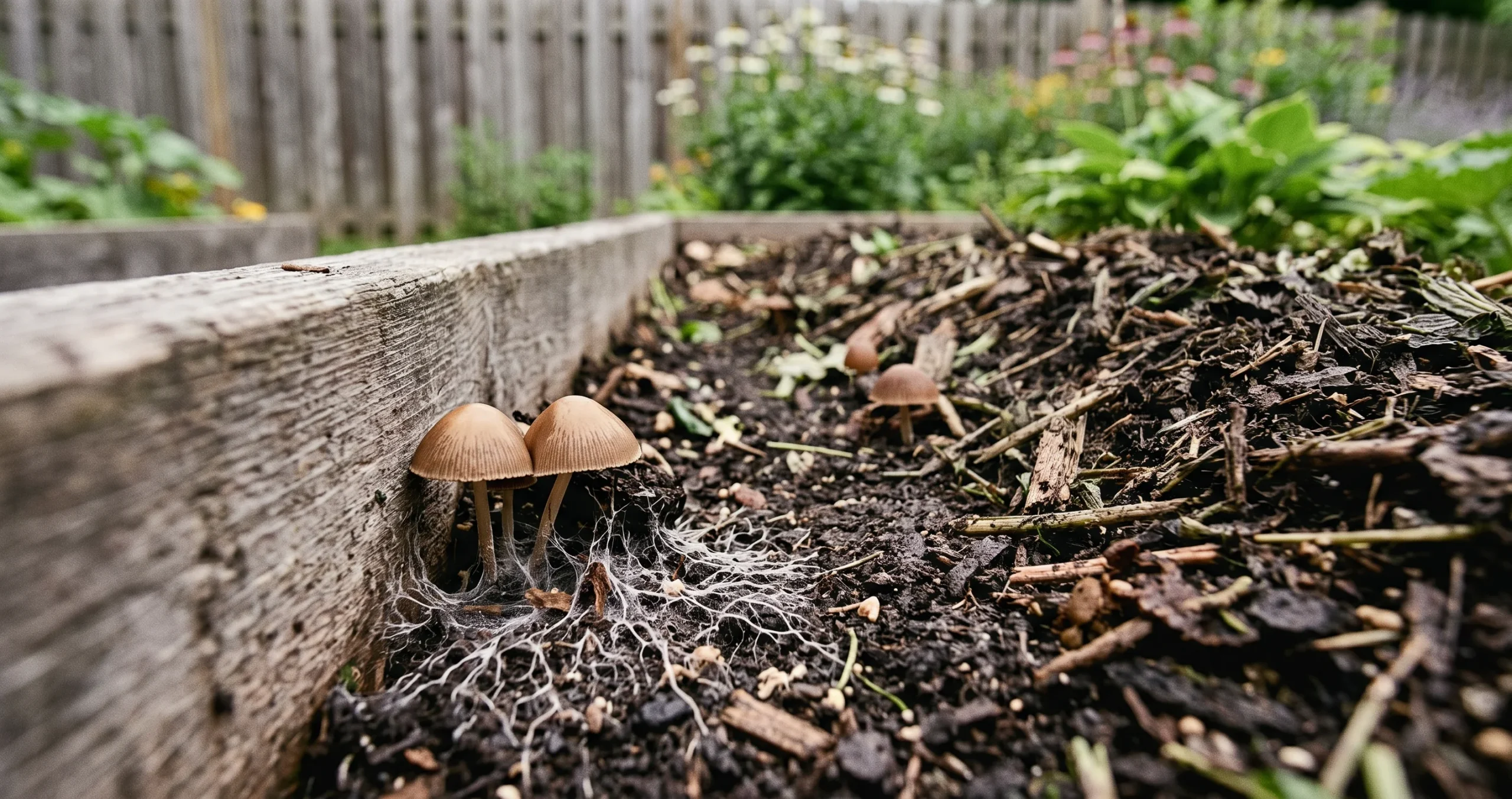
Walk through a healthy woodland and you rarely see large areas of exposed soil. Leaves fall, twigs break, grasses die back, and plant debris accumulates on the surface.
Nobody carries that material to a compost bin.
Instead, dead organic material becomes part of a continuous cycle. Fungi, bacteria, earthworms, arthropods, and other organisms gradually break it down.
Chop and drop mulching borrows this basic principle.
You are accelerating one part of the process by cutting plant material into smaller pieces. Smaller pieces have greater exposed surface area, which can help decomposers work on the material more efficiently. Composting guidance from the University of Illinois Extension similarly notes that chopping or shredding organic materials increases surface area and helps speed decomposition.
The difference is location: with chop-and-drop, decomposition occurs where the material is placed instead of primarily inside a separate compost pile.
Benefits of Chop and Drop Mulching
The most obvious advantage is convenience.
Suppose you prune a vigorous herbaceous perennial or cut back a cover crop. Instead of carrying the material across the yard, processing it elsewhere, and eventually bringing compost back, you can use suitable material close to where it grew.
That reduces handling while keeping organic material in the garden.
It Covers Bare Soil
Bare soil is exposed to sun, wind, and pounding rain. A surface layer of organic material provides physical protection.
Mulch can reduce evaporation, moderate soil temperatures, reduce erosion, and limit the impact of rainfall on exposed soil.
It can also help suppress annual weeds by reducing the amount of light reaching the soil surface. However, established perennial weeds may still grow through mulch, so chop-and-drop should not be treated as a universal weed-control solution.
It Returns Organic Matter
Leaves and stems contain carbon and nutrients that the plant accumulated while growing.
As those tissues decompose, part of that material enters the soil organic-matter cycle.
This does not mean a handful of chopped leaves instantly fertilizes a hungry tomato plant. Nutrient release depends on the material, moisture, temperature, particle size, and activity of decomposer organisms.
Think of chop and drop mulching primarily as gradual recycling rather than instant fertilization.
It Can Support Soil Moisture
A mulch layer reduces direct exposure of the soil surface to sun and moving air.
That can slow evaporation and help maintain more consistent soil moisture. The University of Minnesota Extension identifies improved moisture regulation as one of the important benefits of organic mulch.
For gardeners dealing with hot summers or irregular rainfall, that protective function can be as valuable as the nutrients eventually returned by decomposition.
Best Plants for Chop and Drop Mulching
The best materials are generally healthy, pesticide-free plant tissues that break down reasonably well and are unlikely to create new problems.
Soft green growth is particularly convenient.
Suitable materials can include healthy vegetable leaves, annual plants before seed formation, non-invasive cover crops, tender herbaceous trimmings, grass clippings from untreated lawns, and healthy leaves.
Leguminous cover crops such as clover can also provide useful biomass. Other cover crops may produce large quantities of carbon-rich stems and leaves.
Small amounts of finely chopped woody material can be useful too, but expect woody stems to break down considerably more slowly.
A mixture of textures often works better than a thick mass of one wet material.
For example, freshly cut green leaves can be combined with dry leaves or other coarse, carbon-rich material. This creates a more open layer rather than a dense mat.
For more ways to recycle organic materials in the garden, see the composting and soil-health guides at Secrets of the Green Garden.
What You Should Not Chop and Drop
Not everything that comes out of the garden belongs back on the soil.
Diseased plant material is one of the most important exclusions.
If a plant has a significant disease problem, leaving infected tissues beside susceptible plants can preserve inoculum and potentially contribute to future disease problems. University of Maryland Extension guidance recommends removing diseased plant debris in situations where it could spread disease rather than leaving it in the garden.
Mature weeds are another poor choice.
If weeds already carry viable seeds, spreading them across a bed can distribute the next generation exactly where you do not want it. Extension guidance for organic mulches recommends using materials free from weed seeds and other pests.
Also use caution with aggressive perennial weeds that spread through rhizomes, stolons, bulbs, or other vegetative structures. Cutting their tops does not necessarily kill them, and viable pieces may survive.
Avoid using plant material contaminated with herbicides or other products not intended for reuse around garden crops. Lawn clippings, for example, should not automatically be assumed safe simply because they are organic material. University of Maryland Extension advises against using clippings from lawns treated that season with herbicides or fertilizer-herbicide combinations.
Chop and Drop Mulching vs. Traditional Composting
These methods overlap, but they accomplish different things.
Traditional composting concentrates organic materials in a managed pile. With suitable carbon-to-nitrogen balance, moisture, oxygen, and turning, microorganisms can break those materials down relatively quickly.
A well-managed compost pile can produce usable compost in roughly three months under favorable conditions, according to University of Illinois Extension guidance.
Chop and drop mulching is less controlled.
Material decomposes directly on the soil surface, so breakdown depends heavily on weather and the type of material. Tender leaves may disappear relatively quickly during warm, moist weather, while coarse or woody stems can remain visible much longer.
Traditional composting has another important advantage: properly managed hot composting can reach temperatures capable of reducing weed seeds and some pathogens.
Chop-and-drop provides no comparable sanitation step.
That is why diseased plants, mature seed-bearing weeds, and questionable materials should be handled more cautiously.
On the other hand, chop-and-drop provides immediate soil coverage. You do not need to wait months for finished compost before receiving the moisture-conservation and soil-protection benefits of mulch.
The two methods therefore work well together.
Use chop and drop mulching for clean, appropriate garden residues that can safely remain in place. Use controlled composting for materials you want to transform into a more uniform amendment.
Best Timing for Chop and Drop Mulching
Timing affects both decomposition and usefulness.
Spring is a good opportunity when cutting back suitable cover crops or excess growth. The chopped vegetation can provide surface protection as temperatures rise.
During summer, smaller additions can help maintain coverage and reduce moisture loss. Avoid burying small seedlings under thick layers of fresh vegetation.
Fall offers another excellent opportunity because gardens often produce large amounts of plant material. Healthy residues can contribute to winter soil coverage while decomposition continues whenever conditions permit.
Temperature matters.
Decomposition generally slows dramatically during cold weather and accelerates when conditions become warm and moist. A layer that disappears quickly in midsummer may remain recognizable for months during winter.
How to Layer Chop-and-Drop Material
More mulch is not automatically better.
A huge pile of wet grass or succulent leaves can compress into a dense mat. This can interfere with normal movement of air and water at the surface.
Grass clippings are better used in relatively thin layers. University of Minnesota Extension specifically notes that excessive amounts can mat and restrict oxygen movement.
Chop large leaves and stems into smaller sections and distribute them relatively evenly.
When possible, mix fresh green material with drier, coarser material. The goal is a breathable surface layer rather than a compact blanket of wet vegetation.
Also leave some space around vulnerable plant stems, crowns, and woody trunks. Piling moist organic material directly against them can encourage undesirable moisture conditions and other problems. Extension recommendations similarly advise maintaining separation between mulch and plant stems or trunks.
Common Mistakes to Avoid
One common mistake is treating every weed as free mulch.
Young annual weeds that have not flowered or formed seeds may sometimes be suitable. Mature weeds carrying seeds are different.
Another mistake is dropping extremely long stems intact.
Chopping material increases exposed surface area and usually makes it easier to distribute. Smaller pieces also tend to settle into the mulch layer more naturally.
Avoid creating thick piles of only one wet material. Grass clippings are a classic example because they can quickly form a compact layer.
Finally, do not expect chop-and-drop to correct major nutrient deficiencies immediately.
If a soil test identifies a specific deficiency, address that problem appropriately. Surface decomposition is gradual and cannot be relied upon as a precisely measured fertilizer application.
Common Myths About Chop and Drop Mulching
Myth 1: Fresh plant material steals nitrogen from the soil
This idea needs context.
High-carbon organic material can temporarily immobilize nitrogen as microbes decompose it, particularly when carbon-rich material is incorporated into soil. Illinois Extension, for example, warns that incorporating undecomposed materials can temporarily tie up nitrogen.
Surface mulching is different from thoroughly mixing large quantities of raw carbon-rich material into the root zone.
Keeping the material primarily on the surface reduces direct competition within the cultivated soil, although decomposition dynamics still vary with the material used.
Myth 2: Chop and drop replaces compost
Not completely.
Finished compost is a relatively processed soil amendment that can be distributed wherever it is needed. Chop-and-drop is primarily an in-place recycling and mulching technique.
A productive garden can use both.
Myth 3: The thicker the layer, the healthier the soil
Excessive mulch can create problems.
The ideal amount depends on the material and the plants being grown. Fine, wet materials generally require thinner applications than coarse materials.
Myth 4: Any garden waste can be chopped and dropped
Definitely not.
Diseased foliage, seed-heavy weeds, invasive plant fragments, and contaminated materials may cause more problems than benefits.
Selection is what makes this technique useful.
Frequently Asked Questions
How small should I chop the plants?
There is no universal size. Cutting soft stems and leaves into pieces several inches long is usually enough to make them easier to spread and increase exposed surface area.
The tougher the material, the more useful additional chopping can be.
Can I chop and drop weeds?
Young annual weeds can sometimes be used before they develop viable seeds.
Avoid mature seed-bearing weeds and aggressive perennial weeds capable of reproducing from roots, rhizomes, stolons, bulbs, or stem fragments.
Can grass clippings be used?
Yes, provided the lawn has not been treated with products that make the clippings unsuitable for garden use.
Apply clippings in thin layers because thick piles can mat together.
Can I use tomato leaves?
Healthy tomato foliage can decompose like other plant material, but diseased tomato residues should be removed rather than deliberately spread around the vegetable garden.
When disease status is uncertain, the cautious approach is to keep the material out of chop-and-drop mulch.
Does chop and drop attract pests?
Any organic mulch changes the habitat at the soil surface. Depending on local conditions, thick, damp layers can provide shelter for organisms such as slugs.
Avoid excessively thick wet piles and periodically inspect vulnerable crops.
How long does chop-and-drop mulch take to decompose?
There is no fixed timetable.
Tender green leaves in warm, moist conditions may break down relatively quickly. Dry stems and woody material can take many months or longer.
Should I dig chop-and-drop material into the soil?
Usually not.
One of the major advantages of the technique is allowing organic material to decompose on the surface while protecting the soil. Incorporating large quantities of undecomposed, carbon-rich residues can temporarily affect nitrogen availability.
Conclusion
Chop and drop mulching turns an ordinary garden chore into an opportunity to recycle organic matter where it is produced.
Healthy leaves, soft stems, cover-crop residues, and suitable trimmings can become a protective surface layer instead of being hauled away. As that material decomposes, it contributes organic matter while helping conserve moisture, moderate soil temperatures, and protect exposed soil.
The key is selectivity.
Keep diseased plants, mature seed-bearing weeds, aggressive invasive material, and contaminated clippings out of the mulch. Chop suitable vegetation into manageable pieces, avoid thick wet mats, and leave breathing room around plant stems.
Combined with traditional composting, chop and drop mulching can create a practical closed-loop system: compost what needs controlled decomposition, and leave suitable organic matter directly where the soil can use it.
External Sources:
- University of Minnesota Extension — Mulching for Soil and Garden Health
University of Minnesota Extension mulch guide - University of Illinois Extension — How Composting Works
University of Illinois Extension composting guide - University of Maryland Extension — Organic Weed Management
University of Maryland Extension organic weed management guide