
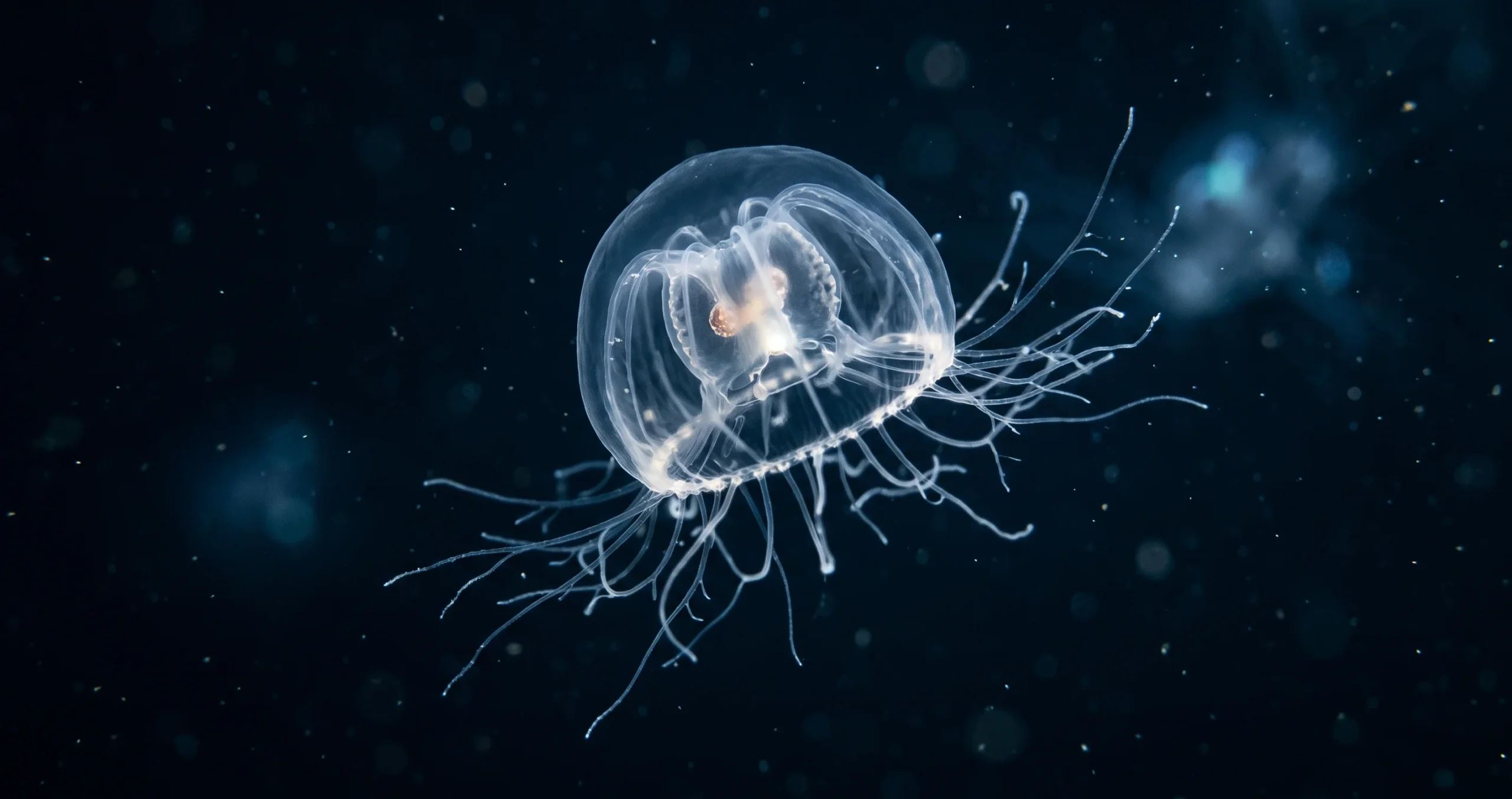
Imagine reaching adulthood and then, instead of continuing toward old age, reorganizing your body and returning to an earlier stage of life. A tiny marine animal called Turritopsis dohrnii can perform something remarkably close to that biological reset. The phenomenon known as immortal jellyfish aging reversal allows this jellyfish to reverse its normal life cycle and return from a free-swimming medusa to a juvenile polyp-like stage.
The nickname “immortal jellyfish” sounds almost supernatural, but the science behind it is even more interesting. Researchers have shown that Turritopsis dohrnii can repeatedly undergo life-cycle reversal, involving extensive cellular reprogramming. That does not make the animal impossible to kill, but it does make it an extraordinary model for studying regeneration, cellular identity, and aging.
Table of Contents
- Meet Turritopsis dohrnii
- The Normal Jellyfish Life Cycle
- How Immortal Jellyfish Aging Reversal Works
- What Is Transdifferentiation?
- What Triggers the Reversal?
- What Happens During the Biological Reset?
- Why “Immortal” Does Not Mean Invincible
- What Its Genome May Reveal About Aging
- What Scientists Hope to Learn
- Common Myths
- Frequently Asked Questions
- Conclusion
Meet Turritopsis dohrnii
Turritopsis dohrnii is a small hydrozoan cnidarian popularly called the immortal jellyfish. The species was originally described from the Mediterranean region, although populations have subsequently been recorded in other parts of the world.
Its fame has little to do with its appearance. The extraordinary feature lies inside its cells and in the unusual flexibility of its life cycle.
Most animals develop primarily in one direction: embryo, juvenile, adult, and eventually death. Turritopsis dohrnii has another option.
Under certain circumstances, an adult medusa can reverse development. Instead of simply continuing toward death, its tissues reorganize through an intermediate cyst-like state, eventually producing the polyp stage from which new medusae can develop.
That remarkable process created the popular idea of a jellyfish that “ages backward.”
The Normal Jellyfish Life Cycle
Understanding the phenomenon requires knowing how hydrozoan jellyfish normally develop.
The cycle begins after reproduction with a tiny swimming larva called a planula. Eventually, the planula settles onto a suitable surface and develops into a polyp.
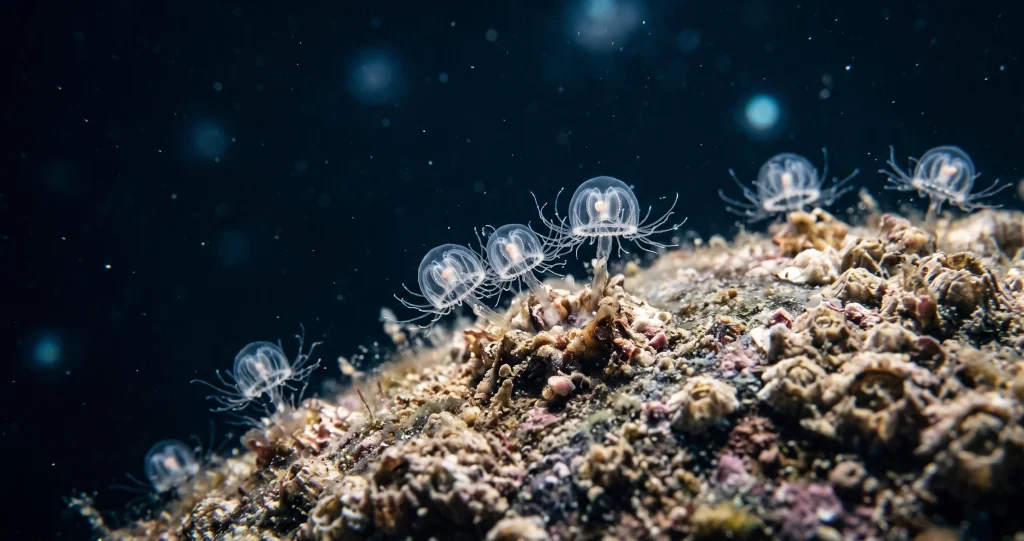
The polyp is attached rather than free-swimming. It can reproduce asexually and eventually produce medusae.
The medusa is the familiar swimming form that most people would recognize as a jellyfish. Adult medusae reproduce sexually, completing the cycle.
In a conventional life cycle, development therefore proceeds broadly from larva to polyp to medusa.
Turritopsis dohrnii can travel in the opposite developmental direction.
Researchers describe this unusual ability as life-cycle reversal or reverse development. Rather than merely repairing a damaged tentacle or replacing a few cells, the animal reorganizes its body into an earlier developmental form.
How Immortal Jellyfish Aging Reversal Works
The immortal jellyfish aging reversal process begins when a medusa stops behaving like a normal swimming jellyfish.
During reverse development, the medusa shrinks and loses its ability to swim. It settles onto a surface and transforms into a compact cyst-like structure surrounded by a thin external layer.
This stage looks dramatically different from either a recognizable jellyfish or a mature polyp.
Inside, however, extensive biological reorganization is taking place.
Research indicates that within roughly 24 to 36 hours, the cyst can begin developing structures characteristic of the polyp stage. New polyps eventually arise, allowing the ordinary polyp-to-medusa life cycle to begin again.
In other words, the jellyfish does not simply become a smaller adult.
Its developmental program changes direction.
This distinction is essential because it explains why scientists find Turritopsis dohrnii so interesting. The animal provides a natural system in which researchers can examine how mature tissues change identity and how developmental programs can effectively be restarted.
What Is Transdifferentiation?
One important concept associated with immortal jellyfish aging reversal is transdifferentiation.
Cells normally become specialized as an animal develops. Muscle cells perform different functions from nerve cells, digestive cells, or skin cells because each cell type follows a particular pattern of gene activity.
Transdifferentiation describes a process in which differentiated cells switch their developmental identity and become another cell type, either directly or after passing through a less differentiated state.
Research on Turritopsis dohrnii indicates that cell-type substitution and changes in cellular identity occur during its transformation from medusa toward polyp. Scientists therefore consider cellular reprogramming and transdifferentiation important components of the reversal process.
This makes the jellyfish especially valuable to researchers studying cellular plasticity.
Rather than looking only at individual cells growing in a laboratory dish, scientists can investigate reprogramming as part of a living animal undergoing whole-body developmental change.
The process is not equivalent to simply converting every adult cell into a generic stem cell. Research suggests a more complicated sequence involving changes in differentiation, gene expression, tissue organization, and developmental signaling.
What Triggers the Reversal?
The jellyfish does not necessarily reverse its life cycle simply because it reaches a particular chronological age.
Experiments and observations have associated reverse development with stressful conditions.
Researchers have reported reversal following physical damage, adverse environmental conditions, senescence, and weakening. Starvation is another documented trigger.
Experimental studies have also induced reversal through forms of environmental or physical stress. This suggests that the process may function as a remarkable survival strategy when continuing as a medusa becomes unfavorable.
Think of it less as a magical fountain of youth and more as an emergency developmental escape route.
When conditions threaten the medusa, the animal can sometimes abandon that body organization and return to an earlier stage capable of starting the developmental cycle again.
This ability is exceptionally unusual among animals.
What Happens During the Biological Reset?
Researchers are now investigating what happens at the molecular level while the jellyfish reorganizes itself.
Transcriptomic research has found changes in biological networks associated with DNA repair, telomerase activity, transposable-element regulation, cellular differentiation, development, and other processes during the cyst stage.
Later genomic research has added another layer.
A 2022 comparative genomics study examined Turritopsis dohrnii alongside the related Turritopsis rubra. Researchers identified differences involving genes associated with DNA replication and repair, telomere maintenance, redox biology, stem-cell populations, and communication between cells.
These findings do not mean scientists have discovered a single “immortality gene.”
Instead, the emerging picture suggests that immortal jellyfish aging reversal involves coordinated biological systems.
DNA must be maintained. Cellular identities must change. Tissues must reorganize. Developmental signals must shift at appropriate times.
Understanding how these systems interact is one of the major goals of current research.
For a deeper scientific look at the process, the peer-reviewed study available through PubMed describes transcriptomic changes occurring during reverse development.
Readers interested in other remarkable marine adaptations can also explore the wildlife and ocean coverage on Secrets of the Green Garden, where unusual survival strategies across the animal kingdom are examined in detail.
Why “Immortal” Does Not Mean Invincible
The word “immortal” is responsible for one of the biggest misconceptions surrounding Turritopsis dohrnii.
Scientists are not claiming that these jellyfish cannot die.
The term refers to their potential ability to escape the usual one-way progression of their life cycle by repeatedly returning to an earlier developmental stage. Laboratory research has demonstrated repeated rejuvenation, which is why researchers sometimes discuss the species in terms of potential or biological immortality.
But reversing development does not make an animal indestructible.
A jellyfish can still be eaten by a predator. It can experience disease or damage severe enough to kill it before successful reversal occurs.
Environmental hazards can also kill an organism regardless of its theoretical capacity for rejuvenation.
This distinction separates biological immortality from literal immortality.
An organism described as biologically immortal may avoid normal senescence under certain circumstances while remaining completely vulnerable to external causes of death.
There is therefore no evidence of ancient individual Turritopsis dohrnii medusae swimming continuously through the oceans for hundreds or thousands of years.
Their remarkable biology is about repeated rejuvenation, not physical invulnerability.
What Its Genome May Reveal About Aging
Aging is enormously complex.
DNA accumulates damage. Cellular communication changes. Proteins become damaged or incorrectly folded. Telomeres and other chromosome-related systems change. Stem-cell function can decline.
Researchers studying long-lived or highly regenerative animals hope that unusual species can reveal alternative ways evolution has dealt with these problems.
Turritopsis dohrnii provides a particularly interesting comparison because it does not merely tolerate aging exceptionally well. It can reorganize an adult body into an earlier developmental stage.
Comparative genomic research has identified candidate mechanisms involving DNA repair and replication, telomere maintenance, cellular communication, oxidative stress, and pluripotency-related processes.
Scientists are still determining which changes are essential to rejuvenation and which simply accompany the transformation.
That uncertainty is important.
A gene associated with reverse development is not automatically an “anti-aging gene,” and discovering a molecular pathway in a jellyfish does not mean scientists can safely reproduce the same phenomenon in humans.
What Scientists Hope to Learn
The scientific value of immortal jellyfish aging reversal extends beyond curiosity about an unusual marine animal.
Researchers can use Turritopsis dohrnii to investigate fundamental questions about cellular identity.
How permanent is a differentiated cell’s identity? Which genes must be activated or suppressed to reorganize mature tissues? How does an entire organism coordinate extensive cellular reprogramming without losing control of development?
There are also obvious connections to regenerative biology.
If scientists understand how animals naturally reprogram cells, those discoveries could improve basic knowledge about tissue repair, stem cells, regeneration, age-associated cellular changes, and diseases involving failures of cellular regulation.
A recent review highlighted Turritopsis dohrnii as a potentially useful organism for studying relationships among transdifferentiation, regeneration, aging, and cellular processes relevant to human disease.
However, this research is still fundamental biology rather than a recipe for human rejuvenation.
Humans and jellyfish are separated by hundreds of millions of years of evolution and have radically different body plans.
The realistic scientific opportunity lies in discovering principles.
Understanding how another animal maintains DNA, alters cellular identity, and coordinates rejuvenation can help researchers ask better questions about what aspects of aging are reversible across biology.
Common Myths About the Immortal Jellyfish
Myth: The immortal jellyfish cannot die
Turritopsis dohrnii can die.
Predation, disease, environmental conditions, and severe physical damage can kill individuals. “Immortal” refers to its unusual potential to repeatedly reverse its developmental cycle rather than guaranteed eternal survival.
Myth: The jellyfish simply becomes young again
The process is much more dramatic.
A medusa transforms through a cyst-like intermediate stage and produces the earlier polyp form. Cellular reprogramming and tissue reorganization are central parts of this transformation.
Myth: Scientists have discovered the immortality gene
No single gene has been demonstrated to explain the phenomenon.
Genomic and transcriptomic studies instead point toward multiple systems associated with DNA maintenance, telomeres, cellular differentiation, stress responses, stem-cell biology, and intercellular communication.
Myth: Scientists can use the jellyfish to make humans immortal
There is currently no evidence supporting that claim.
Research on Turritopsis dohrnii could improve our understanding of aging and regeneration, but translating biological mechanisms from a tiny cnidarian into human medicine would involve enormous scientific challenges.
Myth: Every jellyfish can reverse aging
This ability is not a general characteristic of all jellyfish.
Turritopsis dohrnii is exceptional because experimentally demonstrated repeated life-cycle reversal can occur even after reaching the medusa stage. Research has also documented reverse-development abilities in some other marine organisms, making the broader biology of rejuvenation an active research field.
Frequently Asked Questions
What is the immortal jellyfish?
The immortal jellyfish is the popular name for Turritopsis dohrnii, a small hydrozoan capable of reversing its development from the medusa stage toward the polyp stage.
Its unusual life cycle has made it an important organism for research into cellular reprogramming and aging.
How does immortal jellyfish aging reversal happen?
A stressed, damaged, weakened, or aging medusa can shrink, settle onto a surface, and transform into a cyst-like intermediate stage.
Extensive cellular and tissue reorganization then allows polyp structures to develop. The resulting polyps can eventually produce new medusae, restarting the normal life cycle.
What is transdifferentiation?
Transdifferentiation involves differentiated cells changing their identity and becoming other cell types.
Research indicates that cellular reprogramming of this kind plays an important role during Turritopsis dohrnii life-cycle reversal.
What triggers the immortal jellyfish to reverse its life cycle?
Documented triggers include physical damage, aging or senescence, starvation, and unfavorable environmental conditions.
Laboratory researchers have also experimentally induced reversal using different forms of stress.
Can the immortal jellyfish live forever?
Potentially avoiding ordinary senescence is not the same as being guaranteed to live forever.
The jellyfish remains vulnerable to predators, disease, environmental hazards, and fatal injury. Its nickname describes its capacity for repeated rejuvenation rather than invulnerability.
How many times can it reverse aging?
Experimental evidence demonstrates that Turritopsis dohrnii can undergo repeated life-cycle reversal. This ability underlies its description as potentially biologically immortal.
That does not establish that any wild individual actually repeats the process indefinitely.
Could immortal jellyfish research help humans?
Potentially, but indirectly.
Research may reveal fundamental mechanisms involving DNA maintenance, cellular reprogramming, regeneration, and aging. Scientists would still need extensive research before determining whether any discoveries have meaningful applications to human biology.
Conclusion
The immortal jellyfish aging reversal phenomenon is one of the most remarkable examples of developmental flexibility known in the animal kingdom.
When Turritopsis dohrnii experiences aging, injury, starvation, or unfavorable conditions, it can sometimes abandon its adult medusa organization and return through a cyst-like stage to the polyp phase. This transformation involves extensive cellular reprogramming and changes in gene activity.
Its famous nickname needs perspective. The jellyfish is not indestructible, and biological immortality does not protect it from predators, disease, or environmental hazards.
What makes Turritopsis dohrnii extraordinary is something more scientifically useful: its developmental clock does not always have to move in one direction.
By studying how this tiny animal resets cellular identity, maintains its genome, and reconstructs an earlier stage of life, researchers may gain new insights into regeneration and the basic biology of aging.
The immortal jellyfish does not yet provide a secret to eternal human life. It does something arguably more valuable for science—it demonstrates that, under the right biological conditions, some aspects of animal development and aging can be remarkably reversible.
3 External Sources:
- PubMed / G3 — Transcriptome Characterization of Reverse Development in Turritopsis dohrnii
PubMed scientific study - PNAS / PubMed — Comparative Genomics of Mortal and Immortal Cnidarians Unveils Novel Keys Behind Rejuvenation
PubMed genomic study - Smithsonian Environmental Research Center — Turritopsis dohrnii species information
Smithsonian species profile