
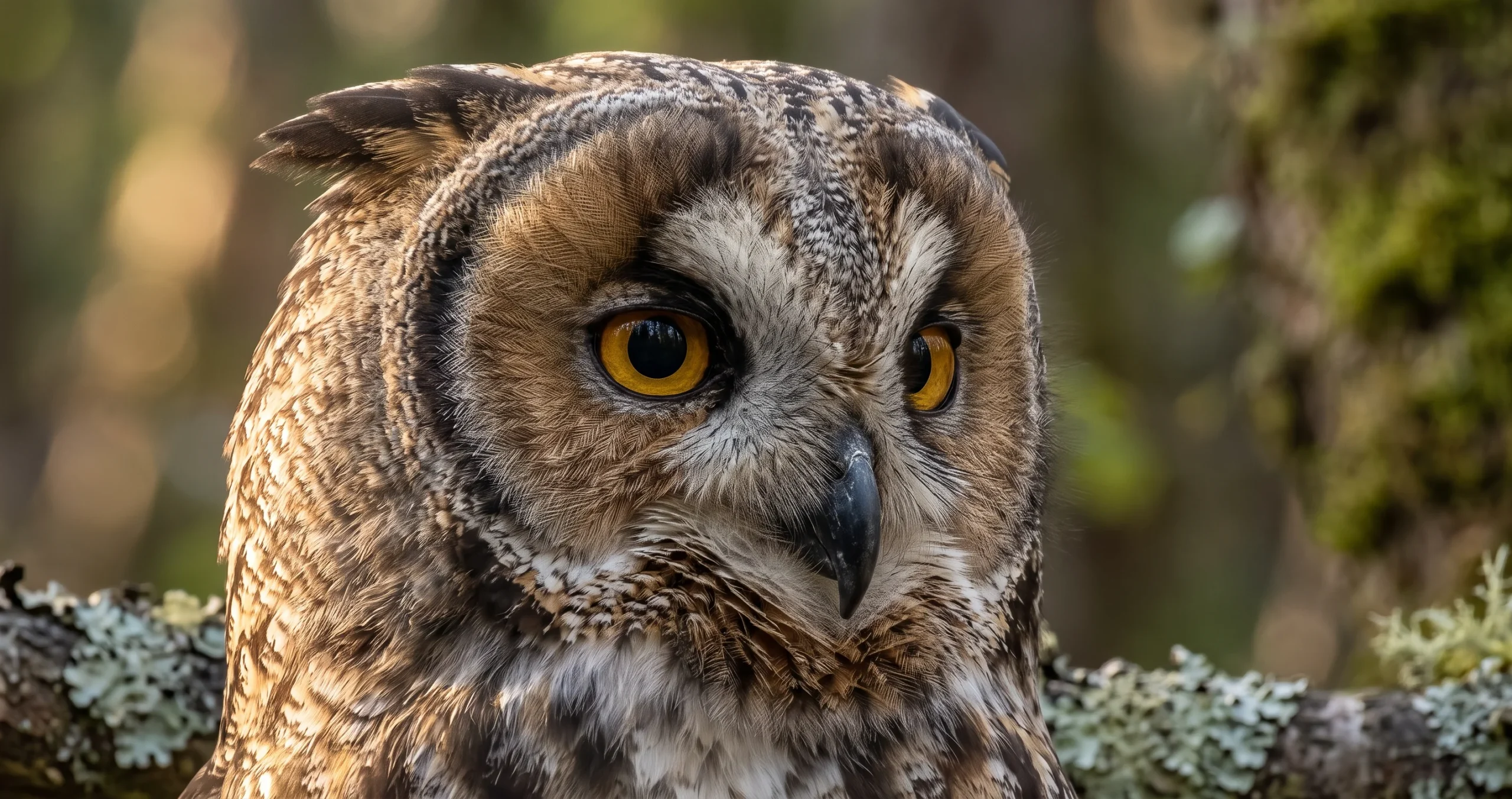
An owl gliding over a dark field may be hunting an animal it can barely see. In some highly specialized species, owl asymmetrical ears provide additional information about where faint rustling sounds originate, helping the bird determine not only whether prey is to the left or right, but also whether the sound comes from above or below its listening axis.
This remarkable system is especially well studied in barn owls (Tyto alba). Classic experiments showed that barn owls can locate sound sources in complete darkness with extraordinary precision, demonstrating that hearing can independently guide a hunting strike.
Yet an important distinction is often lost in popular descriptions: not every owl has asymmetrical ears. Ear anatomy varies among species, and asymmetry has evolved in multiple owl lineages.
Table of Contents
- What Owl “Ears” Actually Look Like
- Why Some Owls Have Asymmetrical Ear Openings
- How the Facial Disc Collects Sound
- How Owl Asymmetrical Ears Determine Direction
- Locating Sound from Left to Right
- Locating Sound in the Vertical Dimension
- How the Owl Brain Builds a Map of Sound
- Hunting Prey Hidden by Vegetation or Snow
- Laboratory Evidence for Precision Hearing
- Hearing and Vision Work Together
- Why Ear Asymmetry Is Not Universal
- FAQ
- Conclusion
What Owl “Ears” Actually Look Like
The prominent feather tufts visible on species such as great horned owls and long-eared owls are not their ears.
These tufts are feathers. They can contribute to visual signaling or camouflage, but sound does not enter the owl’s auditory system through them.
The actual external ear openings are positioned on the sides of the head and normally hidden beneath specialized feathers. This feather-covered region leads toward the auditory structures responsible for detecting sound.
That distinction is important when discussing owl hearing. Saying that an owl’s visible “ears” are offset can create an inaccurate picture of its anatomy.
The relevant asymmetry concerns structures associated with the actual external auditory openings and surrounding tissues, not decorative feather tufts.
Why Some Owls Have Asymmetrical Ear Openings
Humans have ears positioned at approximately the same height on opposite sides of the head. Several owl species have evolved a different arrangement.
In asymmetrical species, the external auditory structures on the two sides are not identical in orientation or position. In simplified terms, one side may be functionally directed differently from the other in the vertical plane.
This arrangement alters how sound reaches each ear.
The effect becomes particularly useful when an owl needs to determine the elevation of a sound source. Instead of receiving virtually identical vertical acoustic information on both sides, the bird receives differences that its nervous system can analyze.
An important comparative study by Volman and Konishi examined both symmetrical and asymmetrical owl species. It explicitly found bilateral ear asymmetry in some, but not all, owls and demonstrated corresponding differences in how spatial auditory information was represented.
Earlier anatomical work by Rolf Åke Norberg also concluded that bilateral ear asymmetry had evolved independently in multiple owl lineages rather than being a single universal feature inherited unchanged by every owl.
How the Facial Disc Collects Sound
The owl’s facial disc is far more than a distinctive arrangement of feathers around the eyes.
Its specialized feathers help influence how incoming sound is directed toward the ear openings. The geometry of the head, facial feathers, and external ear structures together creates a highly directional acoustic system.
This is especially conspicuous in barn owls, whose heart-shaped facial disc surrounds much of the face.
The disc can be compared loosely to an acoustic collector, although describing it simply as a satellite dish is an oversimplification. The complete system modifies sound differently depending on the direction and frequency from which it arrives.
Experiments described by Roger Payne showed that the external ears of barn owls are strongly directional at relevant frequencies. Manipulating tissue near the ear opening altered directional sensitivity, demonstrating how external anatomy contributes directly to sound localization.
How Owl Asymmetrical Ears Determine Direction
Finding an invisible sound source requires more than excellent hearing sensitivity.
The owl must calculate where the sound originated.
Two major types of binaural information are particularly important: differences in when a sound reaches the two ears and differences in the sound level reaching each ear.
These are commonly called interaural time differences and interaural level or intensity differences.
Barn owls provide one of the most extensively studied examples of how a vertebrate nervous system processes these tiny acoustic disparities. Research has shown that the two cues are processed through specialized neural pathways before being combined into representations of auditory space.
Locating Sound from Left to Right
Imagine a mouse rustling slightly to the owl’s left.
The sound reaches the left ear slightly before reaching the right because the two ears occupy different positions in space.
That time difference is extremely small, but the owl’s auditory system can extract useful directional information from it.
For barn owls, interaural time differences provide a major cue for determining azimuth—the horizontal, left-to-right location of a sound.
If the acoustic signal shifts toward the opposite side, the relationship between arrival times also changes.
The brain can therefore translate tiny timing differences into spatial information.
Comparative research indicates that interaural time differences are important for azimuth localization in both symmetrical and asymmetrical owl species, making this ability broader than ear asymmetry itself.
How Owl Asymmetrical Ears Help Determine Elevation
Determining whether something is left or right is only part of the hunting problem.
An owl also benefits from determining the sound’s vertical position.
This is where asymmetrical ear structures can provide an especially powerful advantage.
Because the two external ears are oriented differently in species such as the barn owl, sound arriving from different elevations produces systematic differences in the intensity reaching each side, particularly within certain frequency ranges.
The owl’s auditory system can use these interaural intensity differences as cues for elevation.
Research comparing owl species found an important relationship between ear anatomy and neural processing. In barn owls, which have asymmetrical ears, auditory space is represented in two dimensions, with elevation providing a second mapped dimension.
The system is more complex than a simple rule such as “louder in the right ear means higher.” Directional sensitivity depends on sound frequency as well as the geometry of the head, facial disc, and external ear structures.
The result is nevertheless remarkable: asymmetrical anatomy converts vertical sound position into binaural acoustic differences that the nervous system can interpret.
How the Owl Brain Builds a Map of Sound
The owl’s ears collect the information, but the brain performs the localization.
This became one of the most important discoveries to emerge from decades of barn owl research.
In 1978, Eric Knudsen and Masakazu Konishi reported neurons in the owl midbrain that responded strongly when sounds originated from restricted regions of space. These neurons were systematically organized according to the positions of their auditory receptive fields.
The researchers described this organization as a physiological map of auditory space.
Instead of sound direction remaining only as abstract differences in timing and intensity, neural circuits combine those acoustic cues into representations associated with locations around the owl.
Later research helped clarify how parallel auditory pathways process timing and amplitude differences before those signals converge.
This work made the barn owl an influential model organism for understanding how brains transform sensory signals into spatial information.
Readers interested in other extraordinary wildlife adaptations can explore more animal behavior and biology stories on Secrets of the Green Garden.
Hunting Prey Hidden by Vegetation or Snow
Precision hearing becomes especially valuable when vision is obstructed.
A small rodent moving beneath grass, leaves or other vegetation may reveal itself through scratching, chewing or rustling while remaining largely invisible.
Owls adapted for acoustic hunting can orient their heads toward these sounds before attacking.
Snow presents an even more dramatic challenge.
For owl species that hunt rodents beneath snow, the prey may be completely hidden from direct view. Sound produced by movement beneath the surface can provide crucial positional information.
Ear asymmetry should not be treated as the only factor involved in these hunts. Snow changes acoustic signals, prey may move after producing a sound, and the owl must integrate auditory information with flight control, experience and any available visual information.
Still, highly directional hearing gives certain owls access to information that vision alone cannot provide.

Laboratory Research Revealed How Accurate Owl Hearing Can Be
One of the foundational experiments was published by Roger Payne in the Journal of Experimental Biology in 1971.
Barn owls were studied while attacking prey or targets under conditions where visual information could be eliminated. Payne reported that the birds could locate prey in total darkness using hearing alone, with errors of less than one degree in both horizontal and vertical dimensions under the experimental conditions.
That finding was important because it demonstrated that the owl was not merely using hearing to move approximately toward an area before relying on vision.
Its auditory system itself could provide exceptionally precise spatial information.
The research also showed that higher-frequency components of the sound were important for accurate localization under the tested conditions and connected that directional sensitivity with the barn owl’s asymmetric external ears.
The original study can be consulted through the Journal of Experimental Biology.
Auditory Processing Goes Beyond the Ears
Later neuroscience revealed that remarkable owl hearing cannot be explained by ear anatomy alone.
Neurons at successive stages of the auditory system respond selectively to different acoustic properties. Information about interaural timing and intensity can eventually be combined to represent particular positions in space.
Knudsen and Konishi’s experiments showed that some midbrain neurons responded selectively to sounds coming from restricted spatial regions rather than simply responding to any sufficiently loud sound.
Research has also demonstrated that the organization of auditory spatial processing can be influenced during development.
Experiments in young barn owls showed that altered auditory input could change the developing auditory map while maintaining alignment with visual spatial information.
These findings reveal an auditory system that is both specialized and capable of developmental adjustment.
Hearing and Vision Work Together
Owls are often described as either visual hunters or acoustic hunters, but this creates a false separation.
Both senses can contribute.
Their large, forward-facing eyes provide excellent visual information under low-light conditions. Hearing becomes particularly valuable when darkness, vegetation, terrain or snow prevents a clear view of prey.
The brain must ultimately coordinate these different sensory representations.
Research on barn owl development demonstrated that auditory and visual maps of space are normally closely aligned. Experimental work also showed that visual experience can help calibrate auditory spatial processing as an owl develops.
This relationship makes biological sense.
If a rustling sound indicates that prey is slightly below and to the left, the auditory and visual systems need compatible definitions of spatial direction for the owl to orient effectively.
The owl is therefore not simply switching between eyes and ears. Its nervous system integrates sensory information into coordinated spatial behavior.
Why Ear Asymmetry Is Not Universal Among Owls
Perhaps the most important correction to popular explanations of owl hearing is that asymmetrical ears are not universal.
Comparative research has examined owls with strongly asymmetric external ears alongside species with more symmetrical arrangements.
For example, Volman and Konishi compared the asymmetrical barn owl and long-eared owl with symmetrical species including the burrowing owl and great horned owl. All possessed neural mechanisms for spatial hearing, but their representation of elevation differed.
In the symmetrical species examined, neurons in the relevant midbrain region were not sharply restricted in elevation in the same way observed in barn owls. Horizontal position remained strongly represented.
This comparison provides an important evolutionary lesson.
Owls did not evolve one universal auditory design. Different lineages have evolved different anatomical and neural solutions associated with their ecology and hunting behavior.
The presence of ear asymmetry is therefore a specialization found in particular groups, not a defining anatomical characteristic of every owl.
Frequently Asked Questions
Are an owl’s visible ear tufts its real ears?
No. Feather tufts on species such as long-eared and great horned owls are feathers, not external ears. The actual ear openings are located on the sides of the head beneath feathers.
Do all owls have asymmetrical ears?
No. Ear asymmetry occurs in some owl species and lineages but not others. Comparative physiological studies include both symmetrical and asymmetrical owl species.
Why are some owl ears positioned asymmetrically?
The asymmetrical arrangement changes how sounds from different vertical positions reach the two ears. In highly specialized species such as barn owls, differences in sound level between the ears provide important information about elevation.
How does an owl determine whether prey is on its left or right?
Interaural time differences are a major cue. A sound coming from one side reaches the nearer ear slightly earlier than the farther ear, and specialized neural circuits process this timing difference.
Can an owl hunt without seeing its prey?
At least some species can use auditory information with remarkable precision. Classic experiments demonstrated that barn owls could accurately locate prey in complete darkness using hearing.
Does the facial disc improve hearing?
The facial disc and associated external structures affect how sound reaches the ears. They contribute to the directional acoustic filtering that helps the owl’s auditory system extract information about sound location.
Can owls hear prey beneath snow?
Some owls hunt prey concealed beneath snow and use sound as an important localization cue. Their success depends on the complete sensory and behavioral system rather than ear asymmetry alone.
Conclusion
The hunting ability associated with owl asymmetrical ears begins with a deceptively simple anatomical difference. By orienting external auditory structures differently on opposite sides of the head, certain owl species create additional acoustic contrasts that help reveal a sound source’s vertical position.
Timing differences between the ears provide powerful information about horizontal direction, while frequency-dependent intensity differences generated by asymmetric anatomy can contribute information about elevation. The facial disc and surrounding structures further shape incoming sound before neural circuits process these cues.
Laboratory studies of barn owls have shown just how sophisticated that processing can become. Researchers have identified neurons organized into representations of auditory space and demonstrated that hearing alone can guide extraordinarily accurate localization in darkness.
Yet the adaptation must be described carefully. Not all owls have asymmetrical ears, and visible feather tufts are not the auditory openings. Comparative research shows that owl species differ substantially in both external ear anatomy and the way their brains represent acoustic space.
For species equipped with this specialization, the combination of directional hearing, neural processing, vision and controlled flight creates an exceptionally effective hunting system. A rodent hidden by darkness, vegetation or snow may disappear from view, but the sounds it produces can still reveal where it is.