
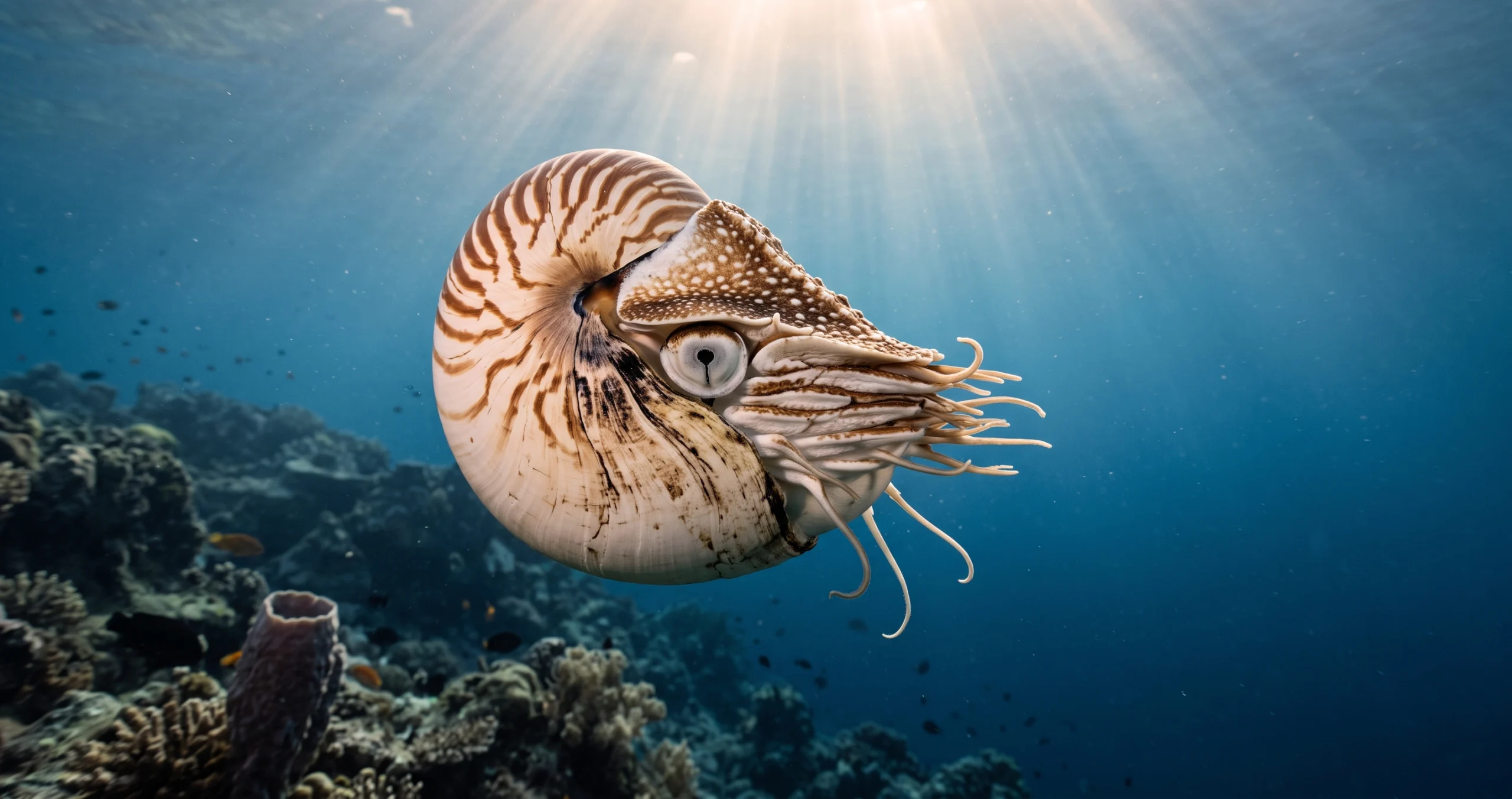
A chambered nautilus drifting along a deep reef slope carries one of the most distinctive buoyancy systems in the ocean. Nautilus buoyancy control depends partly on the animal’s coiled external shell, whose hidden internal chambers contain different proportions of gas and liquid. By controlling the liquid content of this chamber system over time, the nautilus can maintain an overall density close to that of seawater.
The mechanism is sometimes compared with a submarine ballast tank, but that analogy can be misleading. A nautilus does not rapidly pump gas into and out of individual chambers whenever it wants to rise or sink. Its shell provides long-term hydrostatic support, while active swimming and jet propulsion play major roles in immediate vertical movement.
[IMAGE 1 — ALT TEXT: Chambered nautilus swimming underwater using its shell as part of its buoyancy system]
Table of Contents
- Anatomy of the Chambered Nautilus Shell
- The Body Chamber and Phragmocone
- What the Siphuncle Actually Does
- How Liquid Leaves a New Shell Chamber
- How Gas Accumulates in the Chambers
- How Nautilus Buoyancy Control Works
- Neutral Buoyancy and Efficient Movement
- Jet Propulsion and Short-Term Depth Changes
- Ocean Pressure and Shell Depth Limits
- Nautilus Shells Compared With Fish Swim Bladders
- Why the Submarine Analogy Is Incomplete
- Myth vs. Fact
- Evolution and Extinct Shelled Cephalopods
- Frequently Asked Questions
- Conclusion
Anatomy of the Chambered Nautilus Shell
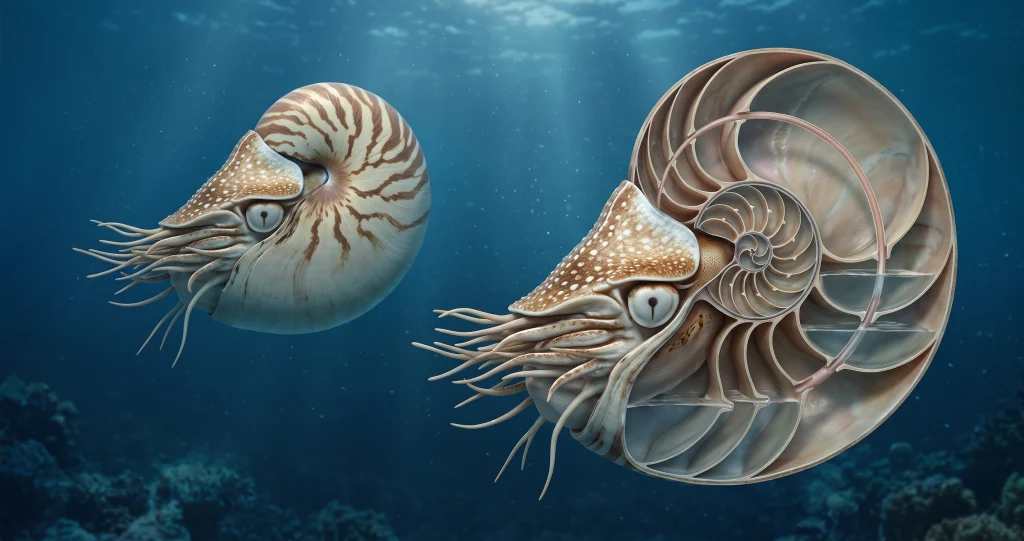
From the outside, a nautilus shell appears to be a continuous spiral. Inside, however, it is divided into a sequence of compartments by curved walls called septa.
The living animal does not occupy the entire spiral. Its soft body sits in the newest, largest outer section called the body chamber.
Behind the body chamber lies a series of older chambers collectively known as the phragmocone. As the nautilus grows, it moves forward, creates a new septum behind itself, and leaves another chamber within the older part of the shell.
Adult chambered nautiluses can possess more than 30 chambers. Research on Nautilus pompilius describes the older chambers as forming a relatively constant-volume hydrostatic apparatus important for buoyancy.
This architecture is what makes a nautilus shell fundamentally different from an ordinary hollow gastropod shell.
The Body Chamber and Older Internal Chambers
The distinction between the body chamber and phragmocone is essential for understanding nautilus buoyancy control.
The body chamber contains most of the animal’s soft tissues. Those tissues, together with the mineral shell and remaining chamber liquid, contribute mass.
The older chambers behind the animal contain varying amounts of gas and liquid. Because gas contributes very little mass compared with an equivalent volume of seawater, maintaining gas-filled chamber space helps reduce the average density of the entire animal.
The result is a biological hydrostatic system in which the relatively heavy soft body and shell are offset partly by low-density spaces within the phragmocone.
What the Siphuncle Actually Does
Running through the chambers is a specialized structure called the siphuncle.
It consists of living tissue contained within a tubular passage that extends through the septa. Smithsonian material describes the siphuncle as the internal connection associated with the chambers, while detailed cephalopod references describe it as an important route through which chamber fluid is removed.
This does not mean that the siphuncle behaves like a mechanical air hose.
The nautilus is not simply blowing atmospheric gas into an empty chamber. Instead, the siphuncle participates in physiological processes that alter the movement of water and dissolved substances between the living tissues and chamber fluid.
Those processes gradually change the amount of liquid occupying the chamber.
[IMAGE 2 — ALT TEXT: Nautilus buoyancy control showing the internal shell chambers and siphuncle]
How Liquid Is Removed From Shell Chambers
A newly produced chamber is not immediately an empty gas-filled flotation compartment.
During shell growth, a new septum forms behind the animal. The newly isolated chamber initially contains liquid, often called cameral liquid.
The siphuncle and associated tissues participate in removing that liquid. Osmotic processes are central to this mechanism: changes in solute concentrations create conditions that draw water from the chamber through the siphuncular system.
This is a physiological process rather than a simple pump mechanically sucking seawater out of a sealed compartment.
The removal can also be slow. Research on fossil cephalopod functional morphology emphasizes that fluid changes in living Nautilus occur too slowly to explain rapid daily vertical migrations by themselves.
That observation is important because it corrects one of the most persistent simplified descriptions of nautilus movement.
How Gas Accumulates Inside Emptied Chamber Space
As liquid is removed, the newly available chamber volume becomes occupied by gas.
The origin and movement of this gas should not be described as though the animal actively pumps bubbles through the siphuncle on command. Gases associated with the animal’s tissues and fluids can diffuse into the chamber as liquid is withdrawn.
The chamber therefore changes from being relatively liquid-rich after formation toward containing substantially more gas.
Because the shell chambers represent a fixed structural volume rather than an expandable bladder, changing their liquid content changes the mass of the nautilus much more than it changes its external volume.
That distinction is the foundation of its hydrostatic effect.
How Nautilus Buoyancy Control Works
An object sinks, floats, or remains suspended according to the relationship between its weight and the buoyant force produced by the water it displaces.
A nautilus displaces a volume of seawater determined largely by the external dimensions of its shell and body. If the average density of the entire animal is close to the density of the surrounding seawater, it can approach neutral buoyancy.
Replacing dense chamber liquid with much less dense gas decreases the animal’s total mass while changing its external displacement very little.
Adding chamber liquid has the opposite effect.
The gas-liquid balance within the phragmocone therefore contributes to the animal’s overall hydrostatic condition. Detailed modeling of living and fossil cephalopods likewise treats shell, soft tissue, chamber gas, and chamber liquid as separate components whose masses and volumes determine overall buoyancy and stability.
Neutral Buoyancy and Energy-Efficient Movement
Near-neutral buoyancy provides an important energetic advantage.
An animal that is strongly negatively buoyant must continually generate upward force to avoid sinking. One that is excessively positively buoyant must constantly counter its tendency to rise.
A nautilus whose average density is close to seawater can remain in the water column without continuously expending large amounts of energy merely to support its body.
Its chambered shell therefore acts as a hydrostatic support system rather than as the primary motor for every movement.
Jet Propulsion and Short-Term Depth Changes
Nautiluses are active swimmers.
Water enters the mantle cavity and can be expelled through a muscular funnel near the head. The resulting jet produces thrust.
By changing the direction of the funnel, a nautilus can maneuver forward, backward, or sideways. The Monterey Bay Aquarium describes this jet-proulsion system as the animal’s means of active swimming.
This becomes particularly important when distinguishing rapid movement from slower buoyancy regulation.
A nautilus does not need to drain or flood its shell chambers before every small ascent, descent, or directional change. Active swimming can change position much faster.
Studies of vertical movement reinforce this distinction. Living nautiluses can undertake substantial daily movements through the water column, while chamber-fluid equilibration occurs on a different physiological timescale.
Ocean Pressure and the Nautilus Shell
Depth introduces another major physical challenge: hydrostatic pressure.
Water pressure rises steadily as an animal descends. Soft tissues containing mostly water tolerate this relatively well because water is only slightly compressible.
A gas-containing rigid shell faces a different problem.
The pressure outside a nautilus shell can become dramatically greater than the pressure inside its chambers. The shell and septa must withstand that pressure difference without collapsing.
Research comparing cephalopod shell strength notes that the internal pressure of gas-containing chambers can remain around one atmosphere while external hydrostatic pressure rises enormously with depth.
The Physical Limits of the Shell
The chambered shell is strong, but it is not infinitely strong.
Research on living nautiluses has placed fatal shell-implosion depths broadly around 700–800 meters, although exact limits depend on species, individual shell characteristics, and experimental conditions.
This helps explain why shell construction matters so much.
Septa do more than divide the shell into attractive geometric chambers. Together with the shell wall, they form part of a structure that must resist substantial pressure while maintaining the internal spaces needed for hydrostatic function.
The nautilus therefore cannot simply descend indefinitely.
Depth Can Also Affect Chamber Fluid
Pressure may influence the buoyancy system before the shell reaches its structural failure limit.
Research on vertical movements of Nautilus pompilius reports evidence that at greater depths, physiological conditions can favor an influx of liquid into chambers. That additional liquid makes the animal more negatively buoyant.
The same study discusses observations consistent with periods of buoyancy re-equilibration at shallower depths.
These findings show why nautilus buoyancy control is better understood as a dynamic physiological system influenced by pressure and fluid balance rather than a collection of simple air tanks.
Nautilus Buoyancy Compared With Fish Swim Bladders
Many bony fish also use gas to regulate buoyancy, but their system is structurally and physiologically different.
A typical swim bladder is a flexible or semi-flexible internal gas-filled organ. Depending on the fish lineage, gas may enter or leave through connections with the digestive tract or through specialized physiological gas-secretion and resorption mechanisms.
Some fish can maintain gas within swim bladders at pressures matching very high surrounding hydrostatic pressures. Research on deep-sea fishes has documented functional gas-filled swim bladders even at extreme ocean depths.
A nautilus instead has multiple rigid shell chambers connected physiologically through the siphuncular system.
Its chambers cannot simply expand freely as a swim bladder might. The rigid shell must physically withstand the difference between internal and external pressure.
Both systems use gas to influence density, but they should not be treated as mechanically identical.
Why the Submarine Ballast Tank Analogy Is Incomplete
The submarine comparison can help introduce the basic concept of changing buoyancy by changing mass, but it quickly becomes misleading.
A conventional submarine can deliberately admit large amounts of water into ballast tanks or force that water out using compressed air. These operations can substantially change buoyancy on command.
A nautilus does not possess an equivalent mechanical system.
Its siphuncle does not function as a high-speed pump that floods and empties selected chambers every time the animal changes direction. Chamber liquid is physiologically regulated, and significant adjustments occur much more slowly than active swimming.
The shell is therefore better viewed as a long-term hydrostatic buoyancy apparatus, complemented by muscular locomotion.
Myth vs. Fact
Myth: Nautiluses pump gas into chambers whenever they want to rise
Fact: Gas-filled chambers contribute strongly to buoyancy, but rapid vertical movement is not produced simply by pumping gas into individual chambers. Fluid regulation through the siphuncular system occurs over longer physiological timescales.
Myth: Nautiluses flood their chambers every time they descend
Fact: Short-term descent can be accomplished through active swimming. Changes in chamber fluid can affect buoyancy, particularly during longer-term equilibration and under different pressure conditions, but the process is not equivalent to instantly flooding submarine ballast tanks.
Myth: The shell alone moves the nautilus through the water
Fact: The chambered shell helps establish favorable buoyancy. Actual directional swimming is powered largely by jet propulsion through the funnel.
Evolutionary Significance of the Chambered Shell
The chambered shell represents an important design in cephalopod evolutionary history.
Living nautiluses are surviving representatives of a much broader history of externally shelled cephalopods. Fossil groups developed an extraordinary variety of straight, curved, and coiled chambered shells.
The combination of a body chamber, septate phragmocone, and siphuncular system allowed shell volume to contribute to hydrostatic support rather than functioning only as armor.
For more examples of unusual marine adaptations, readers can explore the wildlife coverage on Secrets of the Green Garden. During publication, this can be replaced with the site’s closest live marine-wildlife article to create a more specific contextual internal link.
Nautilus as a Model for Extinct Ammonites
The living nautilus gives paleontologists a valuable reference point for understanding extinct chambered cephalopods, including ammonites.
Scientists can reconstruct fossil shells, estimate the volumes of the body chamber and phragmocone, assign plausible densities to shell, soft tissue, chamber liquid, and gas, and calculate potential buoyancy and orientation. Such hydrostatic modeling has become an important tool in cephalopod paleobiology.
However, an ammonite was not simply an ancient nautilus.
Ammonites differed greatly in shell geometry, septal complexity, siphuncle position, body-chamber proportions, and evolutionary history. Their soft tissues are also incompletely known because those structures rarely fossilize.
Nautilus physiology can therefore provide testable analogies and physical constraints, but it cannot establish exactly how every extinct ammonite controlled buoyancy, swam, or behaved.
That distinction is essential when reconstructing animals known primarily from fossil shells.
Frequently Asked Questions
How does a nautilus shell contribute to buoyancy?
The older part of the shell contains chambers holding gas and varying amounts of liquid. Because gas has far less mass than the same volume of seawater, these spaces help lower the average density of the entire animal and allow it to approach neutral buoyancy.
What is the phragmocone?
The phragmocone is the chambered portion of the shell behind the living animal. It consists of older chambers separated by septa.
What is the siphuncle?
The siphuncle is a living tissue structure passing through the shell chambers. It participates in physiological and osmotic processes that regulate chamber liquid and is central to the shell’s hydrostatic function.
Does a nautilus pump air into its shell?
Not in the familiar mechanical sense. As chamber liquid is physiologically removed, gas occupies the available space; the process should not be imagined as the nautilus actively blowing bubbles into individual chambers whenever it wants to rise.
Does a nautilus change buoyancy every time it changes depth?
Not necessarily. Significant chamber-fluid adjustments are relatively slow, whereas the animal can actively swim using jet propulsion. Short-term vertical movements therefore should not automatically be attributed to rapid changes in chamber gas and liquid.
Why does pressure matter to a nautilus?
Increasing depth increases external hydrostatic pressure. Because the shell contains gas-filled spaces, its walls and septa must resist a substantial pressure difference, eventually creating a structural depth limit.
Is nautilus buoyancy the same as a fish swim bladder?
No. Both involve gas and density control, but a fish swim bladder is an internal organ, while the nautilus relies on a rigid, multicameral external shell and siphuncular fluid regulation.
Conclusion
Nautilus buoyancy control is more sophisticated than the familiar image of an animal operating its shell like a miniature submarine.
As a nautilus grows, its body occupies the newest outer chamber while older chambers form the phragmocone. The siphuncle helps remove liquid from newly formed chambers through physiological and osmotic processes, allowing gas to occupy much of the resulting space.
The balance between low-density gas, chamber liquid, shell, and soft tissue helps bring the animal’s overall density close to that of seawater. This hydrostatic support reduces the effort required to remain suspended, while active jet propulsion supplies the thrust needed for faster ascents, descents, and directional swimming.
Pressure places important limits on the entire system, and the rigid shell cannot tolerate unlimited depth. Together, the chambered shell, siphuncle, gas-liquid balance, pressure resistance, and active swimming make the nautilus one of the ocean’s most distinctive examples of biological buoyancy engineering.
2 Internal-Link Suggestions for secretsofthegreengarden.com:
- Link to a live article about a marine animal with an unusual physiological adaptation using anchor text such as specialized adaptations of marine animals.
- Link to a live cephalopod article using anchor text such as remarkable cephalopod adaptations.
3 Authoritative External Scientific Sources:
- Smithsonian Ocean — Chambered Shells — Overview of nautilus chamber architecture, septa, and the siphuncle.
- Monterey Bay Aquarium — Chambered Nautilus — Authoritative overview of nautilus biology, swimming, depth, and jet propulsion.
- Peer-reviewed study — Vertical Distribution and Migration Patterns of Nautilus pompilius — Research addressing vertical movements, pressure, chamber liquid, and buoyancy equilibration.