
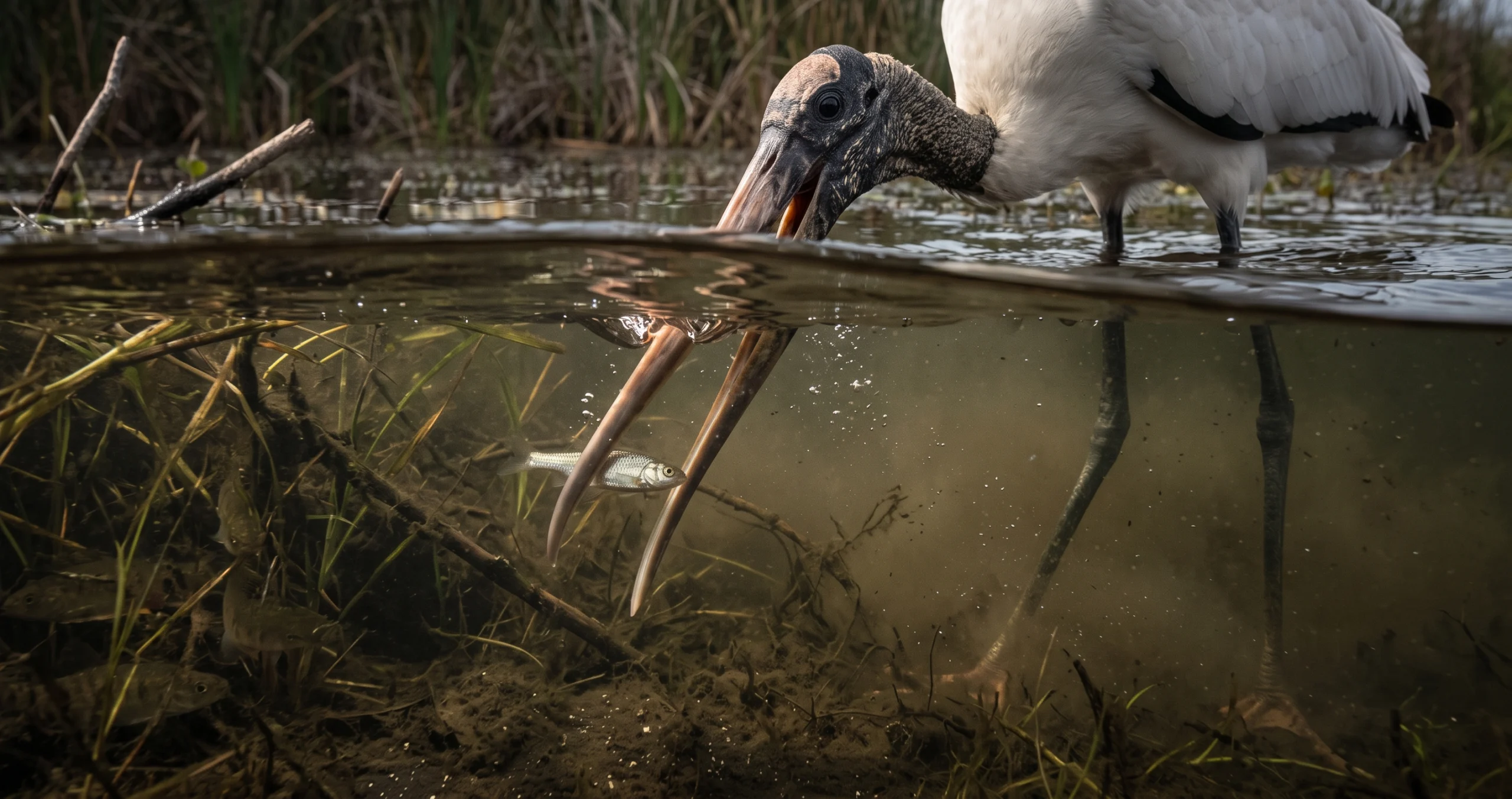
A wood stork walking through a shallow marsh may look as though it is simply probing the water. In reality, it is using one of the most specialized feeding techniques among North American wading birds. Wood stork tactile feeding allows the bird to capture prey by contact rather than depending primarily on clear underwater vision.
The American wood stork (Mycteria americana) often feeds in shallow wetlands where mud, vegetation, and suspended sediment make prey difficult to see. Instead of waiting to visually identify an individual fish and then striking, the stork places its partly open bill underwater and lets touch help determine when to close it.
This unusual strategy connects the bird’s anatomy, behavior, prey availability, and wetland hydrology into a remarkably efficient feeding system.
Table of Contents
- What Wood Stork Tactile Feeding Means
- The Feeding Sequence Step by Step
- Anatomy Behind the Rapid Response
- Why Murky Water Is Not a Major Obstacle
- Foot Movements and Prey Disturbance
- What Wood Storks Eat
- Water Depth and Seasonal Wetland Conditions
- Why Wetland Hydrology Matters
- Myth vs. Fact
- Frequently Asked Questions
- Conclusion
What Wood Stork Tactile Feeding Means
Many familiar wading birds use vision extensively while hunting. A heron, for example, may remain motionless while watching a fish before delivering a rapid strike.
Wood storks frequently use a different method commonly described as tactile foraging, tactolocation, or grope-feeding. According to the U.S. Fish & Wildlife Service, a feeding wood stork moves through shallow water with its large bill held partly open. When suitable prey contacts the bill, it snaps shut.
This means the bird does not need to visually track every prey animal before attempting a capture. Direct physical contact can initiate the closing response.
[IMAGE 1 — ALT TEXT: American wood stork tactile feeding with its open bill submerged in shallow wetland water]
The Wood Stork Tactile Feeding Sequence
The process begins when a wood stork enters water shallow enough for effective wading and places its head downward while keeping much of its head and its eyes above the surface.
Its long bill extends into the water with the mandibles slightly separated. The bird walks slowly forward and may move the bill from side to side through the water.
Historical observations published in Nature described wood storks feeding successfully where water was sufficiently turbid or vegetation sufficiently dense that visual detection of individual prey appeared unlikely. The researchers observed the partly open bill moving underwater until contact with a fish caused the mandibles to close.
The sequence can therefore be summarized as movement, contact, closure, and swallowing. It is important to distinguish this behavior from spearing: the bill acts more like a rapidly closing trap than a pointed weapon driven through a fish.
An Extremely Fast Bill-Snap Reflex
One frequently cited figure makes this feeding method especially impressive. U.S. Fish & Wildlife Service material reports an average response time of about 25 milliseconds for the bill-closing reflex after prey contact.
That number should be described carefully. It comes from research and agency summaries of the specialized bill-snap response; it does not mean every capture in every circumstance takes exactly 25 milliseconds.
The ecological advantage is straightforward. A small fish that bumps into the open bill has very little time to escape before the mandibles close.
Anatomy Behind Touch-Based Hunting
The wood stork’s body is well suited to hunting in shallow wetlands. Long legs allow it to move through water while its long neck brings the bill down to feeding depth.
The elongated, heavy bill provides a large structure with which the bird can encounter prey. During tactile feeding, the eyes remain above the submerged feeding zone much of the time, emphasizing that direct visual tracking is not required for each capture.
Touch information in bird bills is transmitted through mechanosensory systems. Research across tactile-foraging birds shows that avian bills can contain specialized mechanoreceptors connected with sensory nerves, allowing mechanical stimulation to be detected rapidly.
For wood storks specifically, the strongest established behavioral evidence concerns the bill-snap reflex triggered by prey contact. It would be an oversimplification to assume that every detailed sensory structure documented in ducks, geese, ibises, or shorebirds functions identically in wood storks.
That distinction matters because popular explanations sometimes describe tactile feeding as though the stork possesses a precisely mapped “sensor array” identical to those studied in other tactile-specialist birds. The safer scientific description is that contact with prey triggers a remarkably rapid closure response, while comparative avian research helps explain how highly sensitive bill-based mechanoreception can work.
Why Murky Water Is Not a Major Obstacle
Cloudy water presents an obvious challenge to predators that depend on seeing prey before attacking.
For a tactile feeder, reduced visibility can be less limiting. The wood stork can continue moving its open bill through the feeding zone until prey makes physical contact.
Cornell Lab of Ornithology notes that wood storks walk slowly through wetlands with the bill in the water and rapidly close it when they feel prey. Cornell also reports that although the birds can search visually, tactile feeding is used frequently, particularly in muddy water.
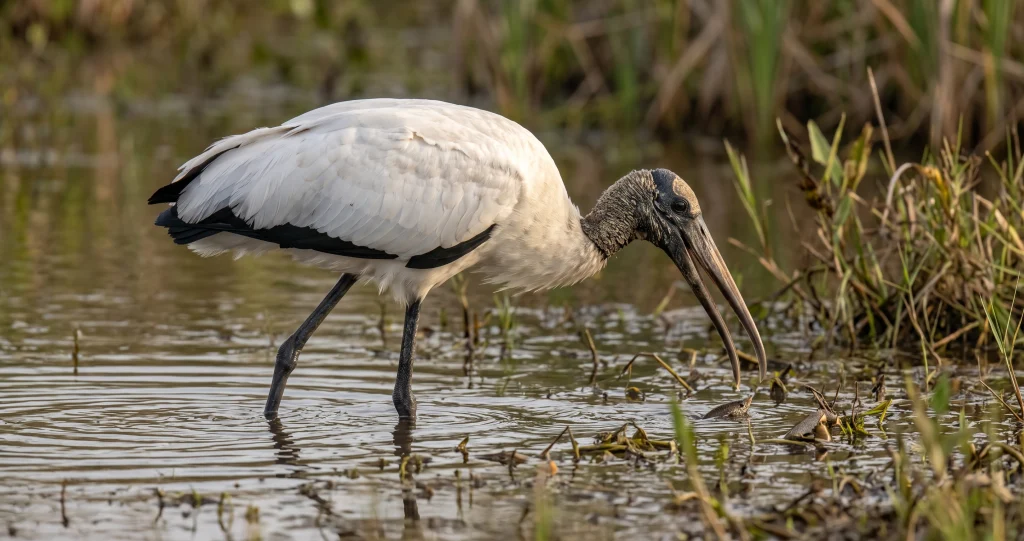
This does not mean visibility is irrelevant or that wood storks are incapable of using sight. Instead, tactile feeding gives them an additional strategy that remains effective when underwater visual conditions are poor.
[IMAGE 2 — ALT TEXT: Wood stork tactile feeding as underwater prey contacts its bill in murky water]
Foot Movements Can Help Flush Prey
The bill is not the only part of the feeding system.
Wood storks may move or pump their feet while walking. These movements can disturb small aquatic animals resting among vegetation, sediment, or submerged structures.
Cornell describes wood storks pushing their feet up and down and sometimes flicking their wings in ways that can startle prey. Earlier field observations also reported vegetation being stirred with a foot, apparently helping move concealed prey toward the open bill.
This behavior does not mean the feet directly locate the prey. Their useful role is primarily disturbance: a hidden fish that suddenly moves may be more likely to contact the waiting bill.
What Wood Storks Eat
Fish make up the major part of the wood stork’s diet, particularly small fish that can be captured and swallowed efficiently.
U.S. Fish & Wildlife Service habitat guidance describes small fish as especially important prey and notes that successful feeding sites provide sufficiently high concentrations for tactile feeding to work efficiently.
Wood storks are not completely restricted to fish. Their broader diet can include aquatic invertebrates and, depending on availability, amphibians, reptiles, and other small animals. Cornell similarly identifies fish as the principal food while documenting additional aquatic and terrestrial prey.
The key factor is not simply the presence of prey. Prey density and accessibility are critical.
A wetland containing many fish spread through deep water may be less useful than a shallow pool containing fewer total fish packed into a much smaller area.
Water Depth and Seasonal Wetland Conditions
Water depth strongly influences wood stork feeding opportunities.
Cornell reports foraging commonly in wetlands around 4–12 inches deep, while U.S. Fish & Wildlife Service guidance has described productive feeding habitats across a somewhat broader shallow-water range. Exact preferred depth varies with site conditions, prey, vegetation, and bird behavior.
Shallow water makes the bottom accessible to a walking stork and places aquatic prey within reach of its submerged bill.
But depth alone does not explain feeding success.
Falling Water Can Concentrate Prey
Seasonal drying can transform a wetland.
During wetter periods, fish and other aquatic organisms may occupy a broad flooded landscape. As water gradually recedes, some of those animals become concentrated in remaining pools, sloughs, depressions, and shallow channels.
That concentration can produce exceptionally productive feeding conditions for wood storks. The U.S. Fish & Wildlife Service notes that decreasing water levels can concentrate prey during the breeding season, when adults face the additional energetic demands of feeding growing young.
This explains why the simple statement “wood storks need wetlands” is incomplete. They need wetlands that produce prey and make that prey accessible at useful densities and depths.
Wood Storks Depend on Wetland Hydrology
Hydrology describes how water moves through a landscape, including its depth, timing, duration, distribution, and seasonal fluctuations.
For wood storks, those patterns help determine when and where fish become available.
A functioning wetland cycle can first provide enough flooded habitat for aquatic prey populations to develop. Later, gradual drying can concentrate those animals into increasingly favorable feeding areas.
Abrupt hydrological changes can disrupt that sequence. Water that remains too deep can keep prey dispersed or inaccessible, while excessively rapid drying may eliminate feeding habitat before birds have benefited from it.
Historic U.S. Fish & Wildlife Service habitat guidance specifically notes that rising water can disperse fish and reduce a site’s feeding value, while falling water often concentrates prey.
This relationship became especially important in discussions of wood stork declines in South Florida. Altered water timing and wetland degradation changed when concentrated food resources were available to nesting birds. Modern conservation therefore involves more than simply preserving patches of standing water; maintaining appropriate hydrological processes across wetland landscapes is also important.
The wood stork’s connection with wetlands remains strong even after its substantial population recovery. The U.S. Fish & Wildlife Service removed the U.S. breeding population from Endangered Species Act protections in March 2026 after reporting major increases in nesting pairs, colony numbers, and geographic range, while establishing post-delisting monitoring.
For more bird adaptations and wildlife ecology, readers can explore the wildlife coverage on Secrets of the Green Garden. A specific internal article URL should be substituted here during publication once the most closely related live bird article is selected.
Myth vs. Fact
Myth: Wood storks spear fish with their bills
Fact: Their characteristic tactile feeding method involves holding the bill partly open underwater. When prey contacts it, the mandibles rapidly close around the animal. The normal mechanism is therefore capture by rapid closure, not spearing.
Myth: A wood stork watches each fish before striking
Fact: Wood storks can use visual information, but their specialized tactile strategy does not require them to visually identify each prey item first. This is particularly valuable in muddy or vegetation-filled water.
Myth: Any wetland provides equally good feeding habitat
Fact: Water depth, prey density, vegetation, seasonal drying, and hydrological timing all influence feeding quality. A shallow area where prey has become concentrated can be far more productive than deeper water containing widely dispersed fish.
Frequently Asked Questions
How does wood stork tactile feeding work?
A wood stork typically wades through shallow water with its bill partly open and submerged. When suitable prey contacts the bill, a rapid closing response traps it.
How fast can a wood stork close its bill?
U.S. Fish & Wildlife Service sources commonly cite an average response time of approximately 25 milliseconds for the bill-snap reflex. The figure describes the exceptionally rapid reflex associated with tactile feeding rather than a guaranteed timing for every feeding event.
What do wood storks eat?
Their diet is dominated by small fish. They can also consume aquatic invertebrates, amphibians, reptiles, and other appropriately sized animals when available.
Can wood storks hunt in murky water?
Yes. Tactile feeding allows them to capture prey even when underwater visibility is poor because direct contact with the bill can trigger capture. This does not mean wood storks never use vision; rather, they do not have to depend entirely on it.
Why do wood storks move their feet while feeding?
Foot movements can disturb hidden aquatic animals and cause them to move. A displaced fish or other prey animal may then encounter the stork’s open bill.
What wetland habitat is best for feeding wood storks?
Productive feeding sites generally contain shallow, accessible water with relatively high prey densities. Seasonal water recession can be particularly important because it concentrates aquatic prey into smaller areas.
Why are healthy wetlands important to wood storks?
Wetlands provide both prey production and the changing water conditions that determine prey accessibility. The timing of flooding and drying can therefore influence whether adults find enough concentrated food, particularly during demanding nesting periods.
Conclusion
Wood stork tactile feeding is a striking example of an animal adaptation working together with the physical characteristics of its habitat. Instead of relying entirely on underwater vision, the stork moves a partly open bill through shallow water and responds rapidly when prey makes contact.
Its success, however, depends on more than a sensitive bill and a fast reflex. Water depth, prey concentration, seasonal drying, vegetation, and the broader hydrology of wetlands all determine whether enough food is accessible.
The wood stork can therefore hunt effectively in environments where visibility is poor, but its specialized feeding strategy also reveals how closely wildlife can be tied to functioning wetland processes. Protecting those processes helps preserve not only feeding opportunities for wood storks but the complex aquatic communities on which wetland birds depend.
2 Internal-Link Suggestions for secretsofthegreengarden.com:
- Link to a live article about another specialized bird-feeding adaptation, using descriptive anchor text such as specialized feeding adaptations in birds.
- Link to a live wetland or wading-bird article using anchor text such as wetland wildlife and seasonal water cycles.
3 Authoritative External Source Suggestions:
- U.S. Fish & Wildlife Service — Wood Stork Proposed Delisting
https://www.fws.gov/story/2023-02/wood-stork-proposed-delisting - Cornell Lab of Ornithology — Wood Stork Life History
https://www.allaboutbirds.org/guide/Wood_Stork/lifehistory - Nature — The Bill-snap Reflex: A Feeding Mechanism in the American Wood Stork
https://www.nature.com/articles/199505a0