
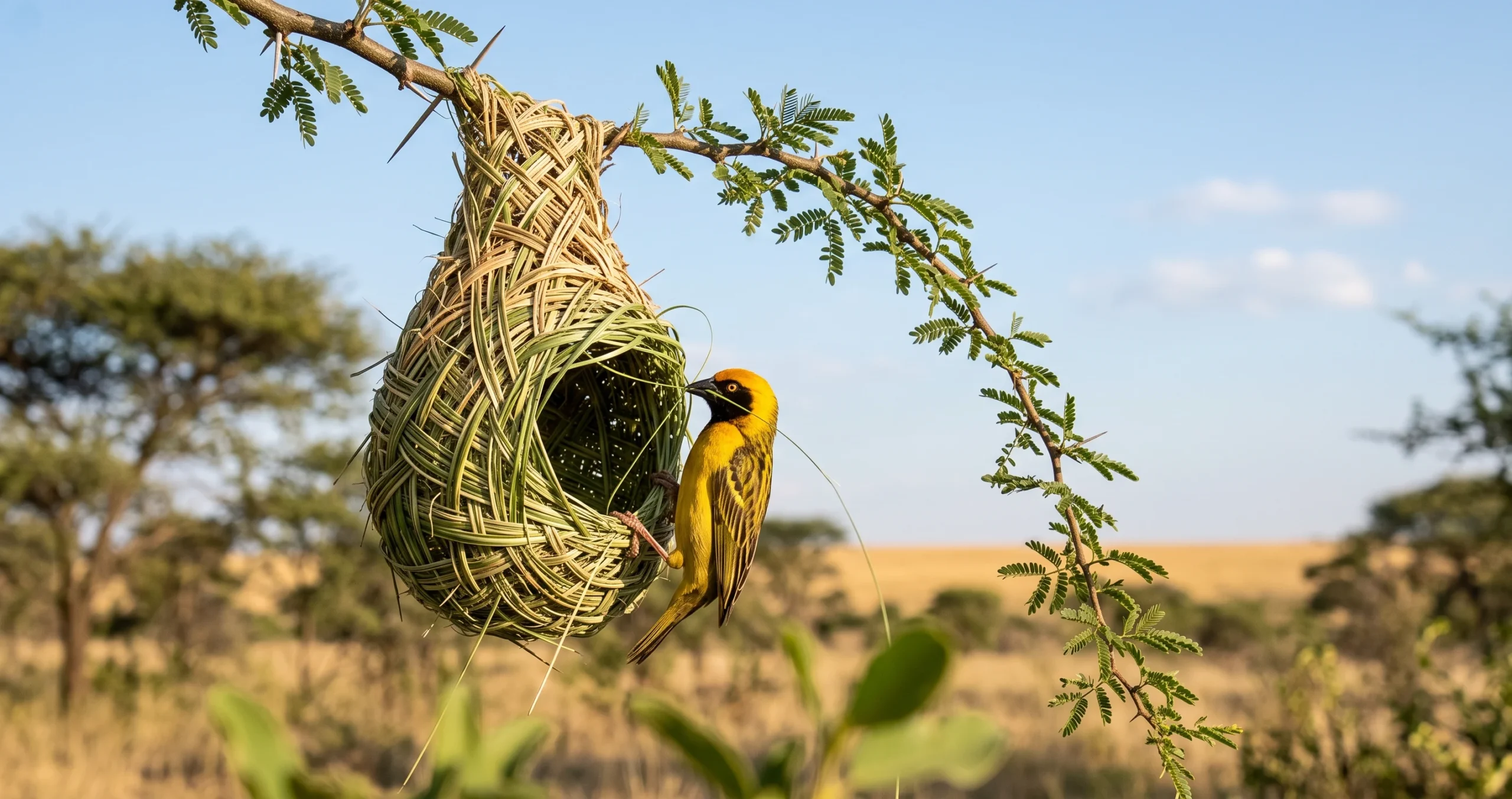
A finished weaver bird nest can look almost too precise to have been made with a beak and two feet. Yet weaver bird nest building is a remarkable combination of specialized behavior, material selection, repeated physical movements, and experience. Depending on the species, a male may transform flexible strips of grass into a suspended structure strong enough to hold eggs, chicks, and an incubating female.
The process is especially striking because there is no rigid internal frame and no human-style blueprint. The bird creates strength by looping, knotting, wrapping, pulling, and interlacing plant fibers. Research also suggests that nest building is not simply a perfectly fixed instinct: experience can improve a bird’s dexterity and alter how it handles materials. PubMed
Table of Contents
- What Makes Weaver Bird Nests So Remarkable?
- Weaver Bird Nest Building Step by Step
- How a Bird Can Knot Grass With Its Beak
- Why Flexible Grass Matters
- Why Females Inspect the Nest
- Nest Quality, Location, and Reproductive Success
- Why Weaver Birds Often Nest in Colonies
- What Researchers Have Learned From Weaver Birds
- Instinct Versus Learning
- Common Myths
- FAQ
- Conclusion
What Makes Weaver Bird Nests So Remarkable?
“Weaver bird” describes numerous species in the family Ploceidae, so there is no single construction method shared identically by every species. Some produce relatively simple woven nests, while others make elaborate suspended chambers with narrow entrances.
The famous hanging nests associated with species such as Baya Weavers and Southern Masked Weavers are essentially pieces of biological textile engineering.
Instead of piling twigs into a cup, the builder interlocks long plant fibers. Weaver birds can secure material with loops, hitches, and knot-like attachments before weaving additional fibers through the developing structure. Research literature describes birds pushing plant material through the growing fabric, grasping the other end, and pulling it into position. ScienceDirect
That distinction is important. A woven nest does not remain together merely because hundreds of grass blades happen to touch one another. Its strength comes from the way individual fibers interact.
Weaver Bird Nest Building Step by Step
The exact sequence varies among species, but researchers studying weavers have identified recognizable construction phases.
Step 1: Selecting the Support
Before weaving can begin, the male needs a suitable attachment point.
A branch must support the completed structure while also allowing the nest to hang freely. Nest placement can be extremely important. Research on Baya Weavers found that nest height, characteristics of the supporting branch, and whether the colony tree was thorny were associated with nesting success. OUP Academic
The bird therefore is not solving only an architectural problem. It is also choosing where that architecture will function.
Step 2: Attaching the First Fibers
This may be the most critical stage of weaver bird nest building.
The male brings long, flexible plant material to the branch and secures it around the support. Observations of weaver construction show that birds can use loops and knot-like attachments to anchor these first strands. ScienceDirect
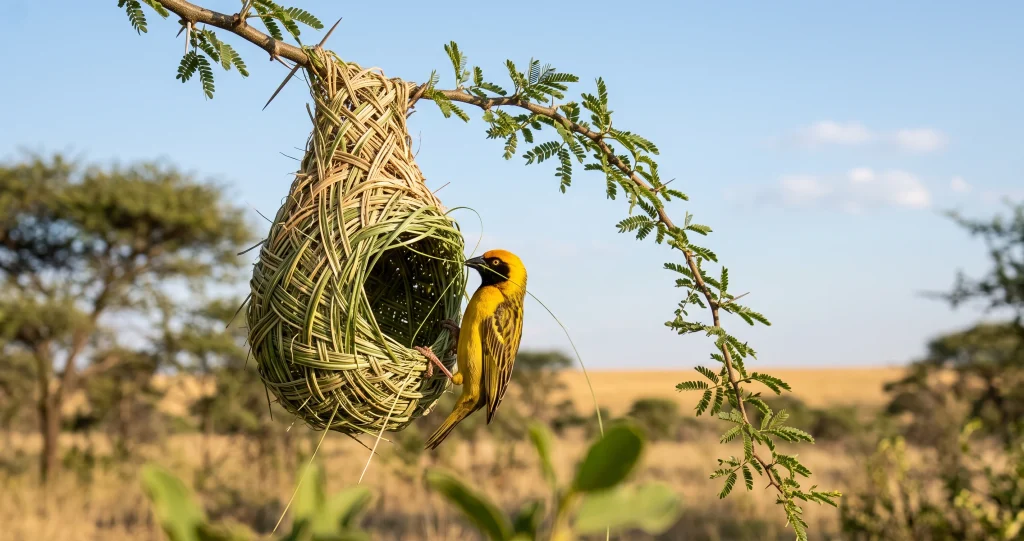
The beak acts almost like a highly precise hand. The bird grips, passes, releases, retrieves, and pulls the fiber while using its feet to maintain its position.
The initial attachment eventually has to support much more than itself.
Step 3: Building the Ring
In several well-studied weaver species, construction develops into a ring or hoop.
This creates a foundation from which the rest of the nest can expand. Rather than simply placing one blade beside another, the male repeatedly passes fibers through existing material.
Each addition creates more opportunities for subsequent strands to become interlocked.
Research on Southern Masked Weavers found measurable differences among males during these early construction phases, including differences in insertion direction, building speed, and how frequently they dropped grass. PubMed
Step 4: Expanding the Woven Shell
Once the foundation is secure, the recognizable nest begins to emerge.
The male continues bringing plant strips and weaving them through the existing structure. The ring gradually becomes a three-dimensional chamber with walls and a roof.
This is where repeated simple movements produce extraordinary complexity.
A strand may pass over one existing fiber, under another, and around a structural section before being pulled tight. Hundreds of these interactions turn flexible vegetation into a surprisingly coherent structure.
Step 5: Creating the Chamber and Entrance
The nest eventually develops an enclosed breeding chamber.
Some weaver species also create downward-facing openings or elongated entrance tubes. These elaborate pendent nest forms have long been associated with defense against predators, although researchers caution that some proposed protective functions are better supported than others. Comparative research supports a broader connection between elaborate nest architecture and defense. PubMed Central (PMC)
The completed object is no longer simply woven grass.
It is a suspended shelter engineered through repeated manipulation of plant fibers.
How Can a Bird Knot Grass With Its Beak?
Calling every attachment a “knot” can oversimplify what weavers actually do.
Researchers have described loops, hitches, tucks, wraps, and knot-like attachments in different species and stages of construction. The important principle is that a loose strip becomes mechanically secured around a branch or existing fibers. ScienceDirect
The beak provides remarkable precision.
A bird can push a strand through a narrow opening, release it, reposition its head, grasp the emerging section, and pull it through. Repeating this process effectively turns the existing nest into something resembling a loom.
Its feet provide additional stability and sometimes help manipulate material.
The result looks engineered because, mechanically, it is.
Why Flexible Grass Matters
Not every plant fiber works equally well.
Fresh or flexible grass can bend around branches and existing strands without immediately snapping. Long strips also allow the bird to make multiple passes through the developing nest.
Material properties can even affect reproductive success.
A study of Baya Weavers found that nests woven with fine fibers had higher fledging success than nests made with coarse fibers. The researchers suggested that fine fibers might contribute to a tighter weave, although the precise causal mechanism was not established. OUP Academic
Another study of Baya Weaver construction identified distinct stages including the initial attachment, ring, and helmet stages, illustrating that the nest develops through a structured sequence rather than appearing all at once. PubMed
Why Females Inspect the Nest
In several weaver species, the male’s construction is closely tied to courtship.
A male may build a partial or nearly completed nest and display around it when a female approaches. The female can then assess the male and his nesting site before accepting him.
Baya Weavers provide a particularly well-studied example.
Research found that females appear to consider nest characteristics, but location can be even more influential than architecture. Nests situated in favorable locations were associated with important direct benefits, including differences in nesting success. OUP Academic
So the popular statement that a female simply searches for “the best woven nest” misses part of the story.
She may effectively be evaluating a package: construction, materials, placement, and the safety associated with the site.
Nest Quality, Location, and Reproductive Success
A beautiful nest is useless if predators can easily reach it or the support fails.
In the Baya Weaver study, nests higher above the ground, nests in thorny trees, and nests attached to thicker supporting branches showed higher success. Fine-fiber construction was also associated with greater success. OUP Academic
Researchers found that location variables were slightly better overall predictors of fledging success than architectural variables.
This makes evolutionary sense.
Natural selection does not reward a nest for looking impressive. What ultimately matters is whether its characteristics help the birds reproduce successfully.
For another look at how birds choose and use nesting materials, see the Secrets of the Green Garden guide to safe nesting materials for birds.
Why Weaver Birds Often Build in Dense Colonies
Many weaver species are highly social and breed colonially, sometimes placing numerous conspicuous nests in the same tree or neighboring trees.
It is tempting to say that colonies exist simply because “more birds mean fewer predators,” but the ecology is more complicated.
Colonial living can provide increased collective vigilance and other social advantages, while nest-site structure itself may make nests harder for predators to reach. Recent research on Village Weavers emphasizes that colony size and nest-site selection reflect multiple factors, including vegetation structure, tree size, food access, water, habitat, and predation risk. PubMed Central (PMC)
There is even evidence of Village Weavers establishing colonies around nests of much larger bird species, an association researchers have proposed may provide protection from predators or brood parasites. Sciaria
So colonial nesting should be understood as part of a broader ecological strategy rather than a single-purpose defense system.
What Researchers Have Learned From Weaver Bird Construction
Weaver birds have become valuable subjects for scientists studying animal cognition and construction behavior.
One major lesson is that a complicated finished structure does not necessarily require the animal to mentally visualize every detail before beginning.
Complex architecture can emerge through repeated sequences of comparatively simple actions.
But the opposite extreme—assuming that a weaver simply follows an unchanging genetic program—is also unsupported.
Researchers studying Southern Masked Weavers found individual differences in construction behavior. Birds varied in how they inserted grass, how quickly they completed construction stages, and how often they dropped material. Some behaviors also changed as males gained building experience. PubMed
That makes weaver bird nest building especially interesting scientifically.
It sits at the intersection of evolved behavior, physical skill, environmental feedback, and learning.
Instinct Versus Learning
One of the biggest myths about bird nests is that birds emerge with something equivalent to a complete architectural plan programmed into their brains.
Evolution clearly supplies species-specific behavioral tendencies. A weaver does not need human instruction before attempting to manipulate vegetation into the characteristic architecture of its species.
But performance can change.
Southern Masked Weaver studies found patterns consistent with increasing dexterity as birds gained experience. Research reviewing weaver construction has similarly noted that weaving skill can develop with experience. PubMed
That means “instinct or learning” creates a false choice.
A more realistic interpretation is that evolution supplies behavioral foundations while experience can refine how effectively an individual performs them.
Common Myths About Weaver Bird Nests
Myth 1: Every Weaver Bird Builds the Same Nest
Ploceidae contains many species with different social systems and construction styles. The famous suspended woven nest represents only part of this diversity.
Myth 2: The Nest Is Made With One Perfect Knot
Construction involves repeated loops, wraps, tucks, interlacing, and knot-like attachments. The strength emerges from the entire woven structure.
Myth 3: Females Care Only About Appearance
Research on Baya Weavers shows that location can be particularly important. A structurally attractive nest in a dangerous location may provide fewer benefits than a safely positioned one. OUP Academic
Myth 4: Nest Building Is Purely Instinctive
Innate behavior matters, but studies show experience-related changes in building performance and material handling. PubMed
Myth 5: Every Weaver Species Has Males Doing All the Construction
Nest-building roles vary across the weaver family. Statements about male-only construction should therefore be tied to particular species rather than applied to every weaver bird.
FAQ
How long does it take a weaver bird to build a nest?
It varies by species, individual, material availability, and nest type. One field study of Baya Weavers reported males taking about 18 days to complete nests under the conditions studied, with different amounts of time devoted to individual construction phases. PubMed
Do weaver birds actually tie knots?
Some weavers use attachments that researchers describe as loops, hitches, tucks, and knots. These help secure vegetation to branches and to the growing nest structure. ScienceDirect
Why do weaver bird nests hang from branches?
Suspension can make a nest more difficult for some predators to access. Elaborate pendent architecture has been studied as a potential structural defense, although different features may serve multiple functions. PubMed Central (PMC)
Do female weaver birds reject poorly built nests?
In species where males build display nests, females can assess nests before mating. In Baya Weavers, evidence indicates that both architecture and especially nest location can influence female choice and reproductive outcomes. OUP Academic
Are weaver birds born knowing how to weave?
They have evolved behavioral predispositions for species-typical construction, but research indicates that experience matters too. Male Southern Masked Weavers changed aspects of their building behavior with experience, consistent with improving dexterity. PubMed
Why are there so many nests in one tree?
Many weavers breed colonially. Group nesting can contribute benefits such as increased vigilance, but colony formation also reflects suitable tree structure, food and water access, social behavior, habitat conditions, and predator pressure. PubMed Central (PMC)
Conclusion
A weaver bird’s nest looks machine-made because hundreds of small actions eventually produce an extraordinarily organized structure.
The bird begins with flexible vegetation and a branch. It anchors the first fibers, establishes a structural foundation, and repeatedly passes additional material through the developing fabric. Eventually, those simple strands become walls, a roof, a breeding chamber, and, in some species, an elaborate entrance.
But weaver bird nest building is more than an impressive instinct.
Studies show that experience can influence building dexterity, individual males can differ in construction behavior, females can evaluate nest-related characteristics, and the location of a nest may be as important—or sometimes more important—than its visible craftsmanship. PubMed
The finished nest is therefore the product of biology, mechanics, behavior, environment, and experience working together.
No ruler is required.
The precision comes one strand at a time.
External Sources: Oxford Academic — What Makes a Good Nest? Benefits of Nest Choice to Female Baya Weavers; PubMed — Individuality in Nest Building in Southern Masked Weavers; PubMed — Studies on Nest Construction and Nest Microclimate of the Baya Weaver.