
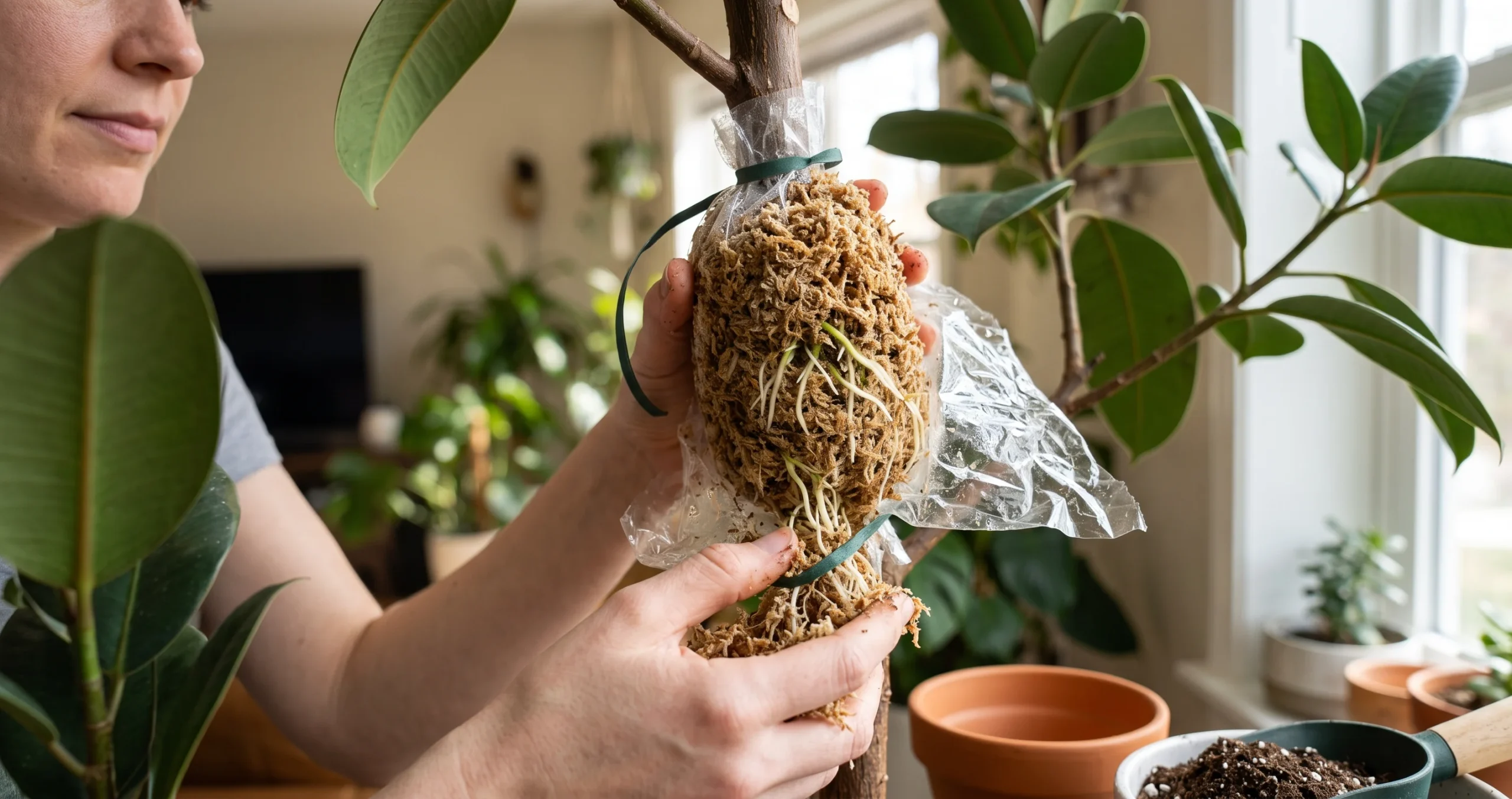
Propagating a favorite plant usually begins with a cut. You remove a stem, place it in water or growing medium, and hope it develops roots before dehydration or rot takes over. Air layering takes a different approach.
With air layering propagation, the selected stem remains attached to the parent plant while new roots develop around a carefully prepared wound. The branch continues receiving water and nutrients from the established root system during this critical period, which can make layering especially useful for larger stems and plants that are less dependable from ordinary cuttings.
The result is a surprisingly practical propagation method: instead of cutting first and rooting second, you encourage roots first and make the final cut only after a new root system is visible.
Table of Contents
- What Is Air Layering?
- Why Air Layering Can Be More Reliable Than Cuttings
- Best Time to Air Layer a Plant
- Supplies You Will Need
- Air Layering Propagation: Step-by-Step
- How Long Air Layering Takes
- Best Plants for Air Layering
- What to Do After Roots Form
- Common Air Layering Mistakes
- Common Myths About Air Layering
- Frequently Asked Questions
- Conclusion
What Is Air Layering?
Air layering is a form of vegetative propagation in which roots are encouraged to form on a stem while that stem is still attached to the parent plant.
Unlike a conventional cutting, the selected branch does not immediately lose access to the parent plant’s established root system. A section of stem is wounded, surrounded with moist rooting material—most commonly sphagnum moss—and wrapped to retain moisture.
Roots eventually develop around the wounded area. Once enough healthy roots have formed, the rooted section can be cut below the new root ball and planted separately.
The new plant is a genetic clone of the parent, just as it would be when propagated from a stem cutting.
The North Carolina State University Extension Gardener Handbook explains that layering is generally successful because water stress is minimized while the attached stem continues to have access to carbohydrates and mineral nutrients.
For gardeners accustomed to cuttings, our guide to plant propagation from cuttings provides a useful comparison between the two methods.
Why Air Layering Can Be More Reliable Than Cuttings
Air layering is sometimes described as having a universally higher success rate than cuttings, but that is too broad. Many plants—pothos, coleus, willow, and numerous herbs, for example—root so readily from cuttings that air layering offers little advantage.
Its strength becomes more apparent with certain woody plants, mature houseplants, and larger stems.
A freshly severed cutting has no functional roots. Until adventitious roots form, it must survive using water stored in its tissues while continuing to lose moisture through its leaves.
An air-layered branch remains connected to the parent during root formation. This reduces the severe water stress associated with an unrooted cutting. NC State Extension specifically identifies minimized water stress and continued access to nutrients and carbohydrates as reasons layering tends to be successful.
Air layering also allows you to start with a substantially larger piece of plant material. Instead of producing a tiny rooted cutting that may require considerable time to become a display-sized plant, you can sometimes root a mature section with several leaves and branches already attached.
This is particularly useful for tall, leggy houseplants. A rubber plant that has lost its lower leaves, for instance, can be air layered below its attractive upper growth. Once roots form, the top can be removed and replanted as a shorter, fuller-looking plant.
Best Time to Air Layer a Plant
Timing affects how quickly roots develop.
For many woody plants, spring is an excellent time because active growth is beginning. Mid- to late summer can also work with suitable current-season growth.
NC State Extension recommends spring using shoots produced during the previous season or mid- to late summer using current-season shoots for many woody ornamentals.
Indoor tropical plants offer more flexibility because their growing conditions can remain relatively stable throughout the year. Even indoors, however, active spring and summer growth usually provides better conditions than the short, low-light days of winter.
Avoid air layering a plant that is severely drought-stressed, diseased, recently damaged, or otherwise declining. Propagation works best when the parent plant is actively growing and healthy enough to support both itself and the developing layer.
Supplies You Will Need
Air layering requires surprisingly little equipment:
- Clean, sharp pruning knife or utility blade
- Sphagnum moss
- Clear plastic wrap or a clear plastic bag
- Plant ties, string, or tape
- Rooting hormone, optional
- Aluminum foil, optional
- Clean pruning shears for final separation
Use sphagnum moss that is moist but not dripping wet. Soak it thoroughly, then gently squeeze out excess water before applying it around the stem.
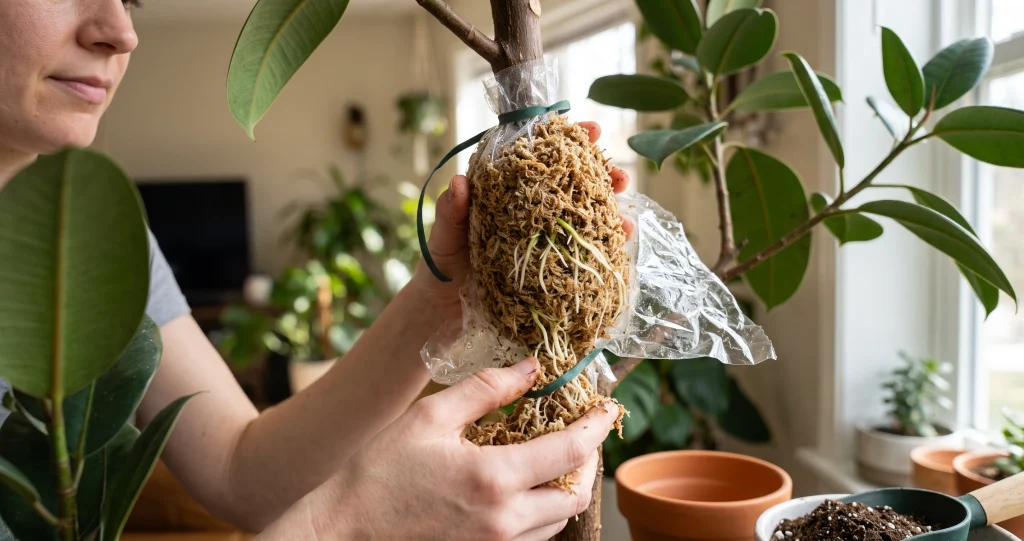
Clear plastic has one particularly useful advantage: it allows you to monitor root development without dismantling the layer.
Air Layering Propagation: Step-by-Step
Step 1: Select a Healthy Stem
Choose a healthy, vigorous stem free from obvious pests, disease, cracks, or damaged tissue.
For woody shrubs, a pencil-thick or larger stem is often suitable. NC State recommends stems approximately pencil diameter or larger for woody plants and commonly preparing the layer roughly 1 foot below the shoot tip.
Do not automatically choose the largest branch available. The future root system must support everything above the layer once the branch is removed.
Step 2: Prepare the Area
Remove leaves or small side shoots immediately around the location where you intend to create the layer.
You need enough bare stem to work safely and to wrap the moss securely.
Use a clean blade. Sanitation matters whenever plant tissue is deliberately wounded because the exposed area can provide an entry point for pathogens.
Step 3: Wound the Stem
The appropriate wound depends partly on the plant.
For many woody dicot plants, a common method is ring-barking or girdling: remove a narrow ring of bark around the stem. NC State describes removing approximately a 1-inch ring and scraping the exposed area to prevent the cambium from simply reconnecting across the wound.
Another method is an upward slanting cut into the stem. University of Missouri Extension describes making a cut an inch or more long and approximately halfway through the branch, then keeping that wound open with a small piece of wood such as a toothpick.
For monocot-type plants such as some Dracaena, the technique differs. NC State recommends an upward cut approximately one-third through the stem rather than removing a complete ring of bark.
The goal is not to sever the stem. You are interrupting tissue in a controlled area while keeping the branch attached and functional.
Step 4: Apply Rooting Hormone if Appropriate
Rooting hormone can be applied to the wounded area to encourage root initiation.
It is helpful for some plants but is not mandatory in every case. NC State notes that rooting hormone is not always necessary for air layering.
Follow the directions on the rooting product rather than assuming that more hormone produces more roots.
Step 5: Add Moist Sphagnum Moss
Take a generous handful of damp sphagnum moss and completely surround the wounded section.
The moss should make close contact with the wound while still containing enough air space for developing roots. Avoid compressing it into a waterlogged, solid mass.
University of Missouri Extension recommends moist, unmilled sphagnum around the wound and emphasizes keeping the rooting medium moist.
Step 6: Wrap the Moss
Cover the moss completely with clear plastic.
Overlap the plastic so moisture cannot escape easily, then secure both ends with plant ties, tape, string, or another gentle fastener.
The wrapping should be secure enough to hold the moss against the stem but should not crush the branch.
In hot, sunny outdoor locations, aluminum foil can be placed around the plastic to reduce heating and exclude light. If you do this, periodically open the foil layer so you can inspect the transparent wrap underneath.
Step 7: Keep the Moss Moist
Air layering is not completely maintenance-free.
Inspect the package periodically. The moss should remain consistently damp throughout root development.
If it begins drying, carefully open or inject water into the wrapping and reseal it. Do not repeatedly unwrap the entire root zone, because disturbing newly developing roots can damage them.
How Long Does Air Layering Take?
Patience is part of the process.
University of Missouri Extension notes that roots will usually take a month or more to appear. In practical home-growing conditions, many tropical houseplants may show visible roots within roughly four to eight weeks, while woody shrubs and slower species can require several months.
Temperature, season, light, species, stem maturity, moisture, and the condition of the parent plant all influence rooting speed.
Do not cut the branch simply because you can see one or two tiny roots.
Wait until a reasonably developed network of roots is visible through the moss. Those roots will become the new plant’s entire underground system immediately after separation.
Best Plants for Air Layering
Air layering is particularly useful for large or overgrown houseplants.
NC State specifically lists rubber plant, croton, and dieffenbachia as examples of houseplants that can be propagated this way. It also identifies woody ornamentals including azalea, camellia, magnolia, oleander, and holly.
Other plants commonly considered for layering include various Ficus species and Dracaena. NC State’s plant database notes that Ficus species can be vegetatively propagated through methods including layering.
Good candidates therefore include:
- Rubber plant (Ficus elastica)
- Other suitable Ficus species
- Croton
- Dieffenbachia
- Dracaena
- Camellia
- Azalea
- Magnolia
- Holly
- Oleander
Air layering is especially appealing when the plant has a valuable cultivar, a mature branch worth preserving, or a form that would take a small cutting years to reproduce.
Not every plant needs this treatment. Fast-rooting vines and soft-stemmed houseplants are usually easier to propagate through ordinary cuttings or division.
What to Do After Roots Form
Once a substantial root system is visible, use clean, sharp pruning shears to cut the stem below the rooted moss ball.
Remove the outer wrapping carefully, but avoid pulling the sphagnum away from the delicate roots. Newly formed roots can be surprisingly brittle.
Plant the rooted section into an appropriately sized container filled with a well-draining potting medium suited to that species. Water thoroughly and allow excess water to drain.
Keep the newly separated plant away from harsh midday sun and extreme temperature changes while it establishes. Even though it already has roots, those roots are limited compared with the mature root system that supported the branch before separation.
Avoid immediately fertilizing heavily. Give the plant time to establish its roots in the new growing medium before pushing vigorous new growth.
Common Air Layering Mistakes
One of the most common problems is allowing the moss to dry completely. New root initials are vulnerable to dehydration.
The opposite extreme can also cause trouble. Moss that is saturated with stagnant water has poor aeration and can encourage deterioration rather than healthy root growth.
Another mistake is cutting the branch from the parent too early. A few visible root tips do not necessarily constitute a root system capable of supporting a large canopy.
Poor stem selection also reduces success. Weak, diseased, severely stressed, or damaged branches are poor candidates for propagation.
Finally, avoid making a wound so aggressive that the branch breaks. Air layering depends on maintaining the branch’s connection to the parent until rooting is complete.
Common Myths About Air Layering
Myth: Air Layering Always Works Better Than Cuttings
No propagation method is universally superior.
Air layering has an important advantage because the branch remains attached during rooting, reducing water stress. But plants that root extremely easily from cuttings may be faster and simpler to propagate conventionally.
Myth: Rooting Hormone Is Essential
Rooting hormone can encourage root development, particularly in less cooperative species, but air layering can succeed without it.
The plant species, season, moisture level, stem condition, and wound preparation are also important.
Myth: More Water Means Faster Roots
Roots need moisture and oxygen.
Sphagnum should be consistently damp rather than waterlogged. Flooding the layer does not accelerate the biological processes responsible for root initiation.
Myth: The Branch Must Be Kept in Darkness
The roots themselves do not require sunlight. Clear plastic, however, makes inspection much easier.
If overheating or light exposure is a concern outdoors, an opaque outer covering such as foil can be placed around the transparent moisture barrier.
Myth: You Should Cut the Branch as Soon as the First Root Appears
The first root is evidence that the process is working, not necessarily that it is finished.
Allow enough roots to develop to support the foliage above the layer after separation.
Frequently Asked Questions
Is air layering difficult for beginners?
The basic process is straightforward, although making the wound correctly requires care. Maintaining moisture and waiting for adequate root development are more important than using complicated equipment.
How long does air layering propagation take?
Roots may begin appearing after a month or more, according to University of Missouri Extension. Many houseplants can develop usable roots within several weeks, while woody plants may need considerably longer.
Can I use regular potting soil instead of sphagnum moss?
Other rooting media can sometimes work, but sphagnum moss is convenient because it holds moisture while remaining relatively lightweight around an elevated stem. It is also easy to wrap securely.
Does the parent plant continue growing during air layering?
Yes. The layered stem remains attached during the rooting period, which is the defining advantage of the technique. Growth rate may vary according to species and conditions.
Can I air layer any branch?
No. Select healthy growth of appropriate maturity and diameter. Avoid damaged, diseased, very weak, or awkwardly positioned stems.
Is air layering the same as grafting?
No. Air layering encourages a stem to produce its own roots while still attached to its original plant. Grafting joins tissues from separate plant parts so they grow together.
When should I separate the new plant?
Separate it when the moss contains a clearly developed root system rather than only a few isolated root tips. Cut immediately below the rooted area and handle the new roots carefully.
Conclusion
Air layering turns the usual propagation sequence around. Instead of removing a branch and hoping it survives long enough to produce roots, you allow the branch to develop roots while it still benefits from the established parent plant.
That is why air layering propagation is particularly valuable for mature houseplants, woody ornamentals, difficult-to-root material, and situations where you want to produce a larger new plant than a typical cutting would provide.
Success comes down to a few fundamentals: start with a healthy plant, make the correct wound for the species, surround it with consistently moist but aerated sphagnum, wrap it securely, and give the roots enough time to develop before making the final cut.
It is not the best propagation method for every plant. For the right plant, however, air layering offers something conventional cuttings cannot—the chance to build the new root system before the new plant ever has to survive on its own.
2 Internal Link Suggestions:
- Plant Propagation from Cuttings: Grow New Plants for Free — ideal contextual link when comparing air layering with traditional stem cuttings.
- How to Propagate Hydrangeas the Easy Way — useful related reading for visitors interested in propagating ornamental shrubs.
3 External Sources:
- NC State Extension — Plant Propagation by Layering — detailed guidance on air layering techniques, suitable plants, wounding, moss, and timing.
- University of Missouri Extension — Plant Propagation — practical instructions covering stem preparation, rooting hormone, sphagnum moss, wrapping, and root development.
- NC State Extension Gardener Handbook — Propagation — comprehensive horticultural reference explaining layering biology and air-layering procedures.