
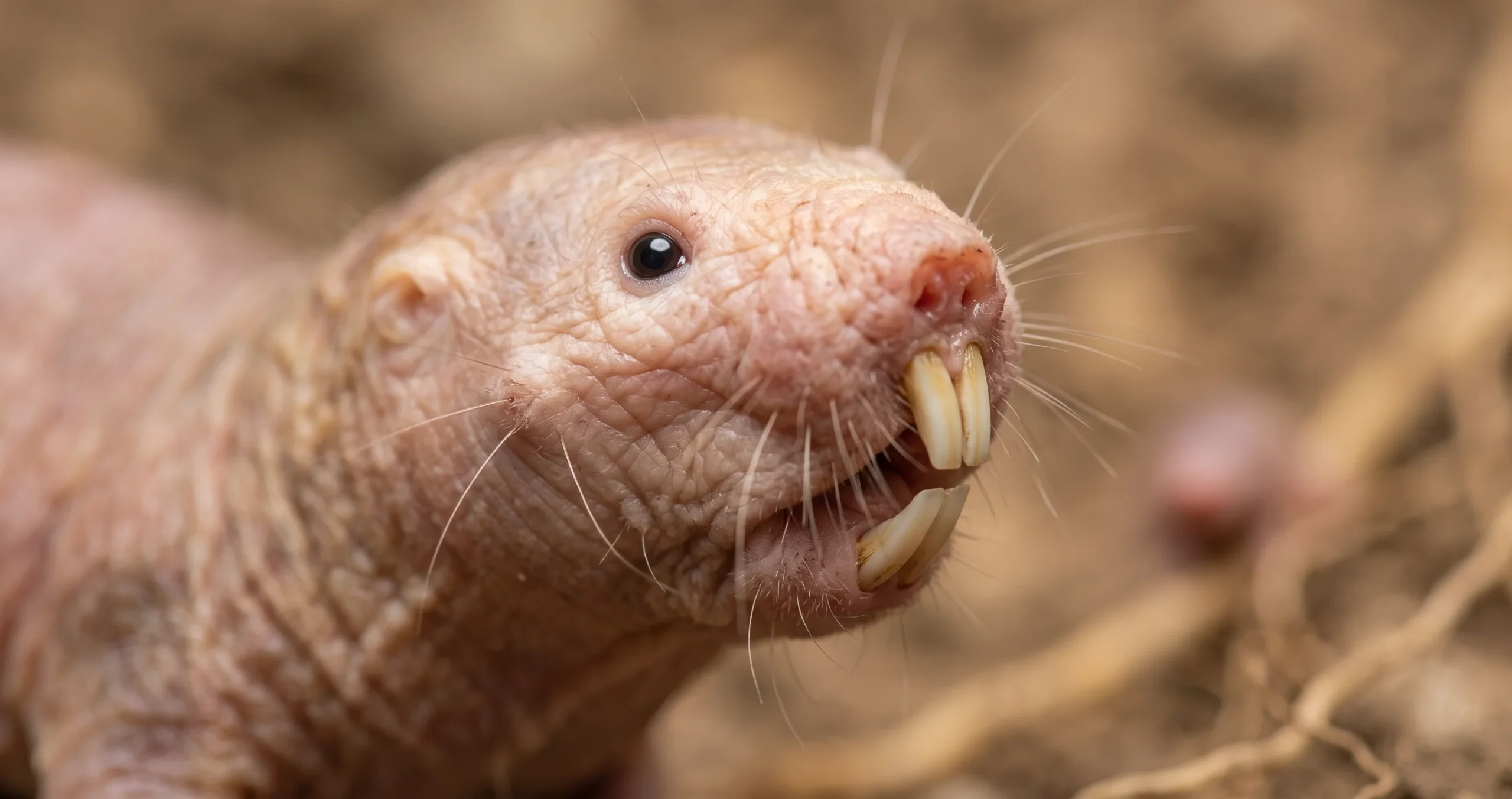
Naked mole rats look fragile: wrinkled skin, tiny eyes, prominent teeth, and bodies barely larger than a mouse. Yet beneath that unusual appearance lies one of the most remarkable biological systems known among mammals. Their exceptional longevity and strikingly low incidence of cancer have made them important animals in biomedical research.
Scientists studying naked mole rat cancer resistance have discovered several unusual cellular defenses, including an exceptionally large form of a molecule called hyaluronan. But the story is more complicated than the popular claim that naked mole rats “never get cancer.” Rare tumors have been documented, and researchers are still investigating how multiple protective mechanisms work together.
Table of Contents
- Meet the Naked Mole Rat
- Why Their Longevity Is So Unusual
- Naked Mole Rat Cancer Resistance and High-Molecular-Weight Hyaluronan
- Cancer Resistance Is Probably More Than One Mechanism
- Naked Mole Rats Can Still Develop Cancer
- Surviving With Very Little Oxygen
- Their Unusual Sensitivity to Pain
- What Scientists Hope to Learn for Human Medicine
- Common Myths About Naked Mole Rats
- Frequently Asked Questions
- Conclusion
Meet the Naked Mole Rat
The naked mole rat (Heterocephalus glaber) is a small subterranean rodent native to arid and semi-arid areas of northeastern Africa. It spends most of its life underground in extensive tunnel systems where colonies cooperate to excavate soil, find food, defend their burrows, and care for young.
Their social organization is unusual for mammals. Colonies generally contain a reproductive female, commonly called the queen, while most other animals function as nonbreeding workers or defenders.
Life underground also presents serious physiological challenges. Crowded tunnels can contain relatively little oxygen and elevated carbon dioxide, creating conditions that would be stressful or dangerous for many surface-dwelling mammals. Naked mole rats possess remarkable adaptations to these conditions.
Those adaptations have helped turn this odd-looking rodent into an important laboratory model for studying cancer, aging, oxygen deprivation, metabolism, and pain.
Why Their Longevity Is So Unusual
Body size and lifespan often show broad relationships among mammals. Small rodents typically live much shorter lives than larger mammals.
Naked mole rats break expectations dramatically.
Early research documented maximum lifespans exceeding 30 years, despite naked mole rats being roughly mouse-sized. More recent research has reported individuals reaching approximately 37 years. By comparison, laboratory mice generally live only a few years.
This extraordinary lifespan immediately raises another biological puzzle.
The longer an animal lives, the more opportunities its cells theoretically have to accumulate mutations and other damage that could contribute to cancer. Yet naked mole rats historically showed surprisingly few tumors.
That combination—small body, long life, and unusually low cancer incidence—is one reason naked mole rat cancer resistance has attracted so much scientific attention.
![Naked mole rat cancer resistance studied in a long-lived underground rodent]](https://secretsofthegreengarden.com/wp-content/uploads/2026/09/Gemini_Generated_Image_lq3m7mlq3m7mlq3m-1024x541.webp)
Naked Mole Rat Cancer Resistance and High-Molecular-Weight Hyaluronan
One of the most influential discoveries came from researchers studying naked mole rat cells in the laboratory.
They noticed something unusual about the liquid surrounding cultured naked mole rat fibroblasts: it was unusually viscous.
Eventually, researchers traced that property to hyaluronan, also known as hyaluronic acid. Hyaluronan is not unique to naked mole rats. Humans and many other animals produce it as part of the extracellular matrix—the material surrounding and supporting cells.
What was unusual was its size.
An Exceptionally Large Molecule
In a landmark 2013 study published in Nature, researchers found that naked mole rat cells produced extremely high-molecular-mass hyaluronan, often abbreviated HMM-HA. Their hyaluronan was more than five times larger than that found in mice or humans in the study.
You can read the original Nature study on high-molecular-mass hyaluronan for the experimental details.
The researchers found two important reasons why so much giant hyaluronan accumulated.
Naked mole rats possess an unusual version of the enzyme hyaluronan synthase 2, or HAS2, involved in producing hyaluronan. Their tissues also showed relatively low activity of enzymes responsible for breaking hyaluronan down.
The result is an extracellular environment unusually rich in very large hyaluronan molecules.
How Could Hyaluronan Help Stop Cancer?
Normal cells contain mechanisms that tell them when to stop dividing. Cancer cells often escape these controls.
The researchers found that high-molecular-weight hyaluronan contributed to an especially strong form of growth control in naked mole rat cells. When cells became crowded, signaling associated with HMM-HA helped prevent inappropriate proliferation.
The strongest evidence came when researchers interfered with this system.
When they reduced production of the unusually large hyaluronan or increased its breakdown, naked mole rat cells became more susceptible to malignant transformation in laboratory experiments.
That experiment suggested that HMM-HA was not simply an unusual chemical characteristic. It was functionally involved in naked mole rat cancer resistance.
Researchers have proposed that this unusual hyaluronan may originally have evolved partly because loose, flexible skin is useful when squeezing through underground tunnels. Cancer protection may have emerged as an additional benefit.
Cancer Resistance Is Probably More Than One Mechanism
It would be tempting to describe HMM-HA as the naked mole rat’s single “cancer shield.” Biology rarely works so simply.
Cancer develops through multiple stages involving genetic mutations, cellular signaling, metabolism, tissue environments, immune responses, and failures of normal growth control.
Research into naked mole rat cancer resistance therefore extends well beyond hyaluronan.
Scientists have investigated unusual tumor-suppressor pathways, cellular contact inhibition, protein maintenance, DNA stability, metabolism, stress resistance, and other characteristics that could contribute to healthy aging.
The animal’s genome itself has become an important research resource. Genome sequencing has identified distinctive features associated with longevity, underground living, low-oxygen tolerance, altered sensory biology, and cancer resistance.
Rather than possessing one miraculous anticancer mechanism, naked mole rats appear to have evolved a collection of defenses that make malignant transformation unusually difficult.
Naked Mole Rats Can Still Develop Cancer
This is where one of the most persistent myths needs correcting.
Naked mole rats are highly cancer-resistant, but they are not completely cancer-proof.
For years, scientists studying colonies reported essentially no spontaneous cancer, encouraging the widespread claim that the animals never developed tumors.
Eventually, documented exceptions appeared.
Researchers reported two cases of cancer in zoo-housed naked mole rats, including an adenocarcinoma and a neuroendocrine carcinoma. Another investigation documented several additional spontaneous neoplasms, including hepatocellular carcinoma, nephroblastoma and lymphosarcoma.
These reports changed the wording scientists should use.
The evidence supports saying naked mole rats have remarkable or unusually strong cancer resistance—not absolute immunity to cancer. Reviews of the evidence continue to describe documented cancers as rare.
That distinction actually makes the animals more scientifically interesting. Researchers can ask why tumors occur so infrequently rather than relying on the biologically unrealistic assumption that cancer is impossible.
Surviving With Very Little Oxygen
Cancer resistance is only one extraordinary part of naked mole rat physiology.
Imagine dozens of mammals living together deep underground, breathing within tunnels where fresh air moves slowly. Oxygen can fall while carbon dioxide rises.
Naked mole rats are exceptionally well adapted to such conditions.
During severe oxygen deprivation, they can reduce energy consumption by slowing physiological processes including heart and brain activity. Research has also shown that under extreme oxygen shortage they can use fructose-driven metabolic pathways in ways that help maintain energy production.
Their cardiovascular system also displays adaptations associated with underground life and hypoxia tolerance.
These traits are being investigated separately from cancer resistance, although researchers are interested in whether the animal’s unusual metabolism, cellular stress responses, and longevity interact.
For another example of extraordinary animal physiology, see our guide to why octopuses have three hearts and blue blood.
Their Unusual Sensitivity to Pain
Another popular claim says naked mole rats “cannot feel pain.”
That is misleading.
They can detect harmful stimuli, but their pain system differs from that of most mammals in important ways. They show dramatically reduced behavioral responses to certain chemical forms of pain, particularly acid-associated pain and responses involving capsaicin.
That makes sense in the context of their underground environment.
High carbon dioxide concentrations can contribute to acidic conditions in tissues. An animal living permanently in crowded, poorly ventilated tunnels would benefit from physiological adaptations that prevent constant irritation from that environment.
Researchers have therefore studied naked mole rat sensory neurons and ion channels to understand why certain painful chemical stimuli produce such unusual responses.
This does not mean a naked mole rat is generally incapable of experiencing injury or pain. It means particular pain pathways have evolved differently.
What Scientists Hope to Learn for Human Medicine
The obvious question is whether naked mole rat biology could someday help humans.
Possibly—but translating discoveries between species is difficult.
Researchers are interested in HMM-HA because humans already produce hyaluronan. Understanding why the naked mole rat version is so large, how it accumulates, and how it affects cellular signaling could reveal new targets or principles relevant to cancer biology.
The goal is not simply to inject people with “naked mole rat molecules.” Human tissues, immune systems, cancer pathways, and metabolism differ substantially from those of rodents.
Instead, comparative biology helps scientists discover mechanisms they might otherwise overlook.
Cancer Research
Naked mole rats provide a natural experiment in suppressing cancer over an unusually long lifespan.
Researchers can investigate how their cells prevent uncontrolled growth, respond to oncogenic changes, maintain tissues, and regulate their extracellular environment.
Those discoveries may eventually suggest therapeutic targets worth investigating in humans.
Aging Research
Their longevity creates another opportunity.
A mouse-sized mammal capable of surviving for decades gives researchers a useful comparison for studying why some species age slowly while closely sized animals age quickly.
Scientists are especially interested in cellular maintenance, protein stability, metabolism, stress responses, DNA protection, and mechanisms that preserve tissue function with age.
Oxygen-Deprivation Research
Their ability to tolerate severe hypoxia may also provide clues relevant to conditions where human tissues suddenly lose oxygen.
Researchers have discussed potential implications for understanding damage associated with events such as heart attacks and strokes, although converting an evolutionary adaptation into a safe human therapy requires extensive additional research.
The naked mole rat should therefore be viewed as a source of biological clues—not a ready-made medical treatment.
Common Myths About Naked Mole Rats
Myth: Naked mole rats never get cancer.
Rare cancers have been documented. Their cancer incidence appears remarkably low, but they are not completely immune.
Myth: Hyaluronan completely explains their cancer resistance.
High-molecular-weight hyaluronan is an important mechanism supported by experimental evidence, but researchers continue studying additional cellular and molecular defenses.
Myth: Naked mole rats do not age.
They are exceptionally long-lived and show unusual aging patterns, but they are not immortal.
Myth: They cannot feel pain.
Their responses to certain chemical pain signals are dramatically reduced. That is different from being incapable of sensing all harmful stimuli.
Myth: Their adaptations can immediately be used to cure human cancer.
Discovering a mechanism in another species is only the beginning. Any potential human application requires extensive laboratory research, safety testing, and clinical evaluation.
Frequently Asked Questions
Do naked mole rats really never get cancer?
No. Several spontaneous tumors and cancers have been documented. The scientifically accurate description is that naked mole rats show unusually strong cancer resistance and apparently very low cancer incidence, not complete cancer immunity.
What is high-molecular-weight hyaluronan?
Hyaluronan is a large carbohydrate molecule found in the extracellular matrix surrounding cells. Naked mole rats produce an exceptionally large form called high-molecular-mass hyaluronan, which has been experimentally linked to their resistance to malignant cellular transformation.
How long can naked mole rats live?
Naked mole rats have been documented living for more than 30 years, extraordinary longevity for such a small rodent. Research published in 2024 referenced a lifespan reaching 37 years.
Why can naked mole rats survive low oxygen?
They possess multiple physiological and metabolic adaptations. During severe oxygen shortage, they reduce energy demands and can use unusual metabolic pathways, including fructose-based metabolism, to help maintain vital cellular functions.
Are naked mole rats immune to pain?
No. They have unusual sensory adaptations that make them insensitive or much less responsive to particular chemical pain stimuli, including acid-related pain. This should not be interpreted as an inability to experience any form of pain.
Could naked mole rats lead to a human cancer treatment?
Their biology may reveal mechanisms that inspire new approaches to cancer prevention or treatment, but no discovery in naked mole rats automatically translates into an effective human therapy. Their value lies in revealing biological pathways researchers can investigate further.
Conclusion
Naked mole rats are not cancer-proof, ageless, or magically immune to disease. Their real biology is more interesting than those myths.
The evidence behind naked mole rat cancer resistance points toward an unusual combination of defenses, with exceptionally high-molecular-weight hyaluronan providing one of the clearest experimentally demonstrated mechanisms. Their cells, metabolism, stress responses, and extraordinary longevity offer additional clues researchers are continuing to investigate.
Add their tolerance of oxygen-poor tunnels and unusual chemical pain responses, and the naked mole rat becomes far more than an evolutionary curiosity.
For biomedical researchers, this small underground rodent represents something particularly valuable: a naturally evolved experiment showing that mammalian cells can remain functional for decades while making cancer unusually difficult to establish.
Understanding exactly how it accomplishes that feat could deepen our understanding of both cancer and aging—even if turning those lessons into human medicine remains a much longer journey.
External Sources:
- Nature — High-molecular-mass hyaluronan mediates the cancer resistance of the naked mole rat: Nature research paper
- PubMed — Four Cases of Spontaneous Neoplasia in the Naked Mole-Rat: PubMed research record
- PubMed/NIH — Naked Mole-Rats Demonstrate Profound Tolerance to Low Oxygen, High Carbon Dioxide, and Chemical Pain: PubMed research record