
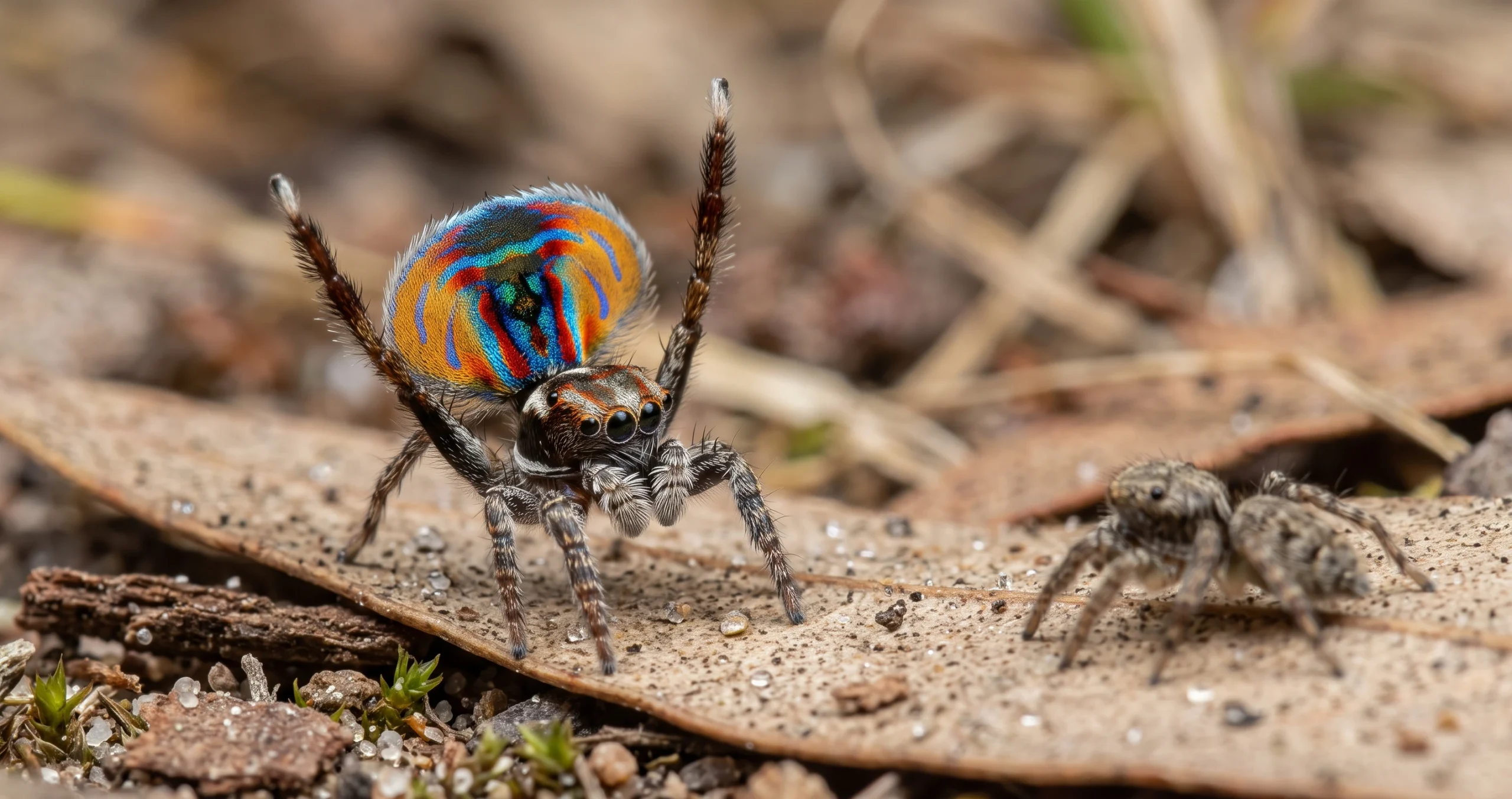
At a scale of only a few millimeters, a male peacock spider approaches a female. He raises his elongated third pair of legs, elevates his brilliantly patterned abdomen, and begins a sequence of precisely timed movements. At the same time, mechanical vibrations generated during the display travel through the surface beneath the spiders.
This is peacock spider courtship, and calling it simply a colorful “dance” misses much of its biological complexity. In the best-studied species, particularly Maratus volans, males combine visual ornaments, body movements, and substrate-borne vibrations during courtship. Experiments indicate that females can respond to multiple components of this elaborate signaling system.
Table of Contents
- Meet the Peacock Spiders
- Why the Males Are So Colorful
- The Female Looks Very Different
- The Courtship Begins
- Raising the Legs
- Unfolding the Colorful Abdomen
- More Than a Visual Performance
- How Courtship Vibrations Travel
- How Spiders Detect Vibrations
- Coordinating Color, Motion and Vibration
- Different Species, Different Performances
- What the Female Is Evaluating
- When Courtship Fails
- Why Did Such Elaborate Displays Evolve?
- Can Peacock Spiders See Their Own Brilliant Colors?
- Why Scientists Study Peacock Spider Courtship
- Frequently Asked Questions
- Conclusion
Meet the Peacock Spiders
Peacock spiders belong to Maratus, an Australian genus within the jumping-spider family Salticidae.
They are tiny. Depending on the species, adults are generally only a few millimeters long, yet males can carry some of the most visually elaborate ornamentation found among spiders.
The genus is remarkably diverse, with numerous described species distributed across Australia. New species have continued to be recognized as researchers investigate different habitats and populations.
Like other jumping spiders, Maratus species are active visual predators rather than web-building hunters. Their large forward-facing principal eyes provide excellent spatial resolution for animals of their size.
Their visual abilities are also central to reproduction.
In many species, males possess elaborate colors and patterns displayed during courtship. These ornaments occur alongside specialized movements and, in studied species, vibratory signaling.
Why the Males Are So Colorful
Male peacock spiders can display combinations of red, orange, yellow, blue, green, white, and black.
The exact palette varies greatly among species.
Much of the spectacular appearance comes from specialized scales or hair-like structures covering portions of the body, particularly the abdomen.
Different physical mechanisms can produce different colors.
Some coloration involves pigments that selectively absorb and reflect wavelengths of light. Other colors are structural, meaning that microscopic architecture manipulates reflected light.
Structural coloration can produce particularly intense or iridescent effects.
Research on peacock-spider scales has revealed extraordinarily small optical structures capable of separating wavelengths of light. In some species, specialized scales function somewhat like microscopic diffraction gratings.
The result is not merely decoration from a human perspective.
These colored surfaces are positioned on body regions prominently presented toward females during courtship, strongly connecting ornamentation with reproductive signaling.
The Female Looks Very Different
Peacock spiders show pronounced sexual dimorphism.
Males of many species possess bright abdominal ornaments and conspicuous leg markings. Females tend to be much more cryptically colored, often in combinations of brown, gray, beige, and muted patterns.
That distinction should not be treated as an absolute template for every species.
Maratus contains considerable variation in body pattern, ornamentation, and morphology.
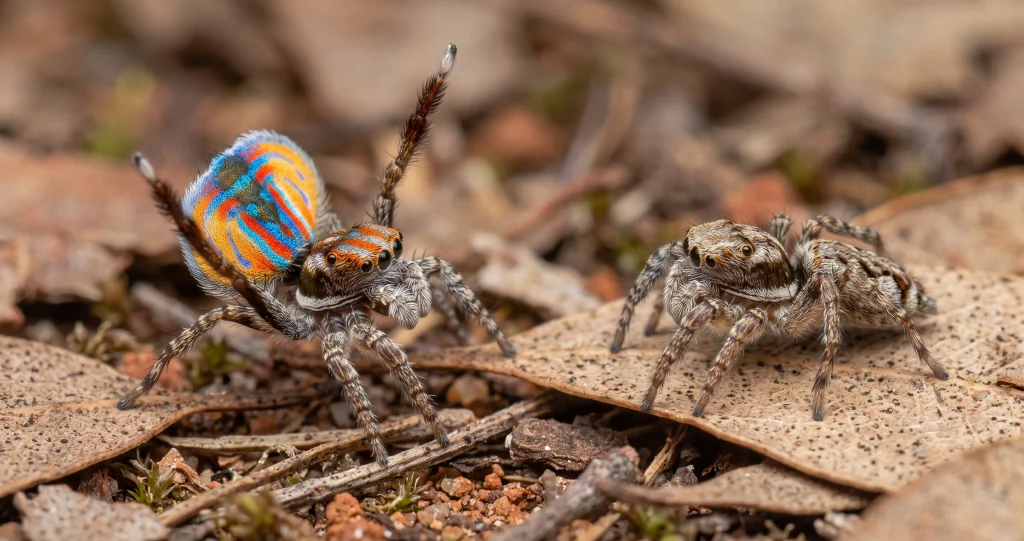
Even among males, the famous expandable abdominal “fan” varies.
Some species possess prominent lateral flaps that can be extended during courtship, while others lack the same dramatic structures or display their abdomens differently.
This diversity is one reason the genus is so valuable for studying signal evolution.
The Courtship Begins
Courtship starts before the famous abdominal display reaches its most spectacular form.
A male must first detect a potential female and attract her attention while avoiding being mistaken for prey or an unwanted intruder.
Jumping spiders possess multiple sensory systems that can contribute to this process.
Vision is particularly important. Their principal eyes provide high-resolution vision, while secondary eyes are effective at detecting movement across a broad field around the animal.
In M. volans, researchers have described several identifiable stages and components of courtship rather than one continuous repetitive dance.
Males may flick their pedipalps, wave their legs, move laterally, oscillate the abdomen, and alter their displays as they approach a female.
Raising the Legs
One of the most recognizable components of Maratus courtship involves the third pair of legs.
In many familiar species, these legs are elongated and ornamented.
A courting male can raise them dramatically above his body and move them through carefully structured sequences.
In M. volans, researchers using regular and high-speed video documented multiple leg positions and movements occurring during different phases of courtship.
The legs may be extended upward, rotated, lowered, or moved in coordination with the abdomen.
These movements create a highly conspicuous visual signal when viewed from the female’s position.
They also illustrate why a still photograph reveals only a fraction of the display.
Image 1 placement — 1200 × 630 px, photorealistic, no text or graphic overlays
Alt text: Male peacock spider courtship display with raised legs and colorful abdomen
Unfolding the Colorful Abdomen
The abdomen, technically called the opisthosoma, provides another major visual component.
In male M. volans, lateral abdominal flaps normally folded around the sides can be extended during advanced courtship.
The expanded structure forms the famous fan-like display that inspired the common name “peacock spider.”
The male elevates the abdomen and presents its colorful dorsal surface toward the female. He can then move the fan from side to side while coordinating those movements with his ornamented third legs.
But this particular arrangement should not be generalized to every member of Maratus.
Male abdominal structures differ considerably among species. Some possess large expandable flaps; others rely on different combinations of abdominal pattern, shape, posture, and movement.
The shared evolutionary theme is elaborate signaling, not one identical choreography.
More Than a Visual Performance
The spectacular colors naturally dominate photographs and videos.
Yet M. volans is communicating through another channel that human observers cannot detect simply by watching the spider.
The male produces vibrations.
Using laser vibrometry, researchers demonstrated that vibratory signals occur extensively throughout M. volans courtship. Several distinct signal components were identified.
Some begin early and recur during much of the display. Others occur during later phases as the male approaches mating.
Researchers found that these vibrations frequently accompany visual movements.
The display is therefore multimodal: information can be transmitted through both visual and mechanical channels.
How Courtship Vibrations Travel
These signals should not be imagined primarily as airborne sounds resembling birdsong.
They are substrate-borne vibrations.
When a spider moves or oscillates part of its body, mechanical energy can pass through its legs into whatever surface it is standing on.
That surface might be a leaf, twig, bark, or another material.
The vibration then propagates through the substrate.
A nearby spider in physical contact with that same surface can potentially detect the mechanical disturbance.
In M. volans, vibrational signals coincide with characteristic abdominal movements. Researchers proposed mechanisms including tremulation, in which oscillations of the body are transmitted through the legs into the substrate, although details of signal production have required further investigation.
Substrate properties matter because different materials transmit mechanical frequencies differently.
A signal traveling through a leaf does not necessarily propagate exactly as it would through a rigid twig.
How Spiders Detect Vibrations
Spiders possess highly sensitive mechanoreceptors.
Among the important structures are slit sensilla—tiny strain-sensitive structures in the exoskeleton. Groups of these sensory organs can form structures called lyriform organs near leg joints.
Mechanical forces slightly deform the exoskeleton.
Sensory cells associated with these structures can detect those minute changes and convert them into neural signals.
Spiders also possess sensory hairs capable of detecting mechanical disturbances, including air movements.
Together, these systems give spiders access to a mechanical world largely invisible to humans.
Vibrations can contain information about prey, predators, web disturbances, environmental events, and other spiders.
During courtship, the male can exploit this sensory channel to communicate with a nearby female.
Coordinating Color, Motion and Vibration
Multimodal communication does not simply mean that several signals happen randomly at once.
In M. volans, researchers have documented structured associations between movement and vibration.
The original detailed study identified distinct visual behaviors alongside multiple vibratory components. Vibrations were used extensively and often occurred before motion displays, particularly when a female was farther away or not directly oriented toward the male.
Later mating experiments examined whether these different aspects of courtship predicted reproductive success.
The results provided evidence of strong sexual selection, with male mating success associated with combinations of visual and vibratory performance rather than a single simple trait.
That does not mean every signal component performs the same function.
Different channels can provide overlapping information, different information, or compensate for one another under different environmental conditions.
Later experimental work also showed that the relationship is complex: manipulating particular long-wavelength colors and vibratory conditions did not produce simple all-or-nothing changes in mating success.
Image 2 placement — 1200 × 630 px, photorealistic, no text or graphic overlays
Alt text: Male and female peacock spiders during a courtship display
Different Species, Different Performances
There is no universal peacock-spider dance.
Species can differ dramatically in abdominal patterning, leg ornamentation, timing, posture, movement, and the structures displayed toward females.
Some males produce broad fan-like presentations.
Others emphasize striking leg movements or differently shaped abdominal ornaments.
The color combinations themselves can be highly species-specific.
These differences are biologically important because courtship signals can help animals identify appropriate mates.
As lineages diverge, changes in female preferences and male displays can contribute to reproductive isolation.
The remarkable diversification of Maratus therefore offers researchers a natural system for investigating how communication evolves alongside species diversity.
What the Female Is Evaluating
A female does not simply sit passively while a male performs.
Her behavior changes during courtship.
Studies of M. volans have documented females orienting toward males, changing position, signaling receptivity, or rejecting courtship.
Experiments have also found relationships between aspects of male performance and mating success.
One study found that both visual and vibratory traits contributed to predicting successful mating, supporting an important role for female choice in maintaining complex male displays.
Researchers should nevertheless be cautious about translating this into statements about what a female “likes” or consciously thinks.
Experiments can determine which signals affect measurable behavior and mating outcomes.
They cannot directly reveal a spider’s subjective experience.
When Courtship Fails
Not every display ends in mating.
A female may move away, turn away, adopt rejection behavior, or otherwise prevent the male from successfully approaching.
Courtship can also carry risks.
Jumping spiders are predators, and females can attack males under some circumstances.
However, the popular claim that every unsuccessful male peacock spider is immediately eaten is exaggerated.
Cannibalism can occur, but rejection and cannibalism are not synonymous.
For the male, successful courtship therefore involves both attracting a female and responding appropriately to her behavior as the interaction progresses.
Why Did Such Elaborate Displays Evolve?
Sexual selection provides the central evolutionary framework.
If females are more likely to mate with males possessing particular traits or performing particular behaviors, those males can leave more offspring.
Over generations, male traits favored through mate choice can become increasingly elaborate.
This does not mean males intentionally evolve brighter colors because females want entertainment.
Evolution has no foresight.
Instead, heritable variation in ornamentation and behavior interacts with differences in reproductive success across many generations.
Research on M. volans provides empirical evidence that female mating decisions are associated with components of complex male signaling.
The diversity of Maratus suggests another possibility.
As signaling traits and preferences diverge among populations, sexual selection may contribute to diversification and potentially reproductive isolation.
Exactly how strongly that process explains the extraordinary species richness and signal diversity of Maratus remains an active research question.
Can Peacock Spiders See Their Own Brilliant Colors?
Jumping spiders possess some of the most sophisticated visual systems among arthropods.
Their principal eyes provide extraordinary spatial resolution relative to body size. Additional eyes expand the field of view and are especially useful for detecting movement.
Color vision, however, is more complicated than simply saying jumping spiders “see every color humans see.”
Salticid visual systems vary among lineages.
Research has demonstrated multiple mechanisms for color discrimination in jumping spiders, including sensitivity extending into ultraviolet wavelengths. Different salticid groups have evolved different solutions for discriminating colors.
The visual ecology of Maratus is particularly interesting because males display intense coloration directly toward females.
Experimental studies of M. volans indicate that visual contrast matters during courtship, while some assumptions about the importance of particular long-wavelength colors have received less straightforward support than researchers initially expected.
It is therefore reasonable to say that peacock spiders possess visual systems capable of evaluating important components of their displays.
It is less defensible to assume that their subjective experience of those colors resembles ours.
Why Scientists Study Peacock Spider Courtship
Peacock spiders compress a surprisingly complex communication system into an animal only a few millimeters long.
That makes them powerful models for behavioral research.
Scientists can quantify color, pattern, body movement, vibration, female responses, and mating outcomes.
Researchers can then ask whether signals provide redundant information, communicate different information, work best in particular combinations, or remain effective under different environmental conditions.
The diversity of the genus creates additional opportunities.
Comparing closely related species can reveal how signaling systems change during evolution and whether shifts in male ornaments correspond with changes in female sensory biology or behavior.
Peacock spiders can therefore illuminate broader questions about sexual selection, multimodal communication, sensory ecology, signal evolution, and speciation.
The foundational peer-reviewed study “Multi-Modal Courtship in the Peacock Spider, Maratus volans” used high-speed video and laser vibrometry to document the combination of visual and vibratory signaling in detail.
For another example of how arthropod behavior can be read from physical structures, see our article on how spider webs reveal different hunting strategies.
Frequently Asked Questions
How large are peacock spiders?
Most are extremely small jumping spiders only a few millimeters long. Published descriptions of the group commonly place adult body lengths within roughly the 2–6 millimeter range, although size varies among species.
Do peacock spiders really dance?
Males perform complex, stereotyped courtship movements, so “dance” is a useful informal description. Scientifically, however, the display includes visual postures, movement patterns, and, in studied species such as M. volans, substrate-borne vibratory signals.
Why do male peacock spiders raise their legs?
In many species, ornamented and elongated third legs form an important part of the visual courtship display. Their movements can be coordinated with abdominal displays.
Do all peacock spiders have expandable abdominal fans?
No. Abdominal structures and courtship displays vary considerably among Maratus species. The spectacular expandable lateral flaps of M. volans should not be treated as a universal feature of every species.
Can female peacock spiders detect courtship vibrations?
Jumping spiders possess sensitive mechanoreceptors capable of detecting substrate vibrations. Experiments with M. volans show that vibratory signals form part of male courtship and can be associated with female behavior and mating outcomes.
Does a female always eat a male that fails to impress her?
No. Females can reject males without eating them. Sexual cannibalism can occur, but the claim that every unsuccessful courtship ends with the male being consumed is inaccurate.
Are peacock spiders found outside Australia?
The genus Maratus is overwhelmingly associated with Australia and represents a remarkable Australian radiation of jumping spiders. Individual species have much more restricted distributions within the continent.
Conclusion
The famous peacock-spider “dance” is only the visible portion of a much richer communication system.
A courting male may raise ornamented legs, elevate a patterned abdomen, extend lateral flaps, change posture, and execute precisely structured movements. At the same time, in well-studied species such as Maratus volans, abdominal movements generate substrate-borne vibrations that travel through the surface beneath the spiders.
Females can respond to multiple components of this display.
Experiments show that mating success cannot necessarily be reduced to the brightest color, fastest movement, or strongest vibration considered in isolation. Instead, peacock spiders provide an example of multimodal communication in which different sensory channels interact in complex ways.
Species diversity adds another layer.
Different Maratus species possess different ornaments and behavioral repertoires, meaning that discoveries from M. volans cannot automatically be generalized across the entire genus.
That variation is precisely what makes peacock spider courtship so scientifically valuable.
Inside an animal smaller than a fingernail is a communication system shaped by visual perception, mechanical sensing, sexual selection, individual performance, and millions of generations of evolutionary change.
What humans see as a miniature colorful dance is, biologically, a precisely coordinated exchange of color, motion, and vibration.