
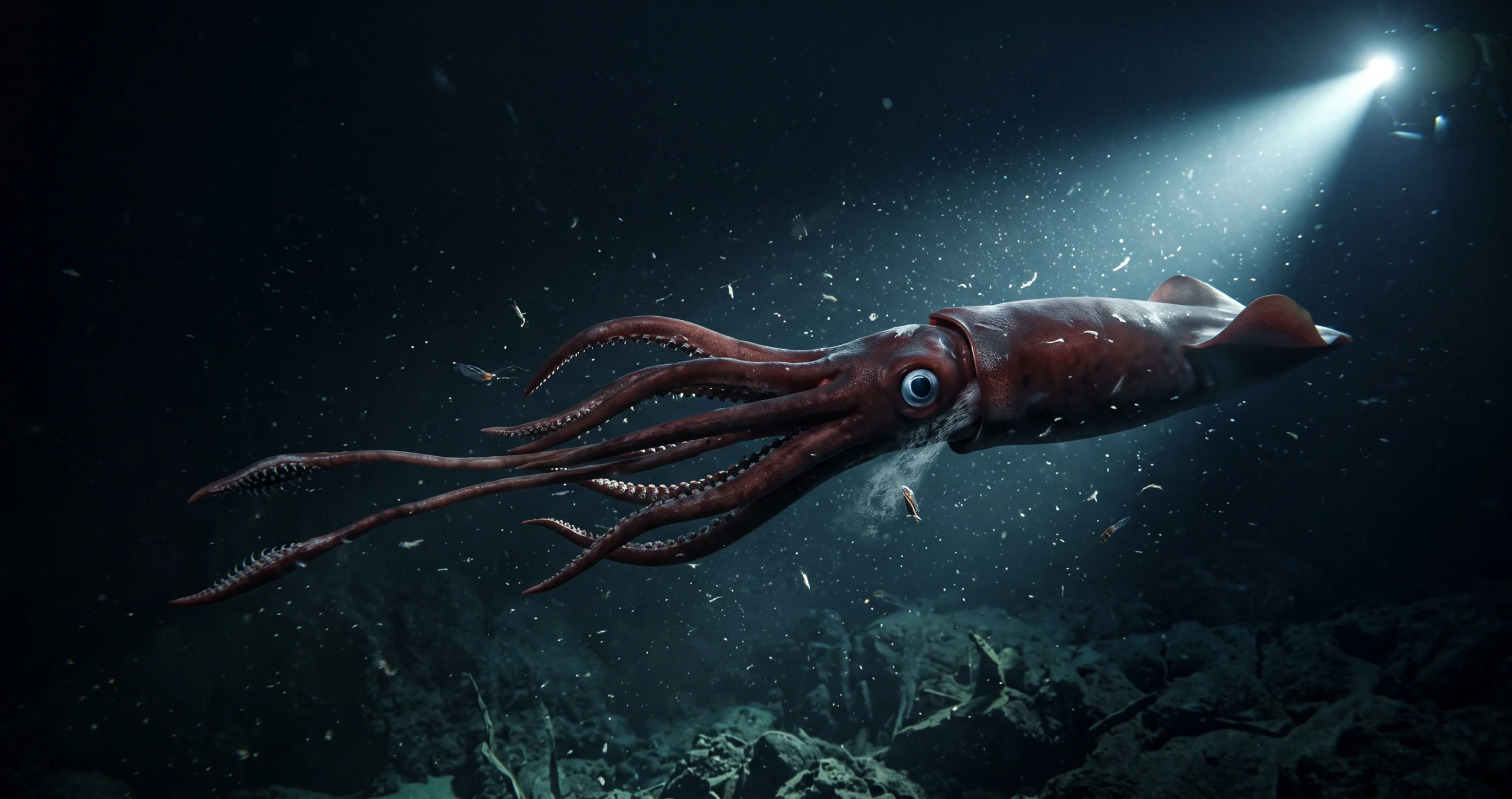
Far below the sunlit surface of the Southern Ocean lives an animal with eyes unlike anything else known in nature. The colossal squid (Mesonychoteuthis hamiltoni) possesses enormous, forward-facing eyes, and the largest colossal squid eyes examined by scientists have reached extraordinary dimensions.
Why would an animal need eyes this large in a world where almost no sunlight penetrates? The leading scientific explanation is surprisingly specific. Rather than simply helping the squid find small prey, these giant eyes may have evolved largely to provide an early warning when one of the ocean’s most formidable hunters — the sperm whale — is approaching.
That theory reveals something important about life in the deep sea. Sometimes the greatest advantage of exceptional vision is not finding something to eat. It is seeing what is coming to eat you.
Table of Contents
- What Is a Colossal Squid?
- How Large Are Colossal Squid Eyes?
- Why Colossal Squid Eyes Became So Enormous
- Detecting an Approaching Sperm Whale
- Why Bigger Eyes Are Useful in Deep Water
- Colossal Squid vs. Giant Squid
- How Large Can a Colossal Squid Get?
- Where Colossal Squid Live
- Why Scientists Know So Little About Them
- What Colossal Squid Eat
- Common Myths
- FAQ
- Conclusion
What Is a Colossal Squid?
The colossal squid is a deep-sea cephalopod found primarily in Antarctic and sub-Antarctic waters. Its scientific name is Mesonychoteuthis hamiltoni, and despite frequent confusion, it is not simply another name for the giant squid.
It belongs to the glass squid family, Cranchiidae, while the giant squid belongs to a completely different family.
Colossal squid are exceptionally robust animals. Their bodies are broader and heavier than those of giant squid, and their arms and tentacles carry formidable structures for holding prey.
The clubs at the ends of their two tentacles possess swiveling hooks, while the arms have a combination of hooks and suckers. Their beaks are also exceptionally large and powerful.
These features make the colossal squid one of the most physically impressive predators in the deep Southern Ocean.
Yet its most remarkable anatomical feature may be its eyes.
How Large Are Colossal Squid Eyes?
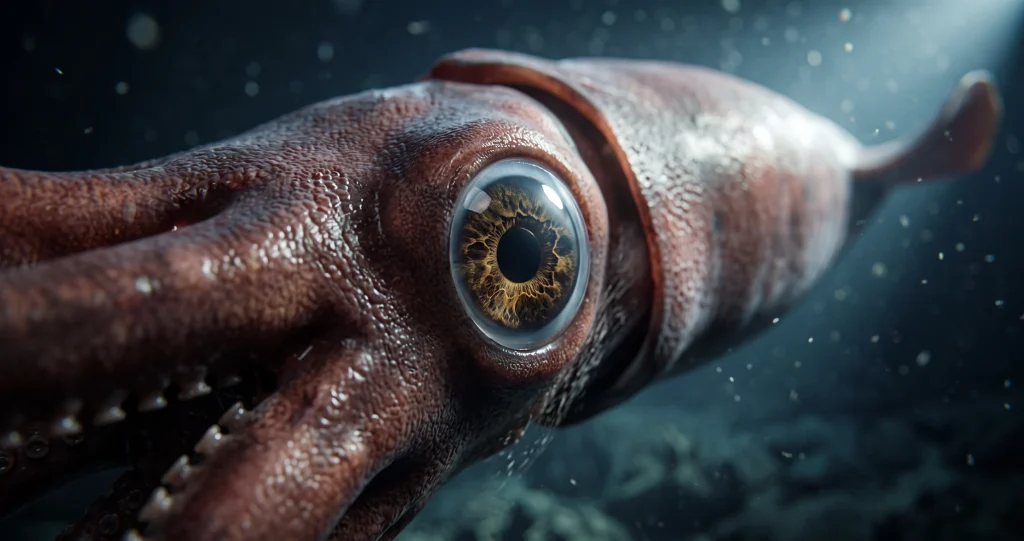
The Museum of New Zealand Te Papa Tongarewa describes the colossal squid as possessing the largest animal eyes ever studied. A living animal’s eyes have been estimated at roughly 27 centimeters across, approximately the diameter of a soccer ball.
Some specimens have produced even larger measurements depending on condition and how the eye was measured. Because soft squid tissues deform, shrink, and change after death and preservation, measurements from different specimens require careful interpretation.
The important point is not whether every adult reaches precisely the same eye diameter.
The remarkable fact is that colossal squid eyes occupy an anatomical scale essentially unmatched among living animals.
Their pupils are enormous as well. A very large pupil can collect the tiny amounts of available light in deep water, where the visual environment is radically different from anything humans experience at the surface.
The eye is a sophisticated camera-type eye with a lens focusing incoming light onto the retina. Cephalopods evolved this type of complex eye independently from vertebrates.
Why Colossal Squid Eyes Became So Enormous
At first, the explanation seems obvious.
The deep ocean is dark, so an animal living there should benefit from having bigger eyes.
That is partly true, but it does not fully explain the extraordinary dimensions involved.
Scientists Dan-Eric Nilsson, Eric Warrant and colleagues examined this problem in a study published in Current Biology. Their mathematical modeling investigated what visual advantages extremely large eyes would provide to giant and colossal squid.
The researchers concluded that simply making eyes increasingly larger does not provide equally large benefits for every visual task.
For detecting relatively small prey or potential mates, there appears to be a point beyond which increasing eye diameter produces diminishing returns.
Something much larger was needed to explain why giant and colossal squid evolved eyes approaching the size of soccer balls.
The researchers proposed an answer: sperm whales.
The original research is available through the Current Biology paper, A Unique Advantage for Giant Eyes in Giant Squid.
The Leading Theory Behind Colossal Squid Eyes
Sperm whales are major predators of large deep-sea squid.
A sperm whale hunting at depth is an enormous animal moving through dark water. But the whale itself does not necessarily have to be directly illuminated for a squid to detect its approach.
The key may be bioluminescence.
Deep ocean water contains numerous organisms capable of producing light. When something as large as a sperm whale moves through the water, it can disturb these organisms.
That disturbance can generate faint flashes or glowing patterns.
Instead of needing to see the whale’s body clearly, enormous colossal squid eyes may detect this disturbed bioluminescence from much farther away.
In other words, the squid could potentially see the visual footprint of an approaching predator.
Detecting the Glow of an Approaching Sperm Whale
The 2012 Current Biology research modeled visual performance in the deep sea and concluded that enormous squid eyes would be particularly effective at detecting very large moving objects through bioluminescent disturbance.
The researchers calculated that a giant squid with an eye about 27 centimeters across could potentially detect an approaching sperm whale at distances exceeding roughly 120 meters under suitable deep-water conditions.
That does not mean scientists have watched a colossal squid detect a whale at exactly that distance.
It is a theoretical prediction based on visual modeling.
This distinction matters because colossal squid behavior has almost never been directly observed in its natural deep-sea environment.
Nevertheless, the theory provides a compelling evolutionary explanation.
A few extra seconds of warning could be extremely valuable when the approaching predator is a diving sperm whale.
The squid could orient itself, prepare its muscles, change direction, or begin an escape response before the whale reaches striking distance.
For an animal living in almost complete darkness, early detection could mean survival.
Why Bigger Eyes Work in the Deep Ocean
Large eyes collect more photons than small eyes.
That becomes especially important when light is extraordinarily scarce.
But the advantage is not simply that colossal squid see the deep ocean as though someone switched on a lamp. Their world remains extremely dark.
Instead, large eyes can improve sensitivity to weak visual signals.
Imagine trying to detect a tiny change in brightness on a nearly black background. A larger optical system can gather more of the limited available light, improving the animal’s ability to detect faint contrasts and broad patterns.
This helps explain why the sperm-whale hypothesis is so interesting.
An approaching whale is enormous.
The visual signal produced by disturbed bioluminescent organisms could therefore cover a relatively large area. Huge colossal squid eyes may be especially effective at detecting that kind of large-scale, faint signal.
The Smithsonian similarly explains how enormous eyes in giant squid can provide an advantage for detecting large predators in dark water. See the Smithsonian Ocean explanation of giant squid vision.
Colossal Squid vs. Giant Squid
Colossal squid and giant squid are frequently treated as interchangeable animals in popular media.
They are not.
The giant squid is Architeuthis dux. The colossal squid is Mesonychoteuthis hamiltoni.
Giant squid generally have a more elongated appearance, with extremely long feeding tentacles contributing significantly to their total length.
Colossal squid are stockier and heavier.
A colossal squid may therefore be shorter from end to end while possessing substantially more body mass.
Their weapons differ too.
Giant squid feeding tentacles carry toothed suckers. Colossal squid have remarkable swiveling hooks on their tentacle clubs, as well as hooks and suckers on their arms.
The colossal squid also possesses a particularly large and robust beak.
Eye orientation provides another interesting difference. Te Papa notes that colossal squid eyes face more forward, providing binocular vision useful for judging distance, whereas giant squid eyes are positioned more laterally.
For a detailed anatomical comparison, see Te Papa’s colossal squid versus giant squid guide.
Both animals, however, belong to the extreme end of cephalopod eye size, and both were considered in the research investigating giant eyes and sperm-whale detection.
How Large Can a Colossal Squid Get?
This is where certainty becomes difficult.
One of the most famous colossal squid specimens was captured in the Ross Sea in 2007. It was initially weighed at approximately 495 kilograms while frozen, although Te Papa notes that a more realistic estimate accounting for ice was around 470 kilograms.
After thawing, the specimen measured approximately 4.2 meters in total length.
Another specimen recorded in 2003 measured about 5.4 meters and weighed roughly 300 kilograms.
These measurements demonstrate why sensational claims about colossal squid length should be treated cautiously.
Dead squid can stretch, contract, dehydrate, lose tentacles, or change dimensions during freezing and preservation.
Scientists can also estimate the existence of larger individuals through their beaks.
Squid tissue is rapidly digested inside sperm whales, but the hard beaks can remain. Colossal squid beaks recovered from sperm-whale stomachs have sometimes been larger than those belonging to complete specimens examined by scientists.
This indicates that larger colossal squid exist than some of the best-known complete specimens.
Exactly how large the maximum individual becomes remains uncertain.
Where Do Colossal Squid Live?
Colossal squid are strongly associated with the cold waters surrounding Antarctica.
Adults appear to occupy deep water, including depths around 1,000 meters and beyond, although their depth distribution changes through development.
Juveniles can occur closer to the surface.
Their remote habitat helps explain why these enormous animals remained mysterious for so long.
The deep Southern Ocean is cold, dark, vast, difficult to reach, and expensive to study. An animal can be physically enormous and still remain almost invisible to science when it occupies such an environment.
Te Papa’s collections information notes that adult colossal squid are exceedingly rare in scientific collections and that much of their life history and behavior remains poorly understood.
Why Scientists Know So Little About Colossal Squid
Much of what scientists know about colossal squid comes from specimens caught accidentally by fisheries or from remains discovered inside sperm whales.
That creates an unusual scientific problem.
Researchers can examine anatomy in extraordinary detail while knowing comparatively little about normal behavior.
A preserved eye can reveal its lens, pupil, retina, and dimensions.
Hooks can reveal how prey might be gripped.
Stomach contents can provide clues about diet.
But these observations cannot show exactly how a healthy adult colossal squid moves, hunts, reacts to a sperm whale, chooses a mate, or behaves over an ordinary day.
This is why descriptions of colossal squid behavior should distinguish observations from hypotheses.
The enormous-eye predator-detection theory is strongly grounded in optical modeling and known deep-sea ecology, but scientists have not watched enough wild encounters to treat every detail as directly observed behavior.
The mystery is partly what makes the species scientifically valuable.
What Do Colossal Squid Eat?
Evidence indicates that colossal squid prey on large fish and other deep-water animals.
Antarctic toothfish are particularly relevant. The famous Ross Sea specimen captured in 2007 was encountered while attacking a toothfish caught on a longline at considerable depth.
The squid’s hooks appear exceptionally well suited for seizing slippery prey.
Its forward-facing eyes may also assist with judging distance when striking.
Yet colossal squid do not occupy the top of the food web without danger.
Sperm whales feed heavily on deep-sea squid, and colossal squid remains and beaks have repeatedly been recovered from whale stomachs.
The relationship therefore works in both directions.
The colossal squid is a formidable predator to smaller animals but potential prey to something vastly larger.
That evolutionary pressure may help explain its extraordinary visual system.
For another example of a marine animal with a highly specialized adaptation, read our article on the pistol shrimp’s extraordinary cavitation-powered snap.
Common Myths About Colossal Squid
Myth 1: Colossal Squid and Giant Squid Are the Same Animal
They are separate species belonging to different families.
The giant squid tends to be longer and more slender, while the colossal squid has a heavier, more robust body and distinctive hooks.
Myth 2: Huge Eyes Let the Squid See Normally in Complete Darkness
No eye can form a conventional visual image when absolutely no photons are available.
The advantage of colossal squid eyes is their exceptional ability to gather extremely faint available light, including potentially bioluminescent signals.
Myth 3: Scientists Know Exactly How Large Colossal Squid Become
They do not.
Only a limited number of large specimens have been examined, and larger beaks recovered from sperm whales suggest that individuals bigger than familiar museum specimens exist.
Myth 4: The Largest Eyes Evolved Mainly to Find Tiny Prey
That sounds reasonable, but the leading visual-modeling research found that extreme eye enlargement offers a particularly important advantage for detecting enormous predators.
The sperm-whale hypothesis therefore provides a stronger explanation for why the eyes became so extraordinarily large.
Myth 5: Scientists Regularly Observe Colossal Squid Hunting
Direct observations are exceptionally limited.
Much of our knowledge comes from captured specimens, anatomy, stomach contents, fisheries encounters, predator stomach contents, and scientific modeling.
Myth 6: Colossal Squid Are Aggressive Sea Monsters That Attack Ships
There is no scientific basis for treating colossal squid as ship-attacking monsters.
Their normal environment is the cold, deep Southern Ocean, far removed from ordinary human activity.
FAQ
How big are colossal squid eyes?
Large colossal squid eyes are roughly soccer-ball sized, with around 27 centimeters often cited for living dimensions. Measurements can vary among specimens and according to specimen condition.
Does the colossal squid have the largest eyes in the world?
Te Papa describes the colossal squid as having the largest animal eyes ever studied. Giant squid also possess exceptionally large eyes and belong to the same extreme size class.
Why does the colossal squid need such huge eyes?
The leading research theory proposes that the extreme size helps detect large approaching predators, especially sperm whales, through faint bioluminescent disturbance in deep water.
Large eyes also improve sensitivity in the extremely dim deep-sea environment.
Can colossal squid see sperm whales in total darkness?
The hypothesis does not require the squid to see the whale itself as a clearly illuminated object.
Instead, it may detect bioluminescent organisms disturbed as a massive whale moves through the water.
Are colossal squid bigger than giant squid?
It depends on how “bigger” is defined.
Giant squid can attain greater total lengths because of their elongated tentacles, while colossal squid have much heavier and more robust bodies. The colossal squid is generally regarded as the heaviest known living invertebrate.
Do sperm whales really eat colossal squid?
Yes.
Colossal squid beaks and other remains have been found in sperm-whale stomachs, providing some of the strongest evidence connecting the two animals.
Where do colossal squid live?
They inhabit Antarctic and sub-Antarctic waters, with adults associated with deep, cold environments around 1,000 meters or deeper.
Have scientists filmed a living colossal squid in its natural habitat?
Our understanding of healthy adult colossal squid behavior in the wild remains extremely limited. This is one reason researchers must rely heavily on specimens, fisheries encounters, anatomical evidence, and ecological modeling.
Conclusion
The extraordinary size of colossal squid eyes becomes easier to understand when we stop imagining them simply as oversized versions of human eyes.
They evolved for a radically different visual world.
At great depths in the Southern Ocean, sunlight becomes negligible. The useful visual information may consist of extraordinarily faint contrasts and flashes of biological light.
Under those conditions, collecting more photons matters.
But research suggests that ordinary deep-sea vision alone does not fully explain why giant and colossal squid pushed eye size to such an extreme.
The strongest evolutionary advantage may come from detecting something enormous.
A hunting sperm whale moving through deep water can disturb bioluminescent organisms around it. An eye approaching the size of a soccer ball may allow a squid to detect that faint disturbance from far enough away to gain precious warning time.
That makes the colossal squid’s enormous eyes more than a record-breaking anatomical curiosity.
They may represent an evolutionary alarm system.
The same animal equipped with swiveling hooks, a powerful beak, a massive body, and the ability to capture formidable deep-sea prey must itself survive one of the ocean’s most effective hunters.
In that environment, evolution produced a remarkable solution.
The colossal squid became better at seeing danger coming.
Internal Link Suggestions
- How Pistol Shrimp Produce One of the Loudest Sounds in the Ocean
Use in the section discussing specialized deep-sea and marine adaptations:
https://secretsofthegreengarden.com/pistol-shrimp-loud-snap/ - The Cookiecutter Shark: A Small Predator That Leaves Perfectly Round Wounds
Use when discussing unusual deep-sea predators, bioluminescence, and adaptations to low-light environments:
https://secretsofthegreengarden.com/cookiecutter-shark-bite/
External Dofollow Authoritative Sources
- Current Biology — A Unique Advantage for Giant Eyes in Giant Squid
Primary peer-reviewed research behind the sperm-whale detection hypothesis.
https://doi.org/10.1016/j.cub.2012.02.031 - Museum of New Zealand Te Papa Tongarewa — The Eyes of the Colossal Squid
Authoritative information from scientists who examined major colossal squid specimens.
https://www.tepapa.govt.nz/digital-museum/explore-digital-museum/colossal-squid/anatomy-colossal-squid/eyes-colossal-squid - Smithsonian Ocean — Largest Eye in the World, Giant Squid
Useful scientific context on giant squid eye size, deep-sea vision, and predator detection.
https://ocean.si.edu/ocean-life/invertebrates/largest-eye-world-giant-squid