

Walk through a damp forest in southeastern Australia and you might hear kookaburras, parrots, whipbirds, and other native birds calling from somewhere ahead. Then a completely different noise may appear: something resembling machinery, an engine, or another unmistakably human-made sound.
The source may be a single superb lyrebird.
Few birds have developed vocal learning as spectacular as this species. Lyrebird sound mimicry allows an accomplished bird to reproduce an extraordinary range of noises, especially the calls of other birds, with enough accuracy to confuse human listeners and sometimes other birds.
Recordings and scientific observations have also documented lyrebirds reproducing mechanical sounds. But the familiar idea that every wild lyrebird routinely spends its day imitating chainsaws and camera shutters oversimplifies a much more fascinating biological story.
Behind the performance lies a sophisticated songbird vocal system, years of learning, cultural transmission, and intense sexual selection.
Table of Contents
- What Is the Superb Lyrebird?
- How Lyrebird Sound Mimicry Works
- The Syrinx: The Lyrebird’s Vocal Instrument
- Can Lyrebirds Really Mimic Chainsaws and Cameras?
- What Lyrebirds Usually Mimic in the Wild
- Why Males Mimic Sounds During Courtship
- The Extraordinary “Mobbing Flock” Illusion
- How Lyrebirds Learn Their Sounds
- Habitat and Daily Life
- Bushfires and Conservation Concerns
- Common Myths About Lyrebirds
- FAQ
- Conclusion
What Is the Superb Lyrebird?
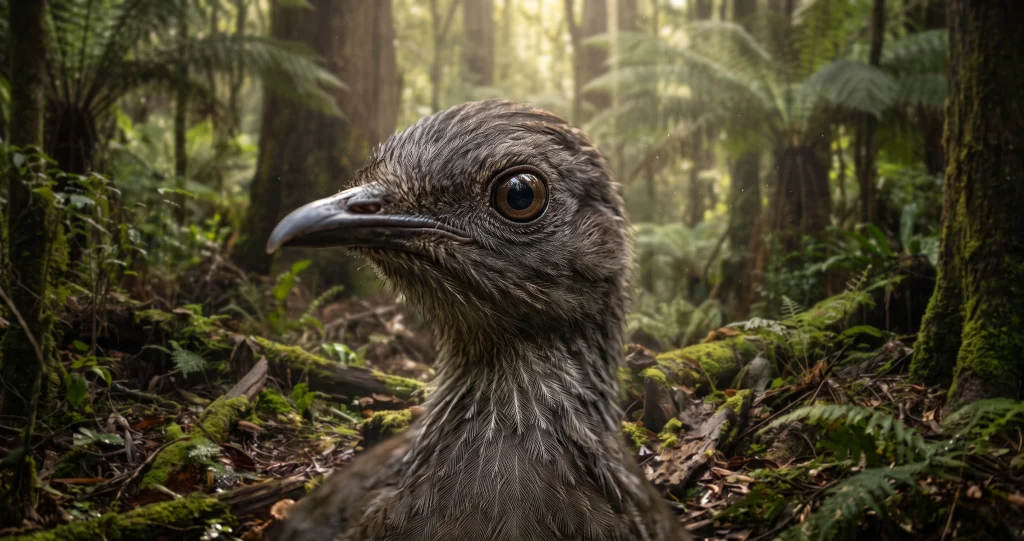
The superb lyrebird (Menura novaehollandiae) is a large, ground-dwelling Australian songbird famous for two remarkable features: the elaborate tail of the adult male and an exceptional ability to imitate sounds.
It naturally occurs in southeastern Australia, particularly in moist forests and rainforests of New South Wales and Victoria. It was also introduced to Tasmania, where populations subsequently became established.
According to the Australian Museum’s Superb Lyrebird profile, the species spends much of its time on the forest floor, scratching through leaf litter for insects and other small animals. At night, however, it typically roosts above the ground in trees.
An adult male is especially recognizable during courtship. His long ornamental tail includes curved outer feathers that create the characteristic lyre-like shape from which the bird gets its name.
But the visual display represents only half the performance.
The other half is sound.
How Lyrebird Sound Mimicry Works
The superb lyrebird is an oscine, or true songbird. Like other oscines, it learns much of its vocal repertoire rather than relying entirely on genetically programmed calls.
That ability to learn is essential to lyrebird sound mimicry.
A lyrebird listens to sounds around it, memorizes vocal patterns, and can later reproduce astonishingly detailed versions of them.
The Australian Museum reports that about 80 percent of a superb lyrebird’s song can consist of expert mimicry. Its repertoire may include numerous native bird species along with sounds originating from its surroundings.
Importantly, mimicry is not simply random noise.
Males arrange copied sounds into elaborate vocal sequences that become part of their displays. Lyrebird populations can also develop recognizable local vocal traditions.
This makes their songs more than impressive imitation.
They are examples of animal vocal learning and cultural transmission.
The Syrinx: The Lyrebird’s Vocal Instrument
Humans create voiced sounds primarily with the larynx. Birds use a different organ called the syrinx.
The syrinx sits deep in the respiratory system around the point where the trachea divides toward the lungs.
In oscine songbirds, it functions as an exceptionally versatile sound-producing system.
Two Controllable Sound Sources
Songbird syringes possess left and right sound-producing sides that can be controlled with remarkable precision. Air passing through the organ causes specialized tissues called labia to vibrate.
Research into songbird vocal physiology shows that the two sides can be controlled independently, allowing birds to switch between sound sources and, in some circumstances, use them simultaneously.
Syringeal muscles adjust properties of the vibrating tissues while precisely controlled respiratory pressure provides the airflow necessary for sound production.
The resulting signal can then be modified by the rest of the vocal tract.
Together, these mechanisms give songbirds extraordinary control over frequency, timing, and acoustic structure.
Is the Lyrebird’s Syrinx Uniquely Built?
Here an important misconception needs correcting.
It is tempting to assume that lyrebird sound mimicry must result from a uniquely elaborate anatomical modification of the syrinx.
There is not good evidence that this alone explains the bird’s talent. Australian Museum material has specifically noted that there appears to be no extraordinary special development of the syrinx that neatly accounts for lyrebird mimicry.
Instead, the broader songbird vocal apparatus provides a highly capable instrument, while exceptional neural control, auditory learning, practice, memory, and motor coordination allow a lyrebird to exploit that instrument to an extraordinary degree.
The distinction matters.
Owning an excellent musical instrument does not automatically make someone a virtuoso. The lyrebird’s achievement depends on how precisely its nervous and respiratory systems control the instrument and how effectively the bird learns the sounds it reproduces.
Can Lyrebirds Really Mimic Chainsaws and Cameras?
This is the part of lyrebird biology that has made the species famous around the world.
Yes, lyrebirds can reproduce human-made sounds.
The Australian Museum lists mechanical and environmental noises such as chainsaws and car engines among sounds that have been imitated, alongside dog barks and native bird calls.
Camera shutters and similar mechanical sounds have also become famous through recordings and filmed demonstrations of lyrebirds.
Other reported imitations include alarms, machinery, whistles, and noises associated with human environments.
There is, however, an important qualification.
Captive Examples Are Not the Same as Typical Wild Behavior
Some of the most spectacular examples circulating in documentaries and online videos involve birds exposed repeatedly to unusual sounds in captivity or around human activity.
That does not mean wild lyrebirds throughout Australian forests commonly encounter and imitate camera shutters, car alarms, and chainsaws.
Wild birds overwhelmingly have access to another enormous library of sounds: other birds.
Their natural repertoires can include detailed imitations of multiple species living around them.
So the famous chainsaw imitation demonstrates what the lyrebird’s vocal-learning system can accomplish. It should not be interpreted as the normal centerpiece of every wild male’s song.
What Lyrebirds Usually Mimic in the Wild
A wild lyrebird’s soundscape is dominated by the forest.
As a result, other birds provide many of its most important models.
Lyrebirds can reproduce calls from numerous neighboring species, sometimes transitioning rapidly between different imitations.
A single male can create the impression that several different birds are vocalizing nearby.
The fidelity can be remarkable.
Research on lyrebirds has shown that geographically separated populations can develop local vocal patterns. Studies of Albert’s lyrebird, the superb lyrebird’s close relative, have even demonstrated that populations reproduce local dialects of species they imitate.
That points toward an important feature of mimicry.
Lyrebird song is learned within a social and ecological environment.
Why Male Lyrebirds Mimic Sounds During Courtship
The most spectacular male vocal performances occur in the context of reproduction.
During the breeding season, a male establishes a territory containing display sites or mounds on the forest floor.
There he performs an extraordinary combination of singing, dancing, and tail movements.
The ornate tail is raised and inverted over the bird’s body while the male moves rhythmically and produces his complex vocal repertoire.
The Australian Museum describes males singing and dancing on display mounds to attract potential mates. Males may mate with multiple females, while females independently construct nests, incubate their eggs, and care for offspring.
The elaborate song therefore functions as part of a sexual display.
A large, accurate, and well-organized repertoire may communicate information relevant to females evaluating males, although scientists continue investigating exactly which characteristics females use when making mating decisions.
What is clear is that mimicry is deeply integrated with male reproductive behavior.
And one discovery has made the story even more intriguing.
The Extraordinary “Mobbing Flock” Illusion
Researchers studying male superb lyrebirds discovered a particularly sophisticated form of lyrebird sound mimicry.
A displaying male can imitate the alarm calls of several bird species simultaneously associated with a mixed-species mobbing flock.
Mobbing occurs when smaller birds gather around a predator and produce alarm calls.
The lyrebird does something remarkable: it acoustically reconstructs the event.
Research published in Current Biology found that males reproduced the sounds of several alarm-calling species and even imitated the wingbeats of small birds. Playback experiments showed that the illusion was convincing enough to provoke responses from other birds.
Even more surprisingly, researchers found that males tended to produce this particular illusion when females attempted to leave display arenas and during copulation.
The researchers proposed that this deceptive soundscape could make a female behave as though danger were nearby, potentially delaying her departure.
This provides an extraordinary example of vocal mimicry serving something more complex than simply displaying a large repertoire.
The bird is effectively recreating an entire ecological scene using sound.
Readers interested in another remarkable example of elaborate avian courtship can also explore our article on the bowerbird’s extraordinary bower-building behavior.
How Lyrebirds Learn Their Sounds
A lyrebird does not emerge from the egg already knowing how to reproduce dozens of other species.
Vocal development involves learning and practice.
Young birds hear vocalizations around them and gradually develop their repertoires. They can learn both from the original species producing a call and from other lyrebirds that already imitate it.
This creates the possibility of cultural transmission.
A copied sound can potentially spread through a population as birds learn from one another rather than independently encountering the original source.
Research on lyrebirds supports the existence of geographically structured vocal traditions. In Albert’s lyrebirds, researchers have found stereotyped sequences shared within populations, providing evidence that higher-order organization of mimicked sounds can itself be socially transmitted.
The result is a vocal culture that can differ between places.
Two lyrebird populations do not necessarily sing exactly the same acoustic “playlist.”
Habitat and Daily Life
Despite their extraordinary voices, superb lyrebirds spend much of their ordinary lives doing something comparatively simple: digging.
Their strong legs and feet rake through leaves and soil in search of invertebrates.
Their diet includes insects, spiders, worms, and occasionally seeds. Constant scratching can turn over substantial quantities of leaf litter and soil, making the species an important ecosystem engineer in Australian forests.
BirdLife Australia describes superb lyrebirds as primarily ground-dwelling inhabitants of moist forest and rainforest.
Their dependence on forest habitat also makes major disturbances particularly important.
And few disturbances are more dramatic than severe bushfire.
Australian Bushfires and Lyrebird Conservation
The superb lyrebird is currently classified as Least Concern globally, so it would be misleading to describe the species as being on the verge of extinction.
That does not make it immune to serious regional threats.
Australia’s catastrophic 2019–2020 bushfire season demonstrated how rapidly enormous areas of wildlife habitat can be affected.
BirdLife Australia’s post-fire assessments reported that as much as half of the superb lyrebird’s range was affected during those fires, with all three populations affected to varying degrees. The species was subsequently included among birds requiring priority management attention following the fires.
Fire can affect lyrebirds directly, but habitat consequences can continue after the flames disappear.
Severe burns can alter understory vegetation, leaf litter, food availability, cover, nesting habitat, and the complex forest-floor environment on which these largely terrestrial birds depend.
Recovery therefore involves more than counting surviving birds.
Scientists and conservation organizations need long-term information about how populations respond as forests regenerate and how future fire regimes interact with habitat.
Protecting extensive, connected forest habitats also benefits many other species sharing the same ecosystem.
Common Myths About Lyrebirds
Myth 1: Lyrebirds Can Perfectly Mimic Literally Any Sound
“Almost any sound” is a useful description of their astonishing versatility, not a literal biological guarantee.
Their ability is constrained by what they hear, learn, remember, and can physically reproduce with their vocal apparatus.
Myth 2: Wild Lyrebirds Constantly Imitate Chainsaws
Chainsaw mimicry is real, but it has become disproportionately famous.
Natural bird calls form a major component of wild lyrebird repertoires. Mechanical noises depend on an individual’s exposure and learning history.
Myth 3: Lyrebirds Have a Completely Unique Vocal Organ
They possess a syrinx, as other birds do.
Their remarkable abilities arise from the sophisticated songbird sound-production system combined with exceptional learning and fine motor control, rather than simply possessing an enormous or completely unique “voice box.”
Myth 4: Only Male Lyrebirds Can Mimic
Male performances receive the most attention because mimicry forms such a spectacular component of courtship.
But mimicry is not biologically exclusive to males. Female lyrebirds also vocalize, and research on lyrebirds increasingly emphasizes the complexity and importance of female vocal behavior.
Myth 5: The Male’s Tail Makes the Sound
The tail is a visual component of the display.
Sound is produced by the respiratory and vocal systems, particularly the syrinx.
Myth 6: Lyrebirds Mimic Only to Attract Females
Courtship is extremely important, but lyrebird vocal behavior occurs in a broader communication system that includes territorial and other calls.
Some specialized mimicry during mating interactions may even function deceptively, as research on the simulated mobbing flock suggests.
FAQ
What sounds can a superb lyrebird mimic?
Documented repertoires include calls of numerous native birds as well as environmental and mechanical noises. Chainsaws, engines, dog barks, and other human-associated sounds have all been reported.
Can a lyrebird really imitate a camera shutter?
Lyrebirds have famously demonstrated camera-like mechanical imitations, particularly in situations where individual birds have repeatedly encountered those sounds.
These examples show the flexibility of lyrebird sound mimicry, but they should not be treated as universal features of every wild bird’s repertoire.
Can lyrebirds imitate car alarms?
Lyrebirds are capable of learning mechanical sounds, and alarm-like noises are among the human-associated sounds attributed to their repertoires.
As with other artificial noises, whether an individual learns one depends greatly on exposure.
How does a lyrebird make so many different sounds?
The bird uses its syrinx, the avian vocal organ.
In songbirds, separate sound-producing structures on the two sides of the syrinx can be precisely controlled. Respiratory pressure, syringeal muscles, neural control, and the upper vocal tract work together to shape the resulting sound.
Why do male lyrebirds mimic other birds?
Mimicry forms an important component of male song and courtship displays.
The repertoire is integrated with visual dancing and tail displays, while particular forms of mimicry may serve specialized functions during interactions with females.
Do lyrebirds understand the sounds they imitate?
There is no evidence that a lyrebird understands a chainsaw or camera in the human conceptual sense.
It learns acoustic patterns and reproduces them within its own behavioral and communication system.
Where do superb lyrebirds live?
Their natural distribution is in southeastern Australia, especially forest habitats in New South Wales and Victoria.
They were introduced to Tasmania, where established populations now occur.
Are superb lyrebirds endangered?
The species is currently listed as Least Concern globally, but populations and habitat can still be seriously affected by major disturbances.
The 2019–2020 Australian bushfires affected a substantial portion of the species’ range, demonstrating the importance of habitat protection and post-fire monitoring.
Conclusion
The superb lyrebird deserves its reputation as one of nature’s greatest vocal mimics, but the real biology is even more interesting than the viral clips.
Lyrebird sound mimicry begins with an extraordinarily versatile songbird vocal system. The syrinx provides independently controllable sound-producing structures, while precise respiratory and neural control allows complex acoustic patterns to be generated.
Learning transforms that biological instrument into something remarkable.
A lyrebird can listen to its acoustic environment, memorize sounds, practice them, and incorporate them into elaborate sequences. Those sequences can even develop local traditions that are transmitted between birds.
Human-made noises such as chainsaws, engines, camera shutters, and alarms demonstrate the impressive flexibility of this system. Yet the natural masterpiece is the bird’s ability to reproduce the living soundscape of an Australian forest.
During courtship, males combine those sounds with one of the avian world’s most elaborate visual displays.
They sing, dance, raise their ornate tails, and move across carefully maintained display areas. Some can even create the acoustic illusion of an entire flock of alarm-calling birds, complete with imitated wingbeats.
That performance is not simply a collection of amusing noises.
It is the product of vocal learning, sexual selection, motor control, social transmission, and millions of years of evolution.
And as severe Australian bushfires have demonstrated, protecting the forests in which this remarkable vocal culture develops is essential if those performances are to continue echoing through the understory.
Internal Link Suggestions
- Why Bowerbirds Build Elaborate Structures to Attract a Mate
Best placement: the section explaining male lyrebird courtship. It creates a natural connection between two Australian birds with exceptionally elaborate mating displays.Suggested anchor text: bowerbird’s extraordinary bower-building behavior - How Bee-Eaters Catch and Eat Bees Without Getting Stung
Best placement: near the discussion of specialized bird behavior or learned techniques.Suggested anchor text: another remarkable example of specialized bird behavior
3 External Dofollow Authoritative Sources
- Australian Museum — Superb Lyrebird
Authoritative species overview covering habitat, feeding, mimicry, mechanical sounds, and breeding behavior.
Australian Museum: Superb Lyrebird - Current Biology / PubMed — Male Lyrebirds Create a Complex Acoustic Illusion of a Mobbing Flock During Courtship and Copulation
Peer-reviewed research documenting the extraordinary simulated mobbing-flock display and its possible reproductive function.
PubMed: Male Lyrebird Acoustic Illusion Study - BirdLife Australia — Superb Lyrebird
Authoritative information covering distribution, habitat, behavior, vocalizations, breeding, and conservation status.
BirdLife Australia: Superb Lyrebird