
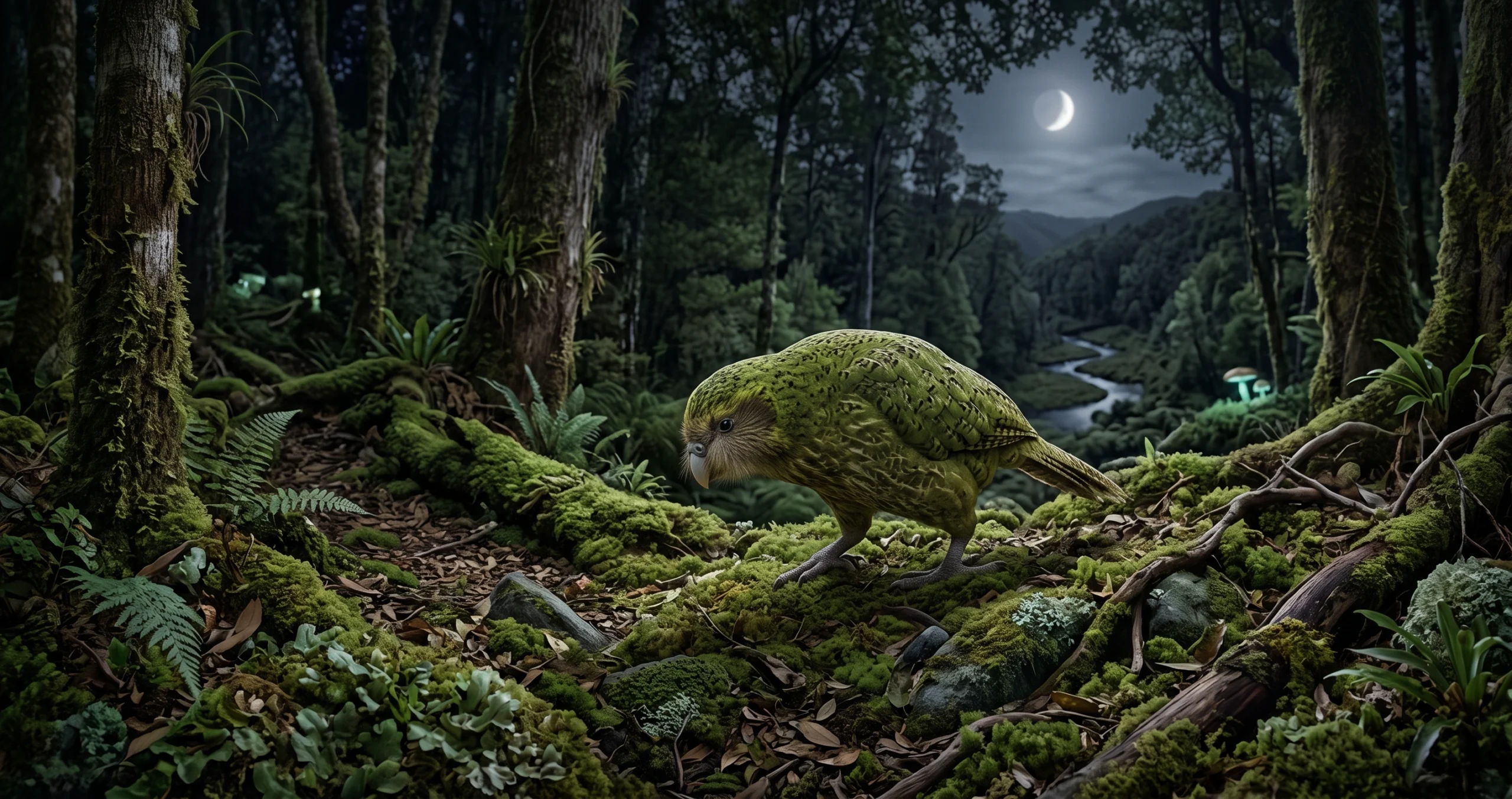
Imagine a parrot that cannot fly, spends much of its life walking through forests at night, can live for decades, and attracts mates by producing deep booming calls that travel across the landscape. That animal is the kākāpō (Strigops habroptilus), the extraordinary kakapo flightless parrot found only in New Zealand.
The kākāpō is the world’s only living flightless parrot. Its unusual biology developed in an island environment where terrestrial mammalian predators were historically absent, reducing some of the evolutionary pressure that makes flight essential for most birds.
That same history eventually became a vulnerability. When humans introduced mammalian predators to New Zealand, the kākāpō’s ground-dwelling lifestyle and defensive behavior offered little protection.
Today, every surviving bird matters. New Zealand’s intensive Kākāpō Recovery Programme combines predator-free islands, genetic management, supplementary feeding, nest monitoring, veterinary medicine, and individual tracking to keep one of Earth’s strangest parrots from disappearing.
Table of Contents
- What Is a Kākāpō?
- Why the Kakapo Flightless Parrot Lost Flight
- What Flightlessness Changed
- Life as a Nocturnal Ground Parrot
- The Kākāpō’s Extraordinary Mating System
- How the Famous Booming Call Works
- Why Males Build Bowls and Tracks
- How Females Find Booming Males
- Why Kākāpō Reproduction Is So Unusual
- How Introduced Predators Nearly Destroyed the Species
- The Kākāpō Recovery Programme
- Why Every Individual Bird Is Monitored
- Common Myths
- FAQ
- Conclusion
What Is a Kākāpō?
The kākāpō is a large, nocturnal parrot native to New Zealand. Its scientific name is Strigops habroptilus, and it represents an evolutionary lineage unlike the familiar parrots seen across tropical forests.
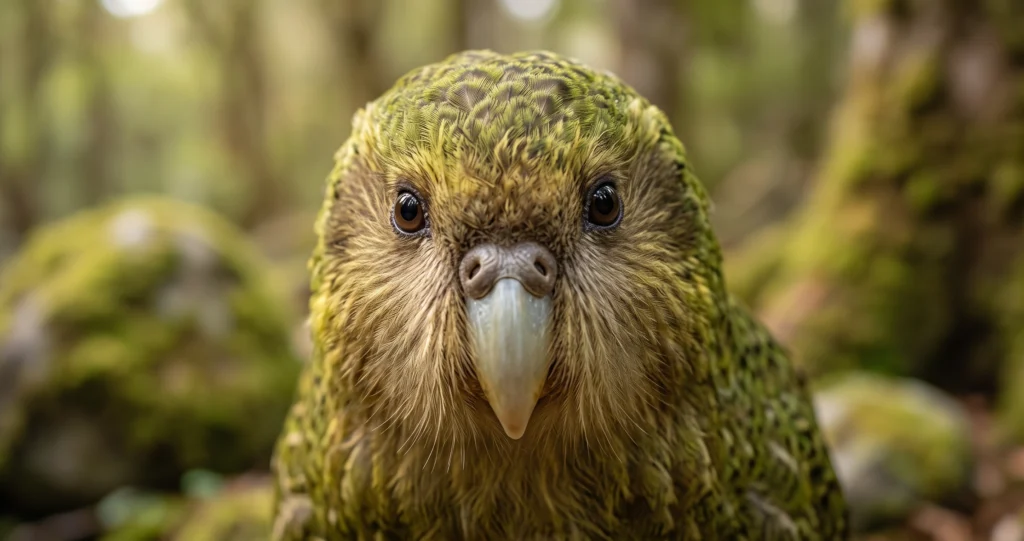
Its moss-green plumage is mottled with yellow, brown, and darker markings. On a forest floor covered with leaves, ferns, moss, and shadows, that coloration provides excellent camouflage.
The face has a distinctive owl-like appearance created by feathers arranged around the eyes and bill.
This resemblance explains an older English name: owl parrot.
But the kākāpō is not closely related to owls.
It is unmistakably a parrot, just one that followed a very unusual evolutionary path.
Kākāpō are also unusually heavy for parrots. Males are larger than females, and adults can become substantially heavier than the flying parrots most people know.
That heavy body is possible partly because flight no longer imposes the same strict weight limitations.
Why the Kakapo Flightless Parrot Lost Flight
Bird flight is enormously useful.
It allows birds to escape predators, travel between feeding areas, search large territories, and reach nesting sites inaccessible to many terrestrial animals.
It is also expensive.
Flight demands powerful muscles, lightweight anatomy, tremendous energy expenditure, and specialized physiology.
If an environment reduces the advantages of flight, natural selection can gradually favor a different balance.
That happened repeatedly on isolated islands.
Before humans arrived, New Zealand had no native terrestrial mammalian predators comparable to cats, stoats, or rats. Predatory birds existed, but the terrestrial predator community was fundamentally different from those on continents.
Birds consequently occupied ecological roles that mammals fill elsewhere.
Some became increasingly terrestrial.
The ancestors of the kākāpō retained wings but gradually lost the ability to sustain powered flight.
The kakapo flightless parrot could instead invest in a heavy body, strong legs, climbing ability, camouflage, and a ground-based lifestyle.
Does a Kākāpō Still Have Wings?
Yes.
Flightlessness does not mean winglessness.
Kākāpō possess fully visible wings covered with feathers, and they can use them for balance.
They are also surprisingly capable climbers.
A kākāpō can use its powerful feet and bill to climb trees and vegetation. When descending from an elevated position, it may spread its wings and make a controlled parachuting or gliding descent.
But it cannot launch into sustained powered flight.
The flight muscles and overall anatomy are not capable of supporting the kind of aerial movement performed by ordinary parrots.
Its sternum is also reduced compared with flying birds, reflecting the diminished importance of the large flight muscles normally anchored there.
Evolution did not remove the wings completely.
It repurposed what remained useful.
Life on Foot
Losing flight changed nearly every aspect of kākāpō life.
These parrots spend much of their time walking.
Their legs are strong, and individual birds can travel substantial distances across difficult terrain.
During the day, they usually remain concealed.
At night, they emerge to feed and move through their territories.
Their diet is predominantly plant-based and can include leaves, shoots, roots, fruits, seeds, and other plant material depending on season and location.
The birds may leave distinctive feeding signs where vegetation has been carefully processed.
Unlike many parrots, kākāpō are primarily nocturnal.
That nocturnal lifestyle combines with green camouflage and quiet daytime behavior to make them difficult to detect naturally.
Unfortunately, camouflage that works against visual predators provides little protection against a mammal following scent.
That distinction became devastating after introduced predators reached New Zealand.
The Kakapo Flightless Parrot Has an Unusual Mating System
Kākāpō reproduction is almost as unusual as their flightlessness.
They are the only parrot known to use a lek breeding system.
In a lek, males gather or establish display areas and advertise themselves to females rather than forming conventional breeding pairs.
Male kākāpō create display sites containing shallow depressions known as bowls.
These bowls are often connected by carefully maintained tracks through vegetation.
Then the male begins calling.
But calling does not adequately describe what happens.
He booms.
How the Famous Kākāpō Boom Works
The kākāpō’s mating call is one of the strangest sounds produced by any bird.
A displaying male positions himself in a bowl and inflates a specialized thoracic air sac.
His body can visibly expand as the sac fills.
He then produces a sequence of extremely low-frequency booming notes.
The air sac functions as part of the resonating system, helping transform the vocal signal into the deep, carrying sound characteristic of breeding males.
These are not sharp parrot squawks.
The boom is low, resonant, repetitive, and designed to travel.
Under favorable conditions, the sound can carry for kilometers through the landscape.
A female may hear a male long before she can see him.
For an animal that cannot fly and may need to attract females across considerable distances, long-range acoustic communication is extremely valuable.
A Bird That Turns Its Body Into a Resonator
The thoracic air sac makes the mating display particularly dramatic.
As a male prepares to boom, the body appears inflated.
The resulting low-frequency signal takes advantage of physical properties that allow lower sounds to propagate effectively through some environments.
The display site can matter too.
Males may position bowls in locations where surrounding terrain helps project the call.
Ridges, slopes, and natural landscape features can influence sound transmission.
The result resembles a biological broadcasting station.
Instead of actively searching over enormous areas for females, the male establishes a display location and repeatedly announces his presence.
This booming behavior is one of the defining characteristics of the kakapo flightless parrot.
Booming Is Only Part of the Performance
Male kākāpō can produce another courtship sound commonly called a “ching.”
This call is higher in frequency than the boom.
The two sounds appear to perform somewhat different functions.
Booming works particularly well as a long-distance advertisement.
Once a female is closer, other vocalizations can help with localization and courtship.
This solves an acoustic problem.
Very low-frequency sounds can travel well, but locating their exact source can be difficult.
A male therefore benefits from being audible at long distances while also providing information that helps an approaching female find him.
It is a sophisticated system built around sound rather than colorful aerial displays.
Why Males Build Bowls and Tracks
A male’s display area is not simply a random patch of forest.
He shapes it.
The shallow bowl provides a regular position for booming. Males also maintain paths or tracks connecting parts of their display area.
Vegetation may be cleared from these routes.
The resulting network becomes part of the lek.
During breeding periods, males can spend night after night at these sites producing repeated calls.
The investment is considerable.
Yet males do not help incubate eggs or raise chicks.
Their reproductive contribution is primarily mating.
Females make the final choice.
Females Decide Which Male Reproduces
A female attracted to the lek approaches displaying males and evaluates them.
Courtship eventually leads to mating if she accepts a male.
Then she leaves.
There is no lasting pair bond.
The female constructs the nest, lays the eggs, incubates them, and raises the chicks without assistance from the father.
This creates intense sexual selection among males.
Some males can be much more reproductively successful than others.
For conservationists managing an extremely small population, that inequality matters.
If only a limited subset of males father many chicks, the next generation can lose genetic diversity even when chick numbers increase.
Modern kākāpō conservation therefore involves not merely producing more birds, but managing genetic representation.
Kākāpō Do Not Breed Every Year
Another major conservation challenge is irregular reproduction.
Kākāpō breeding is closely associated with abundant food production by particular native plants.
On southern New Zealand islands, fruiting of rimu trees has been especially important.
Heavy fruiting events do not occur predictably every year.
When suitable food conditions develop, females can gain the body condition necessary for reproduction and chick-rearing.
When those conditions are absent, breeding may be limited or fail to occur.
This means conservationists cannot simply expect the population to produce a large new generation annually.
Every successful breeding season becomes extremely important.
It also explains why supplementary feeding must be managed carefully.
Food can support bird condition, but managers need to consider how nutrition interacts with reproduction and even offspring sex ratios.
How Introduced Predators Changed Everything
The evolutionary history that produced the kakapo flightless parrot became disastrous after New Zealand’s ecosystem changed.
Humans introduced mammals that had never been part of the kākāpō’s evolutionary environment.
Rats consumed eggs and chicks.
Cats killed adults and younger birds.
Stoats and other introduced predators added further pressure.
A kākāpō confronted by danger may freeze and rely on camouflage.
Against a visually hunting predator, remaining motionless among green vegetation can work remarkably well.
Against a mammal using scent, it can fail completely.
The bird cannot simply fly away.
Habitat changes and human hunting also contributed historically to decline.
By the twentieth century, kākāpō had disappeared from most of their former range.
How Close Did the Kākāpō Come to Extinction?
Alarmingly close.
For years, conservationists searched remote parts of New Zealand for surviving birds.
A population was eventually discovered on Stewart Island/Rakiura, but introduced cats threatened those birds too.
Conservation managers made an extraordinary decision.
Surviving kākāpō were transferred to offshore islands where introduced mammalian predators could be excluded or intensively controlled.
That intervention helped prevent extinction.
The species remains classified as Critically Endangered on the IUCN Red List.
The population is still tiny enough that individual births and deaths can influence the future of the species.
The New Zealand Department of Conservation’s Kākāpō Recovery Programme provides current authoritative information about population management, breeding, research, and recovery efforts.
Every Kākāpō Is Individually Known
Most wild-animal conservation does not involve knowing every surviving member of a species personally.
Kākāpō conservation does.
Individual birds are identified, monitored, and managed throughout their lives.
Transmitters allow conservation teams to track movements and reproductive behavior.
During breeding seasons, nests can be monitored intensively.
Eggs may receive intervention when necessary.
Chicks can be weighed and checked.
Veterinary treatment is available when birds become sick or injured.
Genetic information helps managers make breeding decisions designed to preserve as much diversity as possible.
Technology has become part of the species’ ecosystem.
Without that extraordinary level of management, the kākāpō’s prospects would be much worse.
Predator-Free Islands as Lifeboats
One of the central conservation strategies is maintaining populations in carefully managed sanctuaries where introduced mammalian predators are absent.
These islands function as ecological refuges.
Biosecurity is critical.
A single introduced predator reaching an island containing kākāpō could have severe consequences.
People, boats, equipment, and supplies therefore need strict management to minimize the risk of accidentally transporting rodents or other invasive species.
The goal is not simply to keep birds in permanent isolation.
Conservationists ultimately want a growing, genetically healthy population capable of occupying larger areas of suitable habitat.
But recovery from such an extreme bottleneck takes time.
For another example of how unusual evolutionary adaptations can become vulnerabilities when environments change, see our article on why the blue-footed booby chooses mates based on foot color. Both species demonstrate how reproduction evolves in response to highly specific ecological conditions.
Why Kākāpō Conservation Matters
Saving the kakapo flightless parrot preserves more than one unusual species.
The kākāpō represents a unique evolutionary lineage.
Once such a lineage disappears, millions of years of independent evolutionary history vanish with it.
Its biology also provides scientists with opportunities to study flightlessness, island evolution, nocturnality, acoustic communication, lek mating systems, genetics, reproductive ecology, and conservation management.
The recovery program has become an important example of intensive species conservation.
It demonstrates both the possibilities and limits of intervention.
Humans can move birds to safer islands.
We can monitor nests.
We can sequence genomes.
We can provide veterinary care.
But conservation still depends on the birds reproducing successfully and ecosystems remaining suitable for them.
Technology can support nature.
It cannot replace it.
Common Myths About the Kākāpō
Myth 1: Kākāpō Have No Wings
They have wings.
They simply cannot perform sustained powered flight.
The wings can assist with balance and controlled descents.
Myth 2: Kākāpō Are Related to Owls
Their facial feathers produce an owl-like appearance, but the kākāpō is a true parrot.
“Owl parrot” is descriptive, not taxonomic.
Myth 3: The Male’s Boom Comes From Its Stomach
The characteristic resonance involves a specialized thoracic air sac and the bird’s vocal system.
The male visibly inflates during the display, but it is not simply making noises with its digestive system.
Myth 4: Kākāpō Cannot Climb Because They Cannot Fly
They are strong climbers.
Their feet and bills allow them to climb vegetation and trees despite their flightlessness.
Myth 5: Kākāpō Became Flightless Because They Were Too Heavy
The evolutionary sequence is more complicated.
Reduced need for flight in New Zealand’s historical ecological environment allowed flightlessness and a more terrestrial body plan to evolve. Increased body mass is part of that evolutionary package rather than a simple accidental cause.
Myth 6: They Are Safe Now Because Their Numbers Have Increased
The species remains Critically Endangered and dependent on intensive conservation management.
Population growth does not eliminate risks from disease, low genetic diversity, reproductive limitations, or introduced predators.
Myth 7: Conservationists Keep Kākāpō in Zoos
The recovery program primarily manages birds in protected natural habitats, particularly predator-free islands and carefully controlled sanctuaries.
They are wild animals under intensive conservation management, not a conventional zoo population.
FAQ
Is the kākāpō really the world’s only flightless parrot?
Yes. The kākāpō is the only living parrot species that has completely lost the ability to perform sustained powered flight.
Why can’t kākāpō fly?
Their ancestors evolved in New Zealand’s unusual island ecosystem, where terrestrial mammalian predators were absent.
Over evolutionary time, selection favored a heavily terrestrial lifestyle and reduced flight capability.
Can kākāpō climb trees?
Yes.
They use their strong legs, feet, and bills to climb and can spread their wings when descending.
Why does a male kākāpō boom?
Booming is a mating advertisement.
Males establish display sites and produce low-frequency calls that can travel long distances, helping attract females to their lek territories.
How does the kākāpō make its booming sound?
A displaying male uses its vocal system together with a specialized inflatable thoracic air sac that contributes to the deep resonance of the call.
The body visibly expands during booming.
Are male and female kākāpō monogamous?
No.
Kākāpō use a lek mating system. Males advertise and mate but do not form long-term breeding pairs or help females raise chicks.
Why are kākāpō critically endangered?
Major historical causes include habitat alteration, hunting, and especially introduced mammalian predators such as cats, rats, and stoats.
Their slow and irregular reproductive biology makes recovery difficult.
Where do kākāpō live today?
Surviving birds are intensively managed in protected New Zealand locations, particularly predator-free or highly controlled island sanctuaries.
How many kākāpō are left?
The exact population changes as birds hatch or die, so a static article can quickly become outdated.
The official Kākāpō Recovery Programme is the appropriate source for the latest population figure.
Conclusion
The kakapo flightless parrot is the product of an evolutionary world that no longer exists.
For generations beyond human imagination, its ancestors lived in New Zealand without the community of terrestrial mammalian predators familiar on continents. Flight became less essential, and the kākāpō evolved toward a different way of being a parrot.
It became heavy.
It walked.
It climbed.
It hid among vegetation during the day and moved through forests at night.
Its reproductive system became equally extraordinary. Instead of forming pairs, males gather at display areas, construct bowls and tracks, inflate specialized thoracic air sacs, and broadcast low booming calls across the landscape.
Females listen.
Then they choose.
Those adaptations worked within the environment that produced them.
When humans brought rats, cats, stoats, and other mammals to New Zealand, the rules changed with devastating speed. Freezing beneath camouflage could not reliably defeat a predator following scent, and a bird that had surrendered powered flight millions of years earlier could not suddenly evolve it back.
The kākāpō nearly disappeared.
Its survival today is therefore not simply a natural-history story. It is also one of the world’s most extraordinary conservation projects.
Every bird can be individually monitored. Breeding seasons are followed closely. Genetics inform management decisions. Nests and chicks receive intervention when necessary. Predator-free islands provide refuges, while strict biosecurity attempts to prevent a single invasive animal from undoing decades of work.
The species remains Critically Endangered, and recovery is far from guaranteed.
Yet the fact that kākāpō still walk through New Zealand forests and males still produce their deep nocturnal booms shows what determined conservation can preserve.
The sound is more than a mating call.
For one of the world’s rarest and most evolutionarily distinctive birds, every boom is evidence that the species is still here.
Internal Link Suggestions:
- Why Blue-Footed Boobies Choose Mates Based on Foot Color
Place in the section explaining sexual selection and female mate choice. It provides a strong connection between two very different bird courtship systems. - The Killdeer’s Fake Broken-Wing Display: A Bird’s Predator Decoy Trick
Place in the section discussing unusual bird adaptations. This creates a natural path toward another article showing how specialized behavior evolves under particular ecological pressures.
External Dofollow Authoritative Sources:
- New Zealand Department of Conservation — Kākāpō Recovery
Primary authoritative source for the recovery program, breeding management, protected populations, conservation interventions, and current population updates. - Kākāpō Recovery — Official Conservation Program
Useful specialist resource for individual birds, breeding seasons, conservation history, research, genetics, and ongoing recovery work. - IUCN Red List of Threatened Species
Authoritative source for conservation status, population assessment, threats, distribution, and the criteria behind the kākāpō’s Critically Endangered classification.