
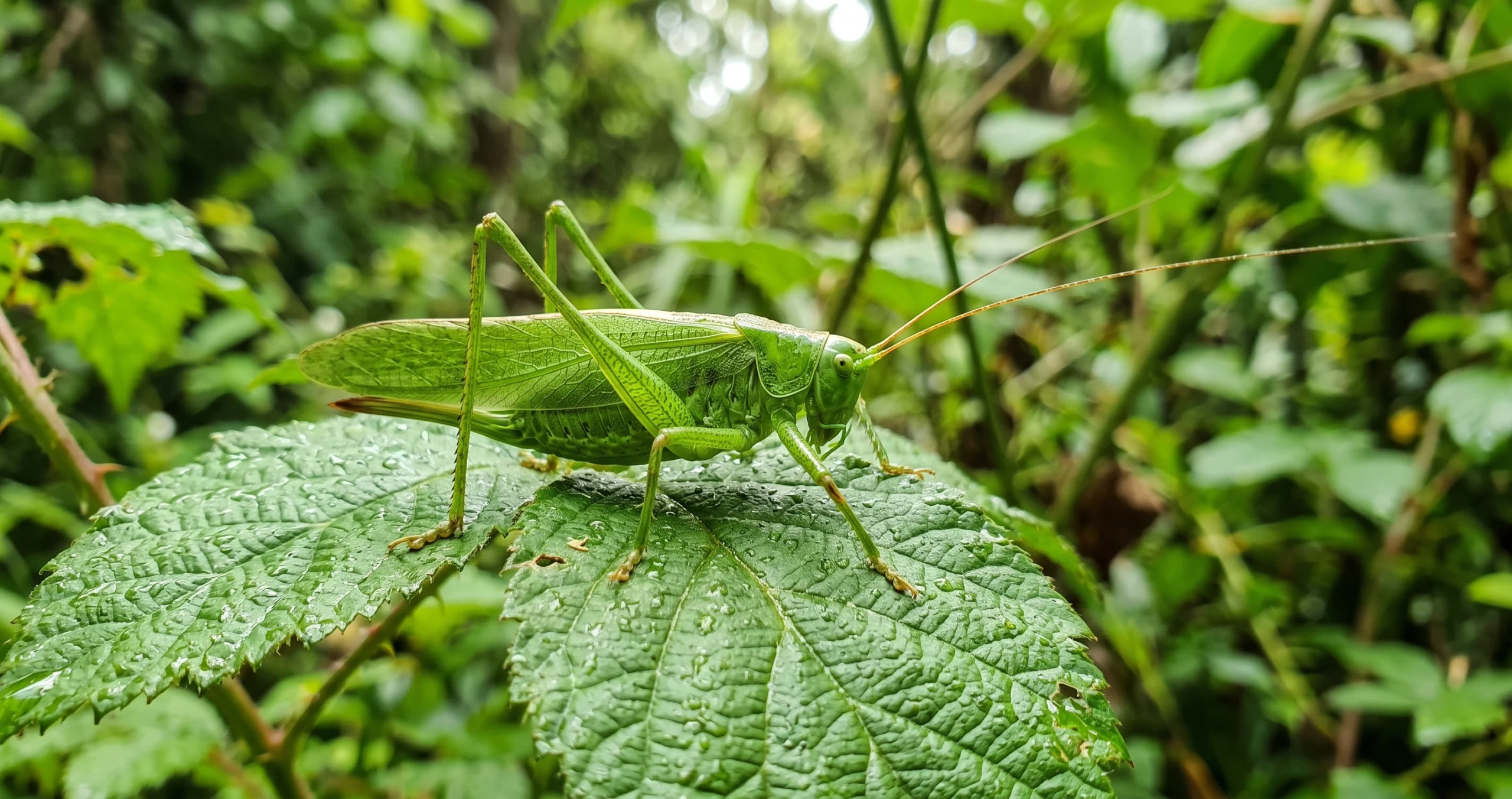
If you looked for a katydid’s ears, its head would be the obvious place to start. You would also be looking in the wrong place. The remarkable katydid ears on legs are located near the upper part of the insect’s front tibiae, just below the equivalent of its “knees.” These tiny hearing organs allow katydids to detect courtship songs, locate potential mates, distinguish frequencies, and, in many species, detect the ultrasonic calls of hunting bats.
Even more surprising, some katydid ears perform mechanical tasks that resemble functions found in the mammalian middle and inner ear. The structures evolved independently, yet both systems had to solve the same fundamental problem: turning airborne sound into information a nervous system can understand.
Table of Contents
- What Are Katydids?
- Where Are a Katydid’s Ears?
- How the Tympanal Organ Works
- Why Katydid Ears on Legs Make Sense
- The Secret Acoustic Tube Inside the Body
- How Katydids Locate Calling Mates
- Hearing Bats Before They Attack
- How Katydid Hearing Compares With Crickets
- How Moths Hear Differently
- Why Insect Ears Evolved in So Many Places
- Common Myths
- FAQ
- Conclusion
What Are Katydids?
Katydids are insects belonging to the family Tettigoniidae within the order Orthoptera, the same major insect order that includes crickets and grasshoppers.
They are sometimes called bush crickets, particularly outside North America.
Many species are green and remarkably leaf-like. Their camouflage can include flattened bodies, vein-like markings, and wings shaped so convincingly like foliage that a motionless katydid can be difficult to spot even when it is directly in front of you.
But hiding is only one part of their biology.
Katydids are also highly acoustic animals.
In many species, males produce calling songs by rubbing specialized structures on their wings together, a process known as stridulation. Females use those signals to recognize and locate appropriate mates.
Depending on species, calls can fall within frequencies humans hear or extend well into ultrasound.
To make that communication system work, katydids need excellent ears.
Evolution simply did not put those ears where humans expect them.
Where Are Katydid Ears Located?
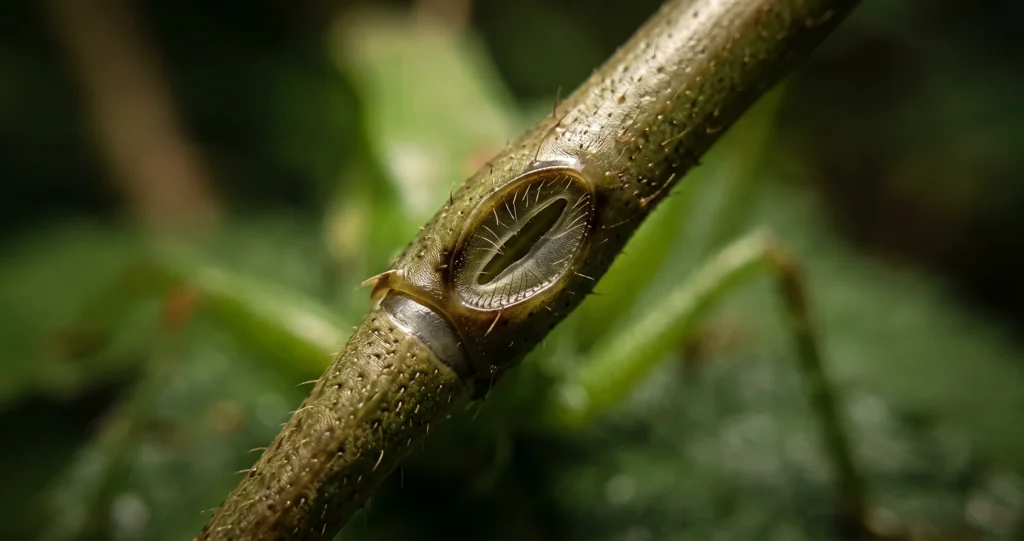
The hearing organ sits on the tibia of each foreleg.
The tibia is the long leg segment immediately below the femur. In many katydids, the hearing structures are found near the upper portion of this segment.
Look closely enough and you may see small openings or membrane-covered areas on opposite sides of the leg.
These are associated with the tympanal organ.
“Tympanum” is also the anatomical term used for an eardrum.
The comparison is appropriate because katydid ears contain thin tympanic membranes that vibrate in response to sound.
In a commonly studied arrangement, each foreleg ear has two tympanic membranes: an anterior tympanic membrane and a posterior tympanic membrane.
These structures are extraordinarily small.
Yet their miniature size does not prevent them from performing sophisticated auditory processing.
How the Tympanal Organ Works
Sound begins as changes in air pressure.
For an animal to hear those changes, acoustic energy must eventually be converted into electrical activity in sensory neurons.
Katydids achieve this through a remarkably elaborate miniature system.
Airborne sound can reach the tympanic membranes from outside the leg. But that is only one route.
Sound also enters the insect through a large respiratory opening, or spiracle, on the thorax. From there, it travels through specialized air-filled tracheal tubes toward the ears in the front legs.
The internal tubes are known as acoustic tracheae.
They evolved from the respiratory system but now play an important role in hearing.
The result is a pressure-difference receiver in which sound can influence the tympanic membranes through multiple pathways.
Inside the ear, mechanical vibrations ultimately stimulate specialized sensory structures and neurons.
One important component is the crista acustica, an array of sensory units that participates in frequency analysis.
In some katydids, different regions of this tiny structure respond preferentially to different frequencies.
That is unexpectedly reminiscent of the mammalian cochlea.
A Tiny Ear With Mammal-Like Functions
The resemblance does not mean katydids possess miniature human ears inside their legs.
Their anatomy is fundamentally different.
Yet researchers have discovered striking functional parallels.
Mammalian hearing involves several major stages. The eardrum receives sound, the middle ear transfers and amplifies mechanical energy, and the cochlea separates incoming sounds according to frequency.
Research on katydids has found equivalents to these functions operating through completely different anatomical structures.
A tiny lever system associated with the tympanum can contribute to air-to-liquid impedance conversion and amplification. Farther inside, frequency-dependent mechanical waves can travel across the auditory structure in a way that functionally resembles frequency analysis in a cochlea.
This is a striking example of convergent evolution.
Mammals and katydids arrived at different anatomical solutions to similar physical problems.
And the katydid accomplishes it inside an ear that may be only a millimeter or two across.
Why Katydid Ears on Legs Make Sense
At first glance, placing ears on legs seems inconvenient.
From an acoustic perspective, however, it offers advantages.
Small animals face a major directional-hearing problem.
Humans can compare subtle differences in when a sound reaches one ear versus the other and how intense that sound is at each ear. Our heads physically separate the ears by a useful distance.
An insect’s head is tiny.
Placing the auditory organs on opposite forelegs increases the separation between them compared with squeezing both ears onto the head.
Research on katydid hearing indicates that this greater interaural distance can improve spatial acoustic information, including phase differences useful for localizing sound.
The location also works beautifully with the insect’s internal acoustic tracheal system.
So the katydid ears on legs are not a bizarre evolutionary accident.
They are part of an integrated sound-processing system.
The Hidden Ear Canal Inside a Katydid
One of the strangest features of katydid hearing is invisible from outside.
The acoustic trachea acts somewhat like an internal ear canal.
Sound enters through the thoracic acoustic spiracle and travels through the air-filled tube toward the tympanic membranes.
But it does not necessarily travel through this system at the same speed and intensity as sound arriving directly from outside.
Research has shown that the geometry of the narrow ear canal can slow internal sound propagation. In one studied katydid system, branching pathways create additional delays before sound reaches the tympana from inside.
Why would a delay be useful?
Because directional hearing depends on differences.
The external and internal versions of the same sound can reach the tympanic membranes with different timing and pressure characteristics.
The nervous system can use the resulting mechanical information when determining where a signal originated.
A tiny insect therefore solves a difficult sound-localization problem partly by routing sound through its own respiratory anatomy.
Finding a Mate in the Dark
For many katydids, hearing is essential for reproduction.
Males call.
Females listen.
A female must distinguish the call of an appropriate male from a complicated nighttime soundscape containing other katydids, crickets, frogs, wind, rain, and countless unrelated noises.
Species recognition matters because different katydids can live in the same habitat.
Calls differ in rhythm, frequency, pulse structure, duration, and timing.
The female auditory system is adapted to extract biologically relevant information from this acoustic mixture.
Once she identifies an appropriate signal, directional hearing helps her move toward its source.
This movement toward sound is called phonotaxis.
The katydid ears on legs therefore do far more than tell an insect that “something made a noise.”
They help answer two crucial questions:
What produced the sound?
And where is it?
For a female searching for a mate at night, both answers matter.
Male Katydids Listen Too
Hearing is not exclusively a female adaptation.
Males also benefit from listening.
They may detect competing males and adjust calling behavior accordingly. Acoustic information can influence spacing, timing, territorial interactions, and decisions about whether continued signaling is worthwhile.
This creates a social acoustic environment.
A calling male is advertising himself to females.
But he may simultaneously be announcing his position to rivals.
Even worse, he may be advertising his location to predators.
That creates one of the most important evolutionary conflicts in katydid communication.
The louder or more conspicuous a call becomes, the easier it may be for a mate to find.
But predators can listen too.
Hearing a Bat Before It Arrives
For nocturnal insects, bats represent a major evolutionary pressure.
Many insect-eating bats locate prey using echolocation.
They emit ultrasonic calls and analyze returning echoes to detect objects and flying animals.
Those calls also reveal the bat’s presence.
Numerous nocturnal insects have independently evolved ultrasonic hearing capable of detecting bat echolocation.
Many katydids belong to this acoustic arms race.
Their hearing can extend into ultrasonic frequencies, allowing them to detect signals that humans cannot hear.
Once a threatening sound is detected, the appropriate response depends on the species and circumstances.
A flying insect might alter its flight.
A calling katydid may stop signaling.
Others rely more heavily on proactive defenses such as producing extremely brief, infrequent calls that reduce the amount of time predators have to localize them. Research on Neotropical katydids has shown that some species continue calling despite detecting bat cues but keep their total signaling time exceptionally low.
Hearing therefore does not dictate one universal response.
It provides information from which different survival strategies can evolve.
Why Predator Detection Shaped Katydid Hearing
A male katydid faces a difficult evolutionary compromise.
He needs to be heard.
But not necessarily by everyone.
Females listening for his courtship signal are desirable receivers.
An echolocating bat is not.
This conflict can influence the frequencies, timing, duration, and structure of insect calls.
Research comparing katydid species has found evidence that bat predation and habitat transmission properties can influence call-frequency evolution.
The ear must therefore operate in two overlapping worlds.
It receives social information from other katydids.
It also receives warnings from predators.
That dual function helps explain why the katydid ears on legs are so sophisticated.
They are simultaneously communication receivers and early-warning systems.
How Crickets Hear
Katydids are not the only singing insects with ears on their legs.
Crickets also possess tympanal organs on their forelegs.
That similarity makes sense because crickets and katydids are both orthopterans and depend heavily on acoustic communication.
Male crickets typically create their familiar chirps by rubbing specialized structures of the forewings together.
Female crickets use hearing to identify and locate males.
Their auditory system can also help detect predators.
But katydid and cricket hearing should not be treated as identical.
The enormous diversity within both groups means that hearing sensitivity, call frequencies, tympanal anatomy, and neural processing differ among species.
Many familiar cricket songs have dominant frequencies in the low-kilohertz range, while numerous katydids communicate at substantially higher frequencies, with some extending deep into ultrasound.
Both groups demonstrate the same important principle.
An insect does not need ears on its head to possess sophisticated hearing.
How Moths Hear Differently
Moths make the story even stranger.
Many nocturnal moths possess tympanal ears, but those ears can occur on very different parts of the body depending on the evolutionary lineage.
Some have hearing organs on the thorax.
Others have them on the abdomen.
The primary evolutionary role of hearing in many nocturnal moths is strongly connected to detecting echolocating bats.
Noctuid moths, for example, possess a relatively simple auditory system with sensory receptors sensitive to ultrasonic frequencies used by hunting bats.
When the bat is relatively distant, auditory activity can alert the moth.
As the threat intensifies, neural responses can trigger more urgent evasive behavior.
Some moth ears can even change their mechanical tuning in response to sound intensity, helping maintain sensitivity as a hunting bat changes its echolocation calls during an attack.
So katydids, crickets, and moths all hear.
Evolution simply built their ears in different places and, in many cases, under different selective pressures.
Insect Ears Evolved Again and Again
Humans naturally assume an ear belongs on the head because that is where our ears are.
Insects demonstrate how arbitrary that assumption is.
Tympanal hearing has evolved independently multiple times across insect evolution.
Depending on the lineage, ears can appear on legs, thorax, abdomen, or other body regions.
A major review of insect tympanal hearing noted that these organs occur in at least seven insect orders and can serve mate detection, rival detection, predator avoidance, and even prey detection.
This diversity exists because evolution modifies structures that are already available.
Insect auditory organs are evolutionarily related to mechanosensory chordotonal organs — structures originally involved in detecting mechanical forces and body movements.
Over evolutionary time, these sensory systems could become increasingly specialized for detecting airborne vibrations.
The result is not one insect ear design.
It is many.
For another remarkable example of insect communication, see our article on how cicadas produce their extraordinarily loud songs. Katydids and cicadas use different sound-producing and hearing systems, but both reveal how strongly acoustic communication can shape insect evolution.
Common Myths About Katydid Ears on Legs
Myth 1: The Holes on the Legs Are Just Breathing Openings
Katydid hearing is connected to the respiratory system through acoustic tracheae, but the tympanal structures on the front tibiae are genuine auditory organs.
They contain specialized membranes and sensory components that convert acoustic energy into neural information.
Myth 2: Katydids Hear Through Their Feet
The hearing organs are on the front legs, but they are not located on the feet.
They occur on the tibial region farther up the foreleg.
Myth 3: Leg Ears Must Be Primitive
Location says nothing about sophistication.
Some katydid ears perform amplification, impedance conversion, and frequency analysis through mechanisms functionally comparable to stages of mammalian hearing.
Myth 4: Katydids Hear Only Other Katydids
Their ears can serve several purposes.
Depending on species, hearing can provide information about mates, rivals, environmental sounds, and predators such as echolocating bats.
Myth 5: Every Katydid Hears Exactly the Same Frequencies
Katydids are extremely diverse.
Auditory sensitivity varies with species, communication system, habitat, and ecological pressures.
Myth 6: All Insects Have Ears on Their Legs
They do not.
Crickets and katydids famously have foreleg tympanal organs, while many moths and other insects possess hearing organs elsewhere on the body.
FAQ
Where exactly are katydid ears?
The katydid ears on legs are located on the tibiae of the two forelegs, usually near the upper part of each tibia.
The tympanal organ commonly includes anterior and posterior tympanic membranes.
Why do katydids have ears on their front legs?
The arrangement provides useful spatial separation between the ears and integrates with a sophisticated internal acoustic-tracheal system.
It supports sound localization, mate communication, and predator detection.
How does a katydid ear work?
Sound reaches tympanic membranes externally and can also travel internally through acoustic tracheae connected to a thoracic spiracle.
Mechanical vibrations are then processed by specialized auditory structures and sensory neurons.
Can katydids hear bats?
Many species can detect ultrasonic frequencies associated with bat echolocation.
This can allow behavioral responses that reduce predation risk.
Can humans hear katydid calls?
Some katydid calls fall within the human hearing range.
Others contain frequencies extending into ultrasound, meaning part or all of the signal can be beyond normal human perception.
Do crickets also have ears on their legs?
Yes.
Crickets also have tympanal hearing organs on the forelegs, although their auditory anatomy and frequency sensitivities differ from those of katydids.
Do moths have ears?
Many moths do.
Their tympanal organs are often associated strongly with detecting ultrasonic bat echolocation, and the ears may occur on the thorax, abdomen, or other locations depending on the group.
Are katydid ears similar to human ears?
They are anatomically very different, but research has uncovered surprising functional similarities.
Some katydid ears perform air-to-liquid impedance conversion, amplification, and frequency analysis — tasks also required in mammalian hearing.
Conclusion
The katydid ears on legs seem bizarre only when judged according to human anatomy.
For a small nocturnal insect, they make remarkable biological sense.
Each front tibia contains a miniature tympanal hearing system capable of detecting vibrations in the air. Sound reaches the ears through external pathways and through specialized acoustic tracheae derived from the insect’s respiratory system.
Inside, tiny sensory structures transform those mechanical vibrations into neural signals.
Some katydid ears go even further.
They amplify acoustic energy and separate frequencies through mechanisms that researchers have compared functionally with processes in the mammalian middle ear and cochlea. These similarities evolved independently, making katydid hearing an extraordinary example of different organisms arriving at comparable solutions to the same physical challenge.
The position on the legs also contributes to what hearing is ultimately for.
A female can identify a male’s courtship song and determine where it is coming from. Males can monitor rivals. Many species can detect ultrasonic signals associated with hunting bats and alter their behavior accordingly.
That means the same pair of tiny organs participates in both reproduction and survival.
Comparisons with crickets and moths reveal an even broader evolutionary lesson.
There is no single correct place for an ear.
Insects have repeatedly transformed mechanosensory structures into auditory systems, placing them wherever anatomy and natural selection could produce a useful result.
Humans carry their ears on their heads.
Katydids carry theirs on their front legs.
Both arrangements solve the same fundamental problem: detecting meaningful vibrations in a noisy world and turning them into information before it is too late.
Internal Link Suggestions:
- Why Cicadas Are So Loud and How Their Sound-Producing Organs Work
Place in the section discussing insect acoustic communication. It creates a natural connection between two insects with very different mechanisms for producing and detecting sound. - How Bats Use Echolocation to Hunt in Complete Darkness
Place in the predator-detection section to explain the other side of the evolutionary acoustic arms race between nocturnal insects and insect-eating bats.
External Dofollow Authoritative Sources:
- PubMed — Biomechanics of Hearing in Katydids
PubMed: Biomechanics of Hearing in Katydids
A detailed scientific review of katydid auditory anatomy, tympanal mechanics, amplification, and frequency analysis. - Proceedings of the National Academy of Sciences / PMC — A Narrow Ear Canal Reduces Sound Velocity to Create Additional Acoustic Inputs in a Microscale Insect Ear
PMC: Katydid Ear Canal and Directional Hearing Study
Useful for the tympanic membranes, acoustic trachea, internal sound pathways, and mechanisms contributing to directional hearing. - Annual Review of Entomology — Hearing in Insects
Annual Reviews: Hearing in Insects
An authoritative overview of how insect hearing evolved, including tympanal organs, auditory processing, communication, and predator detection.