
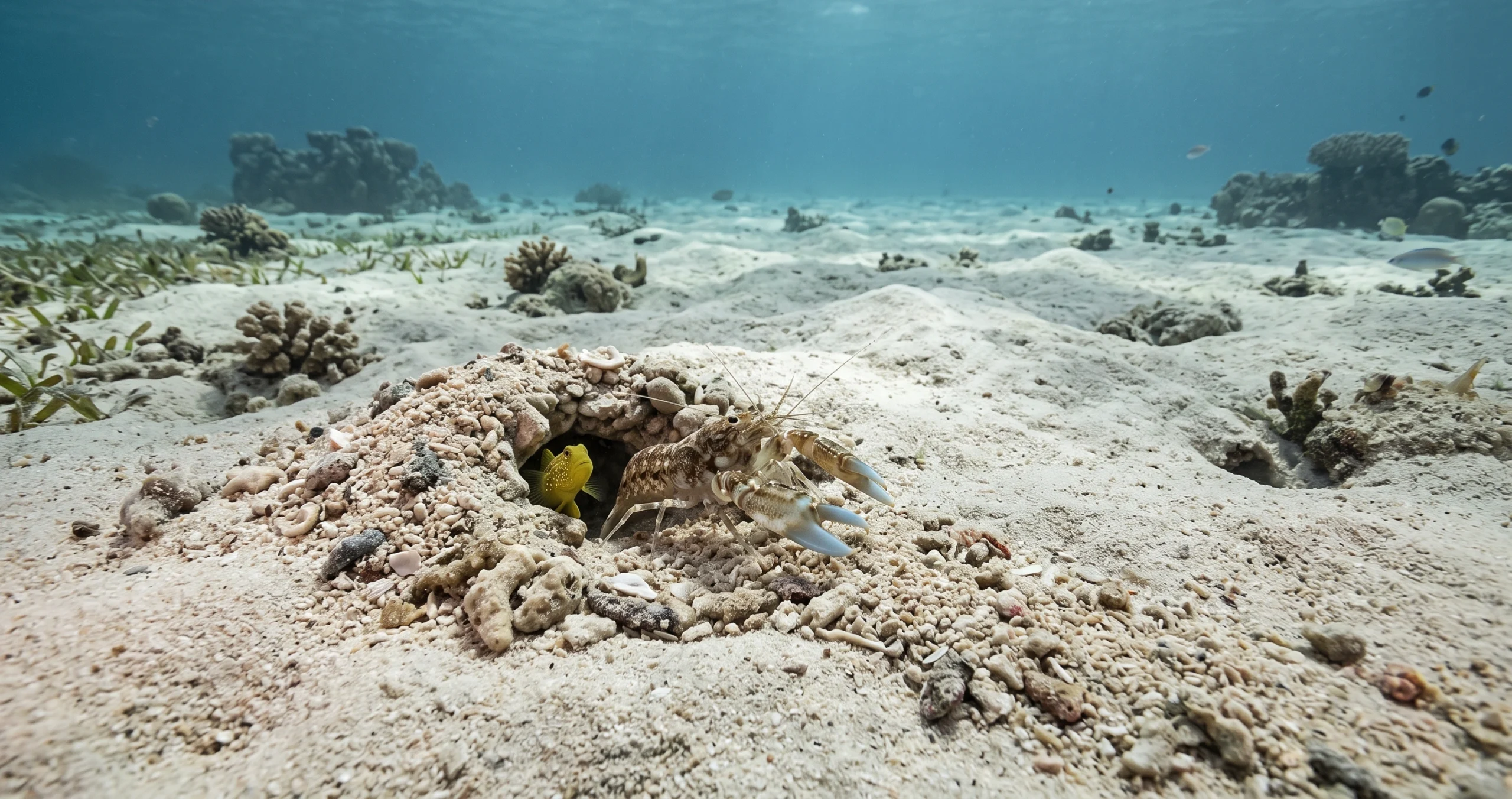
A pistol shrimp is only a few centimeters long, yet it can produce an underwater sound powerful enough to compete with some of the loudest biological noises in the sea. The pistol shrimp loud snap does not come from its claw surfaces smashing together like castanets. Instead, the shrimp closes a specialized claw so rapidly that it fires a high-speed jet of water, creating a cavitation bubble that violently collapses.
That collapse produces the famous snap. It can also generate an intense pressure wave capable of stunning or killing small prey at close range.
The physics becomes even stranger: under suitable conditions, the collapsing bubble briefly produces extremely high temperatures and a tiny flash of light. For the shrimp, however, this remarkable phenomenon is not a physics demonstration. It is a practical tool for hunting, defense, territorial disputes, and communication.
Table of Contents
- What Is a Pistol Shrimp?
- How the Pistol Shrimp Loud Snap Works
- What Is Cavitation?
- Why the Bubble Collapse Is So Powerful
- How Loud Is a Pistol Shrimp?
- Why Underwater Decibels Can Be Misleading
- How Pistol Shrimp Hunt With Sound
- Snapping as Communication and Defense
- Why Colonies Can Be Incredibly Noisy
- Pistol Shrimp and Gobies: An Extraordinary Partnership
- What Each Partner Gets From the Relationship
- Common Myths
- FAQ
- Conclusion
What Is a Pistol Shrimp?
Pistol shrimp, also called snapping shrimp, are crustaceans primarily associated with the family Alpheidae.
Hundreds of species occur in marine environments around the world.
Many inhabit warm shallow waters, including coral reefs, seagrass beds, oyster reefs, rocky substrates, mangrove environments, and burrows in sandy or muddy bottoms.
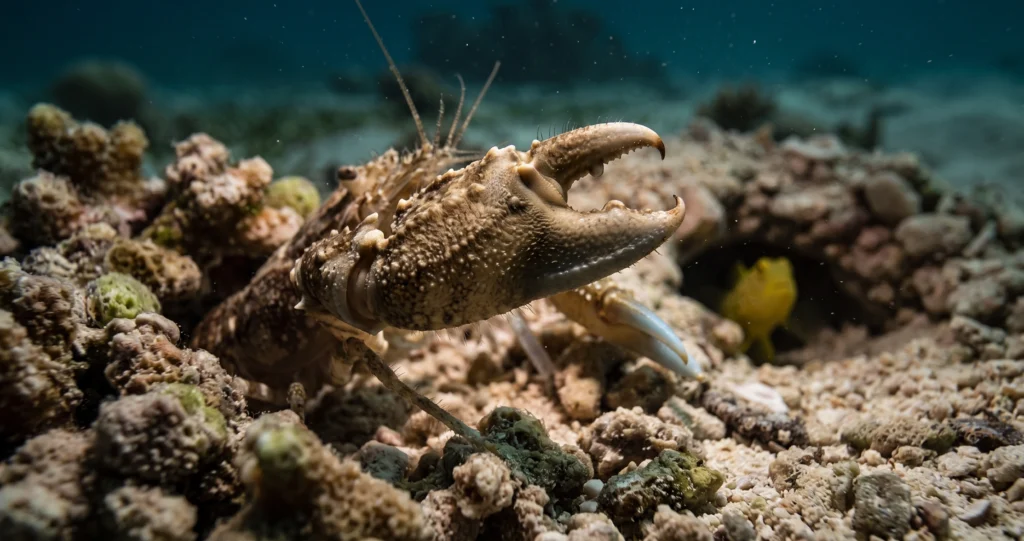
Their most distinctive feature is an asymmetrical pair of claws.
One claw is often relatively ordinary.
The other can become dramatically enlarged and specialized for snapping.
In some species, this snapping claw represents a substantial portion of the shrimp’s body size. Its shape and internal mechanics are very different from a typical pinching claw.
The shrimp does not primarily use it to crush prey between two claw tips.
Instead, the claw functions as a biological water-jet generator.
How the Pistol Shrimp Loud Snap Works
The pistol shrimp loud snap begins with a specialized claw containing a movable part that can rapidly close against a complementary structure.
When the claw is cocked, muscles store energy.
The shrimp then releases the mechanism.
The movable portion closes at extremely high speed, displacing water from the claw and forcing it through a narrow opening.
This produces a fast jet of water.
The water jet is the critical part.
For many years, people assumed the sharp sound came directly from the two hard parts of the claw striking one another.
High-speed imaging and acoustic research demonstrated otherwise.
A landmark study published in Science showed that the characteristic snap is generated primarily by the collapse of a cavitation bubble produced by the water jet, rather than by direct mechanical impact between the claw surfaces.
That discovery transformed the scientific understanding of pistol shrimp.
The claw is effectively the trigger.
The bubble is the explosive acoustic event.
What Is Cavitation?
Cavitation sounds exotic, but engineers have dealt with it for decades.
When water moves rapidly enough, local pressure can fall dramatically.
If pressure drops below a critical level, a vapor-filled cavity or bubble can form.
That is cavitation.
Similar bubbles can develop around rapidly moving ship propellers, turbines, pumps, and other machinery.
They can cause serious engineering problems because their collapse generates intense local pressure and can gradually damage solid surfaces.
A pistol shrimp deliberately creates the same basic physical phenomenon.
When the claw fires its jet, the extremely rapid water flow creates a region of sufficiently low pressure for a cavitation bubble to appear.
The bubble expands briefly.
Then surrounding water pressure forces it to collapse.
That collapse is extraordinarily rapid.
And that is when the pistol shrimp loud snap is produced.
Why the Bubble Collapse Is So Powerful
A cavitation bubble stores energy in a tiny volume.
When it collapses, the surrounding water rushes inward.
The bubble contracts violently, concentrating energy into a very small region.
The collapse creates a sharp pressure pulse that propagates through the water as sound.
At close range, the pressure change can be powerful enough to affect small animals.
Researchers investigating snapping shrimp have measured source levels above 200 decibels referenced to one micropascal at one meter for some snaps, although values vary by species, measurement technique, animal size, distance, and experimental conditions.
That number sounds almost impossible.
It also needs context.
Underwater decibels cannot be directly compared with familiar airborne sound measurements without accounting for different reference pressures and the physical properties of water and air.
So saying “a pistol shrimp is louder than a gunshot” without qualification can be misleading.
The shrimp nevertheless produces an exceptionally intense impulsive underwater sound for such a small animal.
The Bubble Can Produce Light
The cavitation story contains another surprising twist.
Researchers discovered that the collapsing bubble can emit a tiny flash of light.
This phenomenon is related to sonoluminescence.
As the bubble collapses, its contents are compressed extremely rapidly. For an extraordinarily brief period, temperatures within the collapsing cavity can become extremely high.
A study published in Nature reported light emission from snapping-shrimp cavitation bubbles and estimated temperatures of at least several thousand kelvin inside the collapsing bubble.
The researchers called the phenomenon “shrimpoluminescence.”
The flash is extremely brief and faint.
The shrimp is not firing a visible underwater laser, and the light is not thought to be the primary hunting weapon.
Instead, it is a physical side effect of the extreme conditions created during cavitation.
The pressure wave is what matters biologically.
How Loud Is a Pistol Shrimp?
Descriptions of pistol shrimp commonly cite peak source levels around or above 200 dB re 1 µPa at 1 meter for particularly powerful snaps.
That places them among the most intense small biological sound sources measured underwater.
But interpreting the number requires care.
A human conversation might measure around 60 decibels in air.
A motorcycle or power tool may exceed 90 dB.
Very loud concerts can exceed 100 dB, and gunshots can reach much higher peak levels.
Those values are generally measured in air using a reference pressure of 20 micropascals.
Underwater acoustics conventionally uses a reference pressure of 1 micropascal.
Water also has very different density and acoustic impedance from air.
Consequently, 200 dB underwater is not equivalent to experiencing a 200 dB sound in air.
A better conclusion is that the pistol shrimp loud snap generates an exceptionally intense, extremely short underwater pressure pulse.
For an animal only a few centimeters long, that is remarkable enough without forcing an inaccurate air-versus-water comparison.
Can Pistol Shrimp Really Interfere With Sonar?
Large aggregations of snapping shrimp can create an extraordinary acoustic background.
Individual snaps overlap until the habitat sounds like continuous crackling.
During World War II, military sonar operators encountered biological noise from snapping shrimp that complicated underwater listening in some coastal regions.
Modern passive-acoustic researchers also use snapping-shrimp noise as an indicator of biological activity in certain habitats.
The effect does not mean one shrimp can somehow “jam” a submarine.
Rather, thousands of animals snapping repeatedly can raise ambient noise across portions of the frequency spectrum.
Healthy oyster reefs, coral reefs, and other structurally complex habitats can therefore have distinctive snapping soundscapes.
A quiet underwater landscape is not necessarily a healthy one.
Sometimes ecological activity is noisy.
How Pistol Shrimp Hunt With Their Snap
The pistol shrimp loud snap functions as a weapon at very short range.
A shrimp can remain partly concealed within a burrow or crevice while monitoring the surrounding area.
When suitable prey approaches, the shrimp aims its enlarged claw.
Then it fires.
The resulting jet and cavitation collapse generate a pressure wave that can stun, incapacitate, or kill small prey.
The shrimp can then retrieve the animal.
Small crustaceans, worms, fish, and other appropriately sized organisms may become targets depending on the snapping-shrimp species.
This hunting strategy offers a major advantage.
The shrimp does not need to engage every prey animal directly with its relatively vulnerable body.
Its enlarged claw creates a ranged attack.
The effective range is short by human standards.
For an animal only a few centimeters long, however, it is significant.
Accuracy Still Matters
The cavitation bubble does not automatically make every snap successful.
The shrimp must orient the claw appropriately.
Distance matters.
The pressure pulse rapidly loses effectiveness as it travels.
A target too far away may escape unaffected.
That means the pistol shrimp loud snap combines specialized anatomy with sensory and motor control.
The shrimp needs to detect something worth snapping at, orient toward it, and discharge the claw under useful conditions.
The mechanism is therefore comparable to other highly specialized animal hunting adaptations.
Archerfish, for example, use precisely controlled water jets to knock insects from vegetation above the surface. You can read more in our article on how archerfish use physics to shoot insects out of the air.
Both animals weaponize water.
But they do so in completely different ways.
The archerfish uses the mass and trajectory of a water jet.
The pistol shrimp uses a jet to trigger cavitation.
Snapping Is Not Only for Hunting
If every snap meant “food,” snapping-shrimp habitats would contain an extraordinary number of failed hunting attempts.
The behavior serves multiple purposes.
Pistol shrimp also snap during territorial encounters.
Two individuals may use their claws in aggressive displays when competing for shelters, mates, or space.
The sound and pressure pulse can warn a rival without requiring prolonged physical combat.
Snapping can therefore function as a form of communication.
The precise meaning depends on species and context.
Researchers studying snapping shrimp have examined how individuals respond acoustically to rivals and other environmental stimuli.
The large claw becomes both weapon and signal.
This dual function is common in evolution.
Structures capable of inflicting damage frequently become useful for communication because displaying the weapon can prevent the need to actually use it.
The Ocean’s Crackling Soundscape
One pistol shrimp creates a sharp pop.
Thousands create something entirely different.
In habitats with abundant snapping shrimp, underwater recordings can contain persistent crackling reminiscent of frying food or burning twigs.
These biological soundscapes can dominate local ambient noise.
Scientists increasingly study underwater sound as a way of monitoring ecosystems.
Because snapping shrimp are associated with particular structured habitats, changes in their acoustic activity can sometimes contribute information about ecological conditions.
Sound alone cannot provide a complete measurement of ecosystem health.
But passive acoustic monitoring has one enormous advantage.
Hydrophones can listen continuously without needing divers to count every organism.
The pistol shrimp loud snap therefore has become useful to scientists as well as shrimp.
Pistol Shrimp and Gobies: An Extraordinary Partnership
Some pistol shrimp have evolved one of the best-known mutualistic relationships on coral reefs.
They share burrows with goby fish.
The partnership solves a problem created by the shrimp’s lifestyle.
A shrimp can excavate and maintain an excellent shelter beneath the seafloor.
But many burrow-associated snapping shrimp have relatively poor vision.
Leaving the safety of the burrow to remove sediment or search for food can expose them to predators.
Gobies have much better eyesight.
So the two animals cooperate.
The shrimp builds.
The goby watches.
This relationship has been extensively documented in Indo-Pacific reef communities and is a classic example of mutualism: both species gain a benefit.
How the Shrimp-Goby Partnership Works
The pistol shrimp excavates sand, gravel, and rubble, creating and maintaining the shared burrow.
Moving sediment requires repeated trips outside.
While working, the shrimp often maintains physical contact with its goby partner using one of its antennae.
The goby positions itself near the burrow entrance and scans for danger.
If the goby detects a potential predator, it changes its posture or makes characteristic movements.
Because the shrimp is touching the fish, it can detect those signals.
A mild warning may cause the shrimp to become more cautious.
A stronger alarm can send both animals rapidly into the burrow.
The shrimp receives an early-warning system.
The goby receives a maintained shelter.
Neither needs to consciously negotiate the arrangement.
Natural selection favors behaviors that make the partnership beneficial to both species.
Do All Pistol Shrimp Live With Gobies?
No.
This is another area where popular descriptions often overgeneralize.
The family Alpheidae contains hundreds of species with diverse lifestyles.
Some snapping shrimp form partnerships with gobies.
Others live independently.
Some inhabit sponges.
Some associate with corals or other invertebrates.
Certain species of the genus Synalpheus have evolved extraordinarily complex social colonies, including species often described as eusocial because colonies contain specialized reproductive individuals and cooperating nonbreeders.
The phrase “pistol shrimp” therefore describes a large and behaviorally diverse group.
The shrimp-goby partnership is remarkable.
It is not universal.
Common Myths About the Pistol Shrimp Loud Snap
Myth 1: The Claw Makes the Sound by Smashing Together
The claw’s rapid closure produces a high-speed water jet.
The famous snap is primarily generated when the resulting cavitation bubble collapses.
Myth 2: A Pistol Shrimp Produces a 200-Decibel Sound Just Like a Gun
Underwater and airborne decibel values use different reference pressures and occur in media with very different acoustic properties.
Direct numerical comparisons are misleading.
Myth 3: The Bubble Boils the Surrounding Ocean
Extreme temperatures can occur for an extraordinarily short time inside the collapsing bubble.
This does not mean a substantial volume of surrounding seawater becomes thousands of degrees hot.
Myth 4: The Shrimp Shoots an Air Bubble
Cavitation bubbles form because local water pressure drops sufficiently for vapor cavities to develop.
The shrimp is not storing and firing a bubble of atmospheric air.
Myth 5: The Light Flash Is the Weapon
The tiny flash associated with bubble collapse is a physical side effect.
The pressure pulse generated by the cavitation event is the important component for hunting and defense.
Myth 6: Every Pistol Shrimp Has a Goby Partner
Only certain species and ecological populations participate in shrimp-goby mutualisms.
Other snapping shrimp have completely different lifestyles.
Myth 7: One Tiny Shrimp Can Disable a Submarine’s Sonar
Individual shrimp produce intense local snaps.
The famous interference with underwater listening results primarily from the collective acoustic output of large numbers of snapping shrimp.
FAQ
How does a pistol shrimp make its snapping sound?
The shrimp rapidly closes a specialized enlarged claw, forcing out a high-speed water jet. The jet creates a cavitation bubble that expands and then collapses violently.
The bubble collapse produces the characteristic pistol shrimp loud snap.
How loud is a pistol shrimp?
Powerful snapping shrimp can produce peak underwater source levels around or above 200 dB re 1 µPa at 1 meter under some measurement conditions.
However, this number should not be directly compared with decibel values measured in air.
Does the pistol shrimp actually shoot anything?
It shoots water rather than a solid projectile.
The fast water jet creates the cavitation event responsible for the intense pressure pulse.
Can a pistol shrimp kill prey with sound?
The physical pressure wave associated with the water jet and collapsing cavitation bubble can stun or kill small prey at close range.
Describing the weapon simply as “sound” misses the importance of the localized pressure event.
Does the bubble really become hotter than the Sun?
This popular claim is misleading.
Studies suggest extremely high temperatures can occur briefly inside the tiny collapsing bubble, potentially reaching several thousand kelvin.
That does not mean the shrimp or surrounding water experiences those temperatures in any ordinary sense.
Why do pistol shrimp snap at each other?
Snapping can be used during territorial and aggressive interactions as well as hunting.
The enlarged claw therefore functions as both a weapon and a signaling structure.
Why do some pistol shrimp live with gobies?
The shrimp provides and maintains a burrow.
The goby provides superior visual surveillance for approaching predators.
The shrimp can maintain antenna contact with the fish and respond to its warning movements.
Are pistol shrimp dangerous to humans?
They should be treated as wild animals, but the famous hunting mechanism is adapted for interactions at the shrimp’s small scale.
A snap can be startling at close range, yet viral descriptions often exaggerate the danger they pose to people.
Conclusion
The pistol shrimp loud snap begins with a claw, but the claw itself is only the trigger.
When the specialized snapping claw closes, it forces water through a narrow opening at extremely high speed. The resulting pressure drop creates a cavitation bubble.
Then the bubble collapses.
In that tiny fraction of a second, energy becomes concentrated into an intense pressure pulse and the characteristic crack that gives snapping shrimp their name. Under suitable conditions, the collapse can even produce a microscopic flash of light.
For such a small crustacean, the physical forces involved are extraordinary.
But the most interesting part is how evolution puts those forces to work.
Pistol shrimp can use their snapping apparatus to stun small prey without needing to seize it first. The same structure helps defend territories and communicate during confrontations.
When many snapping shrimp live together, their collective activity can transform an entire underwater soundscape into persistent crackling loud enough to become an important component of coastal ambient noise.
Some species add yet another layer of behavioral sophistication through their partnerships with gobies.
The shrimp excavates and maintains a shared burrow but has limited visual awareness of approaching danger. The goby watches while the shrimp works, transmitting warnings through movements the shrimp can detect while maintaining antenna contact.
One animal provides engineering.
The other provides surveillance.
Together, they create a partnership neither could reproduce as effectively alone.
The pistol shrimp loud snap is therefore much more than one of the ocean’s strangest noises.
It is the audible consequence of an extraordinary biological machine — a claw capable of manipulating fluid dynamics so effectively that a tiny crustacean can turn ordinary seawater into a hunting weapon.
Internal Link Suggestions:
- How Archerfish Use Physics to Shoot Insects Out of the Air
Place in the hunting-mechanics section. It creates a strong contextual connection between two aquatic animals that manipulate water as a projectile or hunting tool. - How Manta Rays Use Cleaning Stations — And Wait Their Turn
Place in the ecological-behavior section as another example of complex interactions between marine species, particularly when discussing the mutualistic relationship between pistol shrimp and gobies.
External Dofollow Authoritative Sources:
- Nature — How Snapping Shrimp Snap: Through Cavitating Bubbles
https://www.nature.com/articles/35097152
Landmark research establishing that the characteristic snapping sound is generated by collapse of a cavitation bubble produced by the high-speed water jet. - Nature — Snapping Shrimp Make Flashing Bubbles
https://www.nature.com/articles/35097152
Useful for explaining cavitation, extreme conditions during bubble collapse, and the phenomenon popularly known as shrimpoluminescence. - Smithsonian Ocean — Ocean Sound and Marine Life
https://ocean.si.edu/
Useful authoritative background for underwater biological sound, marine ecosystems, and explaining why sound behaves differently underwater than it does in air.