
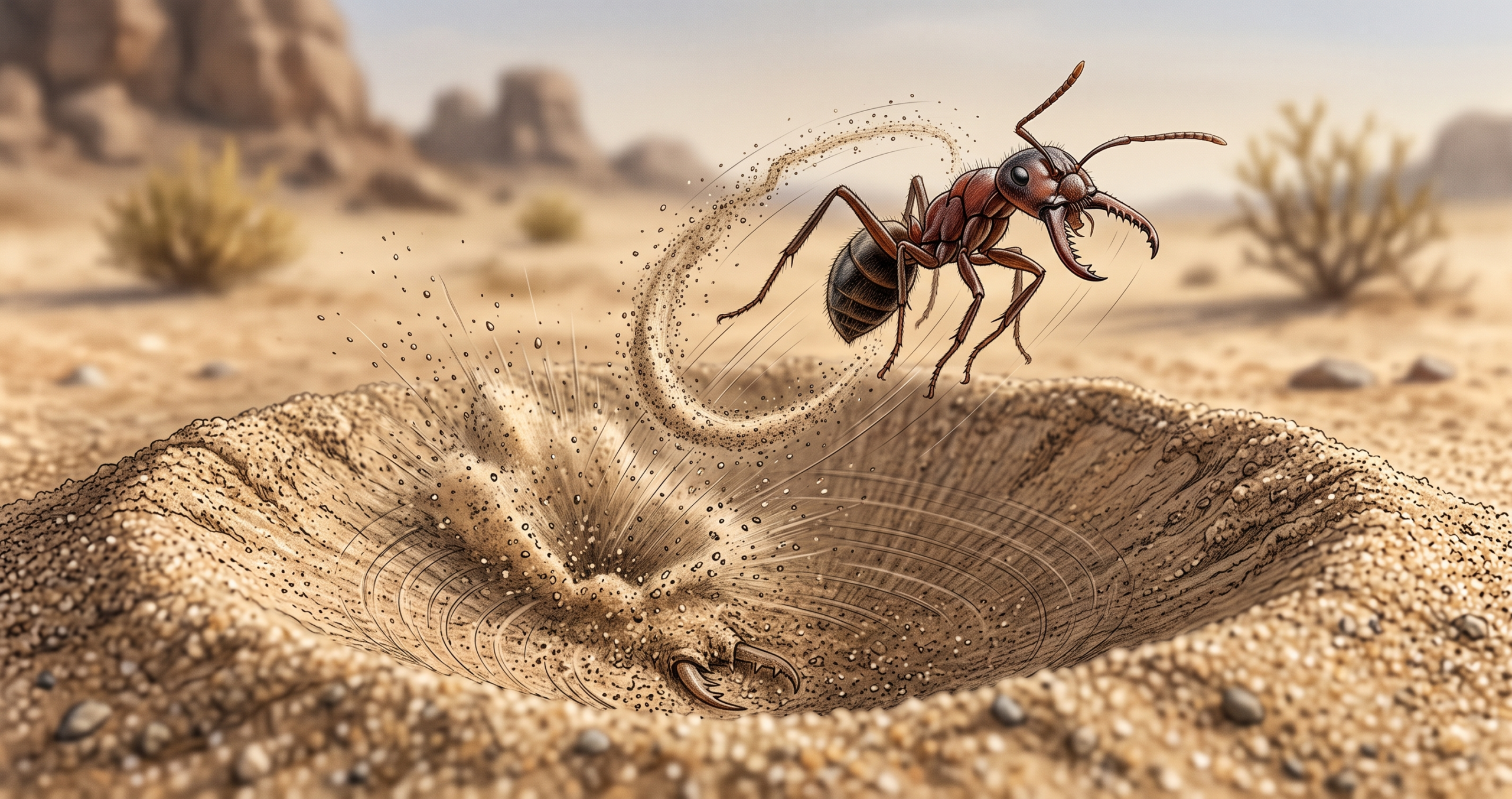
At first glance, a trap-jaw ant appears much like any other forest ant. It patrols leaf litter, searches for food, and communicates with nestmates through chemical signals. Yet hidden inside its head is one of the fastest mechanical systems found anywhere in the animal kingdom. Instead of relying only on speed or strength, these ants store energy inside specialized muscles and structures that allow their jaws to snap shut almost instantaneously.
The trap-jaw ant jump is one of the most remarkable uses of this mechanism. Although the mandibles evolved primarily for hunting and defense, some species can also use the force of a jaw strike to propel themselves into the air, escaping predators in a fraction of a second.
Over the past several decades, high-speed cameras and biomechanical research have transformed our understanding of these extraordinary insects. Scientists have documented how the jaw mechanism works, how it helps ants capture prey, and how it allows them to escape dangerous situations—including encounters with predators such as antlions. While researchers continue investigating the evolution of this behavior, the basic mechanics are now well understood.
Table of Contents
- Meet the Trap-Jaw Ant
- What Is the Trap-Jaw Ant Jump?
- Anatomy of the Spring-Loaded Mandibles
- How the Latch Mechanism Works
- From Hunting Tool to Escape System
- Escaping Antlion Traps
- Hunting With Extraordinary Speed
- The Biomechanics Behind the Jump
- Habitat and Daily Behavior
- Ecological Importance
- Conservation Challenges
- Verified Facts and Scientific Interpretation
- What People Often Get Wrong
- Tips for Observing Trap-Jaw Ants Responsibly
- Frequently Asked Questions
- Conclusion
Meet the Trap-Jaw Ant
Trap-jaw ants belong primarily to the genera Odontomachus and Anochetus, although similar jaw mechanisms have evolved independently in a few other ant groups.
They occur in tropical and subtropical regions around the world, including forests in the Americas, Africa, Asia, and Australia.
Most species live in:
- Leaf litter
- Rotten logs
- Forest soils
- Under stones
- Decaying wood
Workers are active hunters that capture live prey rather than relying mainly on scavenging.
Their unusually long mandibles immediately distinguish them from many other ants.
Instead of short jaws designed for carrying food, trap-jaw ants possess elongated mandibles that open nearly 180 degrees before snapping shut.
What Is the Trap-Jaw Ant Jump?
The trap-jaw ant jump is a defensive escape behavior in which an ant deliberately snaps its mandibles against the ground or another solid object.
Rather than striking prey, the jaws act like a spring-loaded launcher.
The tremendous force generated by the closing mandibles pushes against the surface and sends the ant airborne.
The jump is not the primary purpose of the mandibles.
Instead, it appears to be an ingenious secondary use of an already powerful hunting adaptation.
Researchers have shown that this behavior can rapidly remove an ant from immediate danger, increasing its chances of escaping predators.
Anatomy of the Spring-Loaded Mandibles
The remarkable performance of trap-jaw ants depends on highly specialized anatomy.
Oversized Mandibles
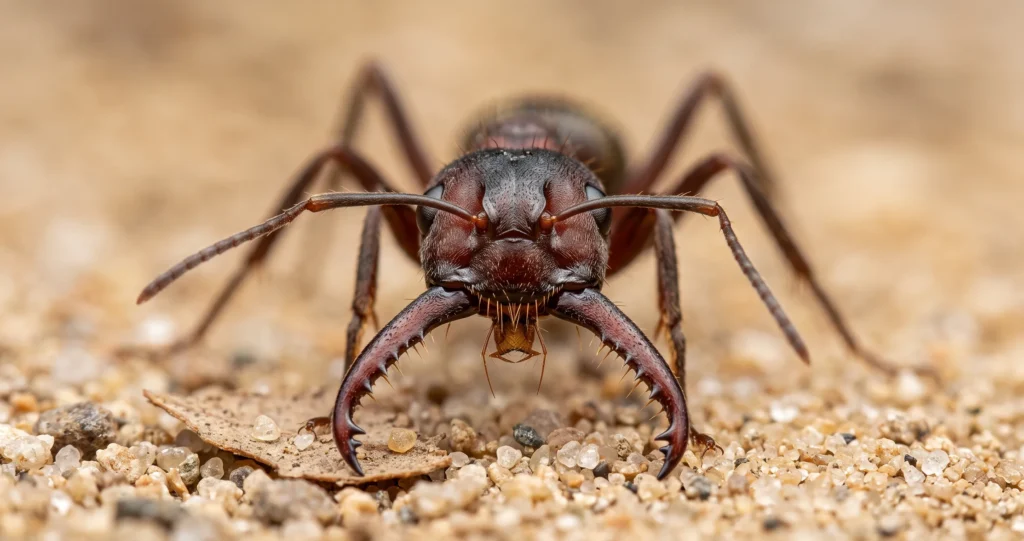
The elongated jaws serve as both weapons and mechanical tools.
They remain fully open while the ant prepares to strike.
Powerful Closing Muscles
Large muscles inside the head generate force by slowly contracting before each strike.
However, the jaws do not close immediately.
Instead, energy is stored.
Trigger Hairs
Tiny sensory hairs near the mandibles detect contact with prey or nearby objects.
Touching these hairs activates the release mechanism.
Reinforced Head Capsule
Because enormous forces are generated during each strike, the head capsule must withstand repeated mechanical stress.
Its rigid structure helps transfer force efficiently while protecting internal tissues.
How the Latch Mechanism Works
The speed of the jaws does not come directly from muscle contraction.
Muscles alone cannot contract fast enough.
Instead, the ant uses a latch-mediated spring mechanism.
The process occurs in several stages.
Step 1: Opening the Mandibles
The jaws open extremely wide.
Muscles contract and begin storing elastic energy.
Step 2: Locking the System
A specialized latch prevents the mandibles from closing despite the tension.
This allows additional energy to accumulate.
Step 3: Trigger Activation
When prey contacts the trigger hairs—or when the ant intentionally strikes a surface during escape—the latch releases.
Step 4: Instantaneous Closure
Stored elastic energy powers the jaws shut far faster than muscle alone could achieve.
This principle resembles other biological spring systems found in organisms such as mantis shrimp, froghoppers, and some jumping insects.
From Hunting Tool to Escape System
Evolution often repurposes existing structures.
The trap-jaw ant provides an excellent example.
Researchers believe the mandibles originally evolved for prey capture.
Powerful jaws allowed ants to seize fast-moving insects before they escaped.
Later, those same jaws became useful for defense.
When threatened, some species discovered another advantage.
By striking the ground instead of prey, they could launch themselves away from danger.
Rather than evolving an entirely new escape mechanism, they modified the use of one they already possessed.
Escaping Antlion Traps
One of the best-known demonstrations of the trap-jaw ant jump comes from studies involving antlions.
Antlion larvae dig cone-shaped pits in loose sand.
Unsuspecting ants that fall inside often slide toward the waiting predator.
Researchers have shown that trap-jaw ants sometimes escape these pits by snapping their mandibles against the sand or pit wall.
The resulting jump may propel the ant completely out of the trap before the antlion can capture it.
Experiments comparing ants capable of jumping with those prevented from using the behavior have demonstrated that escape jumps can significantly improve survival in these situations.
These studies provide strong evidence that the jumping behavior has real defensive value.
Hunting With Extraordinary Speed
Although jumping attracts attention, hunting remains the primary role of the mandibles.
Trap-jaw ants actively pursue:
- Small insects
- Larvae
- Termites
- Other ants
- Soft-bodied arthropods
When prey approaches, the ant waits with open mandibles.
The trigger hairs detect contact.
The jaws snap shut almost instantly.
The speed reduces the prey’s opportunity to escape.
After capture, workers transport food back to the colony where it is shared among nestmates.
The Biomechanics Behind the Jump
The trap-jaw ant jump demonstrates several important biomechanical principles.
Elastic Energy Storage
Muscles generate force relatively slowly.
Elastic structures allow that energy to accumulate before being released almost instantaneously.
Power Amplification
The release produces much greater instantaneous power than muscle contraction alone could provide.
This concept appears repeatedly throughout nature.
Momentum Transfer
When the jaws strike the ground, momentum transfers through the ant’s body.
The resulting force launches the insect into the air.
Precision Matters
The direction of the jump depends on where the jaws contact the surface.
Not every launch follows the same path.
Scientists continue studying how accurately ants control these trajectories during escape.
Habitat and Daily Behavior
Trap-jaw ants thrive in warm environments with abundant leaf litter and invertebrate prey.
Colonies are generally much smaller than those of many common ants.
Workers forage individually rather than in massive columns.
Communication relies primarily on pheromones.
When danger threatens the colony, workers may defend nest entrances aggressively.
Despite their impressive jaws, trap-jaw ants usually avoid unnecessary conflict.
Rapid escape often provides a safer strategy than prolonged fighting.
Ecological Importance
Trap-jaw ants help regulate populations of small invertebrates.
As predators, they contribute to maintaining balanced forest food webs.
They also become prey themselves.
Birds, reptiles, spiders, amphibians, and other insects all feed on ants.
Their nesting activities help mix soil while contributing to nutrient cycling within forest ecosystems.
Although individually small, trap-jaw ants play meaningful ecological roles in tropical habitats.
Conservation Challenges
Most trap-jaw ant species have not been studied as extensively as larger vertebrates.
Many appear locally common.
However, like countless forest invertebrates, they depend on healthy habitats.
Deforestation, habitat fragmentation, intensive agriculture, and changes in forest moisture may reduce suitable nesting sites.
Because many tropical insects remain poorly documented, scientists continue discovering new species and learning more about their distributions.
Protecting diverse forest ecosystems benefits trap-jaw ants alongside thousands of other invertebrates that contribute to ecosystem health.
Verified Facts and Scientific Interpretation
Well-supported scientific findings
Research has clearly demonstrated that:
- Trap-jaw ants possess latch-mediated spring-powered mandibles.
- Mandibles evolved primarily for prey capture and defense.
- Some species use jaw-powered jumps as escape behavior.
- High-speed video confirms extremely rapid jaw closure.
- Experiments involving antlion pits show escape jumps can improve survival.
Areas of ongoing research
Scientists continue investigating:
- The evolutionary sequence that led to jumping behavior.
- Differences among species in jumping frequency.
- Neural control of the latch mechanism.
- Variation in jumping performance across habitats.
Separating established findings from ongoing research provides a clearer understanding of what is currently known.
What People Often Get Wrong
Several misconceptions surround trap-jaw ants.
They do not always jump.
Jumping is an escape behavior used under particular circumstances rather than a normal method of movement.
The jaws are not powered by unusually fast muscles.
The remarkable speed comes from stored elastic energy released through a latch mechanism.
Every trap-jaw ant species behaves identically.
Different species vary in hunting behavior, habitat, and use of escape jumps.
They are not dangerous to people.
Although they can bite defensively, they generally avoid confrontation and are not considered medically significant.
Antlion experiments are not artificial curiosities.
They help researchers understand real predator-prey interactions that occur naturally in sandy habitats.
Tips for Observing Trap-Jaw Ants Responsibly
Trap-jaw ants reward patient observation.
If you encounter them in the wild:
- Watch without disturbing the nest.
- Avoid handling individual ants.
- Use a macro lens rather than moving insects for photographs.
- Leave logs and leaf litter as you found them.
- Observe natural hunting behavior instead of provoking defensive strikes.
- Respect protected forest habitats.
Responsible observation provides valuable opportunities to appreciate insect behavior without affecting local populations.
Frequently Asked Questions
How fast do trap-jaw ant mandibles close?
The jaws close at extraordinary speeds measured using high-speed cameras. Exact values vary among species, but the closure is far faster than ordinary muscle contraction alone could achieve.
Why do trap-jaw ants jump?
The jump helps some species escape predators by converting jaw-closing force into rapid body movement.
Can every trap-jaw ant perform escape jumps?
Not all species have been observed using this behavior to the same extent, although several well-studied species clearly do.
What do trap-jaw ants eat?
They primarily hunt small arthropods, including insects, larvae, termites, and other invertebrates.
How do scientists study jaw movement?
Researchers use high-speed video, force measurements, biomechanical modeling, and microscopy to understand how the latch mechanism stores and releases energy.
Conclusion
The trap-jaw ant jump is an elegant example of how evolution can transform a hunting adaptation into an effective escape strategy. By combining spring-loaded mandibles, a sophisticated latch mechanism, and precisely timed releases, these ants capture prey with remarkable speed while also launching themselves away from danger when necessary. Studies involving antlion predators have demonstrated that these jaw-powered jumps provide genuine survival benefits rather than serving as accidental side effects of powerful bites.
Beyond their impressive biomechanics, trap-jaw ants remind us that even small forest insects possess highly specialized adaptations shaped by millions of years of natural selection. Protecting healthy forests and continuing research into insect biomechanics will deepen our understanding of these remarkable animals and the ecosystems they help sustain.
Recommended Internal-Link Opportunities
Instead of linking to unverified URLs, consider linking from this article to relevant content available on https://secretsofthegreengarden.com, such as:
- Articles about extraordinary insect adaptations and biomechanics
- Wildlife content covering predator-prey interactions
- Articles on ants, termites, or other social insects
- Features on animal escape mechanisms and evolutionary adaptations
Recommended External Authoritative Sources
- Smithsonian National Museum of Natural History – Ant biology and insect evolution
- Peer-reviewed journals including Proceedings of the National Academy of Sciences (PNAS), Journal of Experimental Biology, Current Biology, and Proceedings of the Royal Society B covering trap-jaw ant biomechanics
- Harvard University – Museum of Comparative Zoology and ant research resources
- AntWeb (California Academy of Sciences) – Taxonomy and natural history of Odontomachus and Anochetus
- Animal Diversity Web (University of Michigan) – Species and genus overviews