

Every year, thousands of shorebirds disappear over the horizon and do not touch land again for days. Among them is the bar-tailed godwit, a medium-sized wader that undertakes one of the longest known nonstop migrations in the animal kingdom. Without stopping to eat, drink, or rest on land, these birds cross vast stretches of the Pacific Ocean using carefully timed departures, extraordinary physiological adaptations, and remarkable navigational abilities.
Understanding bar-tailed godwit migration is about more than appreciating an impressive journey. These flights reveal how evolution has shaped birds to survive extreme endurance challenges while highlighting the importance of healthy coastal wetlands thousands of miles apart. A feeding ground in Alaska, an estuary in East Asia, and a tidal flat in New Zealand or Australia may all be essential parts of a single bird’s annual cycle.
Researchers have pieced together this migration through decades of field observations, bird banding, satellite tracking, and advances in lightweight GPS technology. While many aspects of the migration are now well documented, scientists continue studying how weather, climate, and changing coastal habitats influence the birds’ remarkable journeys.
Table of Contents
- Meet the Bar-Tailed Godwit
- Understanding Bar-Tailed Godwit Migration
- Mapping the Trans-Pacific Route
- Fuel Loading Before Departure
- Extraordinary Physiological Changes
- Navigation Across an Ocean
- Using Weather to Their Advantage
- What Satellite Tracking Has Revealed
- Habitat and Staging Grounds
- Ecological Importance
- Conservation Challenges
- Verified Facts and Scientific Interpretation
- What People Often Get Wrong
- Tips for Watching Migratory Shorebirds
- Frequently Asked Questions
- Conclusion
Meet the Bar-Tailed Godwit
The bar-tailed godwit (Limosa lapponica) is a migratory shorebird found across the Northern Hemisphere.
Several subspecies breed in Arctic and sub-Arctic regions before migrating to wintering grounds across Europe, Africa, Asia, Australia, and New Zealand.
One population, often referred to as the Alaska breeding population (L. l. baueri), has become especially well known because many individuals complete nonstop flights across the Pacific Ocean to New Zealand and eastern Australia.
Adults have long legs, a slightly upturned bill, streamlined bodies, and cryptic plumage that blends well with coastal habitats.
Although they spend much of the year feeding quietly on tidal mudflats, their annual migration has made them one of the world’s best-known long-distance travelers.
Understanding Bar-Tailed Godwit Migration
The phrase bar-tailed godwit migration refers to a complex annual cycle rather than a single flight.
Throughout the year, these birds move between breeding grounds, staging areas, and wintering sites.
The longest nonstop flights usually occur during autumn migration from Alaska to the South Pacific.
Instead of hopping between islands, many birds depart directly across open ocean.
The return journey in spring often includes important stopovers in East Asia, particularly around the Yellow Sea, where birds replenish energy before continuing toward Arctic breeding grounds.
This difference between southbound and northbound migration reflects changing weather patterns, food availability, and breeding schedules.
Mapping the Trans-Pacific Route
Most long-distance migrants cannot avoid stopping for food.
Bar-tailed godwits are different.
After feeding intensively in Alaska during late summer, many birds launch over the Pacific Ocean and remain airborne until reaching New Zealand or eastern Australia.
Depending on the individual bird and destination, these flights may cover well over 10,000 kilometers (more than 6,000 miles) without landing.
The exact route is rarely a perfectly straight line.
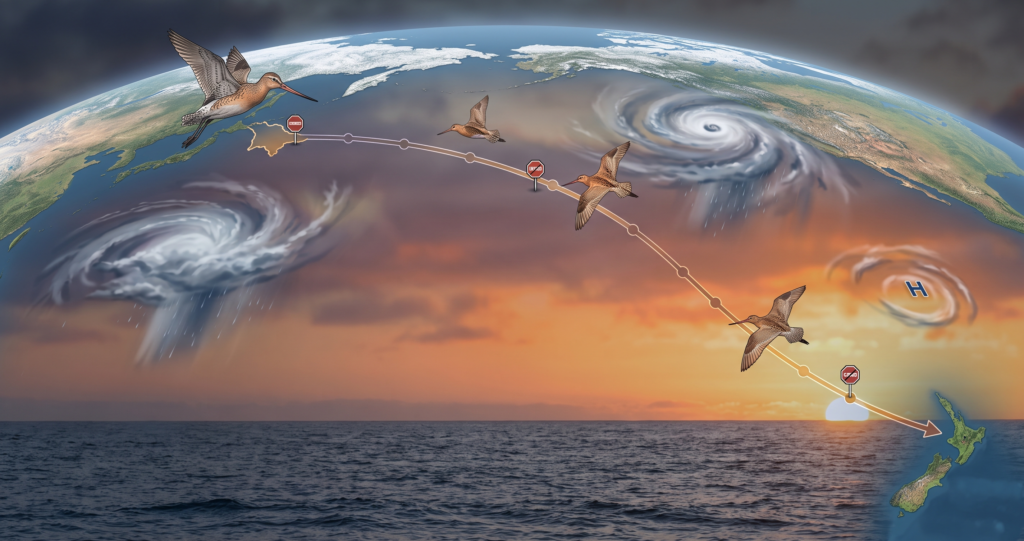
Instead, birds adjust their heading to account for prevailing winds and atmospheric conditions.
Modern satellite tracking has shown that migration paths can curve considerably as birds respond to weather systems.
Fuel Loading: Preparing for an Epic Journey
No bird can remain airborne for over a week without careful preparation.
The secret begins before departure.
Rapid Fat Accumulation
In the weeks before migration, godwits feed almost continuously on nutrient-rich invertebrates such as worms, shellfish, and crustaceans found in tidal mudflats.
Much of this energy is converted into fat.
Fat provides more energy per gram than carbohydrates or protein, making it the ideal fuel for sustained flight.
During this period, birds can nearly double their body weight.
Although carrying extra weight initially makes takeoff more demanding, those reserves become essential once the journey begins.
Productive Feeding Grounds Matter
Fuel loading only succeeds where food is abundant.
Healthy estuaries and tidal flats allow birds to build sufficient energy reserves before departure.
Loss of these feeding areas can reduce migration success even if breeding and wintering habitats remain intact.
Extraordinary Physiological Changes
Migration involves far more than gaining weight.
The bodies of bar-tailed godwits undergo remarkable seasonal changes.
Enlarged Flight Muscles
The powerful breast muscles responsible for wing movement become especially well developed before migration.
These muscles provide the endurance required for continuous flapping flight.
Digestive Organs Shrink
One of the most fascinating adaptations is the temporary reduction in the size of digestive organs.
Once feeding stops, maintaining a large digestive system becomes unnecessary.
Reducing the size of organs such as the stomach and intestines decreases body weight and lowers energy requirements.
After reaching their destination, these organs gradually return to normal size as feeding resumes.
Fat Becomes the Primary Fuel
Throughout the flight, stored fat is steadily converted into usable energy.
As reserves decline, the birds become progressively lighter, making flight somewhat more efficient near the end of the journey.
Water Balance
Metabolism of fat produces both energy and metabolic water.
This internal water production helps support hydration during flights when no external water sources are available.
Researchers continue studying the precise balance between water loss and metabolic water production during these extraordinary migrations.
Navigation Across an Ocean
One of the greatest mysteries surrounding bar-tailed godwit migration has always been navigation.
Crossing an ocean offers few obvious visual landmarks.
Research suggests that migratory birds rely on multiple orientation systems rather than a single navigation method.
Evidence from numerous bird species indicates they may use combinations of:
- The sun
- Stars
- Earth’s magnetic field
- Polarized light patterns
- Wind direction
- Learned geographic information
Exactly how bar-tailed godwits integrate these cues remains an active area of scientific research.
Individual experience may also improve navigational precision over successive migrations.
Using Weather to Their Advantage
Migration timing depends heavily on weather.
Godwits do not simply depart on the same calendar date every year.
Instead, they appear to wait for favorable atmospheric conditions.
Tailwinds can dramatically reduce energy expenditure while shortening travel time.
Conversely, strong headwinds increase the cost of migration.
Satellite tracking has shown that birds often adjust departure timing to coincide with supportive weather systems.
This behavior highlights the importance of flexibility rather than rigid scheduling.
Changing climate patterns may alter wind conditions in the future, making this an important area of ongoing research.
What Satellite Tracking Has Revealed
Modern satellite transmitters have transformed migration research.
Before lightweight tracking devices became available, scientists relied mainly on band recoveries and field observations.
Satellite tracking now allows researchers to follow individual birds throughout their journeys.
These studies have confirmed:
- Exceptionally long nonstop flights
- Precise migration timing
- Flexible routes influenced by weather
- Use of specific staging areas
- Strong fidelity to important wintering and breeding sites
Tracking has also revealed that individual birds often return to remarkably similar locations year after year.
This consistency underscores the importance of protecting the same wetlands over long periods.
Habitat and Staging Grounds
Although the nonstop Pacific crossing attracts the most attention, migration depends equally on habitats before and after the flight.
Critical sites include:
Arctic Breeding Grounds
Open tundra provides nesting habitat during the brief northern summer.
Alaskan Feeding Areas
Rich coastal mudflats allow birds to accumulate fat before southbound migration.
Yellow Sea Region
Many northbound migrants depend on intertidal habitats around the Yellow Sea to rebuild energy reserves before continuing toward Alaska.
New Zealand and Australia
Coastal estuaries and tidal flats provide winter feeding grounds where birds recover from migration and prepare for the next annual cycle.
Each location supports a different stage of the migration.
The loss of any one may affect the entire population.
Ecological Importance
Bar-tailed godwits contribute to healthy coastal ecosystems in several ways.
As predators of worms, mollusks, and crustaceans, they help influence invertebrate communities.
They also serve as prey for raptors and other predators.
Perhaps their greatest ecological significance lies in demonstrating the interconnected nature of global ecosystems.
Their annual movements link Arctic tundra, Pacific weather systems, Asian estuaries, and Southern Hemisphere coastlines into one continuous ecological network.
Conservation Challenges
The greatest threat facing many migratory shorebirds is habitat loss.
Intertidal mudflats have declined in several regions due to coastal development, land reclamation, pollution, and infrastructure expansion.
Because bar-tailed godwits depend on multiple staging areas during different phases of migration, habitat loss at one location can influence survival thousands of miles away.
Climate change presents additional uncertainty.
Sea-level rise, altered storm frequency, and changing food availability may affect both migration timing and habitat quality.
Conservation increasingly focuses on protecting internationally important wetlands, restoring degraded estuaries, monitoring migration through satellite tracking, and supporting international agreements that recognize the shared responsibility for migratory species.
Verified Facts and Scientific Interpretation
Well-supported scientific findings
Research consistently supports that:
- Some Alaska breeding bar-tailed godwits complete exceptionally long nonstop flights across the Pacific.
- Birds accumulate extensive fat reserves before departure.
- Digestive organs temporarily shrink while flight muscles become relatively larger during migration.
- Satellite tracking has confirmed long-distance routes and important staging grounds.
- The Yellow Sea region is critically important for many northbound migrants.
Areas of continuing research
Scientists continue investigating:
- How birds combine different navigation cues during ocean crossings.
- How changing wind patterns may influence future migration routes.
- Individual variation in migration decisions.
- Long-term impacts of climate change on migration timing and survival.
Recognizing these uncertainties helps distinguish established knowledge from active scientific investigation.
What People Often Get Wrong
Several misconceptions surround bar-tailed godwits.
They never stop during migration.
Only certain migration legs are nonstop. Other parts of the annual cycle rely heavily on staging grounds.
They simply fly in a straight line.
Actual routes often shift in response to weather and wind conditions.
They fly without preparation.
The longest flights are only possible after weeks of intensive feeding and major physiological changes.
Every population follows the same route.
Different subspecies and populations use different migration pathways and wintering areas.
Migration depends only on instinct.
Instinct is important, but learning, weather, and environmental conditions also influence migration behavior.
Tips for Watching Migratory Shorebirds
Watching migrating godwits can be rewarding while minimizing disturbance.
- Observe from established viewing areas.
- Avoid flushing feeding flocks.
- Use binoculars or spotting scopes.
- Respect seasonal access restrictions.
- Support protected estuaries and coastal reserves.
- Visit internationally recognized wetlands during migration seasons.
- Report sightings through reputable citizen-science programs when appropriate.
Healthy feeding opportunities are essential for successful migration.
Even repeated disturbances can reduce valuable feeding time.
Frequently Asked Questions
How long can bar-tailed godwits fly without stopping?
Some individuals have been documented completing nonstop flights lasting several days while traveling well over 10,000 kilometers across the Pacific Ocean.
Why do they become heavier before migration?
They store large fat reserves that provide the energy required for continuous flight.
How do they know where to fly?
Evidence suggests they use multiple orientation cues, including celestial information, Earth’s magnetic field, weather conditions, and learned experience. Researchers continue studying the exact mechanisms.
Why is the Yellow Sea important?
Its productive mudflats provide essential feeding habitat for many birds during northbound migration, allowing them to replenish energy before reaching Arctic breeding grounds.
Are bar-tailed godwits threatened?
Global conservation status varies among populations, but habitat loss along migratory routes—particularly at important staging grounds—remains a major conservation concern.
Conclusion
The bar-tailed godwit migration is a remarkable demonstration of endurance, physiology, and ecological connectivity. By combining extensive fuel loading, temporary changes to internal organs, sophisticated navigation, careful use of favorable weather, and exceptional flight efficiency, these shorebirds complete some of the longest nonstop journeys known in nature. Modern satellite tracking has transformed our understanding of these migrations, revealing not only the birds’ extraordinary capabilities but also their dependence on a chain of healthy wetlands stretching across the Pacific.
Protecting breeding grounds, coastal staging areas, and wintering habitats is essential for the future of these migrations. The success of a single bird may depend on habitats separated by thousands of miles and managed by multiple countries. Conserving those interconnected landscapes ensures that future generations can continue witnessing one of the world’s most remarkable examples of long-distance migration.
Recommended Internal-Link Opportunities
Instead of linking to unverified URLs, consider linking from this article to relevant content available on https://secretsofthegreengarden.com, such as:
- Articles about remarkable bird migration and navigation
- Wildlife articles covering shorebirds or wetland birds
- Content on animal physiological adaptations for extreme endurance
- Conservation articles about wetlands and coastal ecosystems
Recommended External Authoritative Sources
- Cornell Lab of Ornithology – Birds of the World (Bar-tailed Godwit species account)
- U.S. Geological Survey (USGS) – Migratory bird research and satellite tracking
- BirdLife International – Species factsheet and flyway conservation resources
- Peer-reviewed journals such as Proceedings of the Royal Society B, Journal of Avian Biology, The Auk, and Nature Communications covering migration physiology and tracking studies
- East Asian–Australasian Flyway Partnership (EAAFP) – Conservation of migratory shorebirds and staging habitats