
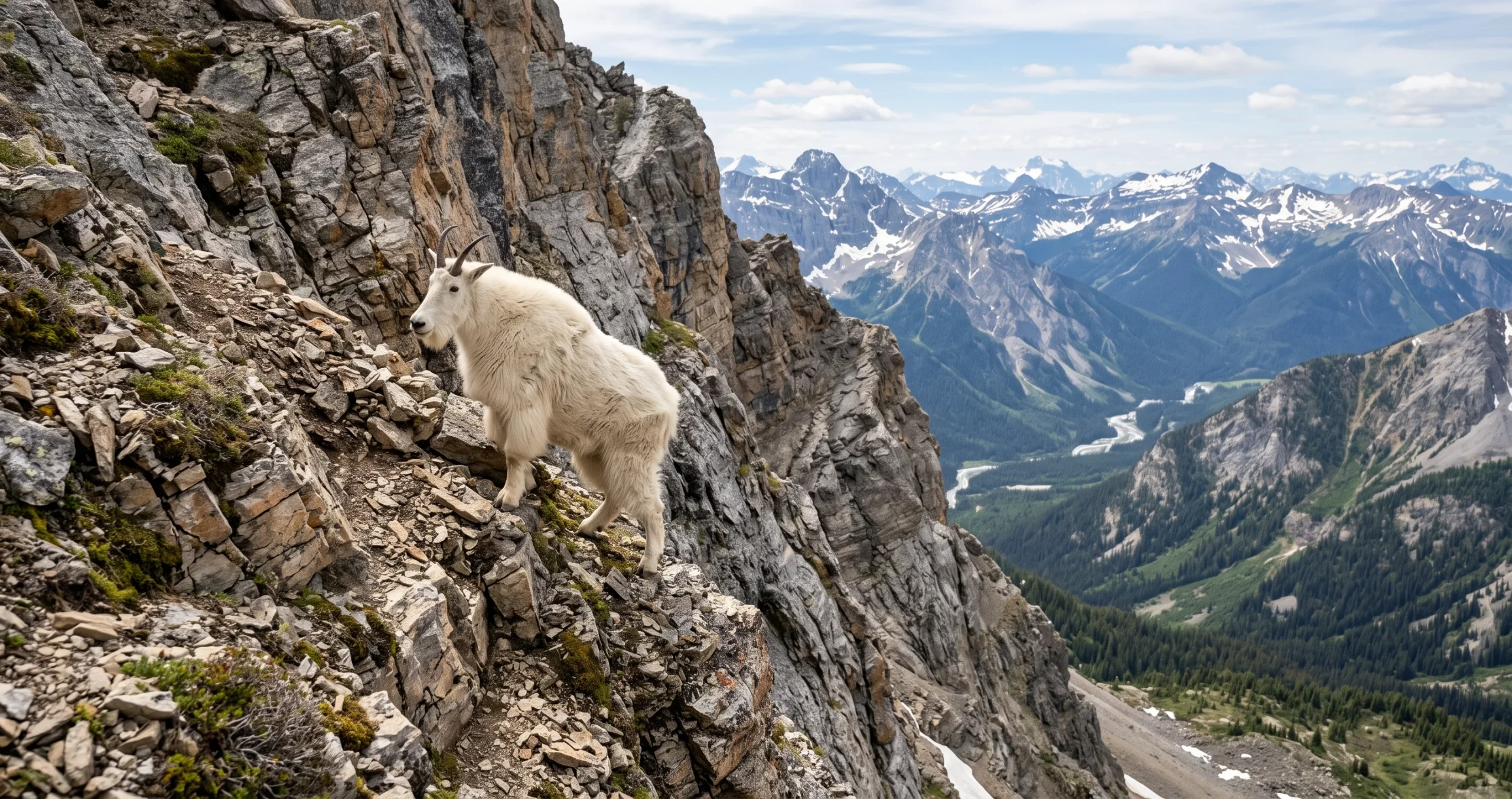
A mountain goat standing on a tiny ledge can look as though someone placed it in the wrong part of a photograph. Beneath its hooves may be a steep wall of rock, yet the animal appears remarkably comfortable.
The secret behind mountain goat cliff climbing is not one extraordinary adaptation. It is a combination of specialized hooves, powerful forequarters, a compact body, careful foot placement, and a lifestyle built around rugged terrain. Mountain goats (Oreamnos americanus) regularly use steep alpine and subalpine landscapes where many large predators have difficulty following them.
Those seemingly impossible cliffs are therefore more than an impressive climbing arena. They are part of the mountain goat’s survival strategy.
Table of Contents
- Meet the Mountain Goat
- How Mountain Goat Cliff Climbing Works
- The Remarkable Anatomy of a Mountain Goat Hoof
- Why Split Hooves Improve Grip
- Soft Pads That Grip Rock
- Body Proportions Built for Steep Terrain
- Why Mountain Goats Seek Dangerous Cliffs
- Cliffs as Escape Terrain
- The Hidden Risks of Life on the Edge
- Mountain Goats vs. Alpine Ibex
- How Young Mountain Goats Learn to Climb
- Frequently Asked Questions
- Conclusion
Meet the Mountain Goat
Despite the familiar name, the mountain goat is not simply a wild version of the domestic goat.
Its scientific name is Oreamnos americanus, and it is the only living species in the genus Oreamnos. The National Park Service notes that mountain goats are more closely related to Eurasian caprines such as chamois, gorals, and serows than their common name might suggest.
Mountain goats are native to mountainous regions of northwestern North America, including Alaska, western Canada, and portions of the northwestern United States.
Their preferred world includes alpine meadows, rocky slopes, ridgelines, and cliffs.
In some areas, observers can see what appear to be little white dots scattered across enormous rock faces. Through binoculars, those dots reveal themselves as mountain goats casually moving across terrain that would require technical equipment for a human climber.
This relationship with cliffs is deeply connected to their anatomy.
How Mountain Goat Cliff Climbing Works
Successful mountain goat cliff climbing starts at ground level—with the feet.
A human hiking boot relies on a broad rubber sole, tread, ankle support, and friction. Mountain goats accomplish something functionally similar with a biological system that can adjust to uneven rock.
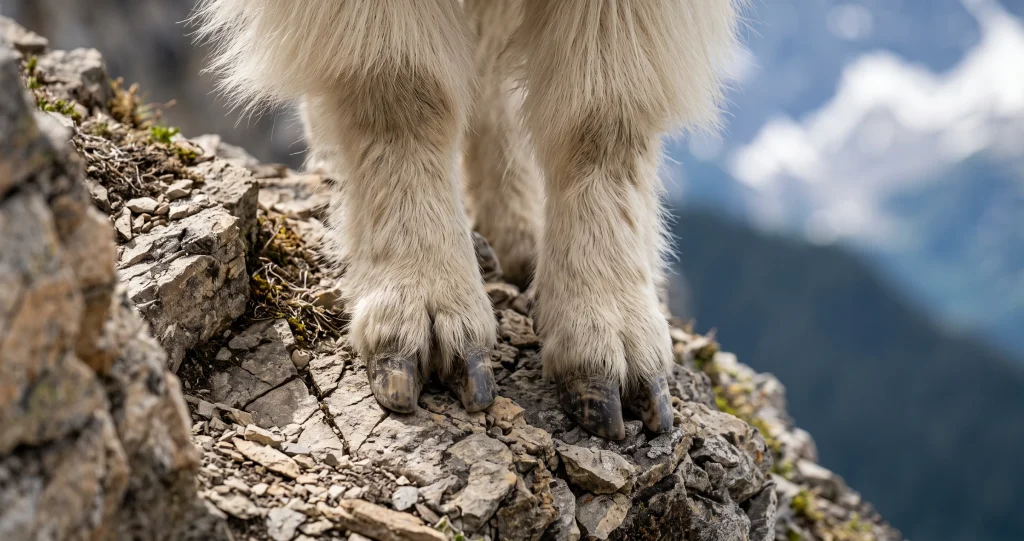
Their hooves are cloven, meaning each foot is divided into two toes.
The toes can spread when necessary, increasing stability. The underside includes relatively soft, flexible pads surrounded by harder hoof material. The National Park Service describes these inner pads as helping mountain goats grip the rocky ledges and cliffs they inhabit.
North Cascades National Park similarly describes the animals as moving across steep terrain using split, pliable hooves with soft, rubbery pads and harder outer margins.
It is an effective combination.
The hard portion helps the hoof engage small irregularities and edges, while the softer area increases contact with the rock.
The Remarkable Anatomy of a Mountain Goat Hoof
Take a close look at a mountain goat’s foot and its climbing ability becomes easier to understand.
Alaska Department of Fish and Game describes the hoof as having a hard keratinous sheath surrounding a softer embedded pad. Together, these structures help the animal gain purchase in tiny granite cracks while maintaining contact with the rock surface.
That combination provides two different advantages within the same foot.
Hard Outer Hoof
The harder outer material provides a durable edge.
When a mountain goat steps onto a small rocky projection, that edge can help engage irregularities in the surface.
Think less about a flat shoe sitting on a smooth floor and more about a climbing shoe finding a tiny edge.
The hoof does not need an enormous platform.
It needs a secure point of contact.
Soft Inner Pad
Inside that harder edge is the softer gripping surface.
Alaska wildlife officials describe the inner area as soft and capable of providing substantial traction when the animal places weight on it.
The softer material can make more intimate contact with irregular rock than an entirely rigid hoof could.
This is the feature behind descriptions of mountain goats having rubbery, grippy hoof pads.
The pad is not literally manufactured rubber, of course. It is living anatomical tissue adapted for traction.
Why Split Hooves Improve Grip
The split design adds another advantage.
A mountain goat’s two toes can move with some independence.
Kenai Fjords National Park specifically identifies this ability as part of the animal’s agility on steep terrain.
Imagine placing a completely rigid object across an uneven surface. Contact may occur at only one or two points.
A more adaptable foot can conform better to variations in the terrain.
The toes can also spread, providing a wider base when circumstances demand it. Glacier National Park describes this spreading action as helping mountain goats balance.
On broken mountain terrain, where almost every step has a different shape and angle, that flexibility is valuable.
The goat is effectively carrying four highly specialized climbing platforms.
Grip Is Only Half the Story
Extraordinary feet would be far less useful if the rest of the body were poorly suited to climbing.
Mountain goats have powerful, muscular bodies.
The National Park Service highlights their large, muscular forequarters, which help them climb slopes of 60 degrees or more.
Kenai Fjords National Park likewise notes their strongly developed shoulder muscles.
This matters because ascending steep terrain places substantial demands on the front of the body.
A mountain goat may need to pull itself upward while simultaneously keeping its feet securely positioned.
Strength and traction work together.
A Compact Body Helps With Balance
Mountain goats also have relatively compact bodies suited to rugged terrain. North Cascades National Park identifies both hoof structure and body shape as important adaptations for traveling on cliffs.
A useful climbing body needs more than raw strength.
The animal must repeatedly control its center of mass while transferring weight from one foothold to another.
Each movement has consequences.
A foot placed slightly too far from the body can shift balance. A loose rock can move. Snow or moisture can change traction.
Mountain goats therefore combine specialized anatomy with deliberate locomotion.
Watching one climb can be deceptive because the movement often looks effortless.
The ease is the result of extreme specialization.
Tiny Ledges Can Be Enough
Perhaps the most visually astonishing part of mountain goat cliff climbing is the size of the footholds these animals can use.
A ledge that appears far too narrow for a large mammal may still offer enough irregularity for a hoof to gain purchase.
Alaska Department of Fish and Game notes that the hard hoof sheath and soft pad help mountain goats use even very small cracks in granite.
The animal does not need to place its entire foot on a broad platform in the way a person might prefer.
Its foot is adapted to exploit small features in the rock.
That changes what counts as usable terrain.
A cliff that looks almost featureless from a distance can contain a network of tiny edges, cracks, and projections large enough for specialized hooves.
Why Mountain Goats Seek Such Extreme Terrain
An obvious question follows from seeing a mountain goat halfway up a cliff.
Why live there at all?
One major answer is predator avoidance.
Mountain goats face predators including wolves and bears, while young animals can also be vulnerable to eagles and other predators.
Their response is not necessarily to outrun every predator across open ground.
Instead, they can move toward terrain where their specialized climbing abilities provide an advantage.
Alaska Department of Fish and Game notes that mountain goats depend on their agility in steep rocky areas to escape predators such as wolves.
Kenai Fjords National Park goes further, describing movement onto steep rocky slopes that predators cannot easily navigate as their most frequent form of defense.
For a mountain goat, the cliff is not merely dangerous terrain.
It is escape terrain.
Cliffs Function Like a Natural Fortress
The predator-avoidance strategy works because different animals have different locomotor strengths.
A wolf is an effective terrestrial predator.
But the features that make a wolf successful at chasing prey across many landscapes do not make it equally capable of following a mountain goat across every narrow cliff ledge.
Mountain goats specialize in exactly that environment.
Historical habitat research in southeastern Alaska describes goats moving into steep, broken terrain when approached by large mammalian predators. Because goats are better adapted than those predators to moving across rugged ground, they gain relative safety there.
Modern USGS research similarly describes steep rocky terrain as a refuge that can reduce predation risk for mountain goats.
This helps explain why goats frequently remain close to cliffs even while feeding elsewhere.
An escape route is valuable only if it can be reached quickly.
Mothers and Kids Use the Cliffs Too
This strategy becomes particularly important for females raising young.
Mountain goat kids enter an unforgiving environment from the beginning of life.
Alaska Department of Fish and Game reports that kids only a few hours old can keep up with adults, while females and newborns commonly form nursery groups.
The ability to move competently through rugged terrain develops extremely early because it has to.
Young animals cannot simply remain on comfortable flat ground until they become adults.
Their protective environment is the mountain itself.
However, kids remain vulnerable, especially to predators such as eagles. Kenai Fjords National Park notes that females may travel close behind their young in situations where aerial predators pose a threat.
The Cliffs Are Safe From Predators—but Not Safe
There is an important paradox in mountain goat ecology.
Terrain that protects goats from predators creates dangers of its own.
Avalanches are a major example.
A 17-year study highlighted by the U.S. Geological Survey tracked more than 400 satellite-collared mountain goats in southeastern Alaska and estimated that avalanches accounted for an average of about 8% of annual mountain goat mortality in the studied populations.
The same steep terrain that can help a goat avoid a wolf can expose it to moving snow, falls, and other hazards.
Kenai Fjords National Park notes that gravity and avalanches can be major causes of mortality.
Evolution does not produce a risk-free environment.
It produces adaptations that help animals survive particular sets of competing pressures.
For mountain goats, rugged terrain offers an extraordinary defensive advantage even though living there carries substantial physical risks.
Mountain Goats vs. Alpine Ibex
Mountain goats are frequently compared with another celebrity of extreme climbing: the Alpine ibex.
The comparison makes sense visually.
Both are hoofed mammals capable of navigating steep rocky terrain.
But they are different animals.
The mountain goat is Oreamnos americanus and is native to North America.
The Alpine ibex is Capra ibex, a true goat native to the European Alps.
Both belong to the family Bovidae, but they occupy different branches within that family.
Similar Problem, Similar Equipment
Both animals face the basic mechanical problem of moving a relatively large body across steep, irregular surfaces.
Split hooves and specialized gripping surfaces help solve that problem.
The spectacular climbing abilities of ibex became widely known through photographs and videos of animals standing on extremely steep natural cliffs and even artificial structures such as dam walls.
Mountain goats achieve similarly astonishing results in North American alpine terrain.
The key lesson is not that one is simply “better” than the other.
Both represent variations on the broader adaptations seen among mountain-dwelling bovids.
Mountain Goats Are Not Invincible Climbers
Viral photographs can create the impression that mountain goats never slip.
That is misleading.
Specialized hooves improve traction; they do not eliminate gravity.
Rock can crumble.
Ice reduces friction.
Snow moves.
Avalanches occur.
Animals can make mistakes.
The impressive part of mountain goat cliff climbing is therefore not supernatural balance. It is how anatomy and behavior reduce the risks of moving through an environment where the margin for error can be extremely small.
Steep Terrain Also Affects Food Access
Predator avoidance is important, but it is not the only reason mountain goats use steep landscapes.
Terrain affects snow accumulation and access to vegetation.
Research in southeastern Alaska found that steep slopes can shed snow more effectively than flatter terrain, potentially improving access to forage during parts of the year. The researchers suggested that both predation and forage availability contribute to mountain goat habitat selection.
Mountain goats are generalist herbivores.
Depending on location and season, their diet can include grasses, sedges, forbs, shrubs, lichens, mosses, and even conifer vegetation.
The mountain landscape therefore provides both refuge and food.
Frequently Asked Questions
How can mountain goats stand on tiny ledges?
Their cloven hooves have hard outer portions and softer inner gripping pads. The two toes can spread and have some independent movement, helping the foot adapt to irregular rock and gain traction on small footholds.
Are mountain goat hooves rubbery?
Descriptions of “rubbery” hooves refer mainly to the relatively soft, pliable gripping pads within the hoof.
The entire hoof is not soft. Mountain goats combine these softer pads with hard outer hoof material, giving them both grip and a durable edge.
How steep can mountain goats climb?
The National Park Service reports that mountain goats can climb slopes of 60 degrees or more and are frequently seen traversing nearly vertical cliffs.
Descriptions such as “vertical” should not be interpreted as meaning that goats can climb a completely smooth 90-degree wall. Natural cliffs contain cracks, ledges, slopes, and irregularities their hooves can exploit.
Why don’t wolves simply follow them?
Wolves can travel through rugged country, but mountain goats are much more specialized for extreme cliff terrain.
Moving onto steep, broken ground can therefore shift the locomotor advantage toward the goat and reduce predation risk.
Are mountain goats actually goats?
They belong to the cattle-and-antelope family Bovidae and the caprine group, but mountain goats are not members of the true-goat genus Capra.
Their scientific name is Oreamnos americanus.
Are mountain goats better climbers than Alpine ibex?
Both species are highly specialized for rugged mountain terrain, but declaring one universally superior oversimplifies their different anatomy, habitats, and evolutionary histories.
The Alpine ibex (Capra ibex) is a European true goat, while the North American mountain goat belongs to the genus Oreamnos.
Built for the Places Predators Struggle to Follow
The extraordinary ability behind mountain goat cliff climbing begins with the hoof.
Two spreading toes provide stability. Hard outer hoof material can engage small irregularities, while softer inner pads increase traction against rock. Powerful forequarters help lift the animal uphill, and a compact, muscular body supports controlled movement through rugged terrain.
But anatomy explains only part of the story.
Mountain goats climb because cliffs are central to how they survive.
Steep, broken terrain can function as a refuge from predators such as wolves. The same landscapes can also influence snow accumulation and access to food.
There is a price for that protection. Avalanches, unstable rock, ice, and falls make the mountains dangerous even for an animal specialized to live there.
That trade-off is what makes mountain goats so fascinating. What looks to us like an impossible cliff is, to them, a landscape filled with footholds—and often one of the safest places available.
For another extraordinary example of animal movement and collective adaptation, see our internal article How Army Ants Build Living Bridges With Their Own Bodies on Secrets of the Green Garden.
Conclusion
Mountain goat cliff climbing is possible because several specialized adaptations work together. Their split hooves can spread for stability, hard outer hoof edges help catch small irregularities in rock, and softer inner pads provide additional traction. Powerful forequarters and a compact, muscular body give them the strength and control needed to move across exceptionally steep terrain.
These climbing abilities are not simply impressive physical tricks. Steep cliffs provide important escape terrain, allowing mountain goats to move into places where predators such as wolves have greater difficulty following. Rugged slopes can also influence access to vegetation and areas with less accumulated snow.
Life on the cliffs still carries serious risks. Loose rock, ice, falls, and avalanches remain dangerous even for animals so well adapted to mountain environments.
That combination of anatomy, behavior, and habitat explains why a mountain goat can stand calmly on a ledge that looks almost impossible from a human perspective. What appears to us as a nearly vertical wall is a landscape of tiny footholds that its specialized feet are remarkably well equipped to use.