
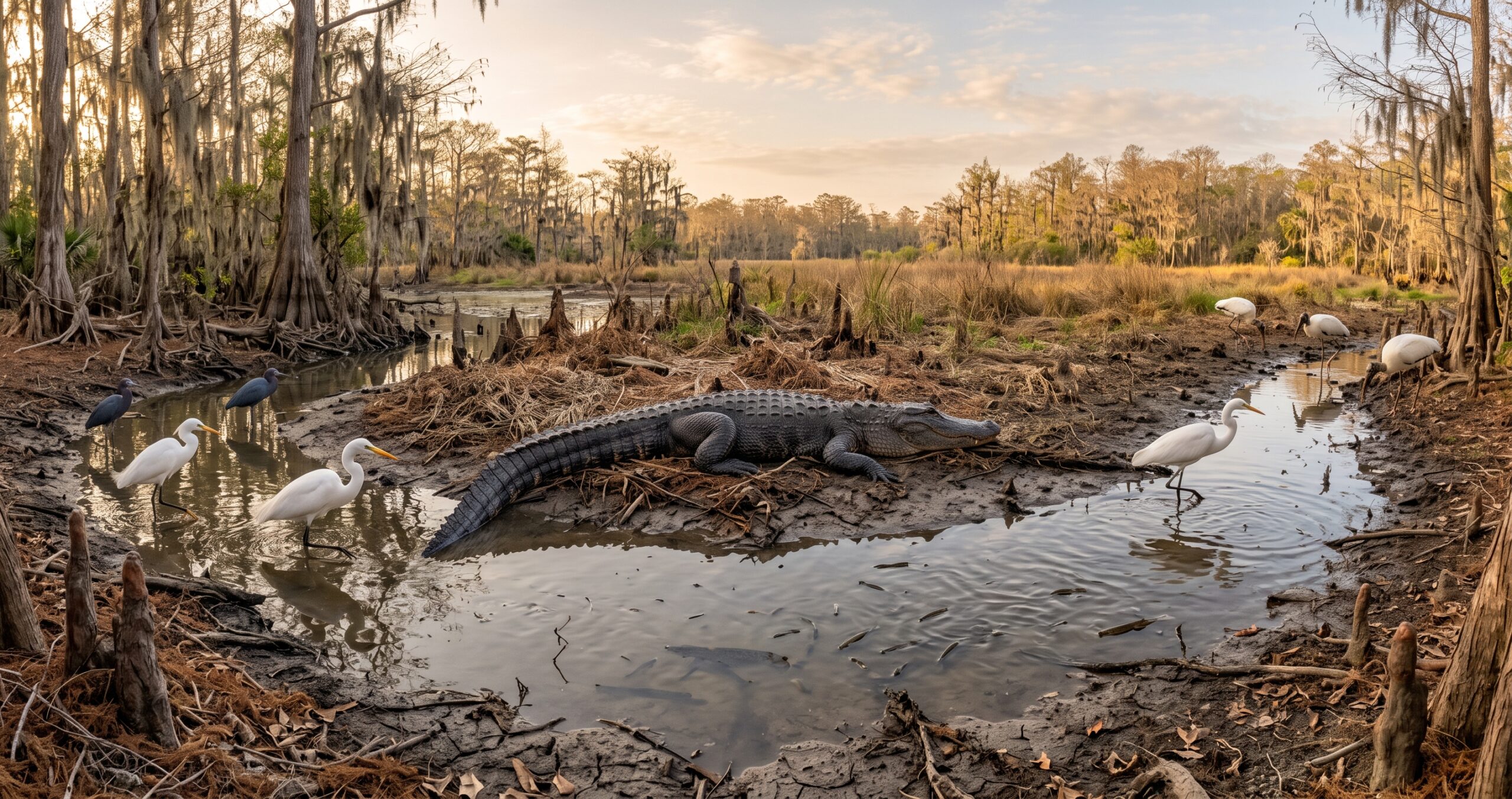
When people think about American alligators, they often picture powerful predators gliding through rivers or basking along swamp banks. Yet one of the alligator’s most important ecological roles has little to do with hunting. By digging depressions known as alligator holes in wetlands, these reptiles create small pockets of water that can become lifelines for entire communities of wildlife during seasonal drought.
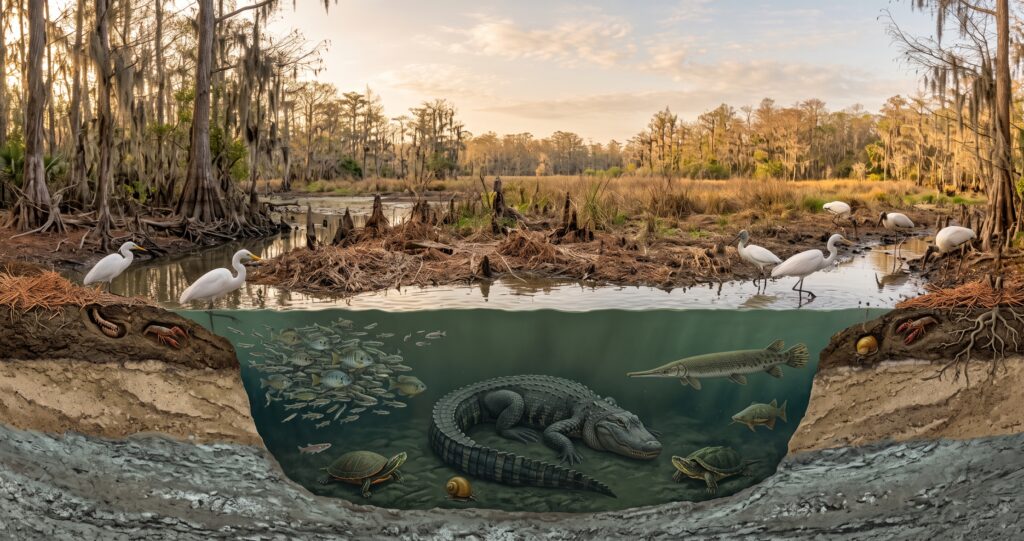
As water levels drop across marshes, swamps, and floodplains, these excavated pools often retain water longer than the surrounding landscape. Fish, turtles, amphibians, aquatic invertebrates, wading birds, mammals, and countless other species may gather around them until seasonal rains return.
This behavior has made the American alligator one of the best-known examples of a keystone species—an animal whose activities shape ecosystems far beyond its own survival. Decades of ecological research in the Florida Everglades and other southeastern wetlands have shown that alligator holes influence water availability, food webs, habitat diversity, and seasonal wildlife movements. Although scientists continue refining their understanding of these complex interactions, the ecological importance of alligator holes is firmly established.
Table of Contents
- Meet the American Alligator
- What Are Alligator Holes in Wetlands?
- How Alligator Holes Form
- Seasonal Dynamics in the Everglades
- Why These Wetland Refuges Matter
- Food-Web Tradeoffs Around Alligator Holes
- Other Wildlife That Benefits
- Keystone Species and Ecosystem Engineering
- Conservation Challenges
- Verified Facts and Scientific Interpretation
- What People Often Get Wrong
- Tips for Observing Alligator Holes Responsibly
- Frequently Asked Questions
- Conclusion
Meet the American Alligator
The American alligator (Alligator mississippiensis) inhabits freshwater wetlands throughout the southeastern United States.
It occupies a wide variety of habitats, including:
- Marshes
- Swamps
- Cypress domes
- Wet prairies
- Rivers
- Lakes
- Freshwater ponds
Although adults are apex predators, they also function as ecosystem engineers—animals that physically modify their environment in ways that affect many other species.
One of their most significant engineering behaviors is the creation and maintenance of alligator holes.
What Are Alligator Holes in Wetlands?
Alligator holes in wetlands are depressions excavated and maintained by alligators.
Unlike temporary puddles created solely by rainfall, these depressions are actively shaped through repeated digging and clearing.
Over time, accumulated mud is pushed outward, forming slightly elevated edges around the depression.
When surrounding marshes begin drying, the deeper hole often retains water after nearby shallow areas have become dry.
This remaining water creates a refuge for aquatic life until seasonal flooding returns.
The size and shape of alligator holes vary depending on habitat, soil type, water depth, and the size of the resident alligator.
Some remain occupied for many years.
How Alligator Holes Form
Alligators do not build these depressions in a single effort.
Instead, formation occurs gradually.
Digging the Basin
Using powerful bodies, tails, and limbs, alligators scrape away mud and vegetation.
Repeated movements deepen the depression over time.
Maintaining Open Water
As aquatic plants grow into the depression, resident alligators continue clearing vegetation.
This maintenance helps preserve open water.
Building Elevated Rims
Excavated sediment accumulates around the edges.
These slightly raised margins may later support different plant communities than the surrounding marsh.
The result is increased habitat diversity within a relatively small area.
Seasonal Dynamics in the Everglades
The Everglades functions as a highly seasonal ecosystem.
Rather than remaining uniformly flooded throughout the year, water levels rise during the wet season and gradually decline during the dry season.
This annual cycle strongly influences wildlife behavior.
Wet Season
As rains increase, marshes expand across the landscape.
Fish disperse into shallow wetlands.
Amphibians breed.
Aquatic plants flourish.
During this period, alligator holes become less obvious because surrounding water levels are high.
Dry Season
As water slowly recedes, shallow marshes begin drying.
Fish and other aquatic animals become concentrated in remaining pools.
Alligator holes increasingly serve as refuges.
Many species move toward these deeper areas as surrounding habitat contracts.
Return of the Rains
When seasonal rainfall returns, water spreads across the marsh once again.
Fish disperse into newly flooded habitats.
Nutrients accumulated within alligator holes are redistributed across the landscape.
The cycle then begins again.
Why These Wetland Refuges Matter
The ecological value of alligator holes in wetlands extends well beyond the alligators themselves.
Protecting Aquatic Life
During drought, fish, crayfish, turtles, aquatic insects, and amphibians often survive because water persists inside these depressions.
Without such refuges, mortality during prolonged dry periods could increase substantially.
Supporting Wading Birds
As prey becomes concentrated around shrinking pools, birds including herons, egrets, ibises, and wood storks gain reliable feeding opportunities.
This seasonal concentration is a natural feature of Everglades ecology.
Maintaining Biodiversity
Different species use alligator holes for different purposes.
Some seek water.
Others hunt concentrated prey.
Still others use surrounding vegetation for shelter.
Together these interactions increase habitat complexity.
Food-Web Tradeoffs Around Alligator Holes
Although alligator holes provide refuge, they also create ecological tradeoffs.
Remaining water attracts predators as well as prey.
Fish gathering in shrinking pools become easier for birds, turtles, snakes, otters, and alligators to capture.
At first glance this may seem harmful.
However, ecologists recognize that concentration of prey is a normal component of seasonal wetland dynamics.
Not every individual survives drought.
Yet the persistence of water allows enough fish and aquatic organisms to survive until flooding returns.
Without these refuges, far greater losses could occur across the entire ecosystem.
In this way, alligator holes support both predator populations and future prey populations.
Other Wildlife That Benefits
Many animals use alligator holes throughout the year.
Common visitors include:
- Fish
- Freshwater turtles
- Frogs
- Salamanders
- Crayfish
- Aquatic insects
- Snakes
- River otters
- Raccoons
- Wading birds
- Marsh birds
Even mammals that do not depend directly on aquatic prey may visit the remaining water during extended dry periods.
The elevated edges surrounding some alligator holes also support distinctive plant communities, adding further habitat diversity.
Keystone Species and Ecosystem Engineering
American alligators are widely recognized as ecosystem engineers.
Their engineering extends beyond hole construction.
They also create trails through marsh vegetation, influence prey populations, and modify local water movement.
Among these behaviors, alligator holes remain one of the clearest demonstrations of how a single species can influence many others.
The concept of a keystone species does not mean the alligator is the only important animal in the Everglades.
Instead, it means its activities have disproportionately large ecological effects relative to its abundance.
Protecting alligators therefore benefits many other organisms that rely indirectly on their habitat modifications.
Conservation Challenges
American alligator populations have recovered dramatically since legal protections were introduced during the twentieth century.
However, the ecosystems supporting alligator holes continue facing challenges.
Hydrological Changes
Water management projects, drainage systems, and altered flow patterns may reduce the natural seasonal flooding that drives Everglades ecology.
Habitat Loss
Wetland conversion for agriculture or development can reduce suitable habitat for both alligators and the many species benefiting from alligator holes.
Climate Change
Changing rainfall patterns, stronger droughts, sea-level rise, and saltwater intrusion may alter freshwater wetland dynamics over time.
Scientists continue studying how these factors may influence alligator hole formation and long-term ecosystem resilience.
Conservation increasingly focuses on restoring natural water flow, protecting wetlands, and maintaining large connected freshwater habitats.
Verified Facts and Scientific Interpretation
Well-supported scientific findings
Research consistently demonstrates that:
- American alligators excavate and maintain depressions known as alligator holes.
- These depressions often retain water longer than surrounding wetlands during dry periods.
- Numerous species use these pools as drought refuges.
- Alligator holes influence prey concentration and seasonal food-web dynamics.
- The American alligator is recognized as a keystone species and ecosystem engineer in many southeastern wetlands.
Areas of continuing research
Scientists continue investigating:
- How climate change may alter seasonal drought patterns.
- Long-term effects of changing water management on alligator hole persistence.
- Differences among wetland types throughout the alligator’s geographic range.
- The relative importance of alligator holes for different animal communities.
Recognizing these ongoing questions helps distinguish established ecological knowledge from active research.
What People Often Get Wrong
Several misconceptions surround alligator holes.
Alligator holes are not permanent lakes.
Most change considerably throughout the seasons as water levels rise and fall.
They are not built only for hunting.
Alligators use these depressions for shelter, thermoregulation, and maintaining access to water as wetlands dry.
Wildlife is not always safe inside them.
Predators also gather around alligator holes because prey becomes concentrated.
Every wetland does not contain alligator holes.
Their occurrence depends on habitat conditions and the presence of resident alligators.
They benefit more than alligators.
The ecological importance extends to fish, birds, reptiles, amphibians, mammals, invertebrates, and aquatic plants.
Tips for Observing Alligator Holes Responsibly
Observing alligator holes offers an excellent opportunity to appreciate wetland ecology.
- Remain on designated trails or boardwalks.
- Keep a safe distance from alligators.
- Never feed wildlife.
- Use binoculars to observe birds gathering around water.
- Avoid disturbing basking reptiles.
- Respect seasonal closures in protected wetlands.
- Support conservation areas that protect natural water flow.
Responsible observation protects both wildlife and visitors.
Frequently Asked Questions
What is an alligator hole?
An alligator hole is a depression excavated and maintained by an American alligator that often retains water during seasonal drought.
Why do other animals gather there?
As surrounding wetlands dry, remaining water provides habitat, food, and drinking opportunities for many species.
Do alligators intentionally create habitat for other animals?
No. The holes primarily benefit the alligator, but many other species take advantage of the modified habitat—a common outcome of ecosystem engineering.
Are alligator holes unique to the Everglades?
They are especially well known in the Everglades but occur throughout parts of the American alligator’s range where environmental conditions allow.
Why are alligator holes important for conservation?
Protecting these features helps preserve biodiversity, seasonal food webs, and the natural ecological processes that sustain healthy wetlands.
Conclusion
The ecological importance of alligator holes in wetlands extends far beyond the alligators that create them. By excavating and maintaining deeper pools within marshes, American alligators provide drought refuges that help sustain fish, amphibians, reptiles, birds, mammals, and countless invertebrates during the dry season. These seasonal refuges also strengthen food webs, support breeding opportunities, and increase habitat diversity across wetlands such as the Everglades.
As water management, habitat loss, and climate change reshape freshwater ecosystems, conserving natural hydrological cycles becomes increasingly important. Protecting alligator holes and the wetlands surrounding them safeguards not only one iconic reptile but also the remarkable ecological relationships that depend on these enduring pockets of water.
Recommended Internal-Link Opportunities
Instead of linking to unverified URLs, consider linking from this article to related content on https://secretsofthegreengarden.com, such as:
- Articles about Everglades wildlife and wetland ecosystems
- Features on keystone species and ecosystem engineers
- Wildlife articles covering American alligators or crocodilians
- Content about drought adaptations and freshwater biodiversity
Recommended External Authoritative Sources
- U.S. National Park Service (Everglades National Park) – Alligator ecology and Everglades ecosystems
- U.S. Geological Survey (USGS) – Everglades hydrology and wildlife research
- U.S. Fish & Wildlife Service – Wetland conservation and American alligator resources
- Smithsonian Environmental Research Center – Wetland ecology resources
- Peer-reviewed journals such as Wetlands, Ecology, Journal of Herpetology, and Freshwater Biology covering alligator ecosystem engineering and Everglades ecology