
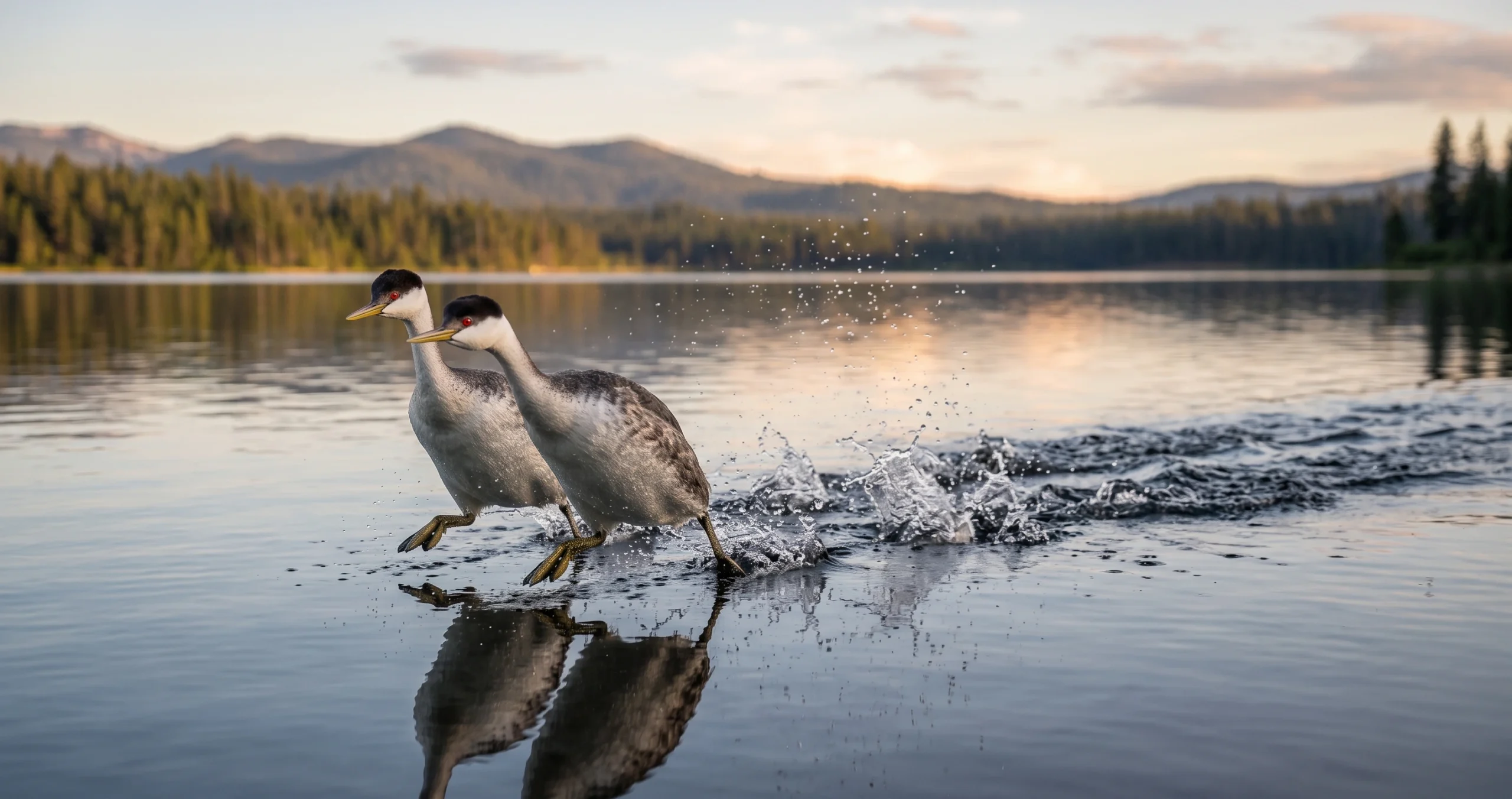
The western grebe rushing display is one of North America’s most remarkable bird courtship behaviors. Watching two elegant waterbirds suddenly rise from the surface and sprint side by side across a lake seems almost impossible at first glance. Their bodies remain upright, their necks stretch forward, and their feet strike the water so rapidly that they appear to dance instead of swim.
This spectacular display is more than a visual performance. It helps strengthen pair bonds, confirms compatibility between breeding partners, and demonstrates the remarkable anatomical adaptations that allow western grebes to move across water in ways few other birds can.
Although scientists understand many aspects of this behavior, researchers continue studying exactly how pairs coordinate their movements so precisely and what subtle signals trigger each rushing event. Like many complex courtship displays, there is still room to learn more.
Table of Contents
- What Is the Western Grebe Rushing Display?
- Meet the Western Grebe
- How the Rushing Display Works
- Anatomy Behind Running on Water
- Why Western Grebes Perform This Courtship Ritual
- Habitat and Breeding Ecology
- Other Courtship Behaviors
- Ecological Importance
- Conservation Challenges
- What People Often Get Wrong
- Tips for Watching Western Grebes Responsibly
- Frequently Asked Questions
- Conclusion
What Is the Western Grebe Rushing Display?
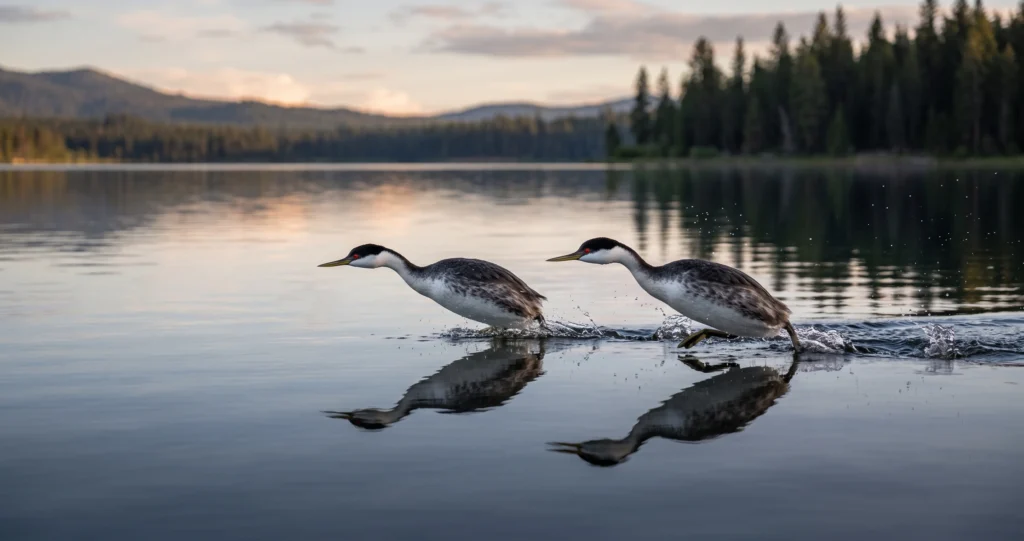
The western grebe rushing display is a synchronized courtship behavior performed primarily during the breeding season.
Instead of remaining on the water, two birds suddenly accelerate until both bodies rise mostly above the surface. For several seconds they run across the lake side by side while beating their feet against the water at incredible speed.
Unlike true flight, the birds remain supported mainly by rapid foot strikes rather than their wings. Their wings may partially open for balance, but propulsion comes from powerful leg movements beneath the surface.
The performance usually ends with both birds settling back into the water together.
Researchers consider rushing one part of a much larger sequence of courtship behaviors rather than an isolated event.
Meet the Western Grebe
The Western Grebe (Aechmophorus occidentalis) is among the largest grebes in North America.
Adults are instantly recognizable by their:
- Long, slender neck
- Sharp dagger-like bill
- Black crown
- White face and neck
- Streamlined body
- Bright red eyes
Unlike ducks, western grebes have legs positioned far back on their bodies.
This placement makes walking on land awkward but creates tremendous swimming power underwater.
Western grebes spend nearly their entire lives on water. They swim, feed, court, nest, raise young, and often sleep while floating.
During winter many populations move to coastal waters, while breeding occurs mainly on freshwater lakes and marshes across western North America.
How the Western Grebe Rushing Display Works
Courtship often begins with quieter interactions.
Pairs face each other, bob their heads, mirror one another’s movements, and perform a variety of synchronized postures.
One famous behavior is the “weed ceremony,” during which both birds present aquatic vegetation while facing each other.
At some point, excitement builds.
Both birds suddenly lunge forward.
Their bodies lift nearly vertical.
Their feet begin striking the water in rapid alternating steps.
Instead of sinking, each powerful stroke creates enough force to keep the body above the surface for several seconds.
The birds may cover dozens of feet while remaining perfectly synchronized.
Good coordination is essential.
If one bird loses timing or balance, the display quickly ends.
Scientists believe the remarkable synchronization reflects both physical ability and the strength of the pair bond.
Anatomy Behind Running on Water
The rushing display depends on several specialized anatomical features.
Lobed Feet
Unlike ducks, grebes have broad toes with flexible lobes instead of full webbing.
These lobes expand during the power stroke, pushing more water backward.
As the foot returns, the lobes collapse, reducing drag.
This design makes underwater propulsion highly efficient.
Legs Positioned Far Back
A western grebe’s legs sit close to the rear of the body.
Although this arrangement makes walking difficult, it greatly improves swimming efficiency.
The powerful leg muscles generate rapid bursts of force needed during rushing.
Streamlined Body
The bird’s narrow body minimizes resistance as it accelerates.
Its dense plumage also provides waterproof insulation while trapping air that contributes to buoyancy.
Strong Neck Muscles
The long neck is more than an elegant feature.
It helps maintain balance during rapid movement and plays an important role in courtship displays, visual communication, and hunting.
Precise Coordination
Running across water is not simply a matter of strength.
The nervous system must coordinate dozens of rapid leg movements while maintaining balance and matching the partner’s speed.
Researchers continue investigating exactly how western grebes maintain such precise synchronization.
Why Western Grebes Perform This Courtship Ritual
Courtship displays serve several biological purposes.
Pair Bond Formation
Western grebes often form seasonal breeding pairs.
Successful rushing appears to strengthen cooperation before nesting begins.
Mate Assessment
The display likely allows birds to evaluate a potential partner’s physical condition and coordination.
Producing such an energetic performance requires excellent health and fitness.
Synchronization Before Breeding
Many breeding tasks require cooperation.
Partners must defend nesting territory, build floating nests, incubate eggs, and care for chicks.
Complex courtship may help establish that cooperative relationship before reproduction begins.
Reducing Conflict
Highly ritualized displays can also reduce unnecessary aggression.
Instead of fighting, birds communicate readiness to breed through predictable behaviors.
Habitat and Breeding Ecology
Western grebes prefer large freshwater lakes with extensive emergent vegetation.
Ideal breeding habitat usually includes:
- Cattails
- Bulrushes
- Reeds
- Sheltered coves
- Calm water
- Healthy fish populations
Floating vegetation provides support for their nests.
Both adults help build a platform anchored to aquatic plants.
Typical breeding habitats occur across parts of western Canada, the western United States, and portions of northern Mexico.
After breeding, many western grebes migrate to coastal marine waters, bays, and estuaries where they spend the winter feeding primarily on fish.
Feeding and Daily Behavior
Western grebes are expert underwater hunters.
Fish make up most of their diet, although they also consume aquatic insects, crustaceans, amphibians, and occasionally other small aquatic animals.
Rather than diving straight down, they often pursue prey underwater using rapid leg strokes.
Their streamlined bodies and rear-positioned legs make them exceptionally agile beneath the surface.
Unlike many waterbirds, western grebes rarely feed on land.
Nearly every aspect of their daily life remains tied to water.
Other Courtship Behaviors
The rushing display attracts the most attention, but western grebes perform numerous additional courtship rituals.
Head Shaking
Partners rapidly shake their heads while facing one another.
This movement often precedes more elaborate displays.
Weed Ceremony
Each bird gathers aquatic vegetation and presents it to the other.
The pair may rise chest to chest while holding plants in their bills.
This behavior has become one of the best-known grebe courtship rituals.
Mirroring
Partners frequently copy each other’s posture and movements.
This synchronization appears throughout the breeding season and may reinforce pair bonds.
Together, these displays create an extended courtship sequence rather than a single isolated performance.
Ecological Importance
Western grebes occupy an important role in freshwater ecosystems.
As fish predators, they help maintain balanced aquatic food webs.
Their breeding success can also reflect the health of wetlands.
Because they depend on clean water, stable fish populations, and intact emergent vegetation, declines in western grebe numbers may signal broader ecological problems affecting lakes and marshes.
Their nests also become part of wetland communities, providing temporary habitat complexity among aquatic vegetation.
Conservation Challenges
Western grebe populations face multiple pressures across portions of their range.
Habitat loss remains one of the most significant concerns.
Wetland drainage, shoreline development, and changes in water management can reduce suitable nesting habitat.
Human disturbance may also affect breeding colonies.
Repeated boat traffic passing close to nesting areas can create waves that damage floating nests or cause adults to abandon eggs temporarily.
Water pollution presents another challenge.
Oil contamination, harmful algal blooms, and declining water quality can reduce prey availability or directly affect grebes.
Climate-related changes, including altered water levels and drought in some breeding regions, may also influence nesting success.
Conservation efforts focus on protecting wetlands, maintaining healthy aquatic vegetation, preserving water quality, and reducing disturbance during the breeding season.
What People Often Get Wrong
Several common misconceptions surround western grebes.
They are skipping across the water.
Not exactly. They are generating continuous support through extremely rapid foot strikes rather than making isolated leaps.
They are flying.
Although wings help with balance, the birds are not truly flying during the rushing display.
Only males perform the display.
Both members of the pair participate, and successful rushing depends on cooperation.
The display is just for entertainment.
It is an important part of reproduction and pair bonding rather than playful behavior.
Western grebes can easily walk on land.
Their rear-positioned legs make walking difficult. They are highly specialized for life on water.
Tips for Watching Western Grebes Responsibly
If you hope to observe western grebes in the wild, a respectful approach benefits both birds and observers.
- Visit freshwater lakes during the breeding season when displays are most likely.
- Watch from shore or maintain a generous distance by boat.
- Use binoculars or a spotting scope instead of approaching nests.
- Never attempt to flush birds for photographs.
- Avoid creating waves near nesting colonies.
- Stay on designated access routes where possible.
- Respect seasonal closures around sensitive breeding habitat.
Patience often produces better wildlife observations than getting closer.
Frequently Asked Questions
How fast do western grebes move during the rushing display?
Researchers describe the display as an extremely rapid sprint across the water powered by fast leg movements. Exact speed varies and is not consistently reported across scientific studies.
Do western grebes perform the rushing display all year?
No. The behavior is mainly associated with courtship during the breeding season.
Why don’t western grebes sink while running?
Their powerful legs strike the water rapidly enough to generate upward support while propelling the birds forward, with balance assisted by body posture and partially opened wings.
Are western grebes related to ducks?
No. Grebes belong to their own distinct bird order, Podicipediformes, and evolved separately from ducks despite sharing aquatic habitats.
Can young western grebes perform the rushing display?
The display is associated with sexually mature birds during courtship. Chicks and juveniles do not perform full rushing displays.
Conclusion
The western grebe rushing display combines anatomy, coordination, behavior, and evolution into one of nature’s most memorable courtship rituals. Specialized lobed feet, powerful rear-positioned legs, streamlined bodies, and synchronized movements allow breeding pairs to sprint across open water in a way few other birds can match.
Although much has been learned about this remarkable behavior, researchers continue exploring the subtle communication and biomechanics that make such perfect coordination possible. Protecting healthy wetlands ensures that future generations can continue witnessing this extraordinary display, reminding us how closely behavior and habitat are connected in the natural world.
Suggested Internal-Link Opportunities
Because I cannot verify the exact URLs on your website, consider linking naturally to existing or future articles covering:
- Snow Leopard Tail Adaptation
- Dragonfly Hunting Accuracy
- Bar-tailed Godwit Migration
- Bird Migration and Navigation
- Wetland Birds of North America
- Bird Courtship Behaviors
Recommended Authoritative External Sources
- Cornell Lab of Ornithology – Birds of the World (Western Grebe species account)
- U.S. Fish & Wildlife Service (wetland conservation and migratory bird resources)
- Smithsonian National Zoo & Conservation Biology Institute (bird biology resources)
- IUCN Red List (species conservation status)
- Peer-reviewed papers published in journals such as The Auk, The Condor, The Wilson Journal of Ornithology, or Behavioral Ecology on grebe behavior and courtship