
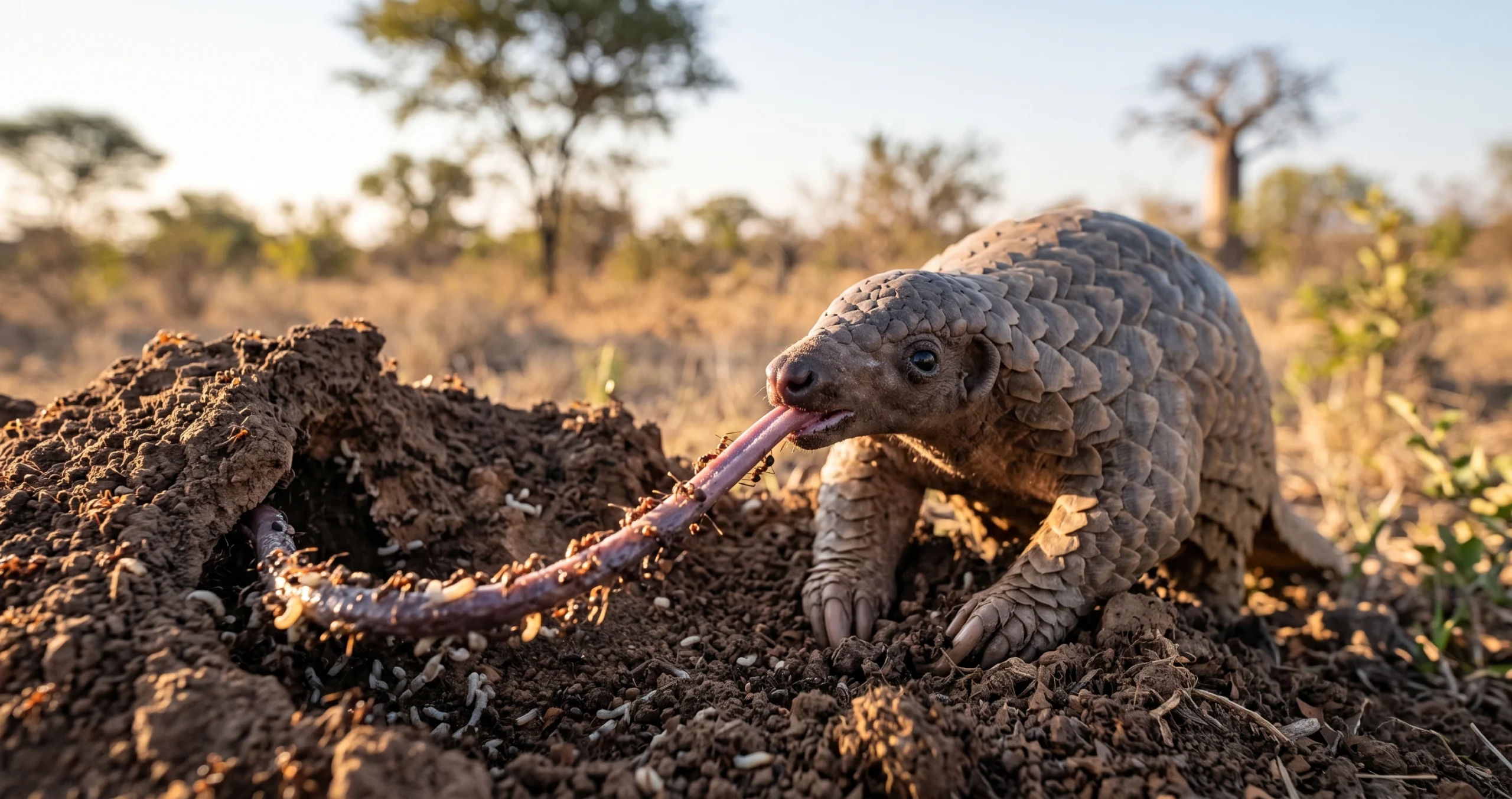
The pangolin tongue adaptation is one of the most specialized feeding systems found in mammals. At first glance, pangolins are best known for their overlapping protective scales, but hidden inside their bodies is an equally remarkable feature: an exceptionally long, muscular tongue designed for harvesting ants and termites.
Unlike many mammals, pangolins do not chew their food. Instead, they rely on a narrow snout, powerful digging claws, an extraordinarily elongated tongue, and a highly specialized digestive system to consume thousands of insects during a single night of foraging.
Scientists have studied pangolins for decades, yet much about their behavior remains difficult to observe because these shy mammals are primarily nocturnal and many species live in dense forests or remote savannas. While researchers continue learning more about their ecology, the anatomy behind their feeding strategy is well established and represents one of evolution’s most fascinating examples of dietary specialization.
Table of Contents
- What Is the Pangolin Tongue Adaptation?
- Meet the Pangolins
- How the Extraordinary Tongue Works
- Anatomy Behind an Exceptional Feeding Tool
- Why Pangolins Do Not Need Teeth
- Hunting Ants and Termites
- Habitat and Daily Behavior
- Ecological Importance
- Conservation Challenges
- What People Often Get Wrong
- Tips for Observing Pangolins Responsibly
- Frequently Asked Questions
- Conclusion
What Is the Pangolin Tongue Adaptation?
The pangolin tongue adaptation refers to a collection of anatomical features that allow pangolins to efficiently collect ants and termites from narrow tunnels deep inside nests.
Their tongues are unusually long compared with their body size. Instead of beginning near the jaw like most mammal tongues, the muscles extend deep into the chest cavity and attach to structures near the sternum and rib cage. This unusual arrangement allows the tongue to extend far beyond the end of the snout.
Combined with sticky saliva and remarkable muscular control, the tongue acts almost like a living probe that can repeatedly reach into insect tunnels.
Rather than biting prey individually, pangolins gather large numbers of insects with each extension.
Meet the Pangolins
Pangolins are unique mammals belonging to the order Pholidota.
Eight living species are recognized today.
Four occur in Africa:
- Giant Pangolin
- Ground Pangolin
- White-bellied Pangolin
- Black-bellied Pangolin
Four live in Asia:
- Chinese Pangolin
- Indian Pangolin
- Sunda Pangolin
- Philippine Pangolin
Although they differ in size, habitat, and behavior, all species share similar feeding adaptations.
Their bodies are covered in overlapping scales made from keratin—the same protein found in human fingernails and hair. These scales provide protection against predators while still allowing flexibility for climbing, digging, and walking.
Depending on the species, pangolins may spend much of their lives in trees, on the ground, or a combination of both.
How the Extraordinary Tongue Works
When searching for food, pangolins rely primarily on their excellent sense of smell.
After locating an ant colony or termite mound, they use powerful foreclaws to open a small access hole.
Rather than destroying the entire nest, they often make a limited opening.
The tongue is then rapidly inserted into narrow tunnels.
Each extension collects numerous insects.
Sticky saliva coats the tongue, causing ants and termites to cling to its surface.
The tongue retracts.
The insects are swallowed whole.
This sequence repeats over and over, sometimes hundreds of times during a single feeding session.
Because the tunnels inside insect colonies are narrow and complex, the tongue’s flexibility is just as important as its length.
Anatomy Behind an Exceptional Feeding Tool
Several specialized structures work together to make this feeding system effective.
An Exceptionally Long Tongue
Among mammals, pangolins possess one of the longest tongues relative to body size.
In larger species, the tongue may extend well beyond the head when fully protruded.
Its unusual origin inside the chest cavity provides additional length without requiring a larger skull.
Muscular Control
The tongue is made of powerful muscles capable of extending, retracting, bending, and twisting.
This flexibility allows pangolins to explore branching tunnels created by ants and termites.
Sticky Saliva
Large salivary glands produce thick, adhesive saliva.
The coating greatly increases the number of insects collected during each tongue extension.
Without this sticky surface, feeding efficiency would be dramatically reduced.
Narrow Snout
Pangolins have elongated, tubular snouts with relatively small mouth openings.
This shape fits easily into narrow nest entrances while protecting the feeding apparatus.
Strong Digging Claws
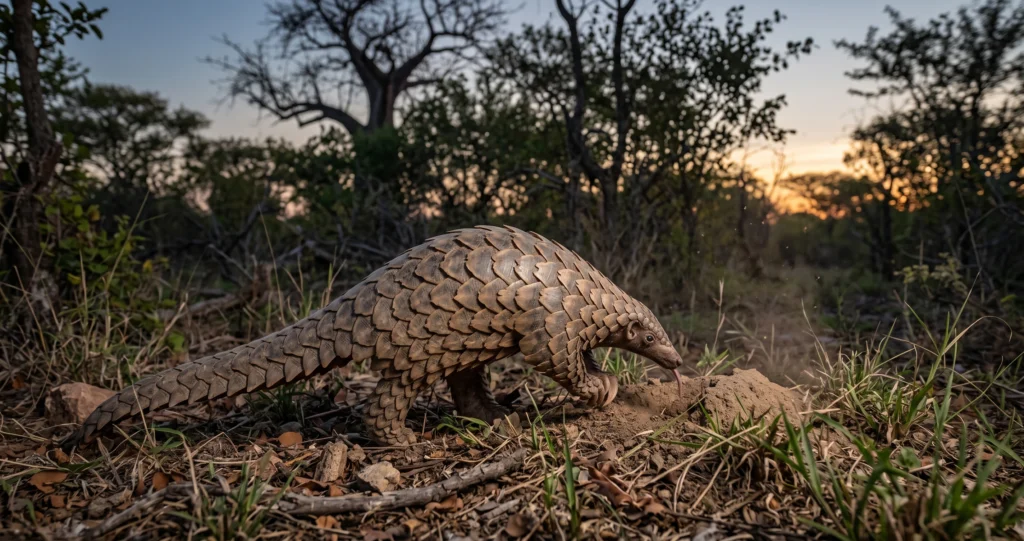
The tongue cannot reach prey without access.
Large curved claws break into hardened termite mounds or expose underground ant tunnels.
The claws perform the heavy work before the tongue takes over.
Why Pangolins Do Not Need Teeth
One of the most surprising facts about pangolins is that adults have no teeth.
Unlike carnivores that bite prey or herbivores that grind vegetation, pangolins swallow insects whole.
Digestion occurs inside a specialized stomach.
The stomach walls are thick and muscular.
Small stones and bits of grit swallowed during feeding may help grind insects internally, functioning somewhat like a bird’s gizzard, although the exact contribution can vary and continues to be studied.
The insects’ soft bodies also require far less mechanical breakdown than tougher foods.
This combination allows pangolins to thrive without teeth.
Hunting Ants and Termites
Pangolins are highly specialized insectivores, or more precisely, myrmecophagous mammals—animals that primarily eat ants and termites.
Not every colony is suitable.
Many species appear selective, feeding on certain ant or termite species while avoiding others that possess particularly strong chemical defenses or aggressive soldiers.
Rather than exhausting one colony completely, pangolins often feed briefly before moving on.
This behavior may allow colonies to recover, creating a sustainable food source over time.
The exact feeding patterns differ among species and habitats, but selective foraging is commonly observed.
Habitat and Daily Behavior
Pangolins occupy a variety of habitats across Africa and Asia.
These include:
- Tropical rainforests
- Woodland
- Savanna
- Grassland
- Secondary forest
- Agricultural landscapes near natural habitat
Most species are primarily nocturnal.
They leave resting sites after sunset and spend much of the night searching for insect colonies.
Some species climb exceptionally well using strong claws and muscular tails.
Others remain mostly terrestrial, walking slowly while sniffing the ground for prey.
When threatened, pangolins usually avoid confrontation.
Instead, they curl into a tight ball, exposing only their hard protective scales.
Few natural predators can penetrate this armor.
Ecological Importance
Pangolins play an important role in maintaining healthy ecosystems.
By feeding on ants and termites, they help regulate insect populations.
Although they do not eliminate colonies, their repeated foraging contributes to ecological balance.
Their digging behavior also benefits the environment.
Small excavations aerate soil, improve water infiltration, and create microhabitats that may later be used by other animals.
In this way, pangolins influence ecosystems beyond simply consuming insects.
Healthy pangolin populations contribute to functioning forests, woodlands, and savannas.
Conservation Challenges
Despite their remarkable adaptations, pangolins are among the world’s most threatened mammals.
Illegal wildlife trafficking remains their greatest conservation challenge.
They are targeted for their scales and meat despite international protections.
Habitat loss also affects many populations.
Deforestation, agricultural expansion, mining, and infrastructure development reduce suitable habitat and fragment remaining populations.
Because pangolins reproduce slowly—typically producing a single offspring after pregnancy—they recover poorly from heavy population declines.
Many aspects of pangolin biology remain difficult to study because the animals are elusive and naturally uncommon.
Conservation organizations focus on strengthening anti-poaching efforts, protecting habitat, improving law enforcement, reducing illegal trade, and expanding ecological research.
Public awareness also plays an important role in supporting conservation.
What People Often Get Wrong
Several misconceptions surround pangolins.
Their scales are not made of bone.
Pangolin scales consist primarily of keratin, the same material found in human fingernails.
They are not reptiles.
Although their scales resemble armor, pangolins are true mammals.
They nurse their young and possess hair between some scales.
They do not shoot their tongues like frogs.
The tongue extends through controlled muscular movement rather than being projected suddenly.
They are not related to anteaters.
Pangolins, giant anteaters, aardvarks, and echidnas evolved similar feeding adaptations independently through convergent evolution.
They do not destroy every termite mound they visit.
Many pangolins feed from nests without completely demolishing them, allowing future use.
Tips for Observing Pangolins Responsibly
Seeing a wild pangolin is a rare privilege.
If visiting areas where they occur:
- Join experienced wildlife guides who follow local conservation rules.
- Observe quietly without blocking the animal’s movement.
- Avoid flash photography during nighttime observations.
- Never disturb feeding animals or resting burrows.
- Support protected areas and responsible ecotourism.
- Never purchase products made from pangolins or their scales.
Responsible wildlife viewing helps protect these vulnerable mammals while encouraging conservation.
Frequently Asked Questions
How long is a pangolin’s tongue?
The exact length varies among species, but the tongue can extend well beyond the head and is among the longest relative to body size of any mammal.
Why do pangolins not have teeth?
Their diet consists of small insects that are swallowed whole and processed inside a specialized muscular stomach, making teeth unnecessary.
Do pangolins only eat ants?
No. They also consume termites, and the balance between these prey groups varies by species and habitat.
How do pangolins find insect colonies?
They rely primarily on an exceptionally well-developed sense of smell to detect underground nests and hidden insect trails.
Are pangolins endangered?
Conservation status differs among species, but all eight living pangolin species face significant conservation pressures, particularly from illegal wildlife trade and habitat loss.
Conclusion
The pangolin tongue adaptation demonstrates how evolution can produce highly specialized solutions to a unique ecological challenge. An extraordinarily long tongue anchored deep within the chest, sticky saliva, powerful digging claws, a narrow snout, and a muscular toothless digestive system all work together to help pangolins harvest ants and termites with remarkable efficiency.
These adaptations have allowed pangolins to occupy a specialized ecological niche for millions of years. Today, however, their greatest challenge is no longer finding food but surviving human pressures such as habitat destruction and illegal wildlife trafficking. Protecting forests, grasslands, and wetlands, along with enforcing conservation laws, is essential to ensuring that these extraordinary mammals continue playing their vital role in ecosystems across Africa and Asia.
Suggested Internal-Link Opportunities
Since I cannot verify your site’s exact URLs, consider linking naturally to existing or future articles covering:
- How Snow Leopards Use Their Long, Thick Tails
- How Dragonflies Predict and Intercept Flying Prey
- How Bar-tailed Godwits Complete Nonstop Trans-Pacific Flights
- Mammals With Unique Feeding Adaptations
- Animals That Eat Ants and Termites
- Convergent Evolution in Wildlife
Recommended Authoritative External Sources
- IUCN Red List – Pangolin species assessments
- Smithsonian’s National Zoo & Conservation Biology Institute – Pangolin resources
- Zoological Society of London (ZSL) – Pangolin conservation and research
- Peer-reviewed research published in journals such as Journal of Mammalogy, Mammalian Biology, or Biological Conservation
- CITES – International trade regulations for pangolin species