
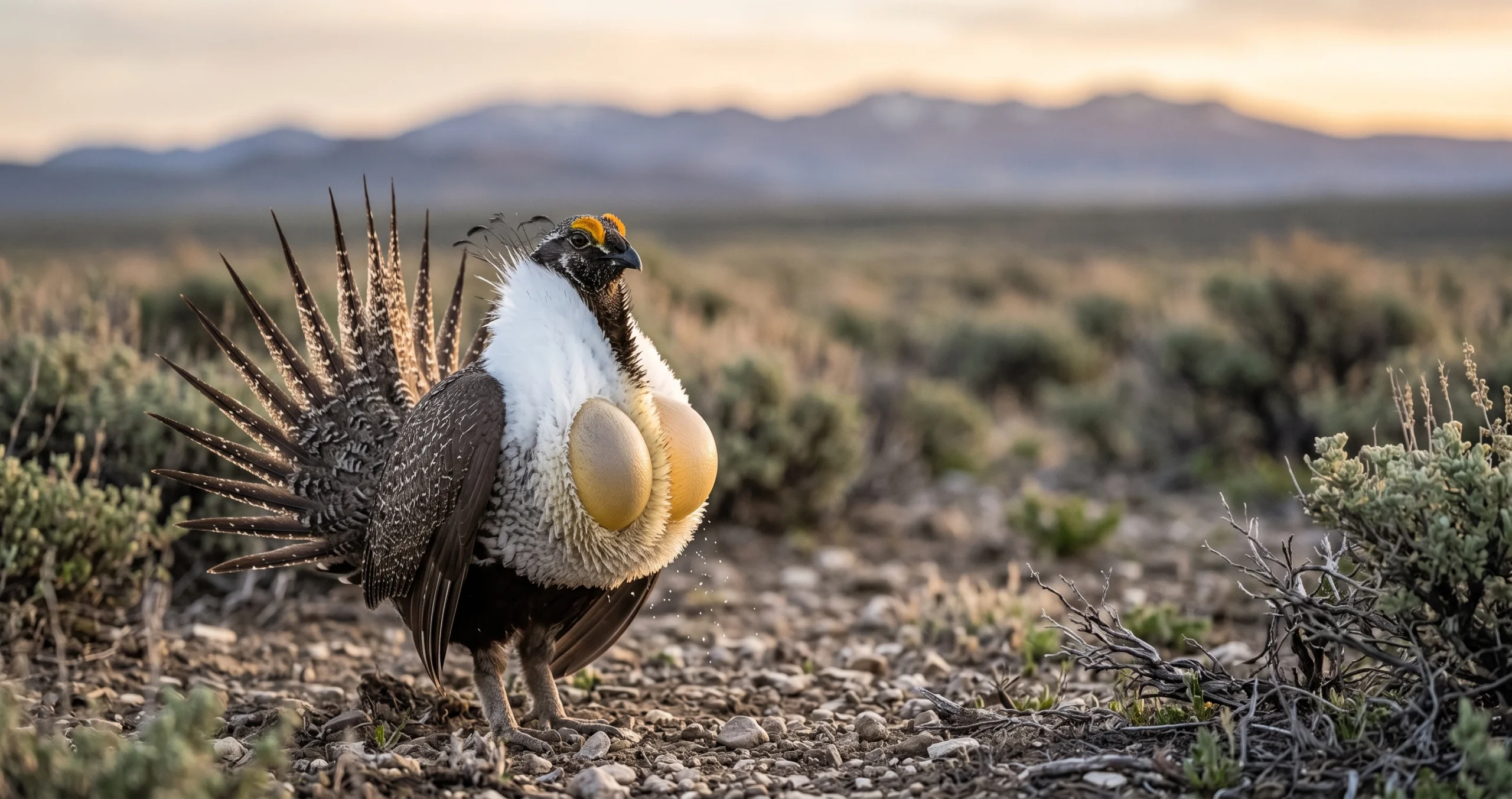
The greater sage-grouse courtship display is one of North America’s most remarkable wildlife spectacles. Before sunrise each spring, male greater sage-grouse gather on open patches of ground known as leks, where they fan their tails, inflate bright yellow air sacs hidden beneath white breast feathers, and produce a series of distinctive popping and booming sounds that can carry across the quiet sagebrush landscape.
To someone seeing it for the first time, the performance can seem almost theatrical. Dozens of birds move in rhythm, each attempting to attract the attention of nearby females while competing with neighboring males. Yet every movement has evolved through countless generations of natural selection. The display communicates health, stamina, and breeding readiness while helping females choose potential mates.
Scientists have studied greater sage-grouse for decades, and much is understood about their courtship behavior. At the same time, researchers continue investigating the finer details of female mate choice, acoustic communication, and how changing landscapes influence breeding success. The birds remain one of the best examples of lekking behavior found anywhere in the world.
Table of Contents
- What Is Greater Sage-Grouse Courtship?
- Meet the Greater Sage-Grouse
- What Is a Lek?
- Anatomy Behind the Booming Display
- Step by Step: How the Courtship Display Works
- Why Females Visit the Lek
- Habitat and Annual Life Cycle
- Ecological Importance
- Conservation Challenges
- What People Often Get Wrong
- Tips for Watching Sage-Grouse Responsibly
- Frequently Asked Questions
- Conclusion
What Is Greater Sage-Grouse Courtship?
The greater sage-grouse courtship display is a breeding ritual performed almost exclusively by males during spring.
Rather than defending territories containing food or nesting sites, males gather on traditional display grounds called leks. There they perform elaborate visual and acoustic displays while females visit primarily to observe potential mates.
This breeding strategy is known as lekking.
Unlike many birds that form long-term breeding pairs, male sage-grouse generally contribute only to mating. Females independently build nests, incubate eggs, and raise chicks.
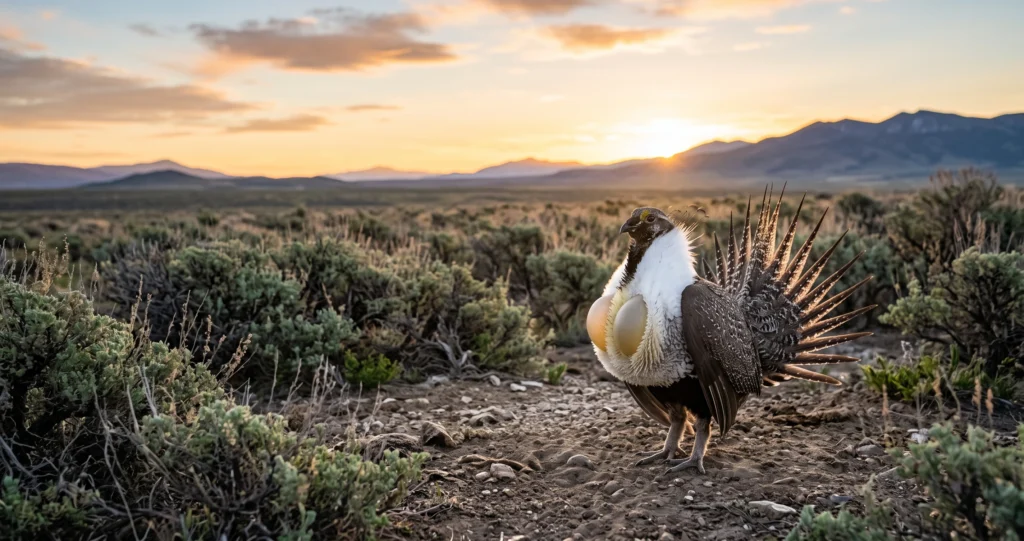
Because mating opportunities depend almost entirely on display performance, males invest enormous energy into producing impressive visual signals and booming sounds.
Meet the Greater Sage-Grouse
The greater sage-grouse (Centrocercus urophasianus) is North America’s largest grouse species.
Adults are well adapted to life in the sagebrush ecosystem.
Key features include:
- Large rounded body
- Long pointed tail
- Feathered legs
- Cryptic brown and gray plumage
- Broad wings
- Strong walking legs
Males are substantially larger than females and possess specialized ornamental feathers used during courtship.
Most striking are the white breast feathers that conceal two expandable yellow air sacs.
Outside the breeding season, these structures remain largely hidden.
During courtship, however, they become the centerpiece of one of the continent’s most recognizable wildlife displays.
What Is a Lek?
A lek is a traditional display ground where multiple males gather to compete for mates.
Unlike nesting territories, leks contain little food or shelter.
Instead, they function as meeting places.
Many sage-grouse return to the same lek year after year, and some display sites have likely been used for generations.
Activity begins before sunrise.
Males arrive while the landscape is still dark.
As daylight increases, displays become more frequent and competition intensifies.
Females usually visit briefly, observe several males, then leave after selecting a mate.
The lek quickly becomes quiet again once the breeding season ends.
Anatomy Behind the Booming Display
The courtship display depends on several remarkable anatomical adaptations.
Inflatable Air Sacs
Perhaps the most recognizable feature is the pair of yellow inflatable air sacs located beneath specialized breast feathers.
These sacs expand dramatically during display.
When air moves through the esophagus and into the sacs, they become clearly visible as rounded yellow patches on the chest.
Their rapid inflation and deflation help produce the characteristic popping and booming sounds.
Specialized Feathers
Long white breast feathers frame the air sacs and enhance their visibility.
Dark pointed feathers surrounding the chest create strong visual contrast, making the display easier for females to see even from considerable distances.
Tail Fan
Males spread their long pointed tail feathers into a dramatic fan.
This makes the bird appear larger while creating an unmistakable display posture.
Strong Leg Muscles
Although the display emphasizes the chest and tail, the legs also play an important role.
Males repeatedly stamp, strut, and shift position while maintaining balance during the energetic performance.
Vocal Anatomy
The sounds themselves are produced through coordinated movements involving the respiratory system, esophagus, and inflatable air sacs.
Researchers continue studying the precise biomechanics of sound production, but it is well established that the sacs amplify and shape the display’s distinctive acoustic signals.
Step by Step: How the Courtship Display Works
A complete display follows a recognizable sequence.
The male first stands upright, alert to nearby competitors and visiting females.
He raises his pointed tail into a tall fan.
The wings drop slightly toward the ground.
Next, the white breast feathers spread apart.
The hidden yellow air sacs begin to inflate.
The bird thrusts its chest forward while rapidly forcing air through the specialized structures.
This produces a series of soft swishes followed by the familiar popping and low-frequency booming sounds.
After the sacs collapse, the entire sequence repeats.
During peak breeding periods, a male may perform this display dozens or even hundreds of times during a single morning.
Neighboring males often display simultaneously, creating an extraordinary chorus that carries across open sagebrush flats.
Why Females Visit the Lek
Female sage-grouse invest heavily in reproduction.
They build nests, incubate eggs for several weeks, and later guide newly hatched chicks through challenging environments.
Because their reproductive investment is so high, choosing a suitable mate matters.
Researchers believe females evaluate multiple characteristics during courtship.
These may include:
- Display consistency
- Vocal performance
- Physical condition
- Dominance over neighboring males
- Experience occupying preferred display locations
Interestingly, mating success is not distributed evenly.
Studies consistently show that a relatively small number of males account for a large proportion of successful matings on many leks.
Exactly why some males become consistently more successful remains an active area of behavioral research.
Habitat and Annual Life Cycle
Greater sage-grouse are closely tied to sagebrush ecosystems across the western United States and parts of southern Canada.
Unlike many birds that occupy a wide variety of habitats, sage-grouse depend heavily on extensive sagebrush landscapes throughout the year.
Spring
Spring centers on courtship.
Males gather at leks while females visit to select mates.
Summer
Females nest beneath sagebrush shrubs.
After hatching, chicks initially depend heavily on insects, which provide valuable protein for rapid growth.
As they mature, plant material becomes increasingly important.
Autumn
Family groups disperse across the landscape while birds build reserves for winter.
Winter
During harsh winters, sagebrush becomes especially important.
Its leaves make up most of the birds’ diet when other vegetation is unavailable.
Because of this dependence, healthy sagebrush is essential during every season.
Ecological Importance
Greater sage-grouse are considered an indicator species for sagebrush ecosystems.
Where healthy sage-grouse populations persist, many other native plants and animals also benefit.
These landscapes support numerous wildlife species, including:
- Pronghorn
- Mule deer
- Golden eagles
- Ferruginous hawks
- Brewer’s sparrows
- Sagebrush-dependent songbirds
- Native pollinators
By consuming leaves, flowers, seeds, and insects, sage-grouse contribute to ecological processes while serving as prey for natural predators.
Protecting sage-grouse habitat therefore supports an entire community of wildlife rather than a single species alone.
Conservation Challenges
Greater sage-grouse populations have declined across portions of their historic range.
Habitat fragmentation remains one of the greatest conservation concerns.
Large, continuous sagebrush landscapes have been altered by agriculture, infrastructure development, invasive plants, altered fire regimes, and energy development in some regions.
Wildfire can also present major challenges.
Although fire is a natural process in many ecosystems, unusually frequent or extensive fires may reduce sagebrush cover for decades because these shrubs recover slowly.
Climate change may further influence vegetation patterns, drought frequency, and habitat quality, although the precise effects vary among regions.
Conservation efforts increasingly focus on protecting large connected landscapes, restoring degraded sagebrush habitat, managing invasive species such as cheatgrass, and reducing disturbance near important breeding leks.
Long-term monitoring by wildlife agencies continues to improve understanding of population trends and habitat needs.
What People Often Get Wrong
Several misconceptions surround greater sage-grouse.
The booming sound does not come from the lungs alone.
The distinctive noises are produced through specialized air sacs working with the respiratory system and esophagus.
Females do not perform the elaborate display.
The dramatic courtship rituals are almost entirely performed by males.
Leks are not nesting areas.
Females leave the lek after mating and build nests elsewhere beneath sagebrush cover.
Sage-grouse are not prairie chickens.
Although both belong to the grouse family and perform elaborate courtship displays, they are different species with distinct habitats and behaviors.
They depend on more than open grasslands.
Healthy sagebrush is essential throughout the year, especially during winter when it forms most of their diet.
Tips for Watching Sage-Grouse Responsibly
Viewing a sage-grouse lek can be an unforgettable wildlife experience.
Responsible observation helps ensure birds continue behaving naturally.
- Visit only where viewing is permitted.
- Follow local wildlife agency guidelines.
- Arrive well before sunrise and remain quiet.
- Observe from designated blinds or approved viewing areas whenever available.
- Use binoculars or spotting scopes instead of approaching birds.
- Avoid drones, loud conversations, or sudden movement.
- Never flush displaying birds for photographs.
Even small disturbances can interrupt breeding behavior during this critical period.
Frequently Asked Questions
Why do greater sage-grouse gather in groups to display?
Gathering on leks allows females to compare multiple males efficiently while males compete directly through courtship displays rather than defending nesting territories.
What causes the booming sound?
The sound is created when air moves through specialized structures involving inflatable air sacs and the respiratory system during the display sequence.
Do males help raise chicks?
No. After mating, females build nests, incubate eggs, and care for young without assistance from males.
When is the best time to see a courtship display?
Displays typically occur during spring breeding season, especially around sunrise when lek activity is highest.
Why is sagebrush so important?
Sagebrush provides food, nesting cover, shelter, and winter survival habitat, making it essential throughout the birds’ annual life cycle.
Conclusion
The greater sage-grouse courtship display is an extraordinary combination of sound, movement, anatomy, and behavior shaped by millions of years of evolution. Inflatable yellow air sacs, striking feather displays, synchronized strutting, and resonant booming calls all help males compete for the attention of females on traditional leks scattered across North America’s sagebrush landscapes.
Beyond its visual appeal, this remarkable ritual highlights the close relationship between animal behavior and habitat. Without extensive healthy sagebrush ecosystems, the annual dawn performances that define the greater sage-grouse breeding season cannot continue. Conserving these landscapes benefits not only sage-grouse but also the diverse wildlife communities that depend on one of North America’s most distinctive ecosystems.
Suggested Internal-Link Opportunities
Since I cannot verify the exact URLs on your website, consider linking naturally to existing or future articles covering:
- How Western Grebes Run Across Water During Courtship
- How Bar-tailed Godwits Complete Nonstop Trans-Pacific Flights
- How Snow Leopards Use Their Long, Thick Tails
- Bird Courtship Displays Around the World
- Grassland and Sagebrush Wildlife
- Bird Mating Behaviors Explained
Recommended Authoritative External Sources
- Cornell Lab of Ornithology – Birds of the World (Greater Sage-Grouse)
- U.S. Fish & Wildlife Service – Greater Sage-Grouse conservation resources
- U.S. Geological Survey (USGS) – Sage-grouse ecology and habitat research
- Smithsonian National Zoo & Conservation Biology Institute – Bird biology resources
- Peer-reviewed journals such as The Auk, The Condor, Journal of Wildlife Management, and Ecology for sage-grouse behavioral and conservation research