
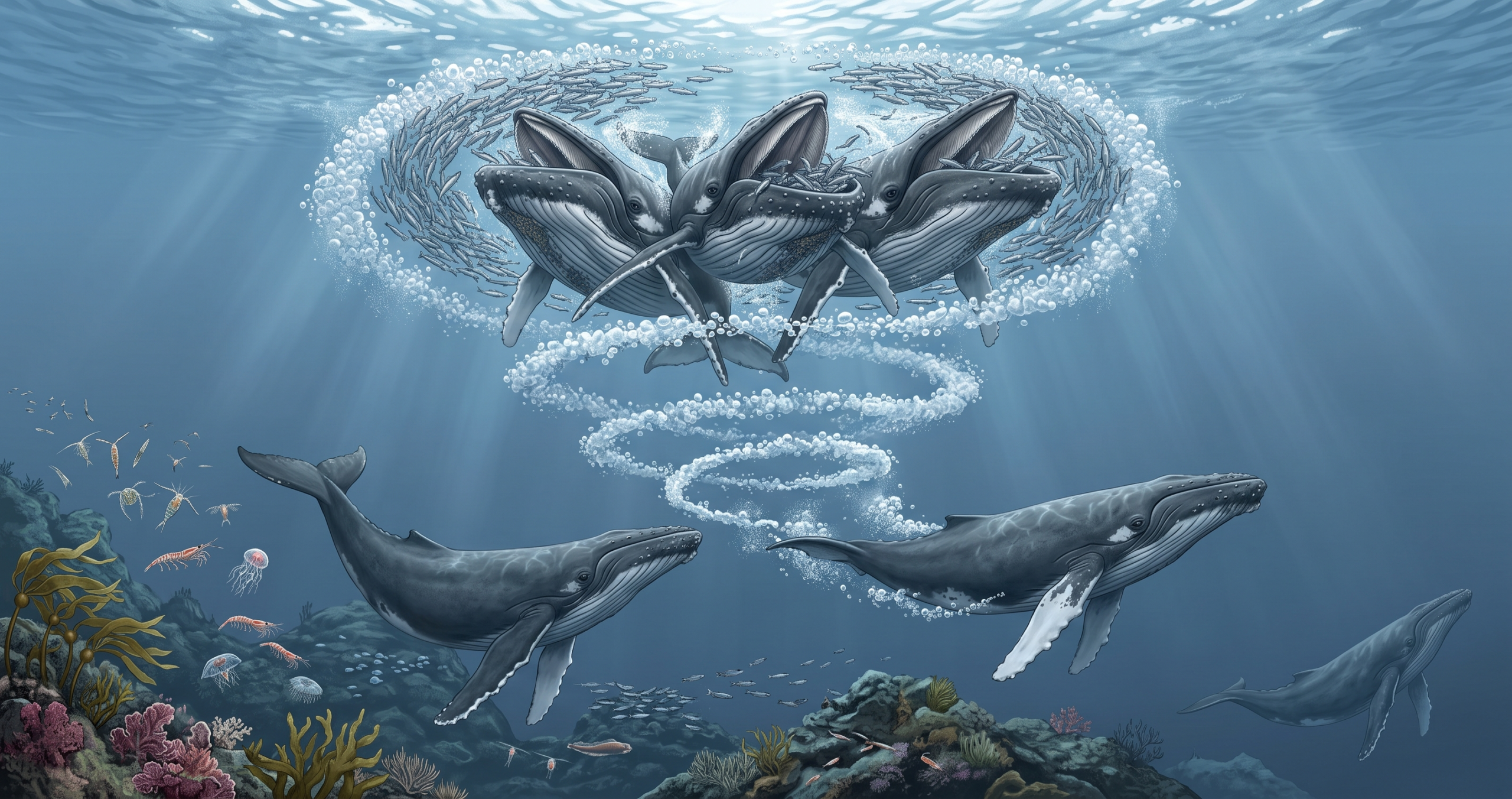
Among the largest animals on Earth, humpback whales are famous for spectacular breaches, haunting songs, and some of the longest migrations in the animal kingdom. Yet one of their most remarkable behaviors happens beneath the ocean’s surface, where groups of whales work together to trap thousands of fish using nothing more than air, timing, and cooperation.
Known as humpback whale bubble-net feeding, this extraordinary hunting strategy is one of the clearest examples of coordinated feeding behavior in marine mammals. Instead of chasing individual fish, humpback whales create a rising curtain of bubbles that concentrates schools of prey into a dense column before several whales surge upward with their mouths wide open.
Scientists have studied bubble-net feeding for decades because it combines communication, learning, and teamwork in a way rarely seen among large marine animals. Although not every humpback whale population performs this behavior, those that do demonstrate how flexible and intelligent these giants can be when food is abundant and conditions are right.
Understanding how humpback whales use bubble nets to hunt together offers a fascinating glimpse into animal cooperation and highlights why protecting healthy marine ecosystems remains essential for the survival of these iconic whales.
Table of Contents
- Meet the Humpback Whale
- Where Humpback Whales Live
- Anatomy That Makes Bubble-Net Feeding Possible
- What Is Humpback Whale Bubble-Net Feeding?
- Step-by-Step: How Bubble Nets Work
- Teamwork Beneath the Surface
- Why Bubble-Net Feeding Is So Effective
- Ecological Role
- Conservation Context
- What People Often Get Wrong
- Responsible Whale Watching
- Frequently Asked Questions
- Conclusion
Meet the Humpback Whale
The humpback whale (Megaptera novaeangliae) belongs to the baleen whale family, meaning it filters food from seawater rather than catching prey with teeth. Adults commonly reach 40–60 feet (12–18 meters) in length and can weigh around 25–40 metric tons, making them among the ocean’s largest animals.
Their scientific name means “large-winged New Englander,” a reference to their exceptionally long pectoral fins, which may reach nearly one-third of their body length. Combined with their powerful tails, these fins provide impressive maneuverability despite the whales’ enormous size.
Humpback whales are also among the most recognizable whales thanks to their knobby heads, distinctive body shape, and individually patterned tail flukes that researchers use to identify individual animals around the world.
Although often observed alone or in small temporary groups, humpbacks become remarkably social during certain feeding events, particularly where bubble-net feeding occurs.
Where Humpback Whales Live
Humpback whales inhabit every major ocean on Earth.
Each year they undertake some of the longest migrations of any mammal, traveling thousands of miles between warm tropical or subtropical breeding grounds and colder, food-rich feeding areas.
During summer, many populations feed in productive waters including:
- Alaska
- British Columbia
- The Gulf of Maine
- Iceland
- Norway
- Greenland
- Antarctica
These regions experience seasonal explosions of plankton that support enormous schools of forage fish such as herring, sand lance, capelin, and juvenile pollock, along with swarms of krill.
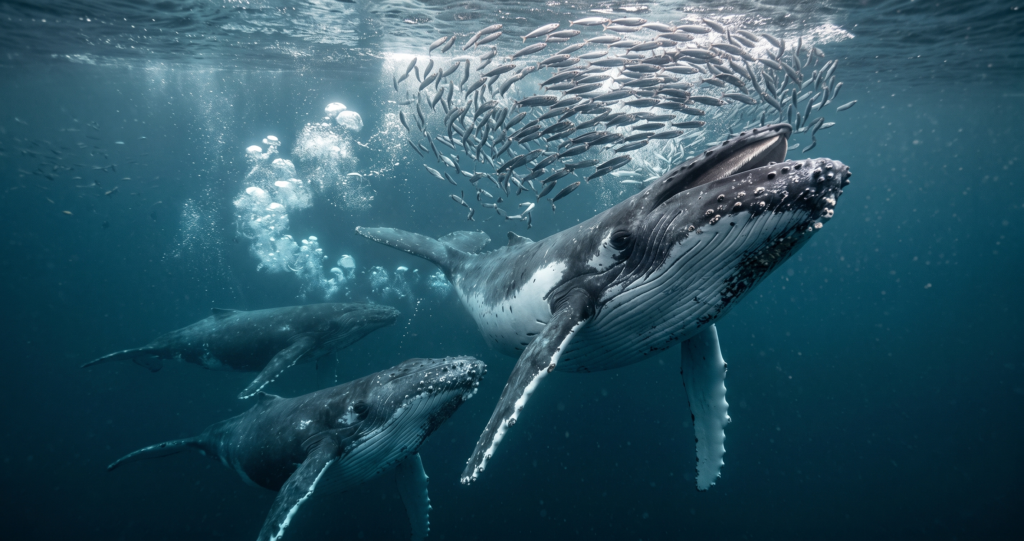
Bubble-net feeding is best documented in parts of Southeast Alaska and British Columbia, although similar cooperative behaviors have also been observed elsewhere in the North Pacific.
The behavior depends not only on the whales themselves but also on prey species that naturally gather into dense schools.
Anatomy That Makes Bubble-Net Feeding Possible
Bubble-net feeding would be impossible without several specialized adaptations that have evolved in baleen whales.
Baleen Plates
Instead of teeth, humpback whales possess hundreds of flexible baleen plates hanging from the upper jaw.
These plates are made of keratin—the same protein found in human fingernails and hair.
After engulfing an enormous mouthful of fish and seawater, the whale closes its mouth and pushes water outward using its tongue.
The baleen traps fish inside while seawater escapes.
This filtration system allows humpbacks to consume thousands of small prey during a single feeding event.
Expandable Throat Pleats
Running from the lower jaw to the belly are deep grooves called ventral pleats.
These folds allow the throat to expand dramatically, enabling a whale to engulf a volume of water that can exceed its own body size.
Few feeding systems in the animal kingdom rival this extraordinary capacity.
Long Pectoral Fins
The humpback’s unusually long flippers help provide precise control during underwater maneuvers.
Researchers believe these fins improve agility while whales circle prey and position themselves within coordinated feeding groups.
Powerful Lungs
Although whales breathe air, they spend extended periods underwater.
Large oxygen stores in muscles and blood allow humpbacks to complete complex underwater feeding sequences before surfacing to breathe.
What Is Humpback Whale Bubble-Net Feeding?
Humpback whale bubble-net feeding is a cooperative hunting strategy in which one or more whales release bubbles beneath a school of fish.
The bubbles rise toward the surface, forming a cylindrical barrier that influences the movement of tightly packed prey.
Many schooling fish avoid swimming through dense columns of bubbles.
Instead, they crowd closer together, forming an increasingly concentrated bait ball.
Once the fish have been compressed into a small area, several whales swim upward through the center with their mouths fully open.
The coordinated lunge captures fish far more efficiently than chasing scattered individuals.
Researchers studying this behavior have documented that different whales often perform different roles within the hunt, suggesting cooperation rather than coincidence.
Step by Step: How Bubble Nets Work
Although each feeding event differs slightly, bubble-net feeding generally follows a recognizable sequence.
Locating Prey
The whales first locate a dense school of fish or krill.
Successful hunts depend on prey already being concentrated enough for collective trapping to be worthwhile.
Diving Below the School
The group dives beneath the fish, sometimes reaching considerable depth depending on prey location.
This positioning allows the whales to work upward.
Creating the Bubble Curtain
One or more whales begin releasing streams of air through their blowholes while swimming in a widening circle.
As the bubbles rise, they form what appears to divers as a shimmering underwater wall.
From above, the structure resembles a giant circular net made entirely of bubbles.
Herding the Fish
The schooling fish respond by swimming inward instead of passing through the rising bubble curtain.
As the circle tightens, prey density increases dramatically.
Some researchers have also documented feeding calls produced during this stage that may influence prey behavior or help coordinate group members.
The Final Lunge
At precisely the right moment, several whales accelerate upward through the center of the bubble net.
Their mouths open to nearly ninety degrees as expandable throat pleats stretch outward.
Within seconds, enormous volumes of water filled with fish enter each whale’s mouth.
The whales then surface, close their jaws, expel seawater through the baleen plates, and swallow the trapped fish.
The entire event often lasts only a few moments but may involve several minutes of preparation beneath the surface.
Teamwork Beneath the Surface
One of the most fascinating aspects of bubble-net feeding is the level of coordination involved.
Studies using drones, underwater recordings, and tagging technology suggest that whales may adopt specialized roles during feeding events.
Some individuals primarily release bubbles.
Others produce feeding vocalizations.
Still others position themselves strategically for the final upward lunge.
These roles may not remain fixed forever, but they demonstrate remarkable behavioral flexibility.
Scientists also believe young humpback whales learn aspects of bubble-net feeding socially.
Calves accompanying experienced adults observe feeding behavior over multiple seasons before becoming fully proficient themselves.
This social learning helps explain why bubble-net feeding occurs in certain populations but not universally throughout the species’ range.
Rather than being purely instinctive, the behavior appears to involve cultural transmission, with knowledge passed between generations.
Why Bubble-Net Feeding Is So Effective
Bubble-net feeding transforms thousands of scattered fish into a concentrated target.
Instead of pursuing individual prey across open water, humpback whales invest energy in briefly organizing prey into a dense cluster.
This strategy increases the amount of food captured during each feeding lunge while reducing unnecessary chasing.
The behavior becomes particularly valuable when prey species naturally school tightly, allowing whales to exploit fish behavior itself.
Rather than overpowering prey through speed alone, humpbacks use cooperation, timing, and an understanding of how schooling fish respond to perceived threats.
It is a sophisticated feeding strategy that illustrates how intelligence and anatomy work together in one of the ocean’s largest predators.
Ecological Role
Humpback whales are major predators within marine food webs.
By consuming schooling fish and krill, they help transfer energy through ocean ecosystems and influence prey populations.
Their feeding also contributes to nutrient cycling.
When whales feed at depth and release waste near the surface, nutrients become available to phytoplankton, the microscopic plants that form the foundation of marine food webs.
Scientists often refer to this process as part of the “whale pump,” highlighting the broader ecological importance of large whales beyond their role as predators.
Healthy humpback populations therefore contribute not only to biodiversity but also to the productivity of the oceans themselves.
Conservation Context
The story of humpback whales is one of the most encouraging conservation successes in the marine world, but it is not a story with a finished ending.
During the 19th and 20th centuries, commercial whaling dramatically reduced humpback whale populations across much of the world. The International Whaling Commission’s moratorium on commercial whaling, introduced in 1986, helped many populations begin recovering. Today, several humpback whale populations have increased substantially, although recovery varies by region.
The International Union for Conservation of Nature (IUCN) currently classifies the humpback whale as a species of Least Concern globally. However, not every regional population has recovered equally, and some remain small or vulnerable to ongoing human pressures.
Modern threats are different from those faced during the whaling era.
Fishing Gear Entanglement
One of the greatest dangers comes from entanglement in ropes, nets, and other fishing gear.
Heavy lines can wrap around fins, tails, or mouths, making swimming and feeding difficult. Some whales survive after disentanglement, while others suffer severe injuries or die.
Ship Strikes
Large vessels share coastal waters with migrating whales.
Collisions are especially dangerous in busy shipping lanes where whales surface frequently to breathe.
Many conservation programs now encourage reduced vessel speeds in important whale habitats.
Climate Change
Bubble-net feeding depends on healthy populations of schooling fish and krill.
Ocean warming, changing currents, and shifting prey distributions may alter where humpback whales can find food during the feeding season.
Scientists continue studying how climate-driven ecosystem changes could affect whale migrations and feeding success in the future.
Ocean Noise
The ocean is becoming noisier because of commercial shipping, industrial activity, and some types of sonar.
Since humpback whales rely heavily on sound for communication, excessive underwater noise has the potential to interfere with social interactions and coordinated behaviors.
Protecting feeding grounds means protecting not only the whales themselves but also the complex marine ecosystems that support their prey.
What People Often Get Wrong
Bubble Nets Are Not Used Everywhere
Many people assume every humpback whale uses bubble nets.
In reality, bubble-net feeding occurs primarily in certain populations, especially in parts of the North Pacific.
Many humpbacks feed successfully throughout their lives without ever performing this behavior.
Every Whale Doesn’t Perform the Same Job
Videos often make it appear that every whale simply swims in a circle.
Research suggests that different individuals may contribute in different ways during cooperative hunts.
Some release bubbles, others vocalize, and several participate in the final upward lunge.
The Bubbles Don’t Trap Fish Physically
The bubbles are not a solid wall.
Instead, they influence the behavior of schooling fish.
Many prey species hesitate to swim through dense rising bubbles, causing them to crowd together into a tighter group.
The whales exploit this predictable response.
Bubble-Net Feeding Isn’t Random
This behavior requires precise timing.
If whales surfaced too early, prey could escape.
If they waited too long, the fish school could disperse.
Successful hunts depend on coordination among multiple whales and careful positioning beneath the prey.
Humpback Whales Are Not Dangerous Hunters
Despite their enormous size, humpback whales feed almost entirely on small prey such as krill and schooling fish.
Their throats are far too narrow to swallow a human.
Although they should always be respected in the wild, they are not predators of people.
Responsible Whale Watching
Watching humpback whales in their natural habitat is an unforgettable experience.
Responsible tourism helps ensure that future generations can enjoy these encounters while minimizing disturbance to the animals.
Choose tour operators that follow established wildlife viewing guidelines.
Keep a respectful distance from whales and avoid attempting to predict or block their path.
If bubble-net feeding begins, allow the whales to continue naturally without trying to approach more closely.
Drones should only be operated where permitted by law and in accordance with wildlife regulations.
Photographs and videos are most valuable when they capture authentic behavior rather than encouraging animals to react to nearby boats.
Supporting marine protected areas, sustainable fisheries, and organizations working to reduce entanglement and ship strikes also contributes to humpback whale conservation long after a whale-watching trip ends.
Frequently Asked Questions
Why do humpback whales create bubble nets?
Bubble nets concentrate schools of fish into a smaller area, allowing several whales to capture far more prey during a coordinated feeding lunge than they could by chasing scattered fish individually.
Do all humpback whales use bubble-net feeding?
No. Bubble-net feeding has been documented in specific populations, particularly in parts of Alaska and British Columbia, but many humpback whales use different feeding strategies throughout their lives.
How do whales make the bubbles?
Whales release air through their blowholes while swimming beneath schools of fish in circular patterns, creating a rising curtain of bubbles around the prey.
What kinds of fish are caught in bubble nets?
Depending on location, humpback whales commonly target schooling fish such as herring, capelin, sand lance, juvenile pollock, and sometimes krill.
Is bubble-net feeding learned or instinctive?
Current research suggests that social learning plays an important role. Young whales appear to observe experienced adults, helping explain why the behavior is common in some populations but absent in others.
Can people safely watch bubble-net feeding?
Yes, but only from a respectful distance and through responsible whale-watching operators that follow local wildlife regulations.
Conclusion
The ocean contains countless remarkable feeding strategies, but few demonstrate cooperation as clearly as humpback whale bubble-net feeding.
By combining precise timing, communication, specialized anatomy, and collective action, humpback whales transform ordinary air bubbles into one of nature’s most effective hunting tools. Rather than relying solely on size or strength, these marine giants work together to manipulate the behavior of entire schools of fish before rising through the center in a perfectly coordinated strike.
This extraordinary behavior reminds us that intelligence in nature often appears in unexpected forms. Bubble-net feeding is not simply an impressive display of teamwork—it is an adaptation shaped by millions of years of evolution and refined through social learning within certain whale populations.
As humpback whale populations continue recovering from the impacts of commercial whaling, protecting productive feeding grounds, reducing ocean noise, preventing fishing-gear entanglement, and conserving healthy marine ecosystems remain essential. Every successful bubble-net hunt depends on thriving oceans, abundant prey, and environments where these remarkable whales can continue passing their knowledge from one generation to the next
Internal-Link Opportunities
Link this article to relevant content on https://secretsofthegreengarden.com if available, such as:
- An article about whale migration and long-distance marine journeys.
- An article exploring animal cooperation or collective hunting strategies.
- An article about unusual feeding adaptations in marine wildlife.
- An article explaining baleen whales and filter feeding.
- An article about ocean conservation and marine food webs.
Recommended Authoritative Sources
- NOAA Fisheries – Humpback Whale Species Profile
- Smithsonian Ocean – Humpback Whale Biology and Behavior
- IUCN Red List – Megaptera novaeangliae
- Wiley, D. N., et al. Peer-reviewed research on humpback whale bubble-net feeding behavior.
- National Marine Fisheries Service (NOAA Fisheries) publications on humpback whale ecology and conservation.