
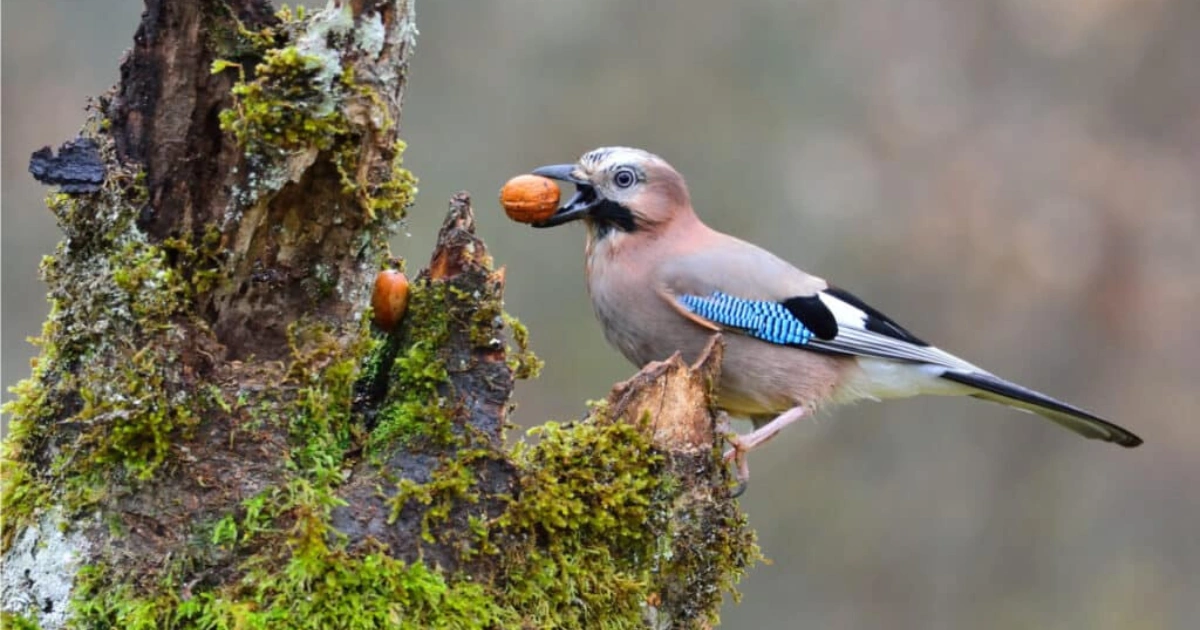
Forests often regenerate through hidden partnerships between plants and animals. One of the most remarkable examples involves the Eurasian jay, a clever woodland bird known for collecting and burying acorns across large distances. Although many people recognize the Eurasian jay for its colorful feathers and loud calls, fewer realize its enormous ecological importance.
By storing acorns underground for later consumption, Eurasian jays unintentionally help grow future oak forests. Forgotten acorns can sprout into young trees, making these birds some of nature’s most effective forest planters.
In this guide, we explore how Eurasian jays support forest regeneration, why oak trees depend on animal seed dispersal, and how this fascinating relationship benefits ecosystems.
What Is the Eurasian Jay?
The Eurasian jay (Garrulus glandarius) is a member of the crow family, known as Corvidae.
Identifying Features
The bird is recognized by:
- Pinkish-brown body feathers
- Bright blue wing patches
- Black facial markings
- Strong beak adapted for carrying acorns
Eurasian jays are intelligent, adaptable birds found throughout many parts of Europe and Asia.
Why Oak Trees Need Seed Dispersal
Oak trees produce heavy acorns that cannot travel far on their own.
The Problem With Acorn Distribution
Without animals, many acorns would:
- Fall near the parent tree
- Compete for sunlight and water
- Face heavy predation
- Have lower survival rates
Animals that transport acorns help expand oak forests naturally.
How Eurasian Jays Spread Acorns
During autumn, Eurasian jays collect large quantities of acorns and bury them in scattered locations.
How Many Acorns Can One Jay Bury?
Research suggests a single Eurasian jay may hide:
- Approximately 3,000 to 5,000 acorns each autumn
Not every acorn is recovered later.
Forgotten acorns often germinate into new oak seedlings.
Why Jays Are Excellent Forest Planters
The Eurasian jay performs several actions that improve the chances of successful oak growth.
They Select Healthy Acorns
Jays often choose:
- Larger acorns
- Undamaged seeds
- Healthy specimens
This natural selection process improves germination potential.
They Spread Seeds Over Wide Areas
Unlike gravity alone, birds transport acorns far from the original tree.
Typical Transport Distance
Eurasian jays may carry acorns:
- Several kilometers away
- Sometimes up to 10 kilometers from the parent tree
This helps oak populations spread into new habitats.
They Bury Acorns at Ideal Depths
Jays commonly bury acorns a few centimeters underground.
Why Burial Depth Matters
Proper burial helps:
- Protect acorns from drying out
- Reduce predation
- Improve moisture retention
- Support germination
Many cached acorns end up buried at depths favorable for sprouting.
Forgotten Acorns Become New Trees
Jays rely on memory to relocate food caches during winter, but not all hidden acorns are recovered.
Spring Germination
When forgotten acorns survive winter conditions, they may begin growing in spring.
This accidental planting plays a major role in forest regeneration.
Seasonal Cycle of Acorn Planting
The relationship between jays and oak trees follows a seasonal pattern.
Autumn: Collection and Storage
In autumn, jays actively gather acorns for winter food reserves.
Why Autumn Matters
This period is critical because:
- Oak trees produce ripe acorns
- Birds prepare for food shortages
- Large-scale caching begins
Winter: Retrieving Hidden Caches
During colder months, jays search for stored acorns beneath leaves, soil, and snow.
Remarkable Memory Skills
Corvids are known for impressive spatial memory and problem-solving abilities.
However, some hidden acorns remain undiscovered.
Spring: New Oak Seedlings Emerge
Forgotten acorns may germinate as temperatures rise.
How Forests Expand
This process helps:
- Restore woodland areas
- Increase biodiversity
- Support long-term forest health
Young oak seedlings may eventually become mature trees decades later.
Special Adaptations of the Eurasian Jay
Several physical and behavioral adaptations make this bird highly effective at seed dispersal.
Throat Pouch Storage
Eurasian jays possess specialized throat storage areas.
Carrying Multiple Acorns
A jay may transport:
- Approximately 5 to 7 acorns at once
This allows efficient movement between feeding and caching sites.
Intelligence and Planning Behavior
Corvids rank among the most intelligent bird groups.
Advanced Behaviors Include
- Food storage planning
- Spatial memory
- Problem-solving
- Cache protection strategies
These abilities increase seed distribution success.
Why Oak Forests Matter
Oak forests support enormous biodiversity.
Ecological Benefits of Oak Trees
Oak ecosystems provide:
- Wildlife habitat
- Soil stabilization
- Carbon storage
- Food for insects and mammals
Thousands of species depend on oak-dominated habitats.
Natural Reforestation Through Animals
The Eurasian jay is an example of mutual ecological benefit.
How Both Species Benefit
The relationship helps:
- Birds secure winter food
- Oak trees spread their seeds
This is a classic example of coevolution in nature.
Climate Change and Forest Regeneration
Natural seed dispersers may become increasingly important as ecosystems shift.
Why Seed Dispersal Matters
Forest regeneration helps:
- Restore damaged landscapes
- Improve biodiversity resilience
- Support carbon capture
Bird-assisted reforestation contributes to healthier ecosystems.
Threats Facing Eurasian Jays and Oak Forests
Habitat changes can disrupt these ecological relationships.
Common Threats Include
- Deforestation
- Habitat fragmentation
- Climate stress
- Urban expansion
Protecting woodland habitats supports both birds and forests.
How Gardeners and Landowners Can Help
Small conservation actions can support native wildlife and tree regeneration.
Helpful Practices
- Preserve mature oak trees
- Avoid unnecessary pesticide use
- Protect woodland habitats
- Support biodiversity-friendly landscapes
Healthy ecosystems encourage natural regeneration processes.
FAQ
What is the Eurasian jay?
The Eurasian jay is a colorful member of the crow family known for storing acorns.
How many acorns can a jay bury?
A single bird may bury several thousand acorns during autumn.
Why do forgotten acorns grow into trees?
Acorns buried underground can germinate when conditions become favorable.
Are Eurasian jays important for forests?
Yes. They play a major role in spreading oak seeds and supporting forest regeneration.
How far can a jay carry acorns?
Some Eurasian jays may transport acorns several kilometers from the parent tree.
Final Thoughts
The Eurasian jay demonstrates how wildlife quietly shapes entire ecosystems. Through the simple act of gathering and storing food, this intelligent bird helps plant future oak forests across large landscapes.
By selecting healthy acorns, transporting them long distances, and burying them at ideal depths, Eurasian jays become powerful natural agents of reforestation. Forgotten caches transform into young oak trees that support countless species and strengthen woodland ecosystems for generations.
Protecting these birds and their habitats helps preserve one of nature’s most remarkable partnerships between animals and forests.
Suggested Internal Links for secretsofthegreengarden.com
- How Native Birds Help Your Garden Thrive
- Best Trees for Supporting Backyard Wildlife
- Why Oak Trees Are Essential for Healthy Ecosystems
Backbiome is an advanced daily wellness supplement formulated to help support spinal comfort, reduce feelings of built-up tension, and promote freer, smoother movement throughout backbiome everyday life.
Boostaro is a modern men’s wellness boostaro formula created to support daily vitality, stamina, and confidence through a practical, natural routine.