
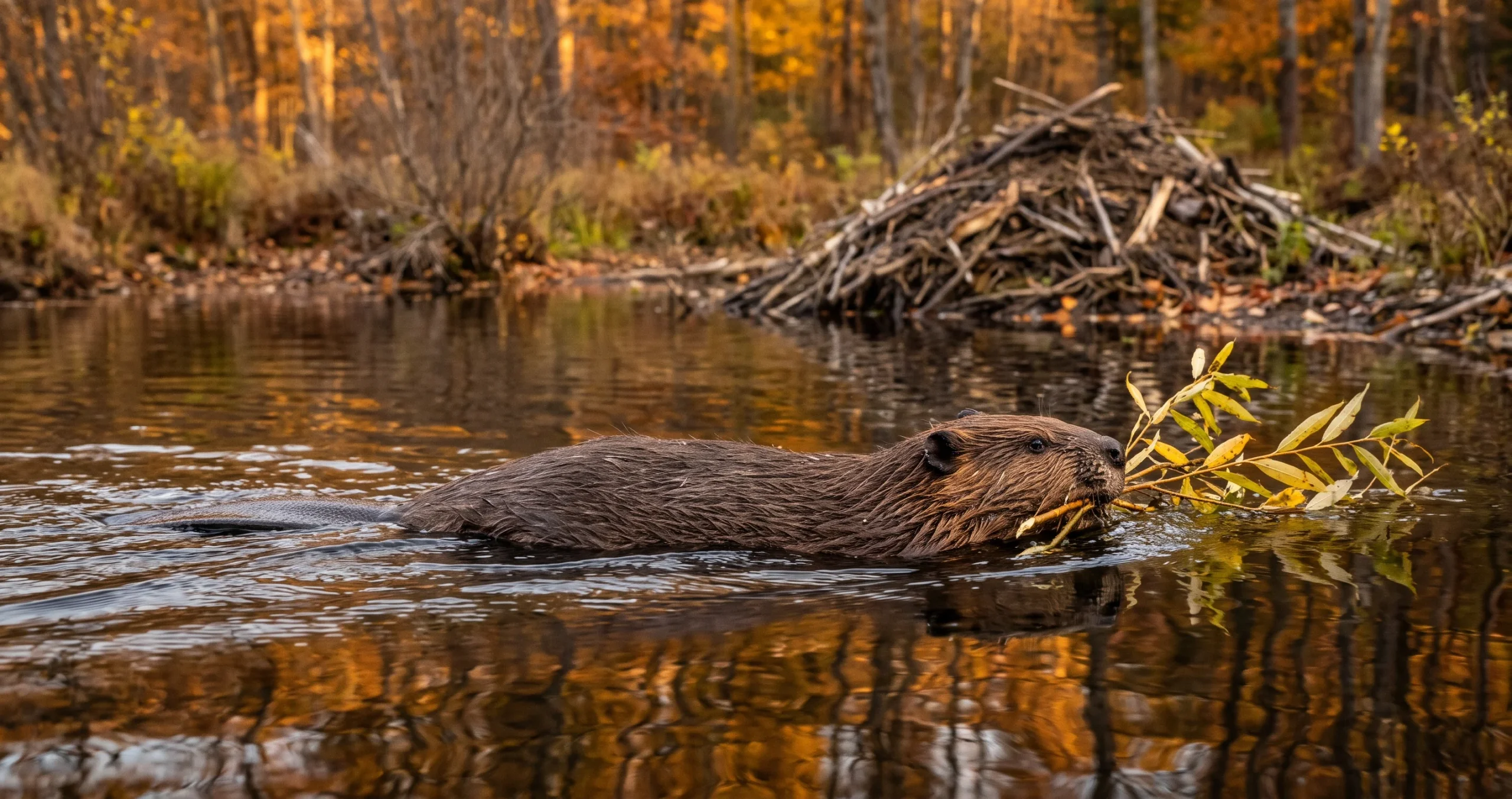
How beavers survive winter is a remarkable example of wildlife adaptation in North America. As temperatures drop and ponds freeze, these resourceful animals rely on underwater food storage, insulated lodges, and specialized physical adaptations to survive the coldest months.
During autumn, many North American beavers (Castor canadensis) prepare for winter by collecting branches from aspen, willow, birch, and other trees. They transport these branches into ponds and secure them beneath the water, creating a beaver food cache that remains accessible even when ice covers the surface.
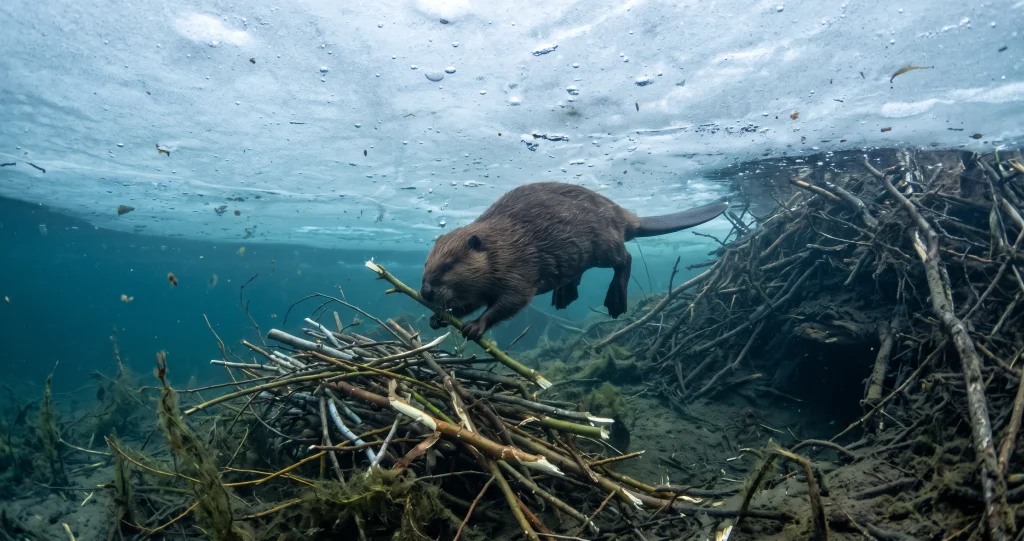
When winter arrives, beavers swim through submerged lodge entrances to retrieve stored branches. They feed primarily on the bark, cambium, and tender twigs, which provide essential nutrients during periods when fresh vegetation is difficult to find.
Unlike animals that hibernate, beavers remain active throughout winter. Their thick waterproof fur, stored body fat, and sheltered lodges help them conserve energy, while their swimming abilities allow them to travel beneath frozen ponds.
However, not all beavers store food in the same way. Northern populations often depend on underwater caches during prolonged freezing, while beavers in warmer regions may continue feeding on accessible vegetation.
Understanding how beavers survive winter reveals the remarkable relationship between seasonal food storage, animal behavior, and the freshwater ecosystems these natural engineers help create.
Table of Contents
- How Beavers Survive Winter
- Why Beavers Store Branches Underwater
- How Beavers Build Their Winter Food Cache
- How Beavers Access Food Beneath Frozen Ponds
- What Beavers Eat During Winter
- How Beaver Lodges Provide Winter Shelter
- Do All Beavers Build Winter Food Caches?
- The Ecological Importance of Beavers
- Frequently Asked Questions
- Conclusion
How Beavers Survive Winter
Beavers are well adapted to life in cold freshwater environments. Unlike bears and certain smaller mammals that undergo winter dormancy, beavers remain active throughout the year.
Their winter survival depends on several complementary adaptations.
Dense waterproof fur: Beavers have thick insulating underfur protected by longer guard hairs. Regular grooming helps maintain the condition of their coat.
Stored body fat: Energy reserves accumulated during productive seasons help support their metabolism when conditions become more demanding.
Sheltered living spaces: A beaver lodge or bank burrow offers protection from wind, snow, and direct exposure to freezing temperatures.
Underwater movement: Beavers are powerful swimmers capable of traveling beneath ice to reach submerged entrances and food supplies.
Seasonal food storage: In many colder regions, beavers gather woody vegetation during autumn and create submerged food caches.
These adaptations work together. A well-positioned lodge, access to liquid water, and suitable winter food sources can allow a colony to remain in its territory throughout the coldest months.
Winter activity is often less visible than summer activity because much of it occurs beneath the ice.
Why Beavers Store Branches Underwater
In summer, beavers have access to a wide variety of fresh vegetation, including aquatic plants, leaves, tender shoots, and tree bark.
Winter changes that availability.
Snow and ice can restrict access to shoreline vegetation, while many herbaceous plants become dormant or disappear above ground.
For beavers living in regions where ponds freeze for extended periods, storing branches underwater provides a practical solution.
A beaver food cache is a collection of woody vegetation placed in water, commonly near the lodge or another sheltered location.
The branches remain accessible beneath the frozen surface, provided sufficient unfrozen water remains.
Submerging branches also helps prevent them from drying out quickly. Cold water can slow decomposition, although stored vegetation may still deteriorate over time.
An important detail is that beavers generally consume the bark, cambium, buds, and smaller twigs rather than the hard interior wood.
The cache functions as a winter food reserve rather than a collection of construction materials.
In suitable northern habitats, this preparation reduces the need for repeated trips onto snow-covered shorelines.
It can also reduce exposure to terrestrial predators during periods when moving across land is particularly difficult.
How Beavers Build Their Winter Food Cache
The construction of a winter food cache usually begins during autumn, before persistent ice makes access to the shoreline more difficult.
Beavers collect suitable woody material and move it into the water. The exact timing, size, and arrangement of the cache vary according to local conditions.
Selecting Suitable Trees
Beavers favor several types of deciduous trees and shrubs.
Commonly used plants include:
- Aspen (Populus tremuloides)
- Willow (Salix species)
- Cottonwood (Populus species)
- Birch (Betula species)
- Red-osier dogwood (Cornus sericea)
The availability of these plants varies across North America.
Aspen and willow are particularly important in many northern beaver habitats because their bark and young twigs provide suitable food.
Beavers may also use other locally available woody plants.
They do not necessarily select the same tree species in every region. Food preferences are influenced by plant availability, nutritional characteristics, stem size, and distance from water.
Cutting and Transporting Branches
Beavers possess large, continuously growing incisors adapted for cutting woody vegetation.
Their front teeth have iron-enriched enamel on the outer surface, contributing to their characteristic orange coloration and effective cutting edges.
Using repeated bites, a beaver can remove branches or fell small trees.
Once suitable material has been collected, the animal drags or carries branches toward the water.
Water transport is particularly useful because floating branches can be moved more easily than they can be dragged over uneven ground.
Beavers may also use established waterways and channels to move vegetation between feeding areas and their lodges.
Anchoring Branches Underwater
After transporting branches to the storage location, beavers push or arrange them into a submerged pile.
Larger branches can become intertwined, helping stabilize the structure.
Some material may become lodged in bottom sediments, while heavier pieces and the arrangement of the pile help keep other branches in place.
A portion of the cache may initially remain visible above the waterline.
As winter progresses, ice can form around the upper parts of the pile, while accessible branches remain submerged below.
The result is a food supply that beavers can reach from underwater.
Cache dimensions vary considerably, depending on colony size, available vegetation, water depth, and the length and severity of winter.
How Beavers Access Food Beneath Frozen Ponds
One of the most impressive aspects of beaver winter behavior occurs after the pond freezes.
A beaver lodge typically has underwater entrances that connect the living chamber to the surrounding pond.
When the surface freezes, beavers can leave through these submerged passages and swim beneath the ice.
If a food cache is located nearby, they can retrieve branches without emerging onto the frozen surface.
A typical feeding trip follows a simple sequence.
First, the beaver exits the lodge through an underwater entrance.
Next, it swims toward the stored branches and selects a suitable piece.
The animal then carries the branch back toward the lodge or another protected feeding location.
Inside the lodge, beavers can consume the bark and softer outer tissues.
Beavers are capable of holding their breath for several minutes, and their streamlined bodies, webbed hind feet, and muscular tails support underwater movement.
However, they still need access to air.
Their winter habitat must therefore provide usable underwater routes between breathing spaces and feeding areas.
Water depth is especially important. A pond that freezes completely or loses sufficient water may become unsuitable for safe winter movement.
This is one reason beaver dams and stable water levels can be so valuable in colder habitats.
What Beavers Eat During Winter
The beaver winter diet differs from the vegetation consumed during warmer months.
During spring and summer, beavers eat a variety of herbaceous plants, aquatic vegetation, leaves, and tender shoots.
In winter, woody plants often become more important, particularly where snow and ice restrict access to fresh greenery.
Beavers primarily feed on the inner bark, cambium, buds, and small twigs of suitable trees and shrubs.
The cambium is a thin layer of living tissue located between the bark and wood. Beavers can obtain nutrients from this region and from other digestible plant tissues.
Their digestive systems are adapted to a plant-based diet containing substantial amounts of fibrous material.
Specialized microorganisms in the digestive tract help process components of this vegetation.
A winter food cache may contain branches from several tree species, allowing the animals to use locally available resources.
Beavers can also feed on accessible aquatic plants and other vegetation during winter.
The exact diet depends on habitat, climate, and food availability.
Importantly, beavers do not survive by eating the hard wood of trees as their primary food. Much of the woody material serves as support for the nutritious outer tissues they consume.
How Beaver Lodges Provide Winter Shelter
A beaver lodge is more than a pile of branches in the middle of a pond.
It is a carefully maintained shelter constructed from woody material, mud, and other locally available materials.
Many lodges have a raised interior chamber positioned above the normal water level.
The surrounding structure provides insulation and protection from direct exposure to winter weather.
Underwater entrances allow beavers to move between the lodge and pond while limiting access by many land predators.
Inside, the living chamber provides a relatively sheltered environment where family members can rest, groom, and feed.
A colony commonly includes a breeding pair, their young of the year, and older offspring that have not yet dispersed.
During winter, these animals may spend considerable time together inside the lodge.
The lodge is not heated like a human home, and its temperature is influenced by outside conditions, water, insulation, and the animals themselves.
Nevertheless, the enclosed chamber offers substantially better protection than an exposed resting place.
Beavers may maintain their lodges and dams before winter by adding mud, sticks, and other materials.
These repairs help preserve the structure and maintain access to water.
For additional background on how these structures influence water levels, see How Beaver Dams Shape Freshwater Habitats.
Do All Beavers Build Winter Food Caches?
Not every beaver colony creates a large underwater winter food cache.
This distinction is important when describing how beavers survive winter across the United States.
Food caching is especially associated with habitats where prolonged freezing limits access to shoreline vegetation.
In colder northern regions, storing branches can provide a significant survival advantage.
However, beavers living in milder climates may continue feeding on accessible vegetation throughout winter.
Colonies occupying flowing rivers may experience different conditions from those living in ponds.
Local water depth, ice cover, vegetation, and available feeding areas can all influence caching behavior.
Some colonies build substantial submerged piles, while others store smaller amounts or rely more heavily on accessible winter food.
Individual behavior and local population characteristics may also contribute to variation.
Consequently, the familiar image of a beaver swimming beneath a frozen pond toward a large branch pile represents an important winter strategy, but it is not universal.
The Ecological Importance of Beavers
Beavers influence much more than their immediate surroundings.
They are often described as ecosystem engineers because their activities physically modify freshwater habitats.
By constructing dams, excavating channels, and cutting vegetation, beavers can alter water movement, sediment deposition, and the distribution of plant communities.
Their ponds and associated wetlands may provide habitat for amphibians, fish, aquatic insects, waterfowl, and numerous other organisms.
Beaver-created wetlands can also retain water during dry periods and create complex mosaics of open water, marshes, and wet meadows.
These effects vary by location. Beaver dams can sometimes flood infrastructure, affect roads, or alter habitats used by other species.
Their ecological influence is therefore best understood within the surrounding landscape.
Winter food gathering also contributes to habitat change.
When beavers cut willow, aspen, and other woody plants, they modify the structure of shoreline vegetation.
Some plants regenerate through new shoots, while others may decline under repeated browsing.
Over time, these activities can influence the composition and age structure of riparian plant communities.
Beavers demonstrate how the behavior of a single mammal species can influence entire freshwater environments.
Frequently Asked Questions
1. Do beavers hibernate during winter?
Beavers remain active throughout winter. They spend considerable time inside sheltered lodges or bank burrows but continue feeding, grooming, and swimming when underwater routes remain accessible.
2. How do beavers find food under frozen ponds?
In colder habitats, beavers may store branches underwater during autumn. After ice forms, they swim through submerged lodge entrances and retrieve food from these nearby caches.
3. How long can beavers stay underwater?
Beavers can remain submerged for several minutes and may stay underwater for approximately 10–15 minutes under favorable conditions. Their routine dives are generally shorter, and they must eventually return to air.
4. Do beavers eat fish during winter?
Beavers are herbivores. Their diet consists of plant material, including bark, cambium, twigs, leaves, and aquatic vegetation. They do not normally hunt or eat fish.
5. Can beavers survive winter without a food cache?
Yes. Some beavers live in regions where water remains open or vegetation remains accessible during winter. Their survival strategies depend on local climate, habitat conditions, and food availability.
For a broader comparison of seasonal adaptations, see How North American Wildlife Survives Winter.
Conclusion
The ability of beavers to prepare for winter illustrates the remarkable adaptations of North American wildlife.
In many northern habitats, beavers gather branches during autumn and secure them underwater, creating food reserves that remain accessible beneath frozen ponds.
Their dense fur, specialized teeth, swimming abilities, and sheltered lodges complement this behavior.
However, winter food caching varies according to climate, water conditions, vegetation, and individual colonies.
Understanding these differences provides a more accurate picture of beaver ecology.
From maintaining ponds to modifying shoreline vegetation, beavers play an important role in freshwater landscapes throughout North America.
Their winter survival strategy demonstrates how animal behavior, seasonal preparation, and habitat engineering work together in the natural world.
External Sources
1. National Park Service — Nature’s Engineer, Gates of the Arctic National Park: Explains how beavers store branches near their lodges during autumn and retrieve them beneath winter ice. Read the National Park Service article
2. National Park Service — The Beaver Marsh, Cuyahoga Valley National Park: Documents autumn storage of willow and aspen branches and winter feeding on cached branches and aquatic plants. Read the Beaver Marsh wildlife guide
3. Pennsylvania Game Commission — Beaver Species Profile: Describes branch anchoring, winter food caches, feeding preferences, swimming adaptations, and lodge construction. Pennsylvania Game Commission: Beaver
4. National Park Service — Beaver, Katahdin Woods and Waters National Monument: Explains why beaver ponds require sufficient water depth to prevent underwater entrances and stored food from freezing. National Park Service: Beaver Habitat and Diet
5. Pennsylvania Game Commission — Beaver Management in Pennsylvania: Provides additional scientific detail about seasonal food preferences and explains why some populations store little or no woody vegetation when aquatic food remains abundant. Beaver Management in Pennsylvania (PDF)