
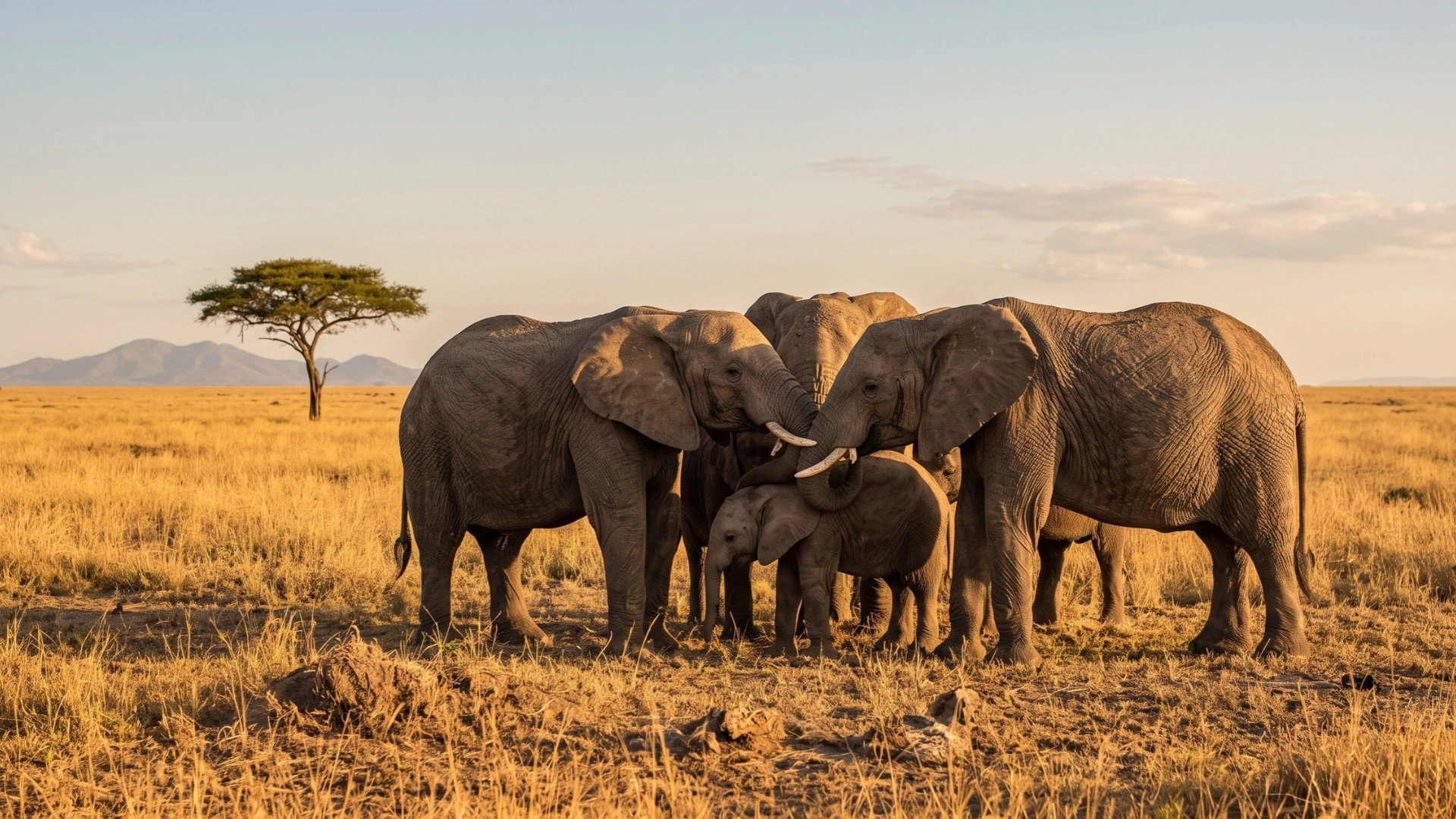
Elephants sometimes do something that is difficult for a human observer to watch without feeling an emotional connection. They approach the body of a dead elephant, investigate it carefully with their trunks, remain nearby, touch bones, and sometimes return to remains later. These observations have made elephant grief behavior one of the most fascinating subjects in the scientific study of animal emotion.
Calling these actions “grief,” however, requires care. Scientists cannot simply ask an elephant what it feels. Instead, researchers document behavior, social relationships, physiological signs, and changes following a death. The resulting evidence reveals something remarkable even without assuming that elephants experience bereavement exactly as humans do: death appears to matter to them socially.
Table of Contents
- What Scientists Mean by Elephant “Grieving”
- Elephants Really Do Investigate Their Dead
- Why Elephant Bones Receive Special Attention
- Elephants That Return to Remains
- How Scientists Interpret Elephant Grief Behavior
- What Death Reveals About Elephant Social Bonds
- What Other Animals Do Around Their Dead
- Does This Mean Elephants Understand Death?
- Common Myths About Grieving Elephants
- Why This Research Matters
- FAQ
- Conclusion
What Scientists Mean by Elephant “Grieving”
In everyday conversation, grief describes the emotional suffering people experience after losing someone important. Applying that same word directly to another species creates a scientific problem because an animal’s internal emotional experience cannot be measured in the same way that human grief can be described through language.
Researchers therefore often use more cautious terms such as responses to death, death-related behavior, or thanatological behavior. Comparative thanatology is the scientific study of how animals respond to dying and dead individuals.
That distinction does not mean researchers believe animals have no emotions.
Instead, scientists separate what can be directly observed from what must be inferred. An elephant touching a carcass with its trunk is observable. Saying the elephant is remembering a specific experience or mourning in precisely the human sense requires additional evidence.
This careful distinction is essential when discussing elephant grief behavior.
Elephants Really Do Investigate Their Dead
Some of the strongest evidence comes from decades of field observations involving wild African elephants.
Researchers have documented elephants approaching dead individuals, smelling and touching carcasses, investigating them with their trunks and feet, standing quietly nearby, and interacting with remains at different stages of decomposition.
A major scientific review by Shifra Goldenberg and George Wittemyer examined observations of elephants responding to dead conspecifics. The researchers found that approaches, touching, and investigative behavior occurred with everything from recently dead elephants to scattered, sun-bleached bones.
The researchers also documented elephants revisiting carcasses. During some encounters, elephants displayed extended investigation, remained stationary near the remains, showed self-directed behavior, experienced temporal-gland streaming, and increased their social interactions with elephants around them.
These observations make one point especially clear: elephants do not always treat a dead elephant as simply another object in their environment.
![elephant grief behavior as elephants investigate the remains of a deceased herd member]](https://secretsofthegreengarden.com/wp-content/uploads/2026/09/Gemini_Generated_Image_kdgx9lkdgx9lkdgx-1024x541.webp)
Why Elephant Bones Receive Special Attention
One particularly interesting experiment asked whether elephants show greater interest in elephant remains than in other objects.
Researchers Karen McComb, Lucy Baker, and Cynthia Moss tested African elephants with different bones and objects. Their study found that elephants showed particularly high levels of interest in elephant skulls and ivory.
That result matters because it moves the evidence beyond anecdotal stories.
Rather than merely observing an unusual encounter and interpreting it afterward, researchers could compare how elephants responded to different stimuli under controlled field conditions.
It demonstrated that elephant remains can have a special significance to elephants.
There is an important limitation, however. Evidence that elephants recognize or preferentially investigate elephant bones does not prove that every elephant knows whose bones they are.
The distinction between recognizing “this came from an elephant” and recognizing “this belonged to a particular individual I knew” is scientifically enormous.
Researchers continue to investigate where elephant cognition falls along that spectrum.
Elephants That Return to Remains
Revisiting behavior is another reason elephant responses to death attract so much scientific interest.
Goldenberg and Wittemyer reported visits and revisits to elephant carcasses in northern Kenya. Interestingly, elephants appeared interested in deceased individuals even when the social relationship between the visitor and dead elephant had not been especially strong.
That complicates the popular image of elephants returning only to the remains of beloved relatives.
Some encounters could involve emotional responses. Others may involve gathering information.
Elephant society provides an important clue.
African elephants live within complex social networks. Family groups can separate and later reunite, producing what behavioral scientists describe as a fission-fusion social system. Individuals therefore benefit from keeping track of who is present, absent, alive, or potentially missing.
Investigating a dead elephant may help surviving animals update their understanding of that social environment.
In other words, elephant grief behavior could contain several overlapping processes: emotional arousal, social recognition, curiosity, information gathering, attachment, and perhaps some understanding that the individual is no longer responsive.
These explanations are not mutually exclusive.
How Scientists Interpret Elephant Grief Behavior
This is where the science becomes especially interesting.
The strongest interpretation is not simply, “Elephants grieve exactly like humans.”
Researchers instead ask smaller, testable questions.
Do elephants distinguish dead elephants from other objects? Do they behave differently around a recently deceased individual? Does the strength of a previous social relationship affect their response? Do surviving elephants change their social behavior after a death?
These questions can be studied systematically.
A study of captive Asian elephants, for example, found changes in social behavior following deaths within the herd. The effects differed according to age and relationships, illustrating how complex the consequences of losing a group member can be.
Field observations of free-ranging Asian elephants have also documented sniffing, inspecting, attempts to support dying calves, and vocal responses around dying individuals. Researchers interpreted these observations cautiously as evidence consistent with distress and possible awareness of death.
This evidence supports the idea that death can produce meaningful behavioral consequences within elephant societies without requiring scientists to claim that the underlying experience is identical to human mourning.
For a detailed example of field research, see Save the Elephants’ research summary on responses to a dying and deceased matriarch. The research used direct observations, long-term association records, and tracking information to examine how elephants responded to a dying matriarch.
What Death Reveals About Elephant Social Bonds
Death-related behavior becomes easier to understand when we consider how intensely social elephant life is.
Female African elephants generally live within long-lasting family networks. Individuals recognize numerous other elephants and navigate changing relationships over many years.
Older females can also hold valuable social information.
Within such a system, losing an individual potentially changes far more than the number of animals in a group. It can alter relationships, caregiving patterns, social organization, and access to accumulated knowledge.
This is one reason elephant grief behavior is scientifically valuable.
Researchers are not studying death only to understand death. These encounters can reveal how elephants recognize individuals, maintain relationships, react to social disruption, and process major changes within their environment.
The same cognitive abilities that allow an elephant to maintain sophisticated long-term relationships while another elephant is alive may influence its behavior when that individual dies.
Readers interested in another example of sophisticated animal cognition can explore our wildlife coverage on Secrets of the Green Garden and our article on how octopuses use remarkably complex camouflage.
What Other Animals Do Around Their Dead
Elephants are not the only animals that show striking responses to death.
Primates
Chimpanzees, monkeys, and other primates have been documented interacting with deceased group members.
Some mothers continue carrying dead infants. Other individuals inspect bodies, remain nearby, or alter their behavior following a death.
Scientific reviews of primate thanatology distinguish between direct interactions with bodies and secondary behaviors such as guarding, visiting, or remaining close to the dead.
Whales and Dolphins
Cetaceans provide another important comparison.
Several species of whales and dolphins have been observed attending to dead or dying individuals. Mothers in some species have remained with or transported dead calves.
A scientific review of cetacean responses found numerous reports of individuals caring for, attending to, or showing heightened interest in dead conspecifics.
Corvids
Crows and related birds are another fascinating case.
Their gatherings around dead individuals may look superficially like human funerals, but researchers investigate other possible functions as well, including learning about danger in the environment.
This illustrates why scientists must resist assigning a single emotional explanation to behavior based solely on how it appears to us.
Comparative thanatology examines exactly these differences. Researchers compare elephants, primates, cetaceans, birds, insects, and other animals to understand how death recognition and death-related behavior may have evolved.
Does This Mean Elephants Understand Death?
This question is considerably harder than establishing whether elephants react to dead individuals.
A sophisticated human concept of death involves several ideas. Death is irreversible, the individual no longer functions, and all living organisms eventually die.
Demonstrating that another species understands all of those concepts is extremely difficult.
Elephants clearly detect important changes in an unresponsive or deceased individual. Their prolonged investigation of carcasses and remains provides evidence that dead conspecifics can represent biologically and socially significant stimuli.
What remains uncertain is exactly what elephants mentally represent during those encounters.
An elephant attempting to lift an unresponsive companion, for example, could initially be trying to help. Continued investigation after decomposition has begun presents a different cognitive situation.
Scientists therefore examine behavior across different stages of death rather than treating every encounter as equivalent.
The evidence points toward sophisticated responses to death. The precise depth of elephants’ conceptual understanding remains an active scientific question.
Common Myths About Elephant Grief Behavior
One common claim is that elephants deliberately hold “funerals” in the human sense.
Elephants certainly gather around bodies and may remain near them, but calling these events funerals implies ritual intentions that scientists cannot currently demonstrate. “Death-related gathering” or “carcass investigation” is more precise.
Another myth is that elephants only visit the bones of family members.
Research suggests elephants can investigate remains belonging to animals outside their immediate social circle. Their interest therefore appears broader than simple recognition of close relatives.
There is also a widespread claim that elephants can always identify the bones of particular individuals.
Research demonstrating special interest in elephant skulls and ivory does not establish reliable identification of a specific deceased elephant from skeletal remains alone.
Finally, avoiding anthropomorphism does not require pretending elephants are emotionless.
The scientifically responsible position sits between those extremes: document what elephants actually do, investigate possible mechanisms, and remain clear about what the evidence cannot yet tell us.
Why This Research Matters
Studying elephant grief behavior helps scientists investigate one of biology’s most challenging subjects: the evolution of emotion and social cognition.
Emotion does not fossilize. Researchers must reconstruct its evolutionary history using comparative anatomy, physiology, cognition, and behavior among living species.
Elephants are especially valuable because their combination of long lifespans, extensive social relationships, large brains, prolonged parental care, and complex communication provides opportunities to study how cognition interacts with social attachment.
Death creates an unusual natural experiment.
When a familiar social partner permanently stops responding, surviving animals face a dramatic violation of their normal social expectations.
How they react can reveal what that relationship meant while the animal was alive.
This is also why long-term field projects are so important. A single dramatic encounter can be compelling, but researchers need years of identification records and behavioral observations to know which elephants knew each other, how often they associated, and whether behavior actually changed following a death.
The science becomes strongest when extraordinary observations are combined with systematic data.
FAQ
Do elephants really mourn their dead?
Elephants display behaviors that are consistent with grief-like responses, including prolonged investigation of bodies, touching remains, revisiting carcasses, and behavioral changes following deaths.
Scientists usually avoid claiming that these experiences are identical to human grief because an elephant’s subjective emotional experience cannot be directly measured.
Do elephants return to places where another elephant died?
Researchers have documented elephants visiting and revisiting carcasses. These encounters can include investigation of remains and increased social behavior among surviving elephants.
This does not mean every herd repeatedly visits every death site.
Do elephants recognize elephant bones?
Experimental evidence indicates that African elephants show greater interest in elephant skulls and ivory than certain other objects or remains.
Whether they can reliably identify the skeletal remains of particular individuals is a separate question and has not been conclusively demonstrated.
Why do elephants touch dead elephants with their trunks?
The trunk is an extraordinarily important sensory organ. Touching and smelling a body allows an elephant to gather information about it.
Emotional arousal, recognition, investigation, and information gathering could all contribute to the behavior.
Are elephants the only animals that appear to grieve?
No.
Death-related behaviors have been documented among primates, cetaceans, corvids, and numerous other animals. The mechanisms and likely emotional components differ considerably between species.
Can scientists prove that elephants feel sadness?
Researchers can measure and document behavioral and physiological evidence associated with emotional states, but subjective experience cannot be directly reported by an elephant.
For that reason, researchers distinguish carefully between observable evidence and interpretations about exactly what an animal feels.
What is comparative thanatology?
Comparative thanatology studies how different animal species perceive and respond to death and dying.
The field examines everything from relatively simple corpse-management mechanisms to the complicated social responses documented among elephants, cetaceans, and primates.
Conclusion
Elephants do not simply provide us with a convenient animal version of human mourning. Their behavior is more scientifically interesting than that comparison suggests.
Decades of observations and experiments show that elephants pay unusual attention to dead members of their species. They investigate bodies and bones, sometimes revisit carcasses, and can undergo social and behavioral changes after members of their group die.
The safest scientific interpretation of elephant grief behavior is therefore neither to romanticize it nor dismiss it.
We know that death can provoke complex, prolonged, and socially meaningful responses in elephants. We also know that scientists cannot yet translate those responses directly into human emotional language.
That uncertainty is precisely what makes the subject so valuable.
Every carefully documented encounter provides another clue about elephant social bonds, memory, recognition, emotion, and perhaps their understanding of one of the most fundamental events experienced by any social animal: the permanent loss of another individual.
External Sources:
- Save the Elephants — Behavioural Reactions of Elephants Towards a Dying and Deceased Matriarch
https://savetheelephants.org/research/research-library/behavioural-reactions-of-elephants-towards-a-dying-and-deceased-matriarch-2006/ - PubMed — Elephant Behavior Toward the Dead: A Review and Insights From Field Observations
https://pubmed.ncbi.nlm.nih.gov/31713106/ - PubMed — African Elephants Show High Levels of Interest in the Skulls and Ivory of Their Own Species
https://pubmed.ncbi.nlm.nih.gov/17148317/