
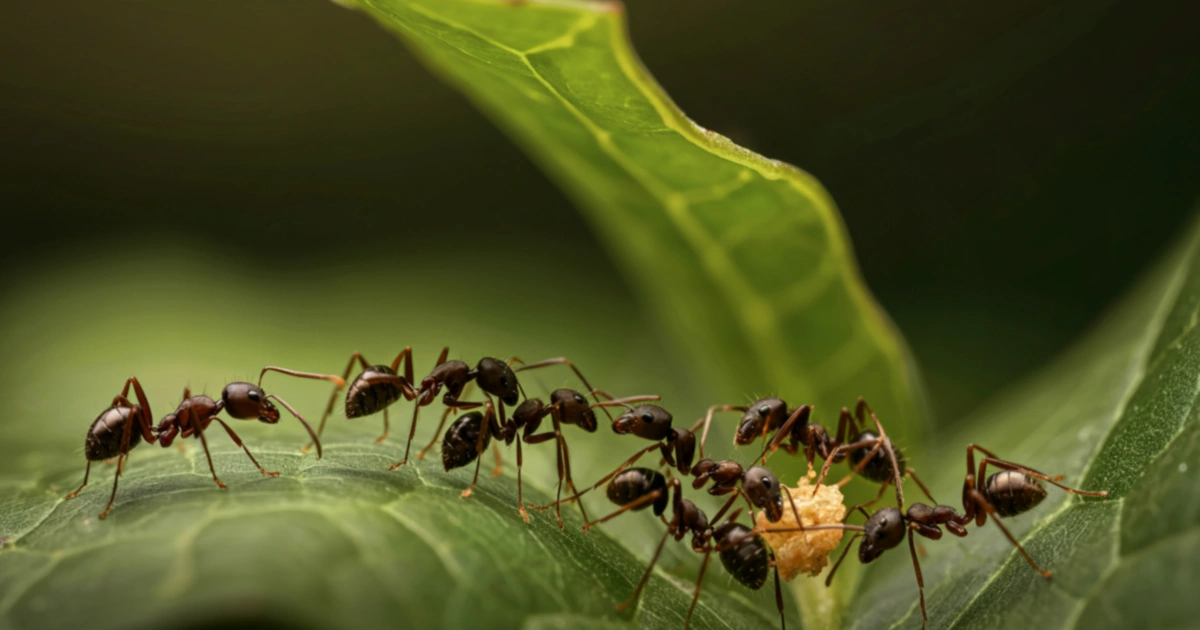
Ants are among the most successful organisms on Earth. Despite their small size, they build enormous colonies, wage organized wars, farm fungi, care for young, defend territories, and solve complex logistical problems — all without a central brain directing their actions.
Scientists have studied ants for decades because their behavior reveals fascinating insights into biology, communication, collective intelligence, and even computer science. What appears to be chaos at first glance is actually an advanced system based on cooperation, chemical signals, and simple behavioral rules.
Understanding how ants operate helps explain why they dominate ecosystems across nearly every continent.
Why Ants Are So Successful
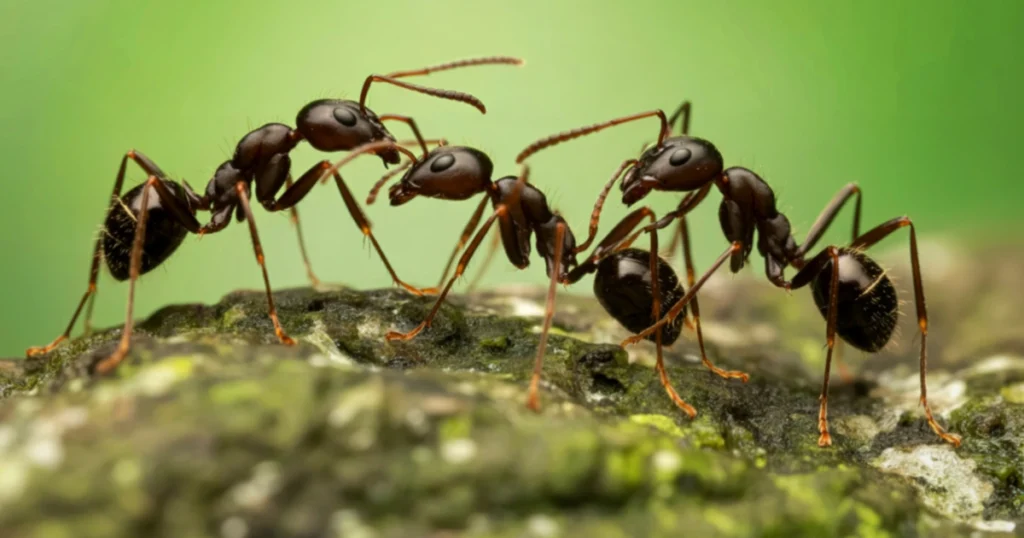
Ant colonies thrive because individual ants work as part of a coordinated social system.
Unlike solitary insects, ants function as:
- Cooperative superorganisms
- Highly specialized communities
- Self-organizing networks
Each ant performs relatively simple tasks, yet together the colony can achieve remarkably sophisticated outcomes.
Do Ants Have a Leader?
Contrary to popular belief, most ant colonies do not operate under direct command from a “leader.”
What the Queen Actually Does
The queen’s primary role is reproduction:
- Laying eggs
- Maintaining colony population
She does not:
- Direct worker behavior
- Plan foraging routes
- Organize battles
- Control daily decisions
Most colony coordination emerges naturally through decentralized interactions.
What Is Distributed Intelligence?
Ant colonies rely on distributed intelligence, meaning no single ant understands the entire system.
Instead:
- Each ant follows simple rules
- Ants react to local information
- Collective behavior emerges naturally
This process is called emergent behavior.
Scientists compare this to:
- Neural networks
- Traffic systems
- Swarm robotics
- Computer algorithms
How Ants Communicate
Ants communicate mainly through chemicals called pheromones.
What Are Pheromones?
Pheromones are chemical signals ants leave behind to share information.
These signals can communicate:
- Food locations
- Danger
- Colony identity
- Trail directions
- Attack coordination
Different pheromones trigger different responses.
How Ant Trails Work
When ants find food:
- They return to the nest
- They leave a pheromone trail
- Other ants follow the trail
- More ants reinforce successful routes
Over time:
- Stronger paths attract more ants
- Efficient routes become dominant
- Poor routes fade naturally
This allows colonies to optimize travel without centralized planning.
Why Ant Trails Look Organized
Trail systems emerge from repeated reinforcement.
The shortest or most efficient path usually accumulates:
- More traffic
- More pheromones
- Faster reinforcement
This self-optimization process inspired many computer-routing algorithms used today.
Ant Farming: One of Nature’s Oldest Agriculture Systems
Some ant species actively farm fungi.
Leafcutter Ants
Leafcutter ants:
- Cut pieces of leaves
- Carry them underground
- Use them to grow fungus
The ants do not eat the leaves directly. Instead, they consume the fungus grown on decomposing plant material.
This relationship is considered one of the oldest known forms of agriculture.
How Ant Fungus Farms Work
Inside underground chambers:
- Leaves are processed
- Fungus gardens are cultivated
- Workers maintain ideal conditions
- Harmful molds are removed
Some ants even produce antibiotic substances to protect crops from infection.
Ant Colonies and Division of Labor
Ant colonies contain specialized workers with different roles.
Common Roles Include
- Foragers
- Soldiers
- Nurses
- Builders
- Waste managers
- Fungus farmers
Role allocation often changes depending on colony needs.
Ant Wars: Why Colonies Fight
Ants frequently engage in territorial conflict.
Reasons for Ant Wars
- Food competition
- Territory defense
- Nest expansion
- Colony survival
Some battles involve thousands or even millions of ants.
Soldier Ants and Colony Defense
Certain ants specialize in combat.
Soldier ants may have:
- Larger mandibles
- Stronger armor
- Defensive behaviors
In many species, soldiers sacrifice themselves to protect the colony.
How Ant Colonies Make Decisions
Colonies solve problems collectively through local interactions.
Examples include:
- Finding food
- Relocating nests
- Adjusting labor distribution
- Managing emergencies
No ant understands the full situation, yet coordinated behavior emerges naturally.
How Ants Find the Best Food Sources
Ants use feedback systems.
Efficient Food Routes
Receive:
- More traffic
- More pheromone reinforcement
Inefficient Routes
Gradually disappear because fewer ants travel them.
This allows colonies to adapt dynamically to environmental changes.
Why Scientists Study Ant Behavior
Ant systems inspire research in:
- Artificial intelligence
- Robotics
- Logistics
- Network optimization
- Swarm engineering
Many modern algorithms were influenced by ant colony behavior.
Ant Colony Optimization Algorithms
Computer scientists developed Ant Colony Optimization (ACO) algorithms based on real ant behavior.
These algorithms help solve:
- Delivery routing
- Traffic optimization
- Telecommunications problems
- Scheduling systems
Nature often provides efficient engineering models.
How Ants Build Complex Nests
Ant nests can include:
- Ventilation systems
- Food chambers
- Nursery areas
- Farming sections
- Waste disposal zones
Some underground colonies extend several meters deep.
Why Ants Rarely Collide
Despite huge colony populations, ants navigate efficiently using:
- Pheromone guidance
- Antenna communication
- Simple movement rules
This reduces congestion and confusion.
Ants and Ecosystem Importance
Ants play major ecological roles.
Benefits of Ants
- Soil aeration
- Seed dispersal
- Organic matter decomposition
- Pest control
- Nutrient cycling
In many ecosystems, ants are considered keystone species.
Can Ant Colonies Think?
Not individually in the human sense.
However, collectively colonies can:
- Adapt
- Learn indirectly
- Optimize behavior
- Solve complex challenges
Researchers sometimes describe colonies as “superorganisms.”
How Long Ant Colonies Last
Some colonies survive:
- Several years
- Multiple decades
Queen ants in certain species can live remarkably long lives compared to other insects.
The Role of Genetics and Environment
Ant behavior depends on:
- Species genetics
- Colony structure
- Environmental conditions
- Food availability
Different species evolved highly specialized survival strategies.
Fascinating Ant Facts
Leafcutter Ants Can Carry Huge Loads
Some carry objects many times their own body weight.
Ant Colonies Can Span Massive Areas
Certain supercolonies stretch across hundreds of miles.
Ants Use Chemical Recognition
Colonies identify members through scent signatures.
Some Ants Enslave Other Ants
Certain species raid neighboring colonies and force captured ants to work.
Frequently Asked Questions
Do ants really farm fungus?
Yes. Leafcutter ants cultivate fungus gardens for food production.
How do ants communicate?
Primarily through pheromones and antenna interactions.
Does the queen control the colony?
No. The queen mainly reproduces while workers self-organize.
Why do ants follow trails?
They respond to pheromone signals left by other ants.
Can ants solve problems collectively?
Yes. Colonies demonstrate complex collective decision-making through distributed intelligence.
Final Thoughts
Ants are extraordinary examples of how simple organisms can create highly organized societies through cooperation and decentralized communication. Without a central brain or leadership structure, colonies successfully farm, defend territory, optimize transportation routes, and solve survival challenges using collective intelligence.
Their ability to coordinate through pheromones and simple behavioral rules has inspired scientists in fields ranging from biology to artificial intelligence and robotics. The more researchers study ants, the clearer it becomes that these tiny insects operate as remarkably sophisticated living systems.
What appears to be instinctive chaos is actually one of nature’s most efficient examples of large-scale cooperation.