
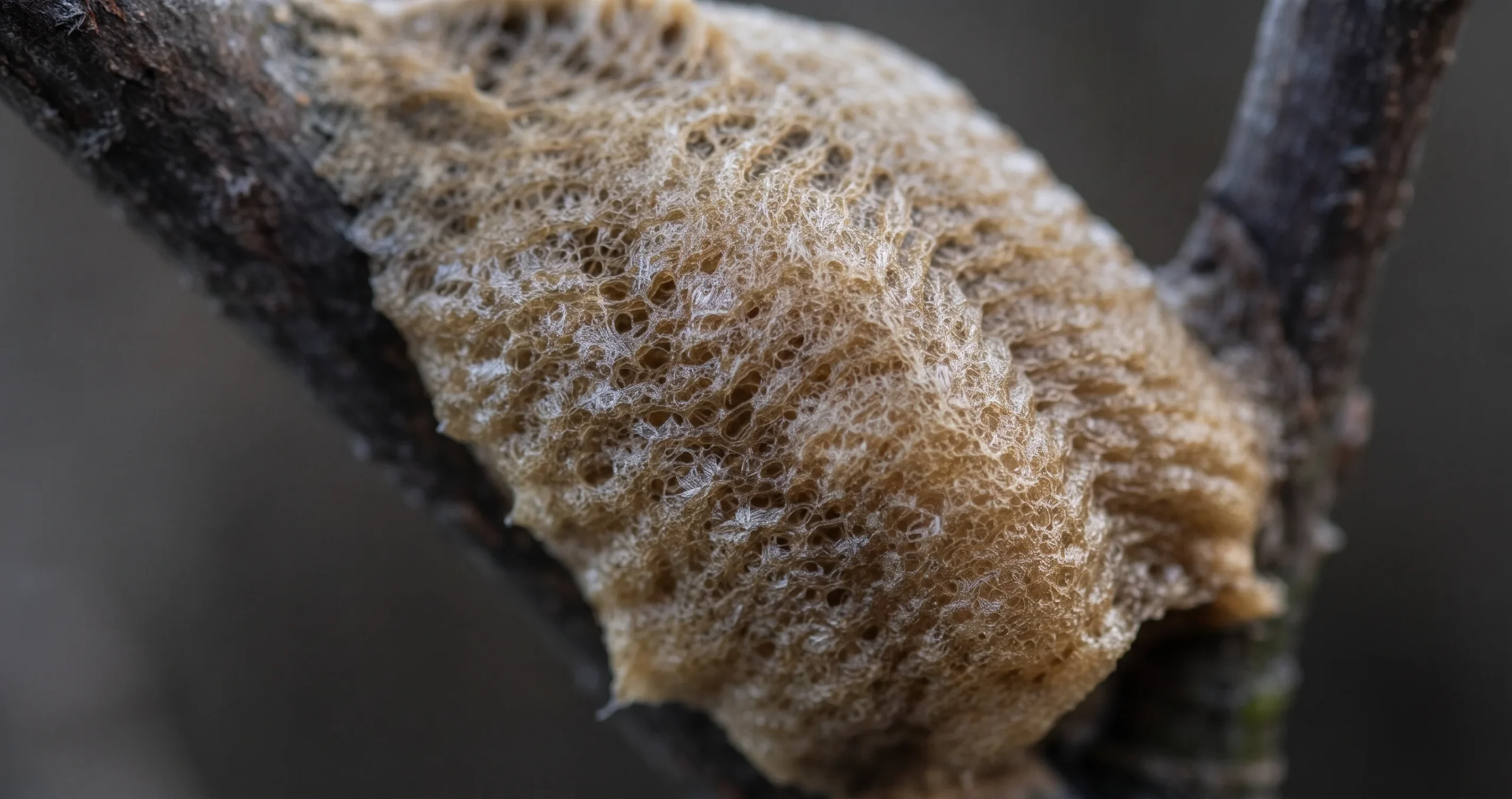
During fall or winter, you might notice an unusual brown, foam-like structure attached to a garden branch, fence, or dried flower stem. At first glance, it may resemble a dried cocoon or a small piece of hardened foam. However, it could be a praying mantis egg case containing the next generation of these remarkable insects.
Finding one offers a fascinating opportunity to observe the natural life cycle of garden wildlife. These protective structures allow developing mantises to survive unfavorable winter conditions before emerging during warmer weather.
Before removing, relocating, or protecting an egg case, it is important to identify the species and understand its ecological role. Some mantises are native to the United States, while others are introduced species that may negatively affect local insect populations.
Table of Contents
- What Is a Praying Mantis Egg Case?
- How to Identify a Praying Mantis Egg Case
- Native vs. Non-Native Mantis Egg Cases
- How Mantis Eggs Survive Winter
- When Do Praying Mantis Eggs Hatch?
- What to Do When You Find a Mantis Egg Case
- Why You Should Never Bring a Mantis Egg Case Indoors
- What Do Praying Mantises Eat?
- Other Insect Structures You Might Confuse With Mantis Egg Cases
- Creating a Wildlife-Friendly Winter Garden
- Frequently Asked Questions
What Is a Praying Mantis Egg Case?
A praying mantis egg case is a protective reproductive structure scientifically known as an ootheca. Female mantises produce these structures to protect their eggs from environmental conditions and certain natural threats.
During egg laying, the female releases a frothy substance that surrounds the eggs. This material gradually hardens into a lightweight but durable protective covering.
Depending on the species, a single egg case may contain several dozen to several hundred eggs. The actual number varies considerably, and not every egg will successfully develop or hatch.
The outer surface usually becomes tan, brown, or grayish as it dries. Its natural coloring helps it blend into surrounding branches, bark, and dormant vegetation.
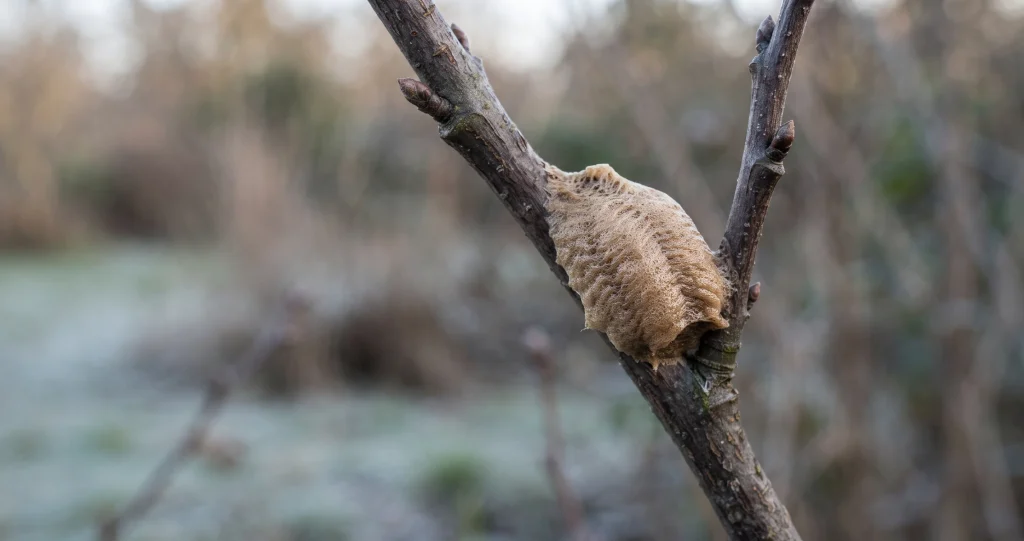
How to Identify a Praying Mantis Egg Case
Identifying a praying mantis egg case becomes easier once you understand its general appearance, texture, and preferred attachment locations.
Although different species produce differently shaped egg cases, several physical characteristics are commonly shared.
Look for these identifying features
- Light brown, beige, tan, or grayish coloring.
- A hardened, foam-like outer surface.
- An oval, rounded, or elongated shape.
- Visible ridges, grooves, or a central seam.
- Firm attachment to a branch, stem, fence, or other surface.
- A size that varies according to the mantis species.
Unlike many butterfly chrysalises, a mantis egg case contains multiple developing insects rather than a single individual.
The structure usually remains attached to its original location throughout winter. Even after hatching, the empty case may remain visible for months.
Common places to find mantis egg cases
Female mantises select various attachment sites depending on their species and surrounding habitat.
Inspect dormant flower beds, dried grasses, woody shrubs, tree branches, garden fences, and outdoor wooden structures.
Late fall and winter are particularly useful times to search because surrounding vegetation has lost much of its foliage, making hidden egg cases easier to notice.
Native vs. Non-Native Mantis Egg Cases
Not every praying mantis egg case found in an American garden belongs to a native species. Identifying the species is an important step before deciding whether to protect or relocate it.
Three commonly encountered species in parts of the United States are the Carolina mantis, Chinese mantis, and European mantis.
Carolina mantis
The Carolina mantis (Stagmomantis carolina) is native to North America and occurs across much of the United States, particularly in eastern and southern regions.
Its egg case is generally elongated, relatively narrow, and flatter than that of the Chinese mantis. It may have a darker central stripe and is frequently attached lengthwise to branches or other surfaces.
Chinese mantis
The Chinese mantis (Tenodera sinensis) is an introduced species that has become established across many parts of the United States.
Its egg case is typically larger, rounded, and bulky, with a textured surface resembling hardened foam.
European mantis
The European mantis (Mantis religiosa) is another introduced species found in parts of North America.
Its egg case is often elongated or oval, with a structured surface that may resemble the egg cases of other mantises.
| Mantis species | Typical egg case appearance | US status |
|---|---|---|
| Carolina mantis | Narrow, elongated, relatively flat | Native |
| Chinese mantis | Large, rounded, bulky | Introduced |
| European mantis | Elongated or oval, textured | Introduced |
These characteristics provide useful identification clues, but appearance alone is not always sufficient. Other native mantis species occur in different regions.
How Mantis Eggs Survive Winter
In many temperate regions, adult praying mantises die as colder weather arrives. Their offspring remain protected inside egg cases until conditions become more favorable.
The hardened outer material provides a physical barrier against environmental exposure. Within the case, the eggs occupy separate spaces surrounded by protective material.
Seasonal developmental adjustments allow the eggs of temperate species to survive periods of cold weather. However, survival depends on the species, local climate, and environmental conditions.
A praying mantis egg case covered with light frost or surrounded by snow is not necessarily damaged. Many locally established mantis populations are adapted to normal seasonal temperature changes.
Gardeners should avoid wrapping egg cases in plastic, soaking them with water, or attempting to keep them artificially warm.
These interventions can interfere with the natural seasonal conditions that influence development and hatching.
When Do Praying Mantis Eggs Hatch?
Most temperate mantis species hatch during spring or early summer, when temperatures become warmer and suitable insect prey becomes more abundant.
There is no universal hatching date. Local climate, species, sun exposure, and seasonal weather patterns all influence the timing.
In warmer regions of the United States, hatching may occur earlier than in northern areas with longer winters.
What happens when mantis eggs hatch?
Tiny mantises, known as nymphs, emerge through openings in the egg case. They resemble miniature adults but lack fully developed wings.
During emergence, the young insects may temporarily hang beneath the case before freeing themselves and moving into nearby vegetation.
The nymphs gradually disperse, searching for suitable hiding places and small prey. They grow through successive molts before reaching adulthood.
How to tell if a praying mantis egg case has already hatched
Look for small openings, loose emergence material, or changes along the central seam.
However, an old egg case can appear surprisingly intact even after the young mantises have left. Visual inspection alone cannot always confirm whether a case remains occupied.
Avoid breaking it open simply to check its contents.
What to Do When You Find a Mantis Egg Case
Your response should depend on the species, its location, and whether garden maintenance threatens to damage it.
In most situations, photographing the structure and identifying it before taking action is the best approach.
Option 1: Leave a native mantis egg case undisturbed
If you have identified the egg case as belonging to a locally native mantis, consider leaving it attached to its original branch or stem.
Avoid unnecessary pruning around the structure until the young insects have had an opportunity to emerge.
Leaving it alone also reduces the risk of accidentally crushing the protective casing.
Option 2: Relocate it carefully when necessary
If a branch must be removed, a confirmed native mantis egg case can sometimes be relocated within the same garden.
Use the following method:
- Cut the supporting twig without touching the egg case.
- Retain enough stem to secure it in another location.
- Select a sheltered outdoor area with suitable vegetation.
- Maintain its natural orientation and keep the emergence seam unobstructed.
- Leave sufficient open space underneath for emerging nymphs.
Never squeeze the egg case or attempt to separate it from its supporting branch by force. University of Maryland Extension recommends preserving adequate space beneath the case to allow normal emergence.
Option 3: Identify introduced species before relocating them
A praying mantis egg case belonging to an introduced species should not automatically be protected or moved to another garden.
Large non-native mantises can compete with native predators and capture valuable pollinating insects.
Consult your local Cooperative Extension office if you are uncertain about identification or appropriate management.
Why You Should Never Bring a Mantis Egg Case Indoors
Bringing an egg case into a heated home during winter is a common mistake.
Indoor warmth can accelerate development and trigger premature hatching, even when outdoor temperatures remain unsuitable.
You could unexpectedly find numerous tiny mantises emerging inside your home at a time when appropriate prey is difficult to obtain.
Returning newly hatched mantises to freezing outdoor conditions may also expose them to unfavorable temperatures.
Check natural Christmas decorations
Freshly cut Christmas trees, decorative branches, and homemade wreaths occasionally carry hidden mantis egg cases.
Inspect outdoor greenery carefully before bringing it inside. If you discover an egg case, identify it and follow appropriate species-specific management advice.
There is generally no reason to provide artificial warmth to a native egg case adapted to local winter conditions.
What Do Praying Mantises Eat?
Praying mantises are generalist predators. They rely on camouflage, accurate vision, patience, and rapid movements to capture prey.
Young mantises generally begin hunting smaller insects, while larger individuals can capture a wider range of prey as they mature.
Their diet may include flies, moths, grasshoppers, crickets, caterpillars, beetles, and other small animals.
Are praying mantises beneficial in the garden?
Native mantises participate in natural food webs and may consume insects that damage garden plants.
However, mantises do not distinguish between garden pests and beneficial insects. Their prey can also include butterflies, bees, and other natural predators.
They should therefore not be considered a guaranteed solution to garden pest problems.
Avoid purchasing and releasing non-native mantis egg cases. Encouraging a diverse community of locally native insects is generally a more balanced approach to garden ecology.
Other Insect Structures You Might Confuse With Mantis Egg Cases
Several natural structures resemble mantis egg cases, particularly when discovered on dormant vegetation.
Knowing the differences can help prevent unnecessary removal of harmless wildlife or accidental protection of unwanted invasive pests.
| Structure | Typical identifying features |
|---|---|
| Praying mantis egg case | Hardened foam-like material with ridges or seams |
| Spider egg sac | Silky, papery, or cotton-like covering |
| Butterfly chrysalis | Defined individual pupal shape |
| Bagworm case | Covered with fragments of leaves, needles, or twigs |
| Spongy moth egg mass | Tan or buff-colored surface with a fuzzy texture |
| Spotted lanternfly egg mass | Flattened cluster often covered with a gray, mud-like coating |
These descriptions are general identification clues rather than definitive diagnostic features.
If you are unsure, photograph the structure from several angles and contact a local insect identification service. Avoid transporting unidentified egg masses between locations.
Creating a Wildlife-Friendly Winter Garden
Discovering a praying mantis egg case is a useful reminder that garden wildlife remains present even when vegetation appears dormant.
A garden containing diverse natural structures can support many insects throughout winter, including native bees, butterflies, beetles, and other invertebrates.
Consider retaining selected dried perennial stems, preserving some fallen leaves, growing regionally native plants, and avoiding unnecessary broad-spectrum insecticide applications.
Inspect branches before pruning and identify unfamiliar insect structures before removing them.
The objective is not to maximize the population of a single predator. Instead, aim to maintain a diverse garden ecosystem where native wildlife can complete its natural life cycles.
Frequently Asked Questions
How many eggs are inside a praying mantis egg case?
Depending on the species, an egg case may contain dozens or hundreds of eggs. The number of successfully emerging nymphs varies according to environmental conditions and natural mortality.
Can a praying mantis egg case survive freezing temperatures?
Many temperate mantis species produce egg cases adapted to overwinter outdoors. Nevertheless, survival is not guaranteed under every climatic condition.
Should I remove a mantis egg case from my garden?
Identify the species first. Native egg cases can generally remain undisturbed, while confirmed non-native cases may require management according to regional conservation recommendations.
Can I touch a praying mantis egg case?
An egg case cannot bite or sting. However, unnecessary handling may damage its protective structure, so it is better to handle the supporting branch instead.
Do mantis egg cases hatch more than once?
No. An individual egg case contains one deposited group of eggs, although emergence may occur over a period of time. The empty casing can remain attached long afterward.
Should I water a mantis egg case during winter?
No. Outdoor egg cases normally experience natural seasonal moisture. Artificial soaking or repeated spraying is unnecessary.
Is finding a praying mantis egg case good for my garden?
It indicates that a female mantis selected your garden as a reproductive location. Whether preserving the case is beneficial depends partly on the species and its ecological role in your region.
Conclusion
A praying mantis egg case is a remarkable example of how insects survive seasonal changes and protect future generations.
By recognizing its distinctive appearance, understanding its winter development, and distinguishing native from introduced species, you can make better garden management decisions.
Leave suitable native egg cases outdoors, relocate them only when necessary, and avoid bringing them into heated living spaces.
Thoughtful garden maintenance begins with understanding the small natural structures that are so easily overlooked.
Save this guide for your next fall or winter garden cleanup, share it with fellow nature lovers, and follow Secrets of the Green Garden for more wildlife-friendly gardening advice.
Internal Sources
1. Does the Female Praying Mantis Really Always Eat Its Mate?
Explain praying mantis reproductive behavior, sexual cannibalism, the relationship between female nutrition and egg production, and the natural life cycle from egg case to adult. Secrets of the Green Garden. https://secretsofthegreengarden.com/praying-mantis-cannibalistic-mating/?utm_source
External Sources
1. Praying Mantid (Mantis)
Provide university-backed information about mantis egg cases, physical identification, reproduction, overwintering, spring emergence, and feeding behavior. University of Maryland Extension. https://extension.umd.edu/resource/praying-mantid-mantis?utm_source
2. Fall Finds: Praying Mantis Egg Cases
Explain how to distinguish native Carolina mantis egg cases from introduced Chinese mantis egg cases using their physical appearance and attachment locations. University of Illinois Extension. https://extension.illinois.edu/blogs/flowers-fruits-and-frass/2020-10-23-fall-finds-praying-mantis-egg-cases?utm_source
3. Challenging the Conventional Wisdom About Praying Mantids
Provide expert guidance about native and non-native mantis species, their effects on pollinators, ecological interactions, and appropriate egg case management. NC State Extension.https://growingsmallfarms.ces.ncsu.edu/growingsmallfarms-chinese-mantids/?utm_source