
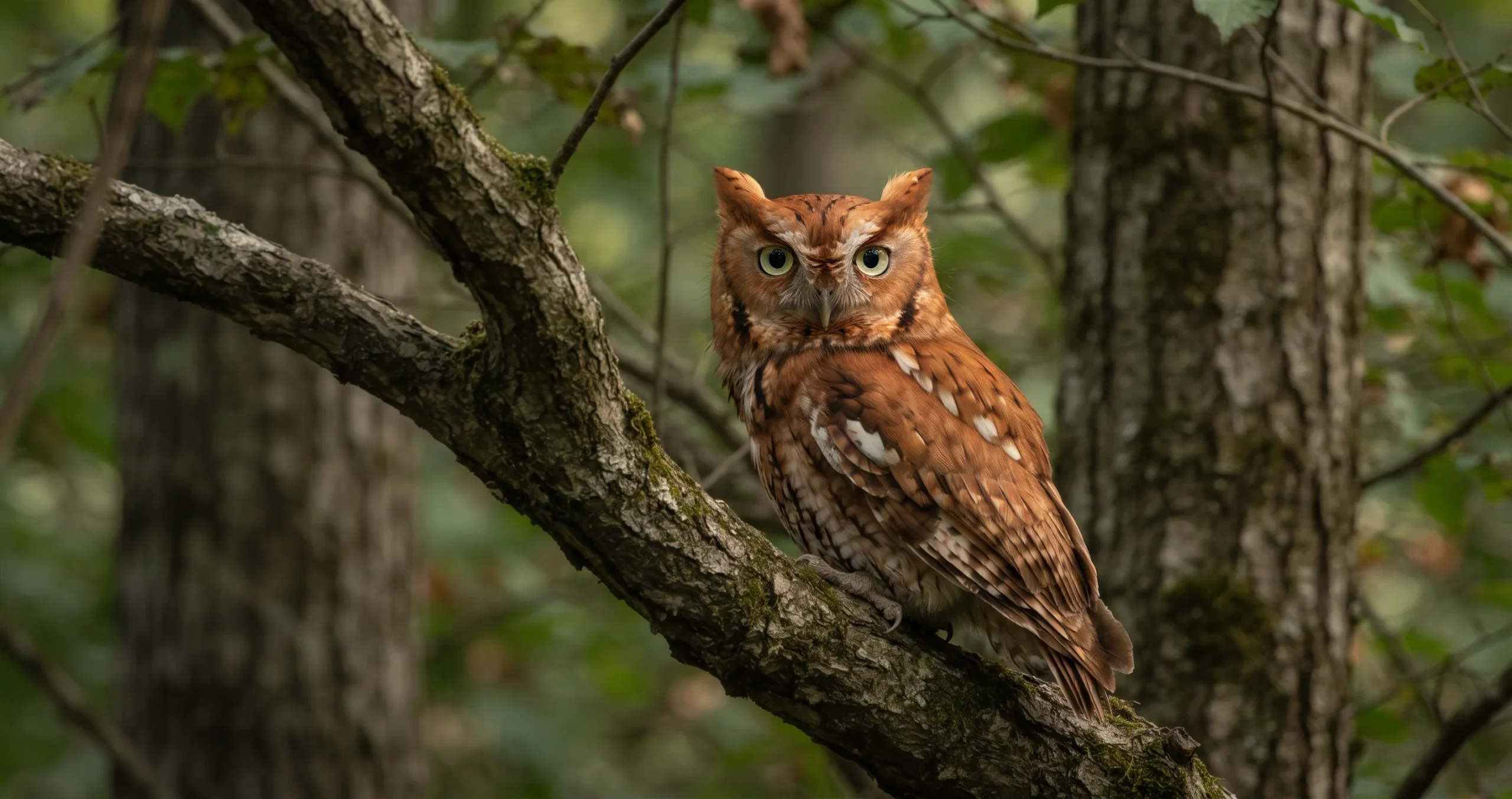
Hidden against tree bark, the Eastern Screech-Owl is one of North America’s most fascinating nocturnal birds. Its small size, remarkable camouflage, and distinctive nighttime calls make it an interesting species for gardeners, birdwatchers, and wildlife enthusiasts.
The eastern screech owl red gray morph variation explains why two individuals of the same species can look surprisingly different. Some have rusty reddish feathers, while others display intricate gray patterns that blend beautifully with mature trees.
Despite these differences, both color forms share many of the same behaviors, habitat requirements, and hunting adaptations. Understanding their biology can help you recognize these elusive birds and create a more wildlife-friendly landscape.
Table of Contents
- What Is an Eastern Screech-Owl?
- Eastern Screech Owl Red Gray Morph: Key Differences
- How Their Camouflage Works
- Geographic Range and Distribution
- Natural Habitat and Daily Behavior
- Nesting Habits and Nest Boxes
- What Eastern Screech-Owls Eat
- Recognizing Their Calls
- How to Help Eastern Screech-Owls
- Responsible Owl Viewing Etiquette
- Frequently Asked Questions
What Is an Eastern Screech-Owl?
The Eastern Screech-Owl (Megascops asio) is a small owl native to eastern North America. It belongs to the typical owl family, Strigidae, and occupies a surprising variety of wooded environments.
Adults generally measure about seven to ten inches in length. Their compact bodies, broad heads, yellow eyes, and prominent feather tufts give them a distinctive appearance.
Although the feather tufts resemble ears, they are not the owl’s actual hearing organs. Its ears are located beneath feathers on the sides of its head.
Females are generally larger than males, but both sexes can display different plumage colors. Feather coloration alone is therefore not a reliable way to determine sex.
The Smithsonian’s National Zoo Eastern Screech-Owl profile provides additional information about the species’ physical characteristics and natural adaptations. nationalzoo.si.edu
Eastern Screech Owl Red Gray Morph: Key Differences
One of the most interesting characteristics of this owl is its naturally occurring variation in feather coloration. Scientists describe these distinct appearances as color morphs.
The eastern screech owl red gray morph difference is largely inherited. It does not represent two separate species, and individuals do not normally switch from one morph to another with the seasons.
The red morph
Red morph Eastern Screech-Owls possess warm reddish-brown or rusty-colored feathers. This coloration is also commonly described as rufous.
Dark markings and lighter areas create intricate patterns across the chest, wings, and back. These patterns help break up the outline of the bird when it rests among branches.
Red individuals may blend particularly well with reddish bark, dry foliage, and warm-toned woodland surroundings.
The gray morph
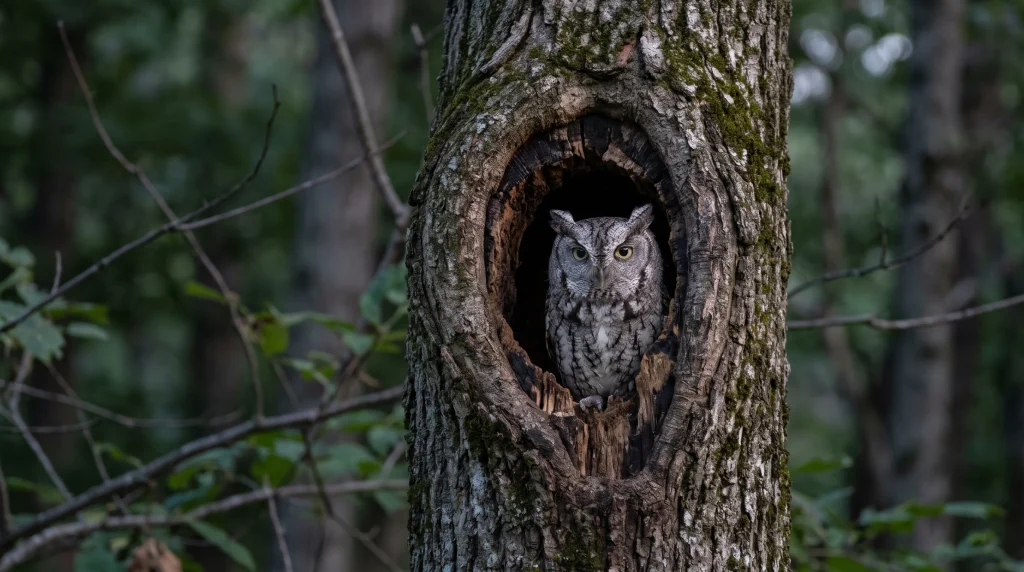
Gray morph Eastern Screech-Owls display silver-gray, charcoal, brownish-gray, and pale feather markings.
Their plumage often resembles the textured surface of mature tree trunks. When an individual rests against suitable bark, its body outline can become remarkably difficult to distinguish.
Gray individuals are widespread throughout the species’ range.
Comparing the red and gray morphs
| Characteristic | Red morph | Gray morph |
|---|---|---|
| Dominant coloration | Rusty reddish-brown | Gray and silver-brown |
| Eye color | Yellow | Yellow |
| Feather pattern | Mottled and streaked | Mottled and streaked |
| Potential camouflage background | Reddish bark and dry foliage | Gray bark and weathered wood |
| Species | Megascops asio | Megascops asio |
| Activity | Primarily nocturnal | Primarily nocturnal |
| Color changes seasonally | No | No |
According to the Cornell Lab of Ornithology, about one-third of Eastern Screech-Owls are red, although the proportion varies geographically.
Some individuals also display intermediate brown coloration. This means the eastern screech owl red gray morph comparison describes the two principal forms without representing every possible appearance.
How Their Camouflage Works
Camouflage is particularly important for nocturnal animals that spend much of the daylight period resting.
Eastern Screech-Owls have complex feather markings that imitate the irregular colors and textures found in wooded environments.
Their camouflage involves both coloration and behavior.
Feather patterns that resemble tree bark
Vertical streaks, irregular spots, and contrasting feather shades help make the owl’s outline less recognizable.
The effectiveness of each color morph depends partly on its surroundings, including the tree species, lighting, bark texture, and nearby vegetation.
The eastern screech owl red gray morph variation provides two striking examples of how different plumage colors can contribute to concealment.
Remaining still during daylight
When resting, an owl may remain nearly motionless for extended periods.
If disturbed, it can narrow its eyes, raise its feather tufts, and compress its body feathers. These movements may make it resemble part of a broken branch or tree trunk.
The American Bird Conservancy’s Eastern Screech-Owl profile describes these behavioral adaptations and their contribution to the owl’s camouflage.
Geographic Range and Distribution
Eastern Screech-Owls inhabit much of eastern North America. Their distribution extends across parts of southern Canada, the eastern and central United States, and northeastern Mexico.
Unlike many migratory birds, they generally remain within their broader residential areas throughout the year.
Both principal color forms occur across much of the species’ distribution. However, their relative abundance varies between regions.
The eastern screech owl red gray morph distinction should not be used alone to identify an owl’s geographic origin. Red and gray individuals can inhabit the same woodland and belong to the same local population.
Natural Habitat and Daily Behavior
Eastern Screech-Owls are adaptable birds capable of surviving in natural forests and developed landscapes, provided suitable trees, shelter, and prey remain available.
Their small size allows them to occupy habitats that might be unsuitable for larger owl species.
Preferred habitats
Eastern Screech-Owls can be found in deciduous woodlands, mixed forests, wooded wetlands, orchards, suburban gardens, and urban parks.
Areas combining mature trees with relatively open hunting spaces can provide favorable conditions. Streamside vegetation and woodland edges may also offer suitable feeding opportunities.
Daytime resting locations
During daylight, these owls frequently shelter inside natural tree cavities or among dense branches.
They sometimes rest near cavity entrances, where their camouflaged feathers make them difficult to notice.
The eastern screech owl red gray morph variation can be particularly impressive when individuals are observed against naturally textured bark.
Nesting Habits and Nest Boxes
Eastern Screech-Owls are cavity-nesting birds. They depend on existing openings rather than constructing elaborate nests from branches.
Natural nesting sites include hollow tree trunks, abandoned woodpecker cavities, and other suitable openings in mature trees.
Installing an Eastern Screech-Owl nest box
Where natural cavities are limited, properly designed nest boxes can provide additional nesting opportunities.
The Cornell Lab’s NestWatch Eastern Screech-Owl nest box guide provides species-specific construction plans and installation recommendations.
| Nest box feature | Recommended specification |
|---|---|
| Entrance diameter | 3 inches |
| Mounting height | About 10–30 feet |
| Bedding | 2–3 inches of wood shavings |
| Mounting surface | Suitable tree or protected pole |
| Location | Wooded edge near open habitat |
Use untreated, weather-resistant wood and provide appropriate ventilation, drainage, and maintenance access. Install the box securely before the breeding season, using professional assistance if the height makes installation unsafe.
Protecting nesting owls
Avoid repeatedly opening occupied nest boxes or disturbing adults during egg-laying and incubation.
A nest box should provide shelter rather than become a source of repeated human disturbance. Install one only within the species’ natural range and where surrounding habitat can support the birds.
What Eastern Screech-Owls Eat
Despite their small size, Eastern Screech-Owls are effective predators with a varied diet.
Their feeding habits change according to seasonal prey availability, local habitats, and individual hunting opportunities.
Insects and other invertebrates
During warmer weather, owls may capture moths, beetles, crickets, grasshoppers, and other invertebrates.
These food sources help explain why gardens containing diverse vegetation can contribute to local wildlife food webs.
Small mammals and other prey
Eastern Screech-Owls also hunt mice, voles, small birds, frogs, lizards, and occasionally other accessible aquatic or terrestrial animals.
They frequently hunt from a perch, using their sensitive hearing and vision to locate potential prey before moving toward it.
Both principal color morphs are opportunistic predators. Feather color alone is not sufficient to predict an individual owl’s diet.
Recognizing Eastern Screech-Owl Calls
Despite its name, the Eastern Screech-Owl is more commonly recognized by musical trills and descending calls than by loud screeches.
Learning these sounds can make identifying the species easier, particularly when its camouflage prevents visual observation.
The trembling trill
One characteristic vocalization is a sustained series of rapidly repeated notes.
This relatively even-pitched sound helps individuals maintain contact with mates or family members.
The descending whinny
Another familiar vocalization begins at a higher pitch and gradually descends, resembling a horse’s whinny.
This sound is commonly associated with territorial communication.
Eastern Screech-Owls also produce barking sounds, short hoots, and other vocalizations in different circumstances. Both males and females can sing. All About Birds
The eastern screech owl red gray morph distinction does not provide a reliable way to predict the call of an individual bird.
How to Help Eastern Screech-Owls
Gardeners and landowners within the species’ native range can support suitable owl habitat through thoughtful landscape management.
The goal is to preserve natural shelter and food resources rather than artificially attract or feed wild predators.
Practical measures include:
- Preserve mature native trees whenever possible.
- Retain safe standing dead trees that contain natural cavities.
- Reduce unnecessary pesticide use.
- Avoid rodent poisons that can expose predators to secondary poisoning.
- Install appropriately designed owl nest boxes.
- Reduce unnecessary outdoor lighting near woodland habitats.
- Keep domestic cats indoors or in secure outdoor enclosures.
Leaving some natural vegetation and fallen leaves beneath trees can also support the invertebrates and other small animals that form part of woodland food webs.
Responsible Owl Viewing Etiquette
Discovering a resting owl can be an exciting experience. However, protecting the bird’s ability to rest, hunt, and raise its young should always come first.
Use binoculars or a telephoto lens instead of approaching closely. Avoid shining powerful lights directly at an owl, using flash photography at close range, or deliberately disturbing its resting location.
Do not repeatedly play recorded owl calls to attract individuals. Artificial calls can provoke territorial responses and interfere with normal behavior.
When photographing an eastern screech owl red gray morph comparison, use separate, responsibly obtained photographs rather than attempting to bring wild individuals together.
If a bird becomes alert, changes its posture, or attempts to move away because of your presence, increase your distance.
Frequently Asked Questions
Are red and gray Eastern Screech-Owls different species?
No. They are naturally occurring color forms of the same species, Megascops asio.
Both can occur within the same population.
Which Eastern Screech-Owl color morph is rarer?
Gray individuals are generally more common across the species’ overall range.
Red individuals represent about one-third of the population, although local proportions vary.
Can an Eastern Screech-Owl change from red to gray?
No. The eastern screech owl red gray morph variation is largely inherited rather than a seasonal color transformation.
Normal feather replacement does not ordinarily switch an individual between these principal morphs.
Can red and gray Eastern Screech-Owls mate?
Yes. Because they belong to the same species, individuals of different color morphs can form breeding pairs.
Do Eastern Screech-Owls stay in winter?
They are generally year-round residents. During colder months, protected cavities and suitable hunting areas remain important.
Do Eastern Screech-Owls use backyard nest boxes?
Yes. They may occupy correctly designed nest boxes installed within suitable habitat.
However, installing a box does not guarantee that owls will use it.
Are Eastern Screech-Owls dangerous to humans?
They generally avoid unnecessary contact with people. Like other wild birds, they may defend their nests or young when approached too closely.
Why is an owl calling near my house at night?
The owl may be communicating with another individual or advertising its territory.
Nearby trees and suitable hunting habitat can make residential neighborhoods attractive to these adaptable birds.
Conclusion
The eastern screech owl red gray morph variation is a remarkable example of natural diversity within a single bird species.
Whether displaying rusty reddish feathers or intricate gray plumage, Eastern Screech-Owls rely on camouflage, sensitive hearing, and adaptable hunting behavior to survive in wooded environments.
Preserving mature trees, providing appropriate nesting opportunities, reducing harmful chemicals, and observing wildlife responsibly can help maintain suitable habitat.
These small nocturnal predators remind us that extraordinary wildlife can exist surprisingly close to home, often hidden in plain sight.
External Sources
1. Eastern Screech-Owl — All About Birds
Provide authoritative ornithological information about color morphs, physical identification, geographic distribution, habitat, and natural behavior.
Cornell Lab of Ornithology. https://www.allaboutbirds.org/guide/Eastern_Screech-Owl?utm_source
2. Eastern Screech-Owl — Right Bird, Right House
Provide scientifically informed nest box dimensions, entrance hole size, mounting height, bedding requirements, and installation recommendations. Cornell Lab of Ornithology — NestWatch. https://nestwatch.org/learn/all-about-birdhouses/birds/eastern-screech-owl/?utm_source
3. Eastern Screech-Owl
Explain the owl’s physical characteristics, natural camouflage, coloration, feeding habits, and biological adaptations. Smithsonian’s National Zoo and Conservation Biology Institute. https://nationalzoo.si.edu/animals/eastern-screech-owl?utm_source