
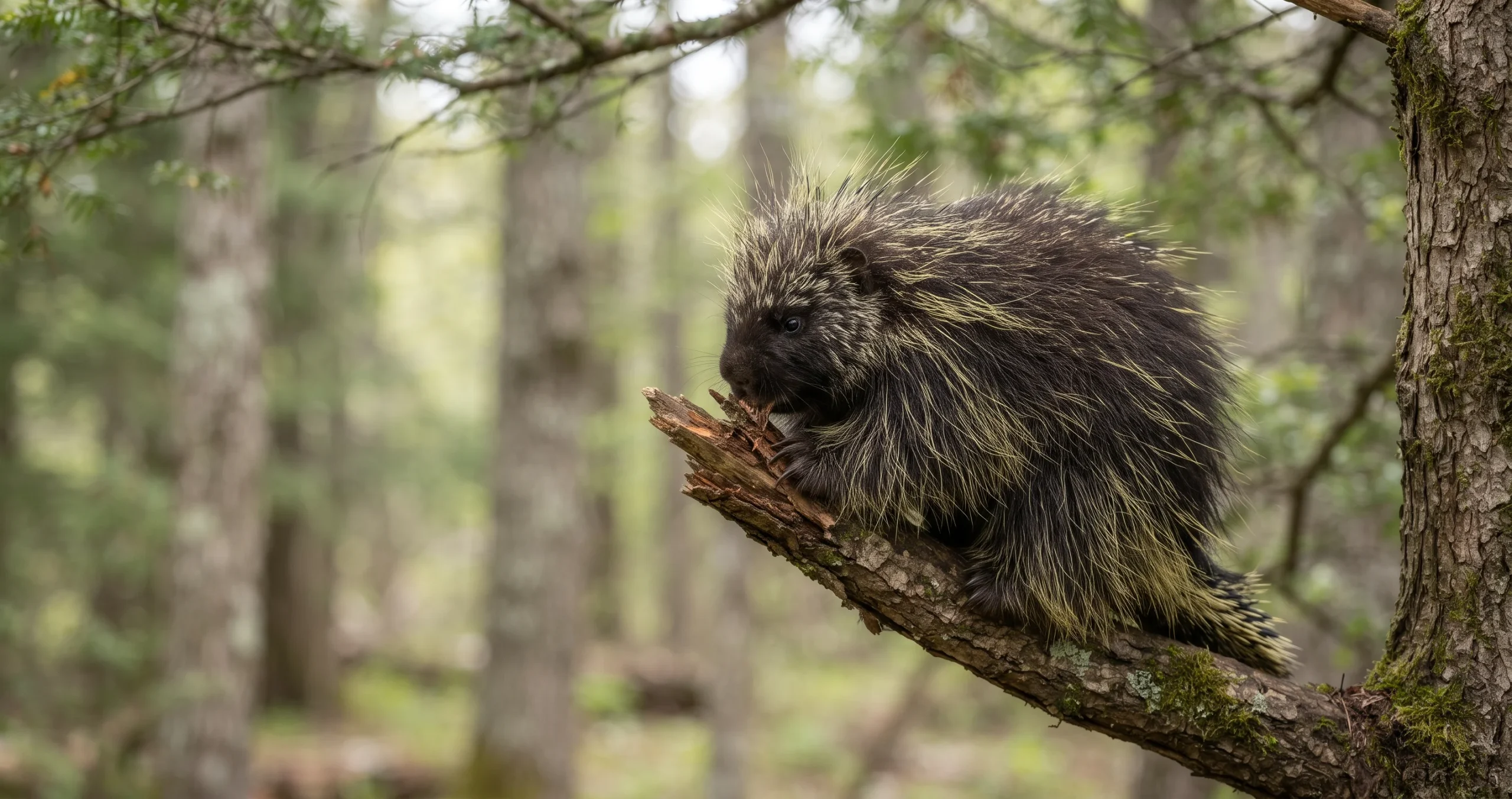
Porcupines are among the most recognizable mammals in the animal kingdom, thanks to their extraordinary coats of sharp, protective quills. For generations, people have believed these animals can launch their quills at predators from a distance.
However, the porcupine shoot quills myth is exactly that: a myth. Porcupines cannot fire their quills like projectiles. Instead, they rely on physical contact, specialized quill structures, and defensive behavior to protect themselves.
Understanding how porcupines defend themselves reveals a fascinating example of natural adaptation. It also helps wildlife enthusiasts, gardeners, hikers, and dog owners avoid unnecessary conflicts with these generally unaggressive animals.
Table of Contents
- The Porcupine Shoot Quills Myth Explained
- How Porcupines Actually Defend Themselves
- How Porcupine Quills and Their Barbs Work
- How Many Quills Does a Porcupine Have?
- Do Porcupine Quills Grow Back?
- What Do Porcupines Eat?
- Porcupine Habitat and Daily Habits
- Natural Predators of Porcupines
- How to Keep Dogs Safe Around Porcupines
- Living Alongside Porcupines
- Frequently Asked Questions
The Porcupine Shoot Quills Myth Explained
The belief that porcupines can shoot their quills probably persists because of how quickly quills become embedded when another animal encounters a porcupine.
A curious dog, for example, may approach a porcupine and retreat with numerous quills lodged around its muzzle. Without seeing the actual contact, an observer might incorrectly assume the porcupine launched them.
In reality, porcupines lack a biological mechanism for deliberately firing quills through the air.
The Smithsonian’s National Zoo and Conservation Biology Institute confirms that North American porcupines cannot launch their quills. Their defense relies on quills that detach when they come into contact with another animal.
This article focuses primarily on the North American porcupine (Erethizon dorsatum), although the inability to shoot quills applies to other porcupine species as well.
Common porcupine myths and facts
| Myth | Fact |
|---|---|
| Porcupines shoot quills at predators. | Quills are transferred through physical contact. |
| Porcupine quills contain venom. | Quills cause mechanical injuries rather than venomous ones. |
| Lost quills never grow back. | Porcupines can grow replacement quills. |
| Porcupines actively chase people. | They generally use their quills for defense. |
| Porcupines are completely protected from predators. | Several predators can successfully hunt them. |
Understanding the porcupine shoot quills myth helps people appreciate these animals without developing unnecessary fear.
How Porcupines Actually Defend Themselves
Porcupines are relatively slow-moving mammals. Rather than relying entirely on speed to escape danger, they possess a specialized protective covering.
Their quills are modified hairs made primarily of keratin, the structural protein also found in ordinary mammalian hair and fingernails.
Raising their quills
When a porcupine detects a potential threat, specialized muscles can raise its quills, making the animal appear larger and more difficult to approach.
This defensive display exposes numerous sharp points that may discourage predators from making contact.
Turning their backs toward danger
North American porcupines often position their heavily protected backs or tails toward an approaching threat.
If another animal comes too close, the porcupine may move its tail defensively. Direct contact can cause multiple quills to penetrate and detach from the porcupine’s body.
Unlike the behavior described in the porcupine shoot quills myth, this defense depends on close physical interaction.
How Porcupine Quills and Their Barbs Work
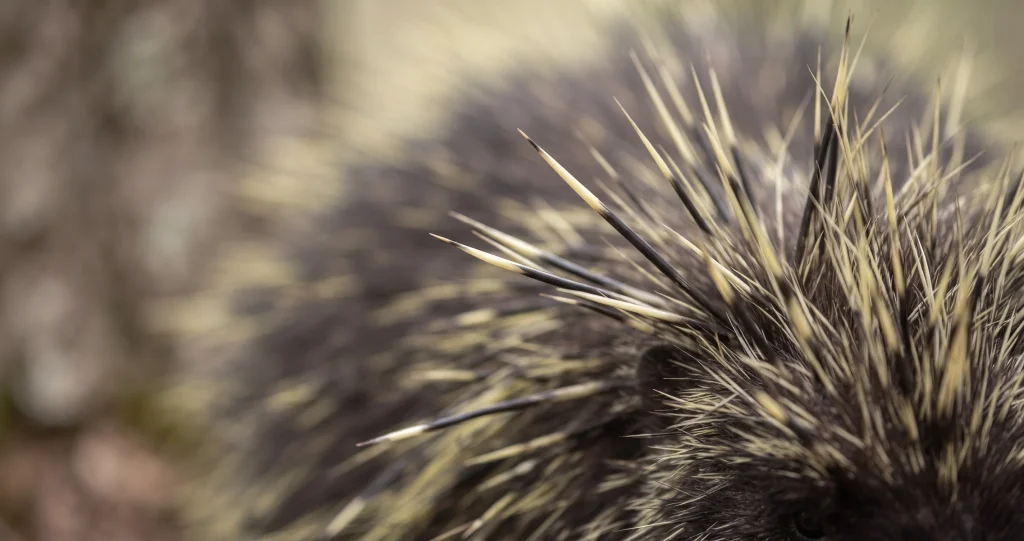
A porcupine’s quills are more sophisticated than ordinary sharp hairs. Their structure makes them particularly effective at penetrating tissue and resisting removal.
Microscopic backward-facing barbs
North American porcupine quills possess tiny backward-facing barbs near their pointed ends.
These structures are difficult to see without magnification. Once a quill enters tissue, the barbs increase resistance when the quill is pulled in the opposite direction.
A peer-reviewed study published in the Proceedings of the National Academy of Sciences demonstrated that these microscopic features can reduce the force required for penetration while making removal more difficult.
Why quills can cause serious injuries
Embedded quills can penetrate deeper into tissue, particularly when affected animals move or attempt to remove them.
This can lead to inflammation, infection, and damage to surrounding structures. Quills near the eyes, mouth, throat, or internal organs are particularly concerning.
Their effectiveness comes from their physical design, not from venom or an ability to propel themselves.
Are all porcupine quills identical?
Different porcupine species possess different quill structures.
North American porcupines belong to the New World porcupine family, Erethizontidae. African and Asian porcupines belong to a separate family, Hystricidae.
Their quill sizes, surface structures, and defensive behaviors vary. Consequently, the microscopic barb structure of North American porcupines should not automatically be attributed to every porcupine species.
How Many Quills Does a Porcupine Have?
An adult North American porcupine can have about 30,000 quills, although the actual number varies among individuals.
These protective structures are distributed across much of the animal’s body, particularly along its back, sides, and tail. The face and underside are less heavily protected.
Quills also vary in length and thickness depending on their location. The shorter, densely arranged quills on the tail contribute to the animal’s defensive abilities.
When a porcupine is relaxed, many of its quills lie relatively flat among its ordinary fur. When threatened, they become much more prominent.
Do Porcupine Quills Grow Back?
Yes, porcupines can replace lost quills through natural growth.
Like ordinary hairs, quills develop from follicles in the skin. When a quill is shed or detached during a defensive encounter, a replacement can develop.
The time required for regrowth varies, so there is no single reliable replacement period for every quill.
Are baby porcupines born with quills?
A baby porcupine, known as a porcupette, is born with relatively soft quills. These gradually harden after birth, providing the young animal with an increasingly effective defensive covering.
North American porcupines usually give birth to a single offspring.
The young porcupine gradually develops the climbing and feeding abilities necessary for independent survival.
What Do Porcupines Eat?
Despite their intimidating appearance, North American porcupines are herbivores. Their diet consists primarily of vegetation rather than other animals.
Food preferences change throughout the year according to seasonal availability.
Spring and summer diet
During warmer months, porcupines may consume fresh leaves, grasses, herbs, berries, flowers, and other accessible vegetation.
They regularly climb trees to reach suitable food, using their strong claws and muscular limbs.
Fall and winter diet
As fresh vegetation becomes less available, porcupines increasingly rely on woody plant material.
Winter foods can include tree bark, evergreen needles, buds, and small twigs. The exact diet varies according to the trees and other vegetation available in their habitat.
Their continuously growing front teeth help them process tough plant materials.
Why porcupines sometimes damage trees
Porcupines may remove bark while feeding on the nutritious tissues underneath.
Extensive feeding around a tree trunk can interfere with the movement of sugars through the plant and potentially cause serious damage.
Porcupine Habitat and Daily Habits
North American porcupines inhabit a variety of environments across Canada, Alaska, and parts of the contiguous United States and northern Mexico.
They are particularly associated with wooded landscapes, although they also occupy shrublands, rocky areas, and other habitats containing suitable food and shelter.
Are porcupines nocturnal?
Porcupines are primarily nocturnal, meaning they are generally more active during the night.
However, they may also be observed during daylight, particularly while resting or feeding in trees.
During periods of inactivity, they may shelter in hollow logs, rock crevices, tree cavities, or other protected locations.
Do porcupines hibernate?
North American porcupines do not truly hibernate.
They remain active during winter, although cold temperatures and difficult snow conditions may reduce their movements. Sheltered resting locations and accessible woody vegetation help them survive colder periods.
Are porcupines related to hedgehogs?
Although both animals possess protective spines, porcupines and hedgehogs belong to different mammalian groups.
Porcupines are rodents, whereas hedgehogs belong to the order Eulipotyphla. Their similar defensive coverings developed independently through evolution.
Natural Predators of Porcupines
The effectiveness of porcupine quills does not mean these animals are completely protected from predators.
Several carnivorous mammals can successfully hunt porcupines, although doing so carries considerable risk.
Fishers
The fisher (Pekania pennanti) is a forest-dwelling mammal belonging to the weasel family.
It is particularly well known for its ability to hunt North American porcupines. Fishers can exploit less heavily protected areas of the porcupine’s body, avoiding much of its defensive covering.
This specialized predator-prey relationship demonstrates that even highly effective biological defenses have limitations.
Other predators
Depending on the region, porcupines may also face threats from coyotes, wolves, mountain lions, lynx, and wolverines.
Not every individual predator possesses the experience necessary to hunt porcupines successfully. Encounters can result in serious injuries to inexperienced animals.
How to Keep Dogs Safe Around Porcupines
Dogs are particularly vulnerable to porcupine encounters because their curiosity may cause them to approach unfamiliar wildlife.
Correcting the porcupine shoot quills myth should not lead owners to underestimate the dangers of direct contact.
Preventing encounters
Keep dogs on a leash in wooded areas where porcupines occur, particularly during evening walks and nighttime outings.
Supervise dogs in gardens bordering forests or natural habitats. Reliable recall training can also help prevent them from pursuing wildlife.
Previous encounters do not guarantee that a dog will avoid porcupines in the future.
What to do if your dog encounters a porcupine
If your dog has embedded quills, seek veterinary care immediately. Even a relatively small number of quills can cause complications.
Keep your dog calm and discourage rubbing or pawing at the affected area while arranging transportation.
Do not attempt to pull out or cut the quills yourself. Improper handling can break them or complicate their removal.
Living Alongside Porcupines
Porcupines are part of the natural communities found throughout their native range.
Their feeding activities influence vegetation, while their presence contributes to woodland food webs. However, their behavior can occasionally create conflicts with gardeners, landowners, and pet owners.
Rather than attempting to handle or relocate a porcupine yourself, maintain a respectful distance and contact local wildlife authorities if necessary.
Protect vulnerable trees using appropriate physical barriers, supervise pets, and avoid deliberately feeding wild porcupines.
Creating wildlife-friendly spaces does not mean encouraging every wild animal to approach your home. Responsible coexistence involves preserving natural habitats while minimizing unnecessary contact.
Frequently Asked Questions
Can porcupines shoot their quills at humans?
No. The porcupine shoot quills myth is scientifically unsupported. Porcupines cannot deliberately launch their quills through the air at people or other animals.
How far can a porcupine shoot its quills?
Porcupines cannot shoot their quills any distance. Their primary defense requires physical contact.
Are porcupine quills poisonous?
Porcupine quills are not venomous. Their sharp points and, in North American species, microscopic barbs can nevertheless cause painful injuries and serious complications.
How many quills does a porcupine have?
An adult North American porcupine may possess about 30,000 quills. The number varies according to individual characteristics.
Do porcupine quills grow back after falling out?
Yes. Replacement quills can develop naturally from follicles in the skin.
Are porcupines aggressive toward people?
Porcupines generally prefer to avoid confrontation. However, they can defend themselves when approached, cornered, or threatened.
What animal can successfully hunt a porcupine?
The fisher is a particularly well-known predator of North American porcupines. Other carnivores may also hunt them under certain circumstances.
Should I remove porcupine quills from my dog at home?
No. Embedded quills require prompt veterinary attention. Attempting to remove them yourself can cause additional pain, breakage, and complications.
Conclusion
The porcupine shoot quills myth is a familiar wildlife misconception, but the real biology behind porcupine defense is even more fascinating.
These remarkable rodents rely on specialized hairs, defensive postures, and physical contact rather than projectile weapons. Their protective adaptations allow them to survive despite their relatively slow movements.
Understanding porcupine behavior also helps people protect their pets, avoid unnecessary wildlife conflicts, and appreciate the diversity of natural defense mechanisms.
By observing porcupines from a respectful distance and protecting their natural habitats, we can coexist with these extraordinary mammals while keeping both wildlife and domestic animals safe.
External Sources
1. North American Porcupine
Explain porcupine biology, natural defenses, physical characteristics, diet, habitat, and the misconception that porcupines can shoot their quills. Smithsonian’s National Zoo and Conservation Biology Institute. https://nationalzoo.si.edu/animals/north-american-porcupine
2. Microstructured Barbs on the North American Porcupine Quill Enable Easy Tissue Penetration and Difficult Removal
Provide peer-reviewed scientific evidence explaining how microscopic backward-facing barbs contribute to quill penetration and resistance to removal. Proceedings of the National Academy of Sciences (PNAS) — National Library of Medicine. https://pmc.ncbi.nlm.nih.gov/articles/PMC3535670/?utm_source
3. Porcupine Quill Injuries in Dogs
Provide authoritative veterinary advice on preventing porcupine encounters, recognizing quill injuries, and seeking appropriate treatment for dogs. Cornell University College of Veterinary Medicine. https://www.vet.cornell.edu/departments-centers-and-institutes/riney-canine-health-center/canine-health-information/porcupine-quill-injuries-in-dogs?utm_source