
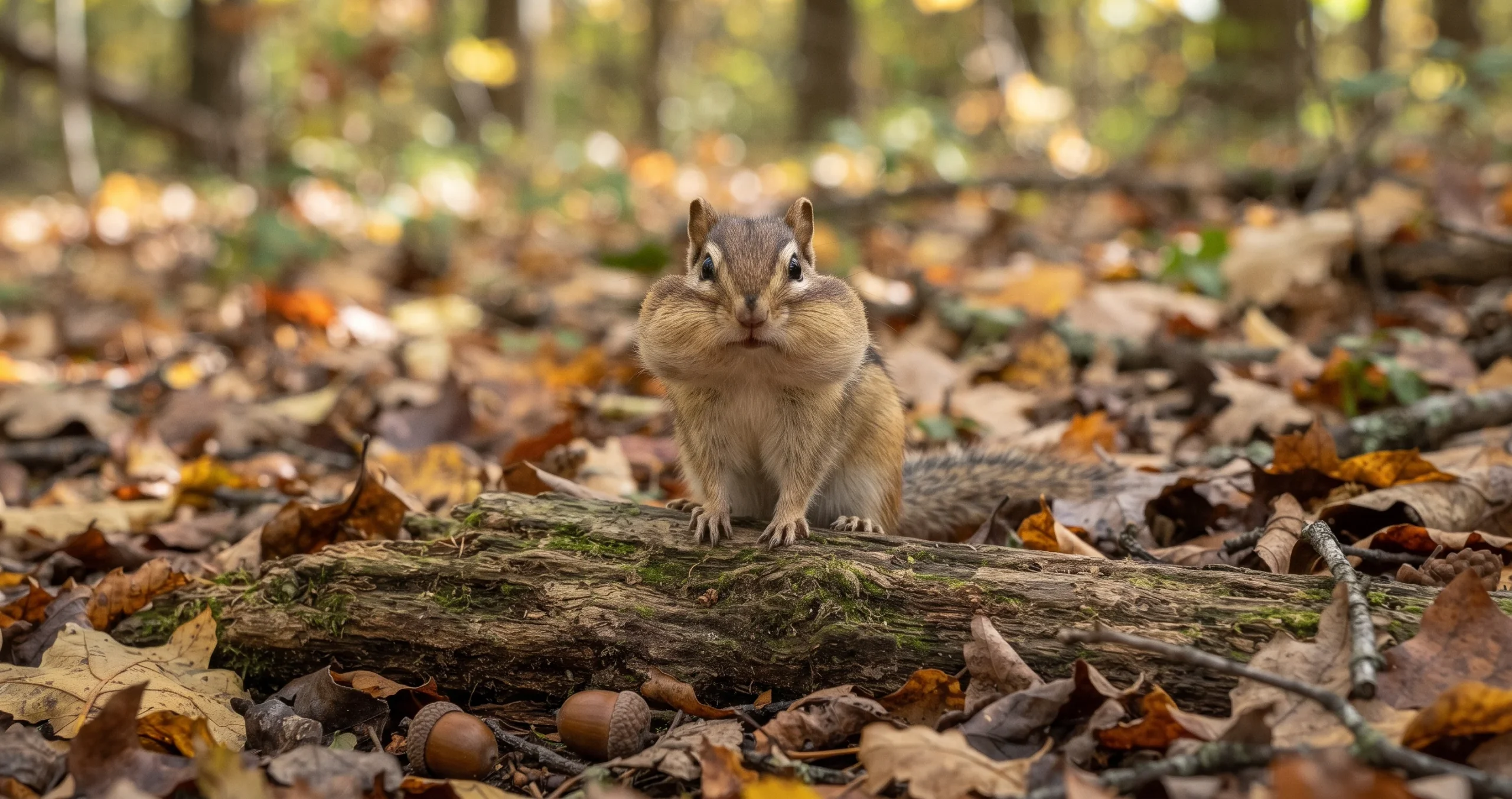
A chipmunk can disappear beneath a pile of leaves and return moments later with cheeks so full that its head seems twice its normal size. Those expandable pockets are more than an amusing feature. Chipmunk cheek pouches are remarkable adaptations that allow these small mammals to transport food, build underground reserves, and prepare for winter.
Throughout autumn, chipmunks become particularly busy collecting seeds, nuts, and other foods. Rather than eating everything immediately, they carry much of their harvest into underground storage chambers.
Their winter survival strategy combines food storage, sheltered burrows, and periods of reduced metabolic activity. Understanding these behaviors can also help gardeners protect their plants while sharing outdoor spaces with these fascinating animals.
Table of Contents
- What Are Chipmunk Cheek Pouches?
- How Chipmunks Fill and Empty Their Cheeks
- Why Chipmunks Store So Much Food
- Inside a Chipmunk’s Underground Burrow
- How Chipmunks Survive Winter
- What Do Chipmunks Eat?
- How Chipmunks Help Disperse Seeds
- How to Protect Flower Bulbs From Chipmunks
- How to Coexist With Chipmunks in Your Garden
- Frequently Asked Questions
What Are Chipmunk Cheek Pouches?
Chipmunk cheek pouches are expandable pockets located inside the mouth, along both sides of the face. They function as temporary storage compartments, allowing the animal to carry food without immediately swallowing it.
When empty, these pockets are barely noticeable. As the chipmunk collects seeds and nuts, the flexible tissues expand outward, producing its familiar rounded cheeks.
Unlike the stomach, cheek pouches are not designed for digestion. Their primary purpose is transportation.
A Natural Food Transportation System
For a small animal that must remain alert to predators, carrying multiple pieces of food in a single trip offers a practical advantage.
Instead of returning to its burrow after finding every individual seed, a chipmunk can collect several items before retreating underground.
This reduces the number of journeys needed to build its food reserves and may limit the time it spends exposed in open areas.
The capacity of chipmunk cheek pouches depends on the animal’s size and the shape of the food being collected. Small seeds can fit together more efficiently than large, irregularly shaped nuts.
Are Chipmunks Born With Cheek Pouches?
Cheek pouches are a natural anatomical feature of chipmunks. Young animals develop the ability to use them as they become independent and begin gathering solid food.
Other rodents, including hamsters and certain ground squirrels, possess similar food-carrying adaptations.
These structures illustrate how specialized anatomy can help small mammals collect and transport resources efficiently.
How Chipmunks Fill and Empty Their Cheeks
Watching a chipmunk gather food reveals a surprisingly coordinated process. The animal uses its front paws, incisors, tongue, and mouth movements to position food inside its expandable cheek pockets.
Filling the Pouches
A chipmunk typically picks up a seed or nut with its mouth, sometimes holding or adjusting it with its front paws.
It then moves the food into one of its cheek pouches rather than swallowing it. Repeated movements allow additional items to accumulate on both sides of the face.
As the pockets fill, the cheeks become increasingly rounded.
A chipmunk carrying a particularly large load may look dramatically different from one that has just emerged from its burrow.
Emptying the Pouches
Once underground or at another storage location, the chipmunk removes the food from its cheeks.
It can use coordinated mouth movements and its front paws to help push stored items forward and out of the pouches.
The collected food is then deposited in a storage chamber or another suitable hiding place.
Chipmunk cheek pouches return to their normal appearance once the food has been removed, allowing the animal to begin another collecting trip.
Why Chipmunks Store So Much Food
Food availability changes dramatically throughout the year. Autumn often provides an abundance of acorns, seeds, and nuts, while winter can make these resources much harder to obtain.
Chipmunks respond by collecting food when it is available and storing it for future use.
This behavior is known as food caching.
Preparing for Seasonal Shortages
As temperatures decline and daylight becomes shorter, chipmunks may spend considerable time gathering food.
Their activities often become especially noticeable beneath oak trees, around seed-producing plants, and near backyard bird feeders.
Chipmunk cheek pouches make these repeated collecting trips more efficient, allowing the animals to build reserves before colder weather arrives.
The amount stored varies according to food availability, species, environmental conditions, and individual behavior.
Storing Food Rather Than Relying Entirely on Body Fat
Some mammals accumulate substantial body fat before winter and depend heavily on those reserves while dormant.
Chipmunks also use stored body energy, but their underground food supplies play an important role in winter survival.
Having access to a pantry allows them to eat during periods when they become active between episodes of winter torpor.
How Much Food Can a Chipmunk Carry?
The carrying capacity of chipmunk cheek pouches is particularly impressive considering the animal’s small body.
According to the SUNY College of Environmental Science and Forestry, an Eastern Chipmunk can carry roughly 30 small, shelled beechnuts at once.
Under favorable conditions, its underground reserves may contain thousands of nuts by the end of autumn. These amounts vary considerably depending on the local harvest and available resources.
Inside a Chipmunk’s Underground Burrow
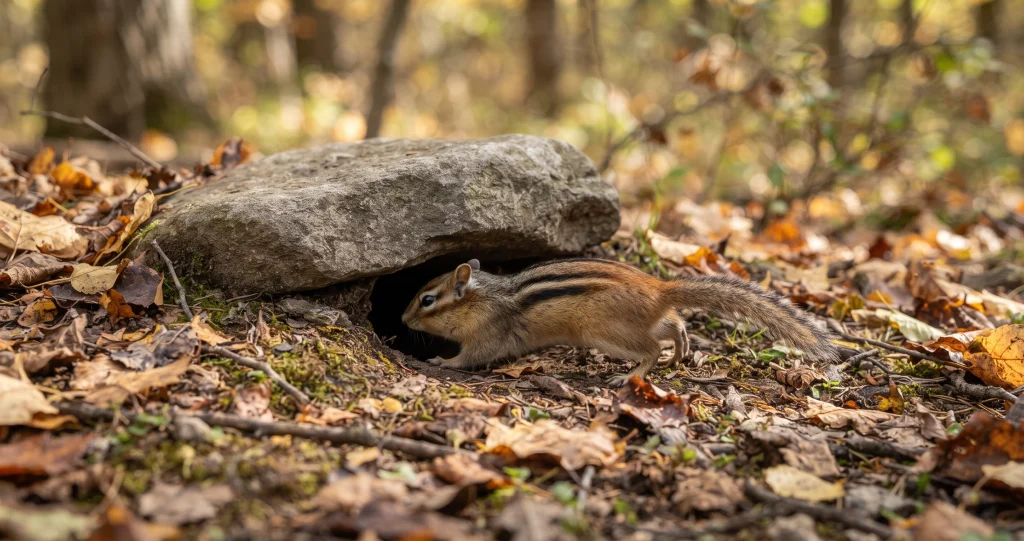
A chipmunk’s burrow is more than a simple hole in the ground. It can contain an organized network of tunnels and chambers that serve different purposes throughout the year.
Eastern Chipmunks (Tamias striatus) commonly establish burrows near tree roots, rocks, logs, stone walls, and other sheltered locations.
The Underground Pantry
A typical burrow may include a sleeping chamber lined with dry vegetation, dedicated food storage areas, connecting tunnels, and alternative routes for escape.
The food storage chambers function much like underground pantries, giving chipmunks access to meals during periods of unfavorable weather.
Their underground location also offers protection from many surface predators and rapid changes in outdoor temperature.
Why Burrow Entrances Are Difficult to Notice
Chipmunk burrow entrances are often surprisingly neat.
Unlike some digging mammals, chipmunks may remove excavated soil from the immediate entrance, making the opening less conspicuous.
A typical entrance measures about two inches across, although its appearance varies with the site and surrounding vegetation.
Some chipmunks also use their cheek pouches to transport excavated soil.
How Chipmunks Survive Winter
Chipmunks generally become less active as winter approaches. In colder regions, they may remain underground for much of the season.
However, their winter dormancy is not simply uninterrupted sleep.
Torpor Versus Continuous Hibernation
Eastern Chipmunks experience repeated periods of torpor, a physiological state in which body temperature, metabolic activity, and energy expenditure decrease.
Between these periods, they become active again and may eat food from their underground reserves.
Although scientists and wildlife specialists sometimes describe this seasonal pattern as hibernation, it differs from the prolonged, deep dormancy commonly associated with animals such as woodchucks.
Other chipmunk species may display different winter dormancy patterns.
Why Underground Food Storage Matters
Chipmunk cheek pouches help make this winter strategy possible.
Food collected during the warmer months remains accessible even when snow, ice, and freezing temperatures limit aboveground foraging.
By alternating between torpor and feeding, chipmunks can conserve energy while maintaining access to stored nourishment.
During unusually mild winter days, some individuals may briefly emerge from their burrows.
What Do Chipmunks Eat?
Chipmunks are omnivores, meaning their diet includes both plant and animal foods. Seeds and nuts make up an important proportion of their diet, particularly when they are preparing winter reserves.
Common foods include:
- Acorns, beechnuts, and other tree nuts.
- Sunflower seeds and various grains.
- Wild berries and seasonal fruits.
- Mushrooms and other fungi.
- Insects, worms, and other small invertebrates.
- Occasionally, bird eggs and other small animals.
Their diet changes throughout the year according to what is available.
Why Seeds and Nuts Are Especially Valuable
Seeds and nuts are relatively energy-dense and often store better than fresh fruit or soft-bodied insects.
Their compact shape also makes many of them suitable for transportation inside chipmunk cheek pouches.
A woodland containing several different seed-producing tree species can therefore provide important seasonal resources.
How Chipmunks Help Disperse Seeds
Although gardeners sometimes regard chipmunks as nuisances, these animals also contribute to natural ecosystems.
Their food-gathering activities can influence where seeds are deposited and which plants become established.
Forgotten Seeds Can Become New Plants
Chipmunks sometimes hide food in several smaller caches scattered throughout their territory, rather than carrying everything into one central pantry.
When viable seeds remain uneaten in suitable locations, some may germinate.
Not every buried seed survives, and chipmunks consume many of the seeds they collect. Nevertheless, their caching behavior can contribute to plant regeneration.
Supporting the Woodland Food Web
Chipmunks also consume fungi, potentially helping distribute fungal spores through their droppings.
They serve as prey for several native predators, including hawks, owls, foxes, and weasels.
Their ecological importance extends well beyond their recognizable stripes and expandable cheeks.
How to Protect Flower Bulbs From Chipmunks
Autumn bulb planting often coincides with the period when chipmunks are actively collecting winter food.
Freshly disturbed soil can attract attention, and some flower bulbs provide an accessible food source.
Fortunately, gardeners can reduce damage without harming wildlife.
Install Protective Wire Mesh
Physical barriers are among the most dependable options for protecting vulnerable bulbs.
The Penn State Extension’s chipmunk management guide recommends protective hardware cloth with approximately quarter-inch openings.
Secure the mesh over newly planted areas and extend it beyond the edges to discourage digging. Remove or adjust temporary surface barriers before shoots emerge if their openings would restrict growth.
Choose Less Attractive Flower Bulbs
Tulips and crocuses are commonly vulnerable to digging animals.
Daffodils, ornamental alliums, and some other bulbs are generally less attractive, although no planting is completely protected from disturbance.
Combining different bulb species can help maintain an attractive spring garden even in locations with frequent wildlife activity.
Remove Planting Debris
Clean up discarded bulb skins and packaging after planting.
Smooth the disturbed soil and avoid leaving exposed planting holes.
These small precautions may reduce obvious signs of recently planted bulbs, particularly when combined with physical protection.
How to Coexist With Chipmunks in Your Garden
A balanced approach recognizes that chipmunks are native wildlife while protecting areas where their activities could cause problems.
In many gardens, occasional chipmunk visits require little intervention.
Manage Spilled Birdseed
Bird feeders often attract chipmunks because seeds fall onto the ground during feeding.
Use suitable seed-catching trays, clean accumulated waste regularly, and keep stored birdseed in secure, rodent-resistant containers.
These measures can reduce concentrated food supplies near buildings without preventing birds from visiting your garden.
Protect Buildings and Foundations
Inspect sheds, garages, and foundations for openings that could provide access.
Seal suitable entry points only after confirming that animals are not trapped inside.
Keep large debris piles and dense ground cover away from vulnerable structures while preserving natural wildlife habitat elsewhere in the garden.
If burrowing threatens a building or retaining wall, consult a qualified wildlife management professional.
Allow Natural Predators to Remain
Owls, hawks, and other predators are valuable components of healthy ecosystems.
Preserving suitable habitat for native wildlife can support natural predator-prey relationships.
Avoid rodent poisons, which may expose pets and wildlife to harmful substances, including through the consumption of poisoned rodents.
Observe Without Hand-Feeding
Chipmunks are entertaining to watch, especially when their cheeks are full.
However, intentionally feeding them by hand can encourage excessive familiarity with people and concentrate animals around artificial food sources.
Enjoy their natural behavior from a comfortable distance, and let chipmunks collect their own food.
Frequently Asked Questions
Do chipmunks swallow the food stored in their cheeks?
Not immediately. Chipmunk cheek pouches temporarily hold food that can later be removed and stored or eaten.
How do chipmunks empty their cheek pouches?
They use coordinated mouth movements and may press against the outside of their cheeks with their front paws, pushing stored food toward the mouth opening.
Do chipmunks sleep throughout winter?
Eastern Chipmunks spend much of winter underground, alternating between periods of torpor and activity. They periodically awaken and consume stored food.
Can chipmunks carry food in both cheeks?
Yes. They have a pouch on each side of the mouth, allowing them to transport multiple seeds or nuts during a single collecting trip.
Are chipmunks beneficial to gardens?
Chipmunks contribute to seed movement and support natural food webs. However, they can also damage seedlings, flower bulbs, and occasionally nearby structures through burrowing.
What is the safest way to protect tulip bulbs?
Secure physical barriers, such as suitable wire mesh, can help prevent chipmunks from digging up newly planted tulips. Choosing less vulnerable bulb varieties can also reduce damage.
Conclusion
The familiar sight of a chipmunk with bulging cheeks reveals an ingenious survival strategy.
Chipmunk cheek pouches allow these small mammals to transport food efficiently, establish underground reserves, and prepare for months of unpredictable weather.
Their combination of food caching, sheltered burrows, and winter torpor demonstrates how animals adapt to seasonal changes.
For gardeners, protecting vulnerable plants while allowing chipmunks to participate in natural ecosystems offers a practical balance. With thoughtful planting and humane prevention, these energetic woodland neighbors can remain a fascinating part of the backyard landscape.
External sources
1. Eastern Chipmunk
An academic resource covering cheek pouch anatomy, feeding habits, food caching, winter torpor, and ecological roles. https://animaldiversity.org/accounts/Tamias_striatus/
2. Chipmunk
An authoritative government resource covering expandable cheek pouches, underground burrows, winter dormancy, and garden damage prevention. Connecticut Department of Energy and Environmental Protection. https://portal.ct.gov/deep/wildlife/fact-sheets/chipmunk