
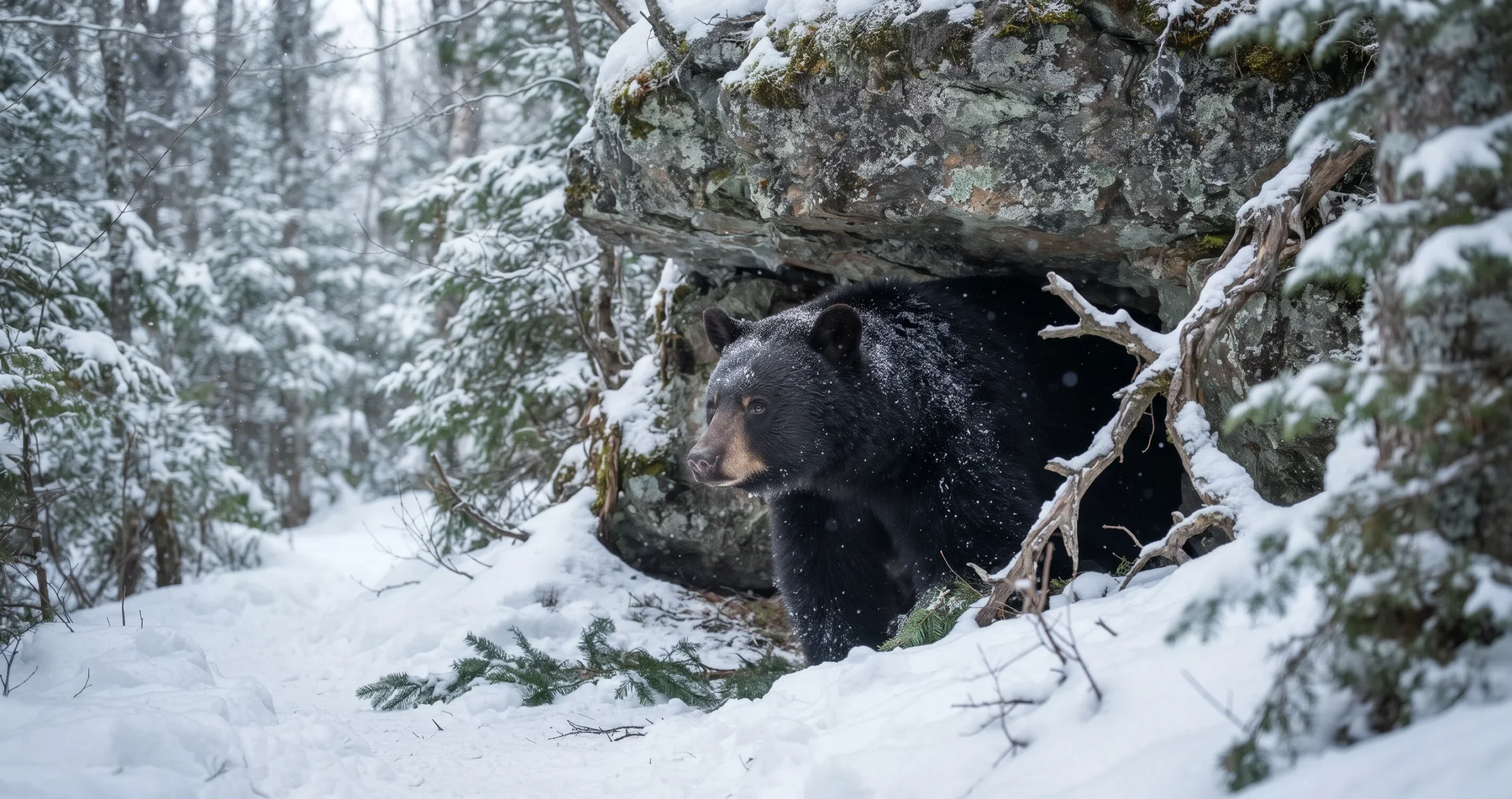
A black bear can spend much of winter hidden inside a den, surviving for months without a normal meal or drink of water. Its heartbeat slows, its metabolism drops, and its body relies on fat stored during the fall. Yet the bear can still respond to danger, and a pregnant female may give birth while denning.
Bear hibernation is one of the most remarkable survival strategies in the animal kingdom. Unlike many small hibernating mammals, bears maintain a relatively warm body temperature while dramatically reducing energy use.
Inside the den, a series of physiological adaptations helps bears conserve water, recycle metabolic waste, preserve muscle, and survive long periods of inactivity. Understanding these processes reveals why winter dormancy is far more complex than simply sleeping through the cold.
Table of Contents
- What Is Bear Hibernation?
- Bear Hibernation vs. Torpor: What Makes Bears Different?
- How a Black Bear’s Body Changes During Hibernation
- How Bears Survive Without Eating, Drinking, or Urinating
- How Bears Preserve Muscle and Bone During Winter
- What Happens Inside a Bear’s Winter Den?
- How Bear Cubs Are Born and Raised During Hibernation
- Why Hibernating Bears Can Wake Up
- How Bears Prepare for Hibernation in Fall
- Bear Hibernation and Safety Around Homes
- Common Myths About Bear Hibernation
- Frequently Asked Questions
What Is Bear Hibernation?
Hibernation is a seasonal strategy that allows certain animals to survive periods when food becomes scarce and environmental conditions are challenging.
During hibernation, metabolic activity decreases, reducing the amount of energy needed to maintain essential bodily functions.
Black bears (Ursus americanus) commonly enter winter dens in regions where seasonal food shortages make prolonged activity energetically costly.
The duration of denning varies considerably. Bears in colder northern environments may remain inside for several months, while bears in warmer regions may den for shorter periods or remain active when food is available.
Why Bears Enter Winter Dens
Cold weather alone does not explain bear hibernation.
Food availability is a major influence. As berries, nuts, insects, and other seasonal foods become less accessible, remaining active can require more energy than the bear can obtain.
Denning allows bears to rely on stored body fat instead of searching continuously for food.
The timing also depends on reproductive status, local weather, and individual circumstances. Pregnant females may enter dens earlier and remain longer than some other bears.
Bear Hibernation vs. Torpor: What Makes Bears Different?
Scientists use the term torpor to describe a physiological state involving reduced metabolic activity and energy expenditure.
Hibernation generally refers to prolonged, seasonally organized dormancy involving torpor, although definitions and patterns vary among animal groups.
Bears are unusual because their winter physiology differs from the dramatic cooling seen in many small hibernators.
Traditional Hibernation in Small Mammals
Some ground squirrels and other small mammals enter deep torpor with body temperatures that approach the temperature of their surroundings.
Their heart rates and metabolic activity may fall dramatically.
Many species periodically rewarm during winter, temporarily returning to higher body temperatures before entering another torpor episode.
These cycles can involve substantial changes in body temperature.
Why Bears Are Different
Black bears usually maintain body temperatures much closer to their normal active range.
Instead of cooling almost to freezing, they lower their temperature by a comparatively modest amount while greatly suppressing metabolism.
Their hearts beat more slowly, and breathing becomes less frequent.
This allows them to conserve energy while retaining the ability to respond relatively quickly to disturbances.
Are Bears True Hibernators?
Yes. Modern physiological research supports classifying bears as hibernators.
Older explanations sometimes excluded bears because their body temperatures do not fall as dramatically as those of small mammals.
However, the depth and duration of their metabolic suppression demonstrate that hibernation does not require an extreme drop in body temperature.
The distinction is important: bear hibernation is not simply ordinary sleep, and it is not identical to the torpor patterns of ground squirrels.
How a Black Bear’s Body Changes During Hibernation
One of the most surprising discoveries about bear hibernation is how strongly metabolism can decline without extreme body cooling.
Researchers have monitored captive black bears using physiological sensors to measure changes in temperature, heartbeat, and oxygen consumption.
These observations reveal a coordinated system of energy conservation.
Body Temperature Drops Modestly
An active black bear generally maintains a body temperature near the upper 90s Fahrenheit.
During hibernation, its temperature may decrease by several degrees, with fluctuations occurring over time.
Unlike a small hibernator, the bear remains relatively warm.
This helps explain why a denning bear may become responsive to a disturbance without undergoing the prolonged warming process required by some deeply torpid mammals.
Heart Rate Slows Dramatically
A bear’s heartbeat becomes much slower during winter dormancy.
Measurements have documented heart rates dropping from roughly 40–50 beats per minute during quiet, nonhibernating conditions to around 8–19 beats per minute during hibernation, although rates vary with activity and physiological state.
Breathing also slows, sometimes with extended pauses between breaths.
These changes reduce energy consumption while maintaining essential circulation and gas exchange.
Metabolism Falls Far Below Normal
Published research has found that hibernating black bears can reduce metabolic activity to approximately one-quarter of their normal basal metabolic rate.
That is an extraordinary reduction considering their relatively modest decrease in body temperature.
It shows that bears possess metabolic control mechanisms beyond the simple cooling effect that reduces energy use in many other animals.
Their bodies actively regulate energy expenditure throughout winter.
A Physiological Balancing Act
The bear must maintain essential organ functions while conserving stored fuel.
Circulation, breathing, temperature regulation, and cellular maintenance continue at reduced levels.
Hibernation therefore involves controlled physiological adjustments rather than a complete shutdown.
The bear remains alive, responsive, and metabolically active, but at a much lower energetic cost.
How Bears Survive Without Eating, Drinking, or Urinating
A denning black bear can survive for months without the regular intake and elimination patterns familiar to humans.
This ability depends on stored fat, careful water conservation, and unusual nitrogen metabolism.
Fat Supplies Winter Energy
During autumn, bears accumulate substantial body fat.
Throughout hibernation, stored fat becomes their principal energy source.
Breaking down fat also produces metabolic water, which helps support hydration.
At the same time, reduced breathing and other physiological changes help limit water loss.
The result is a system that allows many denning bears to avoid drinking for extended periods.
What Happens to Urinary Waste?
In most mammals, protein metabolism generates nitrogenous waste that is converted into urea and eliminated in urine.
Hibernating bears handle this waste differently.
Their bodies conserve and recycle nitrogen, helping reduce the need to excrete it.
Research indicates that nitrogen derived from urea can be reused in processes that support protein maintenance.
Scientists continue investigating the precise pathways and contributions of microorganisms and host metabolism.
Why Bears Usually Do Not Urinate
During normal uninterrupted hibernation, black bears typically produce little or no urine that must be eliminated externally.
Their kidneys and other metabolic systems help conserve water while nitrogen is recycled.
This is not evidence that the kidneys have stopped functioning.
Rather, the bear has entered a specialized physiological state in which water balance and waste handling differ substantially from normal activity.
How Bears Preserve Muscle and Bone During Winter
Humans confined to bed for weeks can lose muscle strength and bone mass.
Hibernating bears face a much longer period of inactivity, yet they generally preserve muscle and skeletal integrity remarkably well.
This has made bear physiology an important subject for biomedical research.
Protecting Muscle Tissue
Bears reduce muscle activity during denning, but they do not experience the same degree of muscle deterioration expected in a similarly inactive human.
Their bodies appear to limit protein breakdown while maintaining mechanisms that support muscle tissue.
Nitrogen recycling may contribute to this process by making nitrogen available for protein maintenance.
Some muscle changes still occur, but overall preservation is unusually effective.
Maintaining Bone Strength
Prolonged inactivity commonly increases bone loss in many mammals.
Hibernating bears, however, show adaptations that help maintain bone structure and balance bone remodeling.
Research suggests that bone formation and breakdown are regulated differently during denning, helping limit net skeletal loss.
This is especially important for an animal that must emerge from its den capable of walking, climbing, and searching for food.
What Scientists Hope to Learn
Researchers study these adaptations to better understand muscle wasting, osteoporosis, and the effects of prolonged inactivity.
However, bear physiology has not yet produced a direct treatment that reproduces these benefits in humans.
The scientific value lies in identifying biological mechanisms that may inspire future research.
What Happens Inside a Bear’s Winter Den?
Black bears use many types of winter shelters.
A den may be located beneath an uprooted tree, inside a hollow log, under rocks, or in a sheltered depression.
Some bears dig dens into slopes or use spaces beneath dense vegetation.
Choosing a Protected Location
A suitable den provides shelter from harsh weather and reduces exposure to disturbance.
The entrance may be relatively small, while the interior provides enough space for the bear to curl into a resting position.
Bears sometimes gather leaves, grass, or other vegetation to create bedding.
Snow can accumulate around a den and provide additional insulation.
Life Inside the Den
The bear spends much of its time in a curled or resting posture.
Its body continues regulating temperature, circulation, and metabolism.
Although movement is greatly reduced, the animal may occasionally shift position.
Denning is not equivalent to unconsciousness, and the bear retains the ability to respond to significant disturbances.
How Bear Cubs Are Born and Raised During Hibernation
For pregnant female black bears, winter denning is also a reproductive period.
Mating generally occurs earlier in the year, but implantation of the embryo is delayed.
This reproductive strategy helps coordinate pregnancy with the female’s physical condition and seasonal timing.
Birth During Winter
Black bear cubs are commonly born in midwinter, often during January or February, although timing varies.
Newborn cubs are extremely small relative to their mother’s size.
They have limited ability to regulate body temperature and depend heavily on maternal warmth and care.
Nursing Without Eating
A mother bear can produce milk while relying on stored energy reserves.
She nurses her cubs inside the den even though she is not regularly eating or drinking.
Her physiology must support both her own survival and the energetic demands of lactation.
Females with cubs may remain in dens longer than other bears, giving the young additional time to develop.
Emerging in Spring
By the time the family leaves the den, the cubs are considerably larger and more mobile.
They continue nursing and learning from their mother after emergence.
The denning period therefore serves as both a survival strategy and an important stage of early development.
Why Hibernating Bears Can Wake Up
A hibernating bear is not unconscious. Although its metabolism is suppressed, it can become alert when disturbed.
This is one reason wildlife professionals advise people to avoid approaching known or suspected bear dens.
Disturbances Can Interrupt Denning
Human activity, approaching animals, and other disturbances may cause a bear to respond or leave its shelter.
Premature den abandonment can be especially concerning for females with dependent cubs.
A disturbed bear may also defend itself if it feels threatened or cornered.
Why Bears Can Respond So Quickly
Because bears maintain relatively high body temperatures during hibernation, they do not need to warm themselves from near-freezing temperatures before becoming active.
Their responsiveness is one of the features distinguishing bear hibernation from the deeper cooling patterns of some smaller mammals.
However, awakening and moving still require energy, potentially drawing on reserves needed for the remainder of winter.
How Bears Prepare for Hibernation in Fall
The remarkable changes inside the den begin with intense feeding during late summer and autumn.
This seasonal increase in food consumption is called hyperphagia.
During this period, bears spend substantial time searching for calorie-rich foods that help build fat reserves.
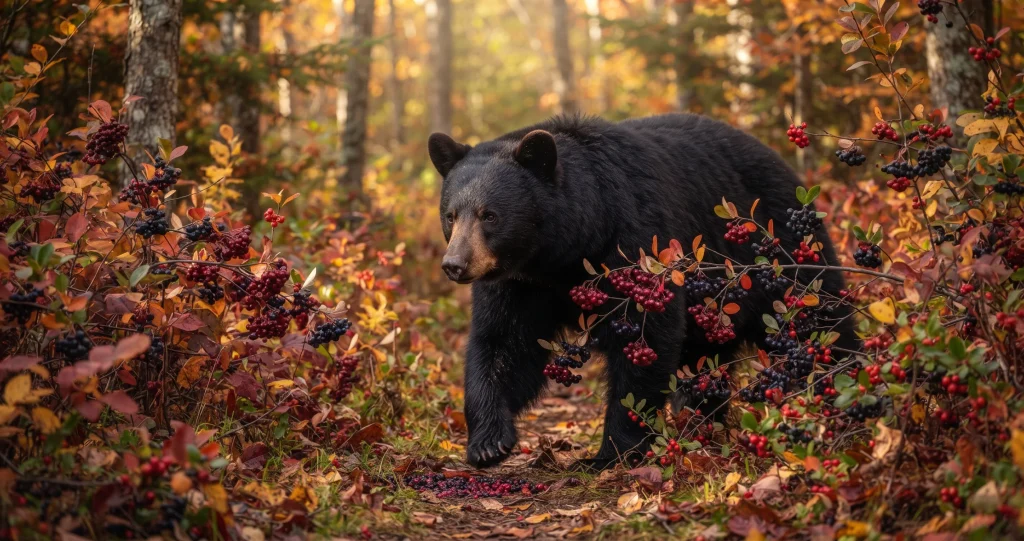
Autumn Foods That Build Energy Reserves
Black bears are opportunistic omnivores. Their diets vary with geography and seasonal availability.
In many North American forests, important fall foods include acorns, beechnuts, berries, and other fruits.
Where available, bears may also consume insects, carrion, and other animal foods.
Foods rich in fats and carbohydrates are especially valuable because they help support the energy stores needed during winter.
Why Natural Food Availability Matters
Years with abundant nuts and fruit can influence bear feeding patterns and denning behavior.
When natural foods are scarce, bears may travel farther in search of calories.
Accessible garbage, birdseed, and outdoor pet food can attract bears into residential areas.
Preventing access to these foods protects both people and wildlife.
Bear Hibernation and Safety Around Homes
Understanding bear behavior is especially important for people living near forests and other bear habitats.
Bears preparing for winter may be strongly motivated to investigate potential food sources.
Human-provided food can encourage repeated visits to neighborhoods, increasing the likelihood of conflict.
Secure Garbage and Outdoor Food
Store household garbage in bear-resistant containers or secure buildings.
Place trash outside as close to collection time as local rules permit.
Keep pet food indoors, clean outdoor grills, and remove fallen fruit where it may attract bears.
Manage Bird Feeders Responsibly
Birdseed and suet are calorie-rich foods that can attract black bears.
In bear country, remove bird feeders when bears are active and follow recommendations from your state wildlife agency.
The BearWise guidance for living responsibly with black bears provides practical recommendations for securing food, garbage, and bird feeders around homes. BearWise
Respect Winter Dens
Never approach, enter, or attempt to photograph the interior of an occupied bear den.
If you discover a suspected den, leave the area quietly and give the animal space.
Follow local wildlife-agency instructions for unexpected bear encounters, and keep pets under control in bear habitat.
Common Myths About Bear Hibernation
Myth 1: Bears Are Simply Sleeping All Winter
Bear hibernation involves major changes in metabolism, circulation, and waste handling.
It is a specialized physiological state rather than an extended period of ordinary sleep.
Myth 2: Bears Cannot Wake During Hibernation
Bears can respond to disturbances and may leave their dens.
Their relatively warm body temperatures help them become active more readily than some deeply torpid mammals.
Myth 3: Every Bear Hibernates for the Same Length of Time
Denning duration varies with climate, food availability, sex, and reproductive status.
Some bears in warmer regions remain active through much of winter.
Myth 4: Bears Lose All Their Muscle During Winter
Although bears remain largely inactive, they possess adaptations that substantially limit muscle and bone deterioration.
Myth 5: Bears Need to Eat Snow for Water
Many denning bears maintain water balance through metabolic water production and physiological conservation.
They generally do not need to leave the den to drink during uninterrupted hibernation.
Frequently Asked Questions
How long do black bears hibernate?
Black bears may den for several months, with some northern populations remaining in dens for roughly five to seven months. Duration varies with local climate, food availability, and reproductive condition.
Do bears wake up to eat during hibernation?
During normal uninterrupted hibernation, black bears generally do not eat or drink. However, bears can awaken or leave dens when disturbed, and some individuals in warmer regions may remain active during winter.
How can bears survive without urinating for months?
Hibernating bears conserve water and recycle nitrogenous waste, including nitrogen derived from urea. These adaptations help them maintain tissues and avoid the usual need to eliminate urine during extended denning.
Conclusion
Beneath a quiet, snow-covered forest, a black bear’s body is performing an extraordinary balancing act.
During bear hibernation, metabolism slows dramatically, stored fat supplies energy, and specialized physiological systems conserve water and recycle nitrogen.
At the same time, bears preserve much of their muscle and bone, remain capable of responding to disturbances, and, in the case of pregnant females, can give birth and nurse cubs.
Understanding these adaptations reveals that winter denning is not simply a long sleep. It is a sophisticated survival strategy shaped by the challenges of seasonal food scarcity.
Protecting natural habitats, preventing access to human food, and respecting denning animals are practical ways to help bears continue this remarkable annual cycle.
External Sources
1. Hibernation in Black Bears: Independence of Metabolic Suppression From Body Temperature
Original research documenting black bears reducing metabolism to approximately 25% of basal levels, body temperatures fluctuating around 30–36°C, and heart rates dropping to as few as nine beats per minute. Science, 2011 — Tøien and colleagues.
2. National Park Service — Species Spotlight: Black Bear
Explains how hibernating black bears survive without eating, drinking, or eliminating waste, including urea recycling and preservation of muscle and bone. Black Bear (U.S. National Park Service).
3. Six At-Home BearWise Basics
Provides practical, bear-specific safety recommendations, including securing garbage, removing bird feeders during bear activity, and keeping pet food indoors. BearWise, supported by state wildlife agencies and bear biologists.