
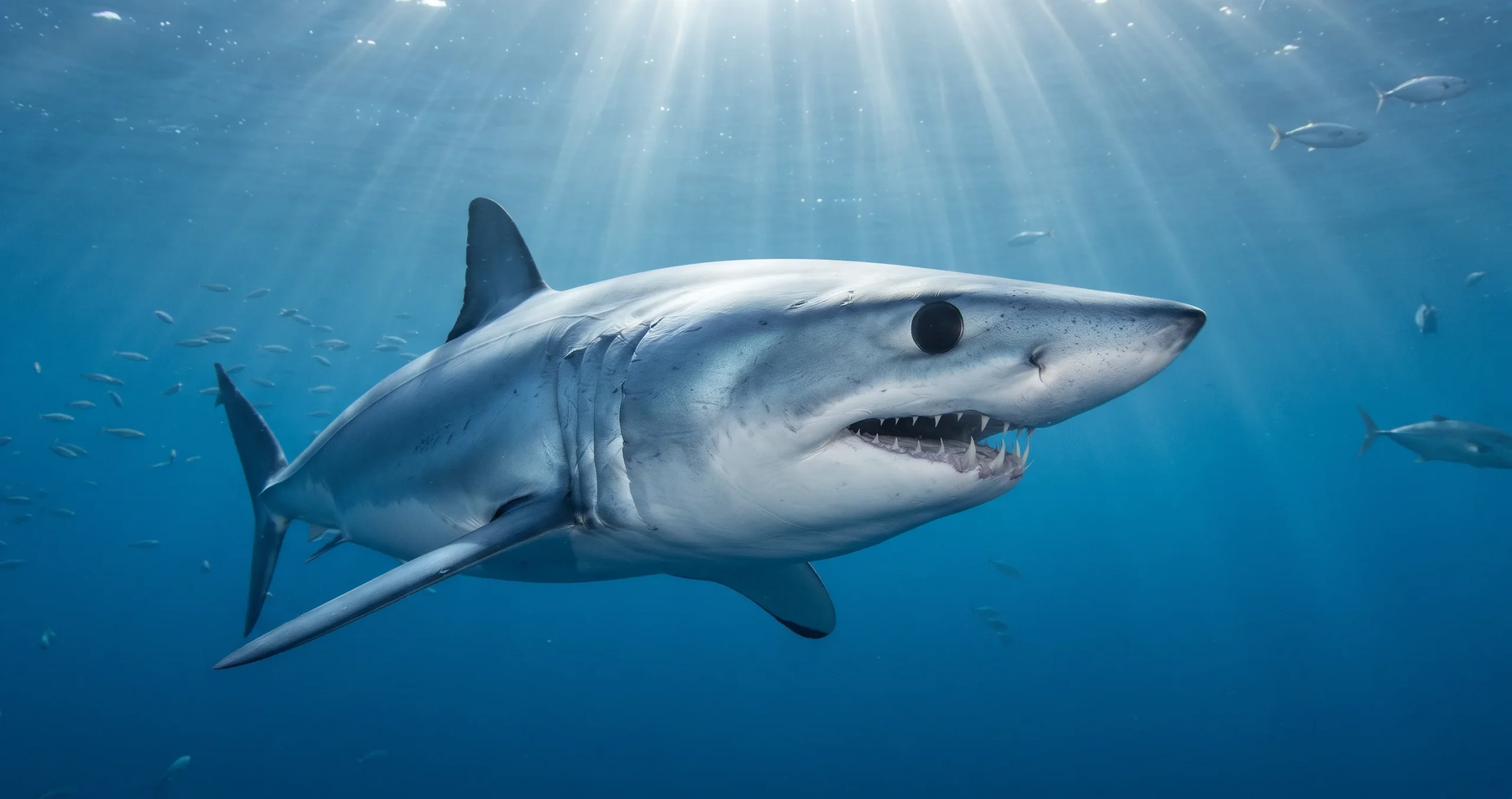
A nurse shark rests motionless beneath a coral ledge while a great white shark travels steadily through open water. Both animals are breathing, yet they use different methods to move oxygen-rich water across their gills.
So, do sharks have to keep swimming to survive? The answer depends on the species. Some sharks rely heavily on forward movement to breathe, while others can remain stationary and actively pump water through their gills.
This difference reveals a fascinating side of shark biology. From specialized breathing structures to resting behavior, sharks have evolved several ways to survive in habitats ranging from shallow reefs to the open ocean.
Table of Contents
- Do Sharks Have to Keep Swimming?
- How Shark Gills Extract Oxygen From Water
- Ram Ventilation: Why Some Sharks Must Keep Moving
- Buccal Pumping: How Sharks Breathe While Resting
- What Are Spiracles, and Why Do Some Sharks Have Them?
- Where and How Do Sharks Rest?
- Can Sharks Sleep While Swimming?
- Why the Constant-Swimming Myth Became Popular
- The Science Behind Different Shark Breathing Strategies
- How Shark Breathing Relates to Conservation
- Common Myths About Sharks
- Frequently Asked Questions
Do Sharks Have to Keep Swimming?
The familiar claim that every shark must swim continuously or die is incorrect.
Sharks are an extraordinarily diverse group of cartilaginous fishes, and their respiratory abilities vary considerably.
Some species, including nurse sharks, can rest on the seafloor while moving water across their gills through muscular pumping.
Others, particularly highly active open-water sharks, depend strongly on swimming to maintain the water flow required for respiration.
Two Different Ways to Breathe
Scientists generally distinguish two important ventilation strategies.
Ram ventilation uses forward movement to direct water into the mouth and across the gills. Buccal pumping uses muscular movements of the mouth and throat region to actively move water through the respiratory system.
Some sharks can combine these methods or switch between them depending on swimming speed and circumstances.
The key distinction is that breathing depends on water moving across the gills, not simply on whether the shark’s body is moving.
How Shark Gills Extract Oxygen From Water
To understand shark breathing, it helps to examine what happens when water passes through the respiratory system.
Unlike mammals, sharks do not have lungs. They obtain dissolved oxygen from water using specialized gill structures.
Most sharks have five pairs of gill slits, although some species possess six or seven pairs.
The Journey of Water Through the Gills
Water generally enters through the mouth or, in species that possess functional spiracles, through openings located behind the eyes.
It then passes across the gill surfaces before exiting through the gill slits.
Inside the gills are delicate filaments containing numerous thin structures called lamellae.
These lamellae provide a large surface area for exchanging gases between water and blood.
How Oxygen Enters the Blood
As water flows across the lamellae, dissolved oxygen moves into the shark’s blood.
At the same time, carbon dioxide moves from the blood into the surrounding water.
This exchange occurs through thin respiratory surfaces, allowing oxygen to enter the circulatory system.
Many fishes use a countercurrent arrangement in which blood and water move in opposite directions across the exchange surfaces.
This helps maintain a favorable gradient for oxygen transfer along much of the gill.
Why Continuous Water Flow Matters
Gill tissues need a continuing supply of oxygenated water.
If water flow becomes inadequate for too long, the shark cannot obtain enough oxygen to meet its metabolic needs.
However, that water flow can be produced in different ways.
For some species, muscular pumping is sufficient. For others, forward movement is an essential part of normal respiration.
Ram Ventilation: Why Some Sharks Must Keep Moving
Ram ventilation is closely associated with sharks adapted for sustained swimming.
Instead of relying primarily on active pumping, these animals move forward with their mouths open enough to allow water to enter.
As the shark travels, water passes across the gills and exits through the gill slits.
Great White Sharks and Makos
Great white sharks and mako sharks are well-known examples of species that rely heavily on ram ventilation.
Their streamlined bodies and powerful swimming muscles are suited to active movement through the water.
For these sharks, forward swimming normally provides the respiratory water flow needed to support their metabolism.
This is why the statement that some sharks must keep swimming contains an important element of truth.
The mistake occurs when that observation is applied to every shark species.
Why Fast Swimmers Benefit
Active sharks may have substantial oxygen requirements associated with swimming, hunting, and maintaining bodily functions.
Ram ventilation allows water to move across the gills as a consequence of swimming.
The strategy is particularly effective for animals that already spend much of their lives moving through open water.
However, relying on forward motion also places constraints on resting behavior and movement in confined environments.
Does Stopping Always Mean Immediate Death?
Not necessarily.
A brief reduction in speed is not equivalent to immediate respiratory failure, and the consequences depend on the species and circumstances.
Nevertheless, a shark that depends on ram ventilation cannot remain stationary indefinitely without an alternative source of adequate water flow.
This distinction is important when interpreting videos of large sharks moving slowly or appearing almost motionless in strong currents.
Buccal Pumping: How Sharks Breathe While Resting
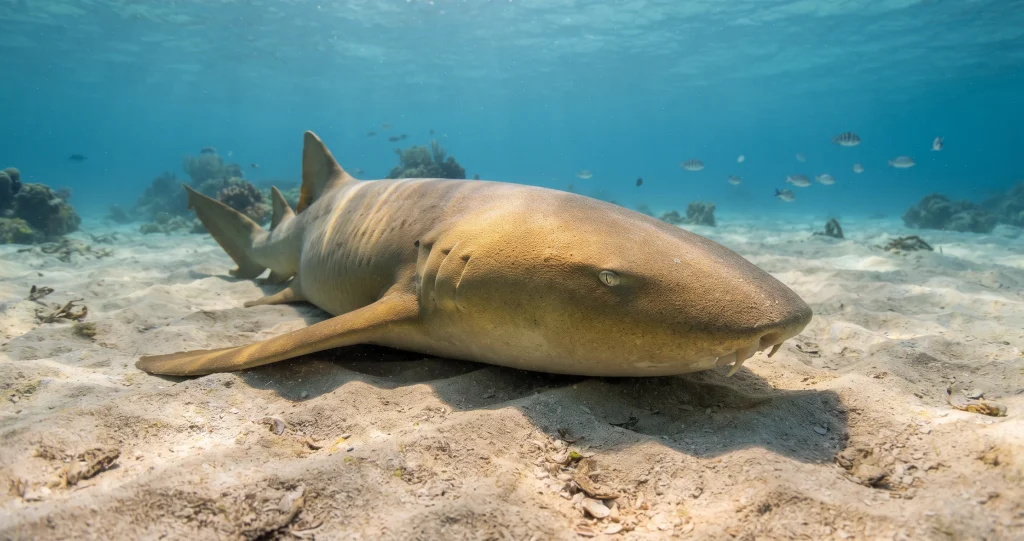
Other sharks can move water across their gills using muscular pumping.
This process is known as buccal pumping, named for the mouth cavity involved in generating water movement.
It allows certain species to breathe even when they are not swimming forward.
Nurse Sharks as a Familiar Example
Nurse sharks are commonly observed resting beneath rocky ledges, along reefs, or on sandy seafloors.
Their ability to remain stationary is supported by active respiratory ventilation.
Muscular movements help draw water into the respiratory system and move it across the gills.
This allows the shark to obtain oxygen without depending on continuous forward travel.
Nurse sharks may remain in sheltered locations for extended periods, particularly during daylight hours.
How the Pumping Process Works
Buccal pumping involves coordinated changes in the volume and pressure of the mouth and associated respiratory cavities.
These movements help draw water inward and push it across the gill surfaces.
The process is repeated to maintain oxygen delivery.
Unlike a ram-ventilating shark, a species with effective buccal pumping can remain on the bottom while breathing.
Other Sharks That Can Rest Stationary
Several bottom-associated sharks possess respiratory adaptations that permit resting.
Examples include certain wobbegongs, horn sharks, and other benthic species.
Their behavior reflects their ecological lifestyles, which may involve waiting for prey, sheltering in crevices, or conserving energy.
What Are Spiracles, and Why Do Some Sharks Have Them?
Spiracles are small openings located behind the eyes in certain sharks and other cartilaginous fishes.
They provide an additional route for water to enter the respiratory system.
Spiracles are especially useful for some species that spend time close to the seafloor.
Breathing Without Taking in Sediment
Imagine a bottom-dwelling shark resting on sand.
Drawing water through a mouth positioned close to the sediment could introduce unwanted particles.
Functional spiracles can help the animal draw water from above the bottom instead.
This adaptation is particularly noticeable in several bottom-associated sharks and rays.
Why Spiracles Differ Among Species
Not every shark has prominent, functional spiracles.
In some highly active sharks, spiracles are reduced or absent.
Their respiratory systems are adapted to different swimming and feeding behaviors.
The presence or absence of well-developed spiracles therefore offers clues about how a species uses its habitat.
Spiracles and Buccal Pumping Are Not the Same Thing
A spiracle is an anatomical opening, while buccal pumping is a method of actively moving water.
These features can work together, but they describe different parts of the respiratory system.
Understanding this distinction helps explain why sharks with similar appearances may breathe differently.
Where and How Do Sharks Rest?
Sharks do not all rest in the same way.
Some remain on the seafloor, while others continue swimming through open water.
Their resting strategies are shaped by respiratory needs, habitat, predation risk, and daily activity patterns.
Resting on the Seafloor
Nurse sharks may shelter beneath ledges or gather in protected areas.
Other bottom-dwelling sharks can remain among rocks, reefs, or sandy habitats.
These locations may provide protection and opportunities to conserve energy.
A stationary shark is not necessarily unhealthy or unable to move. For some species, resting motionlessly is normal behavior.
Resting in Caves and Sheltered Areas
Some sharks use caves, overhangs, and other sheltered underwater structures.
Such places may offer reduced disturbance and protection from currents.
However, the presence of a resting shark does not automatically mean it is asleep in the same way a human would be.
Scientists distinguish visible inactivity from physiological sleep, which requires additional evidence.
Resting While Moving
For sharks that rely on ram ventilation, prolonged stationary rest may be incompatible with normal breathing.
These animals can instead exhibit changes in swimming activity that may reduce energy expenditure.
Whether particular swimming behaviors represent sleep, quiet wakefulness, or another form of rest remains an active research question.
Can Sharks Sleep While Swimming?
Sleep in sharks is more complicated than simply observing whether their eyes are open or closed.
Many sharks lack the obvious external signs of sleep familiar from mammals.
Researchers therefore examine activity patterns, responsiveness, posture, and physiological changes.
Evidence of Sleep in Some Sharks
Research on certain bottom-dwelling sharks has identified periods consistent with sleep.
In particular, studies of draughtsboard sharks have associated prolonged resting behavior with changes in metabolism and responsiveness.
These findings provide evidence that at least some sharks experience genuine sleep-like physiological states.
However, they do not establish that every shark sleeps in the same manner.
The Mystery of Active Sharks
For continuously swimming sharks, determining when and how sleep occurs is challenging.
Researchers have proposed that some species may experience periods of reduced activity while continuing to move.
Yet direct evidence for sleep during continuous swimming remains limited.
It would therefore be misleading to claim that all active sharks sleep while swimming or that scientists have fully explained the process.
Why the Distinction Matters
Rest is a behavioral description. Sleep is a physiological state with particular characteristics.
An animal can remain still without sleeping, and some animals can maintain movement during unusual states of reduced responsiveness.
Shark research continues to reveal how diverse these patterns may be.
Why the Constant-Swimming Myth Became Popular
The idea that sharks must always move likely spread because it contains a memorable fragment of truth.
Highly recognizable species such as great white sharks are associated with powerful, continuous swimming.
Documentaries and popular descriptions often emphasize their movement and hunting abilities.
A Simple Explanation Became Too Broad
The statement that certain sharks rely on forward movement for breathing is scientifically useful.
But when shortened to a claim about all sharks, it becomes inaccurate.
This is a common problem in wildlife communication: an adaptation observed in one group becomes a supposed rule for an entire animal category.
Different Sharks, Different Lifestyles
Sharks occupy a wide variety of marine environments.
Some hunt in open water, while others remain near reefs, rocky bottoms, or sandy habitats.
Their breathing strategies reflect these ecological differences.
Recognizing this diversity makes shark biology more interesting than the oversimplified myth.
The Science Behind Different Shark Breathing Strategies
Shark ventilation is closely connected to energy use, body design, and habitat.
Different species have evolved respiratory strategies that suit their typical movements.
Energy Requirements and Swimming Behavior
A fast-moving predator has different oxygen demands from a relatively inactive bottom-dwelling species.
Respiratory adaptations help meet those demands.
Ram ventilation can be effective when forward movement is already a regular part of the animal’s behavior.
Buccal pumping, meanwhile, provides greater flexibility for species that frequently remain stationary.
Anatomy and Ecology Work Together
Gill structure, mouth position, spiracle development, and body shape all influence how sharks interact with their environment.
A bottom-associated shark may benefit from breathing while lying on the seafloor.
A pelagic shark may benefit from respiratory water flow generated during sustained swimming.
Neither strategy is universally superior.
Each represents a different solution to the same biological requirement: obtaining enough oxygen from water.
Environmental Conditions Also Matter
Water temperature, oxygen availability, and current strength can affect respiratory demands and performance.
Warmer water generally holds less dissolved oxygen than colder water under otherwise comparable conditions.
At the same time, metabolic demands may increase with temperature.
These interactions make adequate oxygen delivery especially important in changing marine environments.
How Shark Breathing Relates to Conservation
Understanding shark respiration is useful beyond correcting a popular myth.
It can help researchers, fisheries managers, and conservation organizations evaluate how sharks respond to environmental pressures.
Accidental Capture and Respiratory Stress
Sharks caught in fishing gear may experience serious physiological stress.
For species dependent on ram ventilation, restricted movement can interfere with normal respiratory water flow.
Handling, exhaustion, injury, and reduced oxygen availability can further complicate survival.
This is one reason reducing accidental capture and improving scientifically informed handling practices are important conservation goals.
Habitat Protection
Sharks depend on healthy marine ecosystems for food, shelter, reproduction, and migration.
Coastal development, habitat degradation, overfishing, and pollution can affect different species in different ways.
Protecting nursery habitats and maintaining sustainable fisheries are important components of shark conservation.
Why Species-Specific Research Matters
Conservation measures must account for differences among shark species.
A bottom-dwelling nurse shark does not have exactly the same ecological requirements as a wide-ranging mako shark.
Researchers use information about movement, respiration, reproduction, and habitat use to develop more appropriate management strategies.
For a broader introduction to marine biodiversity, the Smithsonian Ocean Portal offers educational resources on sharks and ocean ecosystems.
Common Myths About Sharks
Myth 1: Every Shark Must Swim Continuously
False. Some species can remain stationary and actively pump water across their gills.
Others rely heavily on forward movement for normal breathing.
Myth 2: Sharks Cannot Rest
False. Many sharks display periods of reduced activity, and some species rest motionlessly on the seafloor.
The details of sleep and rest vary and remain under investigation.
Myth 3: Sharks Are Always Aggressive
Sharks are predators, but their behavior is far more varied than popular portrayals suggest.
Most shark encounters do not involve attacks on people.
Myth 4: Sharks Have No Natural Enemies
Sharks can be preyed upon by larger sharks and other marine predators.
Some species are also vulnerable to predation during their juvenile stages.
Myth 5: Sharks Are All Similar
Sharks differ dramatically in size, diet, habitat, behavior, and reproductive biology.
Their breathing strategies are just one example of this diversity.
Frequently Asked Questions
Do great white sharks have to keep swimming to breathe?
Great white sharks rely heavily on ram ventilation, which uses forward movement to maintain water flow across their gills. They normally need to keep moving to obtain adequate oxygen, although brief changes in speed do not necessarily cause immediate respiratory failure.
Can nurse sharks breathe while lying on the ocean floor?
Yes. Nurse sharks can actively pump water through their respiratory system while remaining stationary. This allows them to rest beneath ledges, near reefs, and on the seafloor.
Do sharks sleep with their eyes open?
Some sharks lack obvious eyelid movements that humans associate with sleep, so open eyes alone cannot determine whether a shark is asleep. Researchers assess sleep using behavior, responsiveness, and physiological measurements rather than eye position alone.
Conclusion
A nurse shark resting quietly beneath a reef and a great white shark traveling through open water demonstrate two very different approaches to the same challenge.
The answer to do sharks have to keep swimming is therefore species-dependent.
Some sharks rely on forward movement to ventilate their gills, while others can use muscular pumping to breathe while stationary.
Their respiratory systems reflect the extraordinary diversity of shark evolution, from specialized gills and spiracles to different patterns of movement and rest.
Understanding these differences replaces a familiar myth with a more fascinating reality: sharks have evolved multiple ways to breathe, survive, and thrive in the ocean.
External Sources
1. 12 Shark Facts That May Surprise You
Explains shark respiratory anatomy, spiracles, and why certain bottom-dwelling species can breathe while resting. NOAA Fisheries
2. Fishing for Sharks in the Gulf of Mexico
Describes nurse sharks’ ability to rest on the seafloor and draw respiratory water through their spiracles. NOAA Fisheries
3. Sharks Apparently Do Sleep, Even With Their Eyes Wide Open
Discusses research on draughtsboard sharks showing physiological evidence of sleep, including reduced metabolic activity during prolonged rest. Smithsonian Magazine.