
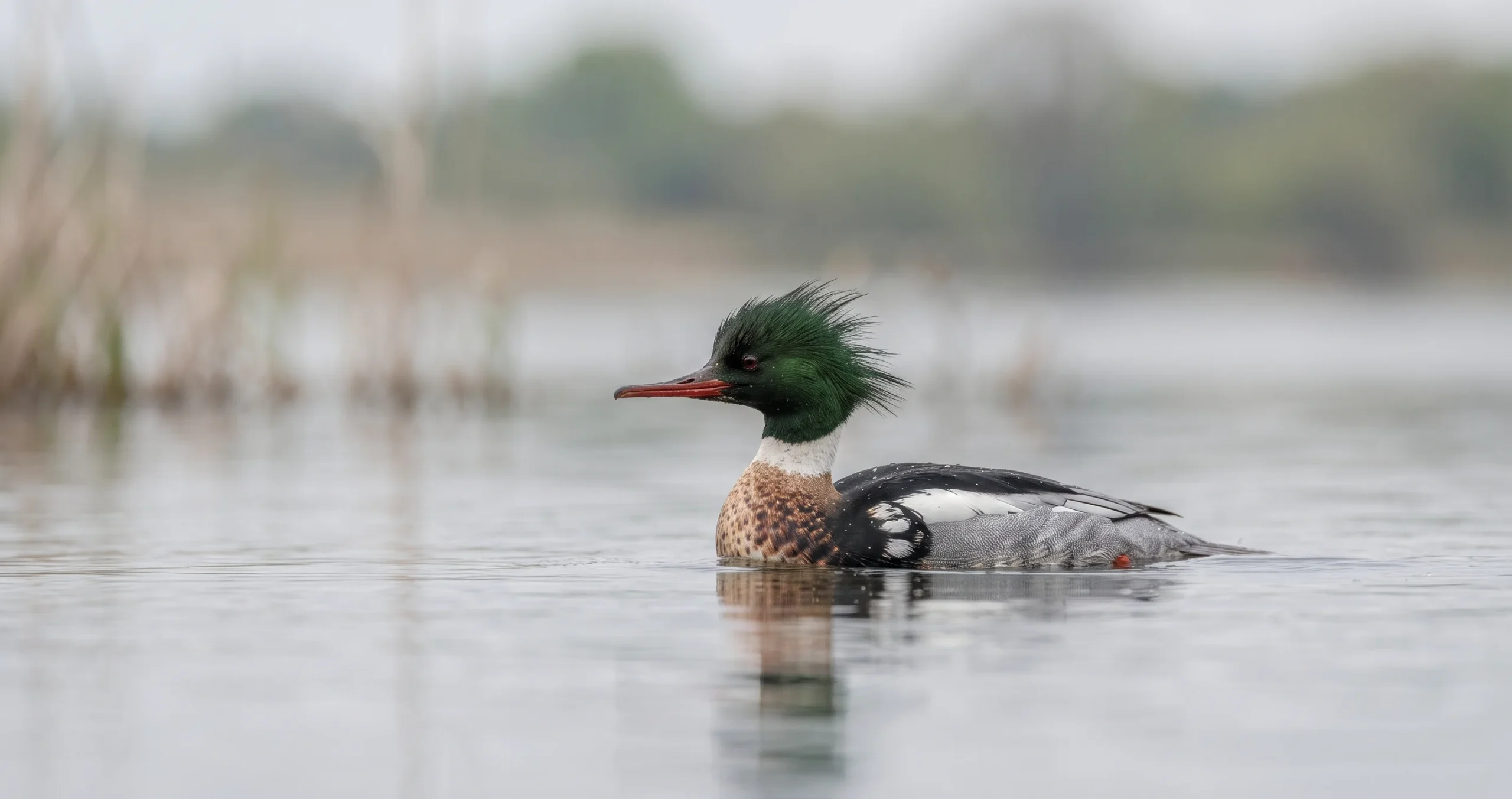
A duck with a wild, spiky hairstyle and a bill lined with toothlike serrations may sound like a creature from prehistoric times. Yet this remarkable bird can be spotted diving for fish along America’s coastlines during winter.
The red-breasted merganser (Mergus serrator) is one of North America’s most distinctive diving ducks. Unlike familiar mallards that dabble near the water’s surface, these specialized waterbirds pursue small fish underwater using their streamlined bodies, powerful feet, and unusually narrow bills.
Their shaggy crests give them an unmistakable appearance, while their energetic hunting techniques make them fascinating to observe.
From sheltered coastal bays to large inland lakes, these extraordinary ducks offer a wonderful opportunity to discover the hidden world of aquatic wildlife.
Table of Contents
- Understanding the Red-Breasted Merganser
- How to Identify Red-Breasted Mergansers
- Where Red-Breasted Mergansers Live
- The Science Behind Their Underwater Hunting Skills
- What Do Red-Breasted Mergansers Eat?
- Migration and Winter Behavior
- Red-Breasted Merganser vs. Common Merganser
- Breeding and Nesting Habits
- The Ecological Importance of Red-Breasted Mergansers
- In Your Own Yard: Supporting Healthy Aquatic Habitats
- Frequently Asked Questions
Understanding the Red-Breasted Merganser
The red-breasted merganser belongs to the family Anatidae, which includes ducks, geese, and swans. It is also part of a group of ducks commonly known as mergansers, recognized for their narrow, serrated bills and specialized fish-catching behavior.
Unlike many familiar freshwater ducks, red-breasted mergansers frequently inhabit coastal environments, particularly outside the breeding season.
They have a broad distribution across the Northern Hemisphere, occurring in North America, Europe, and Asia.
A Duck With an Unusual Appearance
The most immediately recognizable feature of this species is its irregular, shaggy crest.
Rather than forming a smooth arrangement of feathers, the elongated head feathers often project in different directions, giving the bird a permanently windswept appearance.
Combined with its slender neck, pointed bill, and elongated body, this crest creates a distinctive silhouette that experienced birdwatchers can recognize from considerable distances.
Why They Are Called Sawbills
Mergansers are sometimes referred to as sawbills because of the serrated edges of their bills.
These serrations resemble tiny teeth, although they are not true teeth. Instead, they are specialized structures that help the birds maintain a secure grip on slippery prey.
For a duck that spends much of its time catching fish, this adaptation is particularly useful.
How to Identify Red-Breasted Mergansers
Male and female red-breasted mergansers have noticeably different plumage, especially during the breeding season. Learning the characteristics of both sexes makes identification much easier throughout the year.
Adult Male Red-Breasted Mergansers
Males in breeding plumage display a striking combination of colors and patterns.
Their identifying features include:
- Dark, iridescent green head.
- Long, irregular double crest.
- Bright red or reddish-orange eyes.
- Slender reddish bill.
- White neck collar.
- Rust-colored breast with dark markings.
- Gray flanks and contrasting black-and-white wing patterns.
The reddish-brown breast is the feature that gives the species its common name.
Outside the breeding season, males may develop more subdued plumage, making identification slightly more challenging.
Adult Female Red-Breasted Mergansers
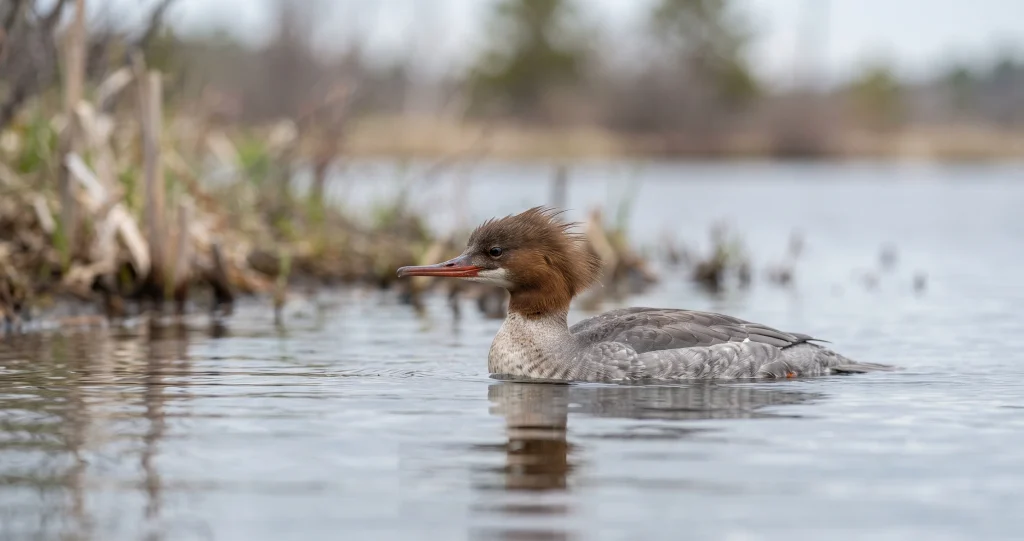
Females have more understated coloration but retain the species’ distinctive shape.
Their most recognizable features are a reddish-brown head, shaggy crest, gray body, pale underside, and narrow reddish bill.
Unlike female common mergansers, they typically lack a sharply defined boundary between the reddish head and pale neck.
Size and Body Shape
Red-breasted mergansers generally measure approximately 20–25 inches in length.
Their elongated bodies and relatively slender necks make them appear quite different from more rounded diving ducks.
When swimming, they often hold their bodies relatively low in the water, creating a streamlined profile well suited to underwater pursuit.
Where Red-Breasted Mergansers Live
Red-breasted mergansers occupy a wide range of aquatic environments throughout the year.
Their habitat preferences change with the seasons, breeding requirements, and availability of prey.
Coastal Habitats
During winter, these birds are frequently found in saltwater and brackish environments.
Typical locations include sheltered ocean bays, estuaries, tidal inlets, coastal lagoons, and harbors.
These habitats often support populations of small fish, providing abundant feeding opportunities.
Along the Atlantic and Pacific coasts of the United States, red-breasted mergansers may be observed swimming individually or gathering in groups.
Freshwater Habitats
Although strongly associated with coastal waters during winter, red-breasted mergansers also inhabit freshwater environments.
Large lakes, rivers, reservoirs, and northern wetlands can provide suitable breeding or feeding habitat.
The Great Lakes are particularly important for observing migrating and wintering waterbirds, including mergansers, wherever suitable open water remains available.
The Science Behind Their Underwater Hunting Skills
Watching a red-breasted merganser disappear beneath the water reveals only a small part of its remarkable hunting strategy.
Below the surface, several specialized adaptations work together to help the bird locate, pursue, and capture fast-moving prey.
A Streamlined Body Reduces Resistance
Moving through water requires considerably more effort than moving through air.
The merganser’s elongated body and narrow profile help reduce resistance as it swims underwater.
This streamlined shape allows it to maneuver efficiently while searching for fish.
Powerful Webbed Feet Provide Propulsion
Red-breasted mergansers primarily use their webbed feet to propel themselves underwater.
Their legs are positioned relatively far back on their bodies, an arrangement that supports efficient swimming and diving.
However, this specialization also makes movement on land somewhat awkward compared with ducks that spend more time walking and grazing.
Underwater Vision Helps Locate Fish
Like other diving birds that hunt visually, red-breasted mergansers must locate moving prey beneath the water’s surface.
They sometimes swim with their heads partly submerged, scanning the environment before initiating a dive.
Water clarity, light levels, and prey behavior can all influence their hunting opportunities.
A Serrated Bill Secures Slippery Prey
Catching a fish is only part of the challenge. Holding onto it long enough to swallow requires another specialized adaptation.
The backward-oriented serrations along the bill help prevent slippery fish from escaping.
Rather than chewing their prey, mergansers generally swallow appropriately sized fish whole.
Cooperative Feeding Behavior
One of their most fascinating behaviors occasionally occurs when several mergansers feed together.
Groups may swim in coordinated formations, concentrating small fish in shallower areas where they become easier to capture.
Not every feeding group displays this behavior, but it illustrates the flexibility of their hunting strategies.
A seemingly chaotic gathering of diving ducks may actually represent a remarkably effective way of exploiting a shared food source.
What Do Red-Breasted Mergansers Eat?
Red-breasted mergansers primarily feed on small fish, making them considerably different from ducks that consume large quantities of aquatic vegetation.
Their diet depends on local prey availability and seasonal habitat conditions.
Their Favorite Natural Food Sources
Their diet may include:
- Minnows.
- Herring.
- Sand lance.
- Sticklebacks.
- Small crustaceans.
- Aquatic insects.
- Tadpoles.
Although fish dominate their diet, other aquatic animals can provide additional feeding opportunities.
The Energy Demands of Fishing
Diving repeatedly in cold water requires considerable energy.
According to the Cornell Lab of Ornithology, researchers estimate that a red-breasted merganser may need to consume 15–20 fish daily and make 250–300 dives to meet its energy requirements. Actual feeding activity varies with environmental conditions and prey availability. All About Birds
This incredible workload explains why these ducks spend so much time actively searching for food.
Migration and Winter Behavior
Autumn marks an important transition for red-breasted mergansers as northern breeding habitats become increasingly unsuitable for feeding.
Seasonal Migration
Migratory populations gradually move south toward areas where open water and fish remain accessible.
Along the United States coastline, these seasonal movements bring mergansers into bays, estuaries, and harbors.
Some birds travel considerable distances to reach wintering grounds.
Winter Feeding Strategies
During colder months, sheltered coastal waters can provide favorable feeding conditions.
Mergansers may concentrate near tidal channels and shallow bays where small fish gather.
Their activity can change throughout the day depending on tides, weather, and prey movements.
Taking Flight From Water
Red-breasted mergansers often require a running start across the water before becoming airborne.
Once in flight, their rapid wingbeats, elongated bodies, and extended necks create a distinctive appearance.
Both sexes display noticeable white wing markings during flight.
Red-Breasted Merganser vs. Common Merganser
Distinguishing between these two closely related species can be challenging, particularly when observing females or immature birds.
Fortunately, several characteristics can help.
| Feature | Red-Breasted Merganser | Common Merganser |
|---|---|---|
| Male’s head | Shaggy green crest | Smoother green head |
| Male’s breast | Rusty brown | Mostly white |
| Female’s neck | Gradual color transition | Sharply defined color transition |
| Bill | Very slender | Slightly heavier |
| Body shape | Slim and elongated | Larger and more robust |
| Winter habitat | Often coastal saltwater | Often freshwater |
| Typical nesting site | Sheltered ground | Tree cavities |
Female common mergansers also tend to display a more distinctive white chin patch. Audubon Field Guide+1
Habitat alone is not enough to confirm identification because both species can occupy similar environments.
Breeding and Nesting Habits
Despite spending much of their lives on water, red-breasted mergansers return to land to raise their young.
Courtship Displays
During courtship, males perform elaborate movements involving head raising, body dipping, and upward-pointing bills.
These unusual displays can make an otherwise peaceful gathering of ducks surprisingly animated.
Nesting Near Water
Females generally establish their nests in concealed locations close to shore.
Dense vegetation, low branches, rocks, and fallen logs can provide suitable protection.
The nest is typically a shallow depression lined with plant material and soft down feathers.
Raising the Ducklings
Newly hatched ducklings are covered in down and capable of leaving the nest shortly after hatching.
They begin feeding independently under their mother’s supervision. Small aquatic invertebrates are particularly important during their early development. Audubon Field Guide
The Ecological Importance of Red-Breasted Mergansers
Red-breasted mergansers occupy an important position within aquatic food webs.
As predators of small fish and other aquatic animals, they participate in the natural movement of energy through freshwater and marine ecosystems.
However, their survival depends on productive aquatic environments.
Water pollution, shoreline development, habitat degradation, discarded fishing equipment, and human disturbance can all create challenges for diving birds.
Protecting coastal wetlands and maintaining healthy fish habitats benefits mergansers alongside countless other wildlife species.
In Your Own Yard: Supporting Healthy Aquatic Habitats
Although red-breasted mergansers are unlikely to visit an ordinary backyard pond, gardeners can still contribute to their conservation.
Many everyday gardening decisions influence the health of nearby rivers, lakes, and coastal waters.
Grow Native Plants
Native vegetation helps stabilize soil, reduce erosion, and slow surface runoff before it reaches waterways.
Create a Rain Garden
A rain garden filled with moisture-tolerant native plants can collect stormwater and encourage natural infiltration.
This reduces the amount of untreated runoff flowing directly into nearby aquatic habitats.
Reduce Unnecessary Garden Chemicals
Using fertilizers and pesticides carefully helps limit the movement of excess nutrients and potentially harmful substances into waterways.
Observe Waterbirds Responsibly
When visiting coastal parks or wildlife refuges, bring binoculars and maintain a respectful distance from feeding birds.
Late fall and winter are particularly rewarding seasons for observing these fascinating ducks.
Frequently Asked Questions
1. Are red-breasted mergansers rare in the United States?
Red-breasted mergansers are not generally considered rare. However, their abundance varies by location and season. They are more commonly encountered along coastlines during migration and winter.
2. Do red-breasted mergansers have teeth?
No. Their bills contain toothlike serrations rather than true teeth. These specialized edges help them hold slippery fish before swallowing them.
3. Where is the best place to see red-breasted mergansers in winter?
Sheltered coastal bays, estuaries, harbors, tidal channels, and large ice-free lakes are excellent places to look. Binoculars can help you recognize their narrow bills and distinctive shaggy crests.
Conclusion
With its windswept crest, serrated bill, and impressive diving abilities, the red-breasted merganser is a wonderful example of nature’s ingenuity.
Every feature, from its streamlined body to its powerful webbed feet, contributes to a lifestyle centered on underwater hunting.
The next time you explore a quiet coastal bay in winter, watch for a shaggy-headed duck disappearing beneath the waves. You may be witnessing one of North America’s most fascinating feathered fishermen at work.
External Sources
1. Red-Breasted Merganser Life History
Red-breasted mergansers can hunt together by driving schools of small fish into confined areas. Cornell Lab of Ornithology. Cornell Lab of Ornithology
2. Red-Breasted Merganser Overview
satisfy their energy requirements. Cornell Lab of Ornithology. All About Birds
3. Red-Breasted Merganser Field Guide
Several groups of ducklings may join together and receive supervision from one or more adult females. National Audubon Society. Audubon Field Guide