
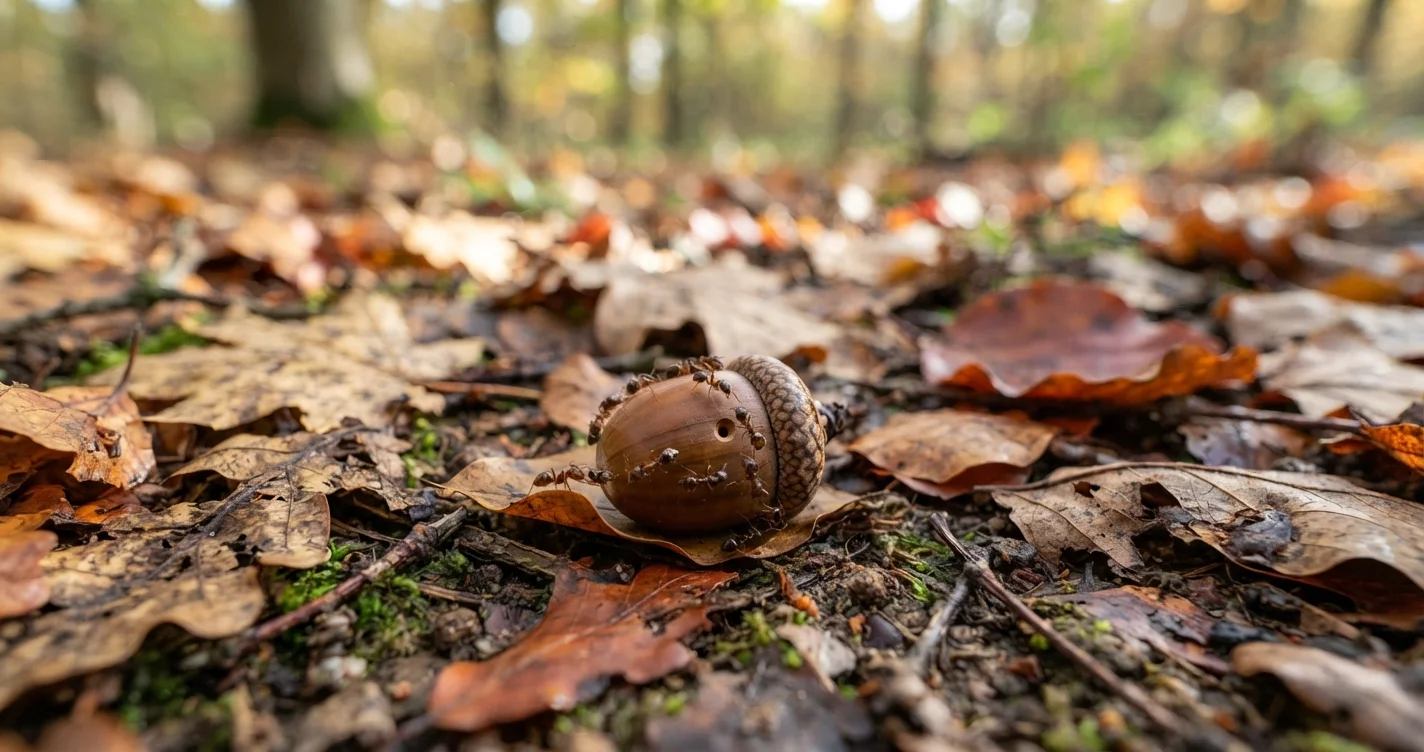
An empty acorn lying beneath an oak tree may look like nothing more than a discarded seed. But hidden inside its tiny shell could be an entire community, complete with a queen, hardworking adults, developing larvae, and a carefully maintained living space.
Known as acorn ants, these remarkably small insects have adapted to living inside hollow acorns, abandoned nutshells, and other natural cavities scattered across the forest floor.
Unlike ants that construct elaborate underground tunnels, acorn ants often take advantage of shelters that nature has already provided.
Their miniature colonies reveal an extraordinary world of cooperation, collective decision-making, and seasonal survival.
Even an ordinary pile of autumn leaves can contain entire communities that remain almost invisible to the human eye.
Table of Contents
- What Are Acorn Ants?
- How Acorn Ants Fit an Entire Colony Inside One Acorn
- How Acorn Ant Colonies Are Organized
- What Acorn Ants Eat
- How Acorn Ants Choose a New Home
- How Acorn Ants Survive Winter
- Where to Find Acorn Ants in North America
- Why Acorn Ants Matter to Forest Ecosystems
- In Your Own Yard: Creating Habitat for Acorn Ants
- Frequently Asked Questions
What Are Acorn Ants?
Acorn ants are small, cavity-nesting ants belonging to the genus Temnothorax. Many species inhabit temperate forests, where they occupy naturally occurring spaces within fallen plant material.
One particularly well-known North American species is Temnothorax curvispinosus, which commonly nests inside hollow acorns and small woody cavities.
These insects are easy to overlook because of their tiny size and relatively inconspicuous behavior.
How Small Are Acorn Ants?
Workers of many acorn ant species measure approximately 2–4 millimeters in length, making them smaller than a grain of rice.
Their coloration varies by species, but many have yellowish-brown, reddish-brown, or dark brown bodies.
Despite their miniature appearance, they maintain highly organized social communities.
A Different Kind of Ant Colony
Some familiar ant species establish enormous colonies containing thousands of individuals.
Acorn ant colonies are generally much smaller, often containing several dozen to a few hundred workers, depending on the species and available nesting space.
Their modest colony size allows them to exploit shelters that would be unsuitable for larger ant communities.
How Acorn Ants Fit an Entire Colony Inside One Acorn
From the outside, an acorn appears far too small to accommodate an organized insect society.
However, its hollow interior can provide a surprisingly functional living space.
Finding a Naturally Hollow Shelter
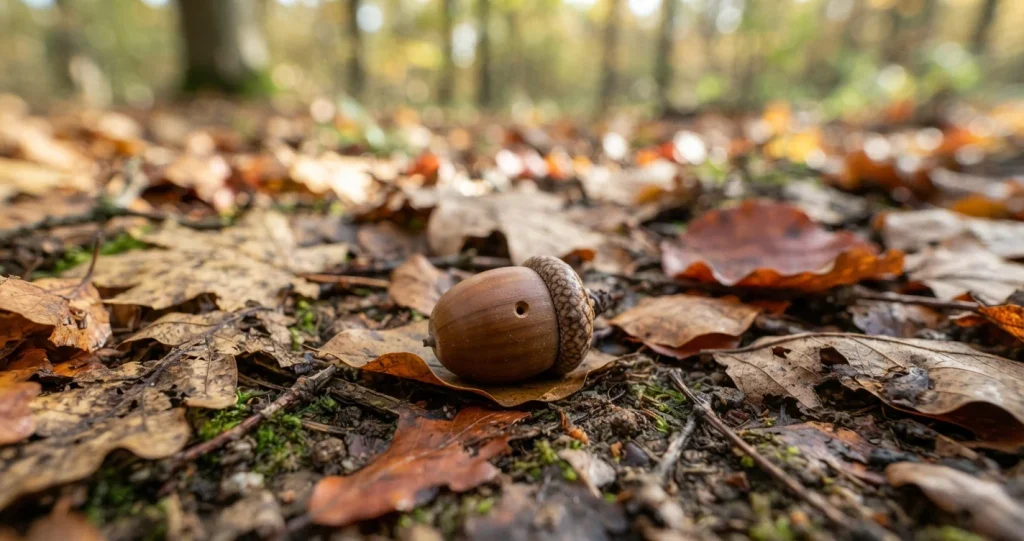
Acorn ants generally occupy acorns that have already become hollow or damaged.
Acorn weevil larvae, other insects, decomposition, and natural weathering can create openings or remove portions of the seed’s interior.
Once abandoned, these cavities may become available to a variety of small organisms, including ants.
The ants take advantage of this existing structure rather than excavating an entire underground nest.
A Compact but Functional Living Space
Inside an occupied acorn, workers move between the queen, developing eggs, larvae, and pupae.
Different areas within the cavity may serve as temporary resting spaces or locations for brood care.
However, an acorn nest does not necessarily contain elaborate permanent chambers like those found in some underground ant nests.
Its organization is largely determined by the available cavity and the colony’s changing needs.
The Advantages of a Small Entrance
A narrow entrance can make the nest easier to defend against larger insects and other potential intruders.
In some cases, workers modify the entrance using small particles of soil or plant debris.
The hard outer shell also provides a degree of protection against physical disturbance and direct exposure to the elements.
The Limitations of a Tiny Home
An acorn is not a permanent or perfectly insulated shelter.
It can crack, decay, become excessively wet, or experience substantial temperature fluctuations.
As the colony grows or its existing shelter deteriorates, workers may begin searching for a more suitable nesting location.
This ability to relocate is an important part of their survival strategy.
Researchers studying Temnothorax curvispinosus have documented colonies of approximately 100 workers living inside individual hollow acorns or hickory nuts, with adult workers measuring around 2.5 millimeters in length. ScienceDirect
Their miniature size makes this extraordinary living arrangement possible.
How Acorn Ant Colonies Are Organized
Despite occupying such a small space, acorn ant colonies maintain a sophisticated social structure.
Each member contributes to the survival and development of the community.
The Queen
The queen is primarily responsible for reproduction.
She lays eggs that develop into new members of the colony. Some established colonies of Temnothorax curvispinosus may contain multiple queens.
Interestingly, queens do not necessarily direct the everyday activities of their workers.
The Workers
Worker ants perform most of the tasks required to maintain the colony.
Their responsibilities include searching for food, protecting the nest, caring for developing larvae, and investigating potential new shelters.
Younger workers often remain inside the nest caring for the brood, while older workers are more likely to venture outside. PubMed Central (PMC)
The Developing Brood
Like other ants, acorn ants undergo complete metamorphosis, passing through four developmental stages:
- Egg
- Larva
- Pupa
- Adult
Workers feed the larvae, maintain suitable conditions, and move developing individuals when the colony relocates.
This cooperative system allows an entire generation of insects to develop within a space smaller than a walnut.
What Acorn Ants Eat
Although they live inside acorns, these ants do not primarily depend on the acorns themselves for food.
Instead, workers venture into the surrounding environment to collect a variety of nutritional resources.
Small Insects and Organic Material
Acorn ants may feed on dead insects, tiny invertebrates, and other edible organic material found among fallen leaves.
Animal-based foods provide nutrients that support larval development and colony growth.
Natural Sources of Sugar
Workers may also collect sugary liquids, including honeydew produced by certain sap-feeding insects.
These carbohydrates provide energy for everyday activities.
Searching Close to Home
Because of their small size, acorn ants often forage within a relatively limited area.
Research on Temnothorax curvispinosus indicates that workers frequently search for food within approximately 3 feet of their nests. PubMed Central (PMC)
A small patch of undisturbed leaf litter can therefore provide both shelter and feeding opportunities.
How Acorn Ants Choose a New Home
Perhaps even more fascinating than their miniature nests is the way these ants collectively decide where to live.
When an existing nest deteriorates, workers can investigate alternative shelters and coordinate the relocation of the colony.
Scout Ants Explore the Surroundings
Individual workers search for suitable cavities within nearby acorns, nutshells, or hollow twigs.
They may evaluate several characteristics, including entrance size, interior space, and exposure to light.
A dark, sheltered cavity with a narrow entrance can offer important advantages.
Tandem Running: Teaching Other Ants the Way
In several Temnothorax species, scout ants use a behavior known as tandem running.
An experienced worker leads another ant toward a potential nesting location.
The follower maintains contact with the leading ant, allowing it to learn the route.
Through repeated recruitment, more workers become familiar with the proposed shelter.
Making a Collective Decision
As enough workers gather at a suitable location, the colony may begin relocating more rapidly.
Workers transport other adults and developing brood to the new nest.
Remarkably, this coordinated process takes place without a central leader directing every movement.
It is an excellent example of collective intelligence emerging from relatively simple individual behaviors.
In laboratory experiments, researchers have found that colonies of Temnothorax curvispinosus can compare potential homes and collectively select more desirable nesting sites, even when most individual workers have not personally inspected every alternative. PubMed Central (PMC)
How Acorn Ants Survive Winter
While many ant species retreat into underground chambers during winter, acorn ants can spend the colder months inside their miniature aboveground shelters.
Slowing Down During Cold Weather
As temperatures decrease, the ants’ metabolic activity generally slows.
Workers become less active, foraging opportunities decline, and colony development may slow considerably.
During warmer winter days, some individuals may temporarily resume activity.
The Protective Role of Fallen Leaves
An acorn resting beneath a layer of fallen leaves experiences different conditions from one lying on exposed ground.
Leaf litter helps moderate temperature fluctuations, retain moisture, and reduce direct exposure to wind.
Snow cover can also provide insulation against extreme cold.
Adapting to Urban Temperatures
Acorn ants have become particularly interesting to scientists studying how wildlife adapts to urban environments.
A 2023 study found that winter-acclimated urban populations of Temnothorax curvispinosus displayed greater heat tolerance than rural populations while retaining several aspects of cold-weather physiological performance. PubMed
Even these tiny forest inhabitants can offer valuable insights into evolutionary responses to environmental change.
Where to Find Acorn Ants in North America
Acorn ants occupy various woodland habitats, with Temnothorax curvispinosus widely distributed across the eastern United States.
They are particularly associated with hardwood forests containing abundant fallen leaves and naturally occurring nesting cavities.
Promising Places to Observe Them
| Habitat | Potential nesting sites |
|---|---|
| Oak woodlands | Hollow acorns |
| Mixed hardwood forests | Abandoned nutshells |
| Hickory groves | Hollow hickory nuts |
| Woodland gardens | Small decaying twigs |
| Urban forest patches | Acorns beneath leaf litter |
| Shaded forest edges | Small woody cavities |
Look for older acorns with small openings, especially in areas where fallen leaves have accumulated naturally.
Avoid breaking open occupied acorns. Doing so can destroy the protective shelter of an entire colony.
Why Acorn Ants Matter to Forest Ecosystems
Although their colonies are small, acorn ants participate in the complex ecological relationships that sustain woodland environments.
Recycling Organic Resources
By collecting dead insects and other edible organic material, these ants contribute to nutrient cycling within the forest floor ecosystem.
Their activities connect the living insect community with decomposing organic matter.
Supporting Forest Food Webs
Acorn ants can become prey for spiders, predatory insects, and other small animals.
Their presence adds another layer of biodiversity to woodland habitats.
Helping Scientists Understand Collective Intelligence
Acorn ants offer researchers an opportunity to study how groups make decisions without centralized leadership.
Their nest selection behavior provides insights into cooperation, information sharing, and decentralized decision-making.
These principles are also of interest to researchers studying robotics and artificial intelligence.
In Your Own Yard: Creating Habitat for Acorn Ants
A wildlife-friendly garden does not necessarily require elaborate insect hotels or expensive landscaping features.
Sometimes, the smallest natural materials provide the most interesting habitats.
Leave Some Autumn Leaves
Allow fallen leaves to accumulate beneath established trees and shrubs where practical.
These sheltered areas provide valuable habitat for ants, beetles, spiders, and other small woodland inhabitants.
Preserve Fallen Acorns and Twigs
Leave some acorns, nutshells, and small branches in undisturbed garden corners.
As these materials age, they may develop cavities suitable for nesting insects.
Plant Native Oak Trees
Where space and growing conditions permit, native oaks provide long-term ecological benefits.
Their fallen leaves, acorns, bark, and branches support a remarkable diversity of wildlife.
Reduce Broad-Spectrum Pesticide Use
Choose targeted pest management techniques that minimize unnecessary harm to beneficial and non-target insects.
Maintaining a diverse garden ecosystem allows many small organisms to coexist naturally.
Observe Without Disturbing
Use a magnifying glass or macro photography to explore the miniature world beneath your trees.
If you discover ants entering and leaving an acorn, observe their movements without damaging or relocating their shelter.
Frequently Asked Questions
1. How many acorn ants can live inside one acorn?
A single acorn can house several dozen to approximately 100 worker ants, along with one or more queens and developing brood. Colony size varies depending on the species, maturity, and available nesting space.
2. Do acorn ants eat the acorns they live in?
Acorn ants generally occupy previously hollowed or damaged acorns rather than relying on them as their primary food source. They forage for small insects, organic material, and sugary substances.
3. Are acorn ants harmful to gardens?
Acorn ants are generally harmless to garden plants and people when left undisturbed. They naturally inhabit woodland debris and contribute to local biodiversity and nutrient cycling.
Conclusion
The next time you walk beneath an oak tree, take a closer look at the fallen acorns scattered among the leaves.
What appears to be an empty nutshell could contain an entire community of tiny insects working together to survive.
Acorn ants demonstrate that sophisticated social organization, collective intelligence, and remarkable environmental adaptations can exist within the smallest natural spaces.
Their miniature homes also remind us why preserving fallen leaves, acorns, and woody debris matters for biodiversity.
Sometimes, an entire world of wildlife is hiding beneath our feet.
External Sources
1. Acorn Ants Carefully Evaluate the Architecture of Their Homes
Researchers found that 52% of the natural nest entrances examined had been made smaller by ants using soil and leaf litter. The ants also preferred compact cavities over narrow, flattened spaces. The Pierce Lab. Harvard University. Read the scientific study
2. Tiny Ants Compare Homes Without a Central Leader
Acorn ant colonies can collectively evaluate alternative nesting locations even when most individual ants have not examined all the available options. PubMed Central (PMC). PLOS ONE. Read the full scientific study
3. Acorn Ants Can Build a Second Entrance to Their Homes
Researchers studying the European acorn ant Temnothorax crassispinus discovered that colonies sometimes created a second entrance while modifying damaged nesting cavities. They used sand, soil, and plant fragments as construction materials. PubMed Central (PMC) .Insects. Read the full scientific study.