
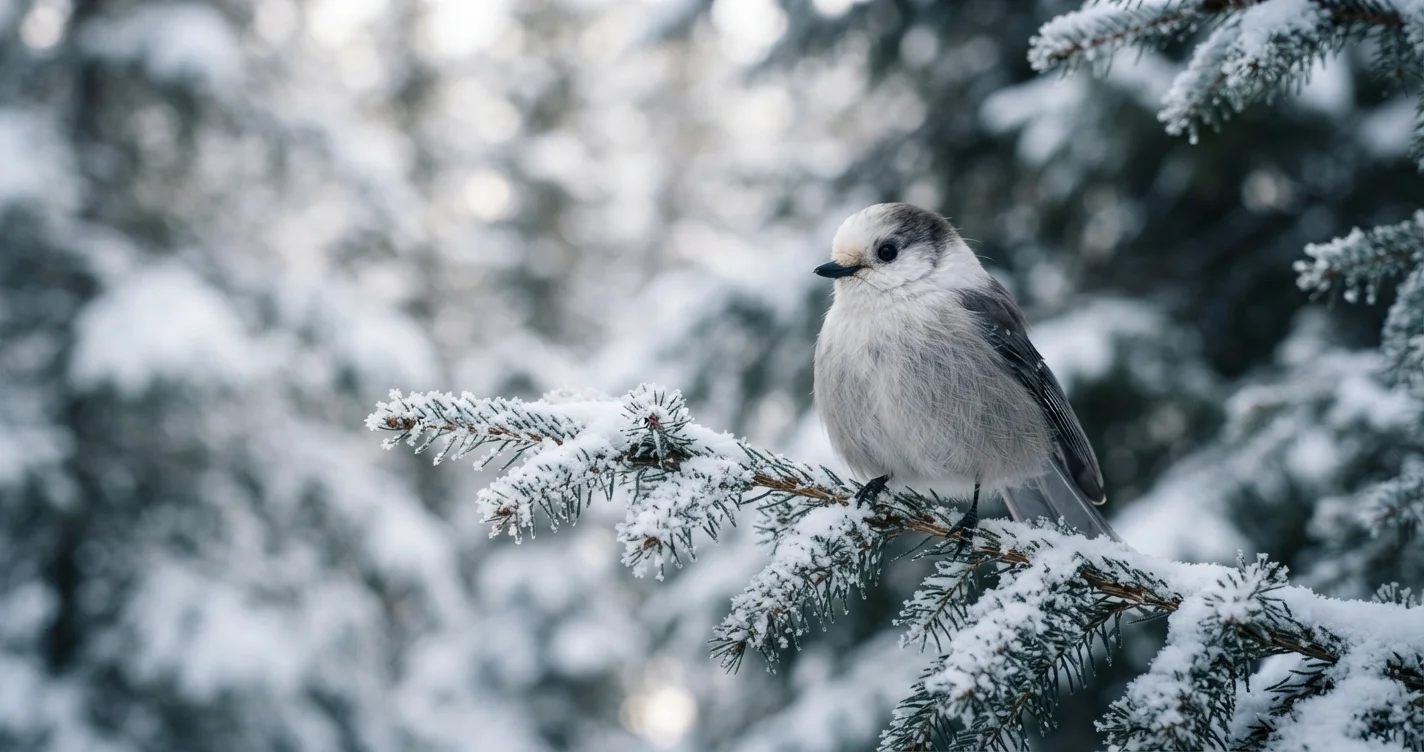
Deep in a snow-covered evergreen forest, a small gray bird presses a sticky piece of food beneath a strip of tree bark. It leaves the meal behind and flies away, storing another valuable resource for the difficult winter months ahead.
This remarkable example of Canada jay food caching reveals one of North America’s most fascinating bird survival strategies.
The Canada jay (Perisoreus canadensis), formerly known as the gray jay, produces sticky saliva that helps it attach food to branches, bark crevices, and other sheltered places.
Instead of migrating south to escape freezing temperatures, this resourceful bird remains in northern forests throughout the year.
Its unusual saliva, impressive spatial memory, and ability to preserve food in cold environments help it survive conditions that many other birds avoid.
Table of Contents
- What Is a Canada Jay?
- Canada Jay Food Caching: How Sticky Saliva Helps Preserve Food
- What Foods Do Canada Jays Store for Winter?
- Where Canada Jays Hide Their Winter Food
- How Canada Jays Remember Their Hidden Food
- Why Canada Jays Remain in Northern Forests During Winter
- How Climate Change Affects Canada Jay Food Storage
- Where to Find Canada Jays in Winter
- In Your Own Yard: Supporting Winter Forest Birds
- Frequently Asked Questions
What Is a Canada Jay?
The Canada jay is a medium-sized songbird belonging to the family Corvidae, which also includes crows, ravens, and magpies.
Unlike the brightly colored blue jay, this northern forest resident displays subtle shades of gray, white, and charcoal.
Its soft plumage and rounded appearance give it a particularly distinctive silhouette against snowy evergreen branches.
Physical Characteristics
Adult Canada jays generally measure approximately 10–13 inches in length. Their most recognizable features include:
- Soft gray feathers covering the back and wings.
- A pale gray or whitish underside.
- A rounded head with a white forehead.
- Dark feathers around the back of the head.
- A relatively short black bill.
- A long, rounded tail.
Young Canada jays are generally darker than adults, developing their more recognizable plumage as they mature.
The Bird With Several Names
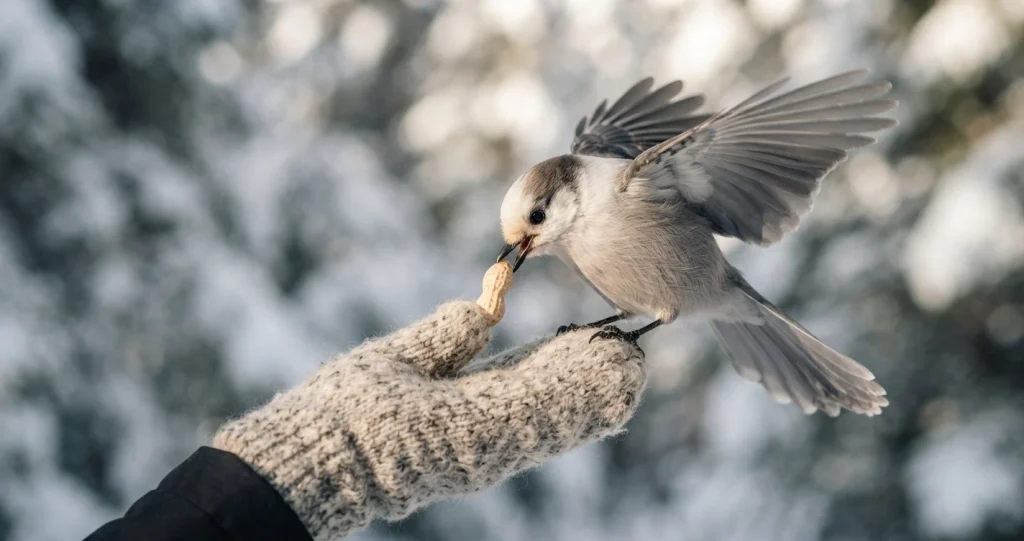
The Canada jay has also been known as the gray jay, whisky jack, and camp robber.
Its reputation for investigating campsites comes from its opportunistic feeding behavior and remarkable curiosity around people.
In 2018, the American Ornithological Society restored Canada jay as the species’ official English name, replacing gray jay.
Canada Jay Food Caching: How Sticky Saliva Helps Preserve Food
Imagine preparing hundreds of miniature meals and hiding them throughout a forest before winter arrives.
For Canada jays, collecting and storing food is an essential part of everyday life.
Their specialized saliva allows them to create small, adhesive food packages that can be stored above the ground.
Specialized Salivary Glands
Canada jays possess unusually large salivary glands that produce thick, sticky saliva.
When preparing food for storage, the bird manipulates small pieces inside its mouth, coating them with saliva and sometimes combining them into a compact mass known as a bolus.
The saliva acts like a natural adhesive, allowing the food to stick to suitable surfaces.
A small piece of food that might otherwise fall from a branch can remain attached within a sheltered crevice.
A Natural Food Storage System
Unlike squirrels that may accumulate food in underground chambers, Canada jays generally distribute numerous small caches throughout their territories.
This strategy is known as scatter hoarding.
By spreading their food supplies across many locations, the birds reduce their dependence on any single storage site.
If another animal discovers one cache, many others may remain available.
How Cold Temperatures Help Preserve Food
Canada jays frequently store perishable foods, including insects, berries, and animal tissue.
Cold northern temperatures can slow microbial activity and food decomposition, helping some cached foods remain edible for extended periods.
In this respect, the surrounding forest functions somewhat like a natural outdoor refrigerator.
However, the sticky saliva primarily serves as an adhesive rather than a proven natural preservative. Temperature, moisture, food type, and storage location all influence how long cached food remains usable.
The Four Stages of Food Caching
The Canada jay’s food storage process can be divided into four basic stages:
- Collecting: The bird searches for berries, insects, fungi, or other suitable food.
- Preparing: It coats the food with sticky saliva inside its mouth.
- Hiding: It attaches the food beneath loose bark, among conifer needles, or behind lichens.
- Retrieving: It returns to its hidden supplies when fresh food becomes scarce.
This remarkable combination of physical adaptation and behavior allows Canada jays to exploit resources long after their original period of abundance. research.fs.usda.gov
What Foods Do Canada Jays Store for Winter?
Unlike many food-caching birds that primarily store seeds and nuts, Canada jays have a remarkably diverse diet that includes highly perishable foods.
Insects and Other Invertebrates
During summer and early autumn, Canada jays collect caterpillars, beetles, spiders, and other small invertebrates.
These foods provide valuable protein and other nutrients.
Wild Berries
Blueberries, crowberries, and other forest berries provide seasonal feeding opportunities.
When berries are abundant, Canada jays may store some for later consumption.
Mushrooms and Fungi
Canada jays also consume and cache pieces of mushrooms and other fungi, adding another unusual ingredient to their winter pantry.
Animal Tissue
As opportunistic omnivores, Canada jays sometimes feed on animal carcasses and small prey.
They may store small pieces of animal tissue in trees for future use.
A nutritional study published in 2022 found that Canada jays stored food with proportions of macronutrients similar to those in the food they consumed immediately, suggesting that they forage to meet both present and future nutritional needs. PubMed
Where Canada Jays Hide Their Winter Food
The forest canopy offers an extraordinary number of potential storage locations.
Even a single mature evergreen tree can contain numerous sheltered surfaces suitable for hiding food.
Beneath Loose Tree Bark
Small openings beneath bark flakes provide concealed spaces where food can remain relatively protected from direct exposure.
Behind Lichens
Lichens growing on trunks and branches offer convenient hiding places for small food packages.
Their irregular surfaces help conceal the stored material.
Among Evergreen Needles
Dense clusters of spruce and fir needles can provide suitable locations for attaching and concealing small food items.
Why Store Food Above the Ground?
By caching food in trees, Canada jays retain access to their supplies even when deep snow covers the forest floor.
This important advantage allows them to continue feeding throughout much of winter without searching beneath accumulations of snow.
How Canada Jays Remember Their Hidden Food
Creating scattered food caches would provide little benefit if the birds could not relocate them.
Fortunately, Canada jays possess effective spatial memory.
Remembering Locations Across the Forest
Canada jays appear capable of remembering many of their storage locations across their home territories.
Spatial memory helps them navigate familiar environments and relocate previously hidden food.
Tree trunks, branch arrangements, and other environmental features may provide useful visual landmarks.
Protecting Food From Other Birds
Hidden supplies are not always safe.
Other Canada jays and competing bird species may discover and steal stored food.
Distributing supplies among numerous locations helps reduce the consequences of losing individual caches.
Not every stored item will be recovered, but successful retrieval of enough food can make an important difference during winter.
Why Canada Jays Remain in Northern Forests During Winter
Many North American birds migrate south when temperatures decrease and insects become scarce.
Canada jays follow a different strategy.
Remaining Within Familiar Territories
Canada jays are generally nonmigratory and maintain territories throughout the year.
Their familiarity with local feeding areas, shelter, and cache locations offers important advantages during periods of scarcity.
Dense plumage also provides insulation against cold winter conditions.
Raising Young Before Spring Arrives
Perhaps even more remarkable than their ability to survive winter is their unusual breeding schedule.
Canada jays often begin nesting in late winter, while snow remains on the ground and temperatures can still fall below freezing.
Stored food helps support adults and their developing offspring during this challenging period.
A 2024 study combining DNA analysis with historical feeding observations found evidence that cached foods contribute substantially to adult winter diets and also help nourish nestlings. PubMed Central (PMC)
Their winter pantry therefore supports more than individual survival. It also contributes to the success of the next generation.
How Climate Change Affects Canada Jay Food Storage
For many animals, milder winters might appear beneficial.
For Canada jays, however, warmer conditions can create unexpected challenges.
When the Forest Refrigerator Stops Working
Because Canada jays store perishable foods, their supplies are vulnerable to natural decomposition.
Extended periods of above-freezing temperatures may reduce the quality of cached food before the birds need it most.
The Effects of Freezing and Thawing
Researchers studying Canada jays in Ontario’s Algonquin Provincial Park examined 40 years of breeding records.
They found associations between more frequent autumn freeze-thaw events and poorer reproductive outcomes during the following breeding season. PubMed
Further experimental research published in 2025 examined simulated food caches placed between pieces of black spruce bark.
The researchers found that longer thaw periods increased food mass loss, an indicator of potential cache degradation. Early freeze-thaw events also produced greater losses than later ones under the experimental conditions. PubMed Central (PMC)
These findings illustrate how temperature patterns can influence wildlife months after the original weather events occur.
Protecting Northern Forest Ecosystems
Preserving mature spruce and fir forests helps maintain suitable habitat, natural feeding opportunities, and potential storage locations.
The Canada jay’s dependence on cold forests makes it a particularly interesting species for understanding ecological responses to environmental change.
Where to Find Canada Jays in Winter
Despite their name, Canada jays inhabit several regions of the United States.
They are primarily associated with boreal forests and high-elevation coniferous woodlands.
Promising Winter Birdwatching Regions
| US region | Typical habitat |
|---|---|
| Alaska | Boreal spruce forests |
| Northern Minnesota | Spruce bogs and coniferous woodlands |
| Northern Maine | Dense northern evergreen forests |
| Washington and Oregon | Mountainous conifer forests |
| Colorado | High-elevation spruce-fir forests |
| Montana and Wyoming | Rocky Mountain subalpine woodlands |
| Northern New York | Adirondack boreal habitats |
Watch for Caching Behavior
When visiting suitable forests, observe birds moving repeatedly between feeding locations and evergreen branches.
A Canada jay carrying a small piece of food may be preparing to create another cache.
Binoculars and patient observation provide an excellent opportunity to witness this behavior without disturbing the birds.
In Your Own Yard: Supporting Winter Forest Birds
Canada jays are highly associated with northern and mountain forest habitats. Although they are unlikely to visit most suburban gardens, homeowners can still support local food-caching birds and other winter wildlife.
Plant Native Evergreen Trees
Where appropriate for your region, consider growing native spruce, fir, or pine trees.
Evergreens provide year-round shelter and valuable habitat for numerous bird species.
Grow Native Berry-Producing Shrubs
Regionally appropriate blueberries, serviceberries, and other native fruiting shrubs provide seasonal food for birds and support beneficial insects.
Preserve Natural Tree Features
Healthy trees with naturally textured bark and established branches provide shelter and potential food storage opportunities.
Retain naturally occurring lichens and mosses where practical.
Encourage Natural Feeding Behavior
In areas inhabited by Canada jays, observe the birds without offering human food.
Keep picnic supplies secure and respect wildlife feeding restrictions in national parks and protected forests.
A healthy natural habitat provides resources that support wildlife throughout the seasons.
Frequently Asked Questions
1. Why do Canada jays have sticky saliva?
Canada jays produce thick, adhesive saliva from enlarged salivary glands. This adaptation allows them to attach small food items to tree bark, branches, lichens, and evergreen needles for later consumption.
2. Do Canada jays migrate south during winter?
Canada jays are generally year-round residents of northern and high-elevation coniferous forests. Their insulating plumage and extensive food caches help them survive cold conditions without seasonal migration.
3. How long can Canada jays store their food?
Canada jays can store food for several months under favorable conditions. The actual storage life depends on temperature, moisture, food type, and cache location. Consistently cold conditions generally help slow decomposition.
Conclusion
Somewhere in a quiet, snow-covered forest, a small gray bird is retrieving a meal it may have hidden months earlier.
What appears to be an ordinary piece of food tucked beneath tree bark is part of an extraordinary survival system.
Canada jay food caching demonstrates how specialized anatomy, spatial memory, and seasonal behavior work together to overcome environmental challenges.
With sticky saliva and an entire forest serving as its pantry, the Canada jay has developed a remarkable solution to winter food scarcity.
Sometimes, nature’s most ingenious inventions are hidden beneath a tiny piece of bark.
External Sources
1. A Bird That Uses Its Saliva as Natural Glue
Canada jays produce adhesive food packages inside their mouths before attaching them to concealed surfaces in trees. USDA Forest Service. https://research.fs.usda.gov/feis/species-reviews/peca
2. DNA Analysis Reveals the Importance of Hidden Food
Researchers used DNA analysis of droppings alongside historical feeding records to investigate how stored food supports winter survival and breeding. PLOS ONE (2024). https://pmc.ncbi.nlm.nih.gov/articles/PMC11042713/
3. Scientists Recreated Canada Jay Food Caches in Freezers
Scientists placed small pieces of raw chicken between layers of black spruce bark and used programmable freezers to investigate how changing temperatures affect stored food. PLOS ONE (2025). https://pmc.ncbi.nlm.nih.gov/articles/PMC11970643/