
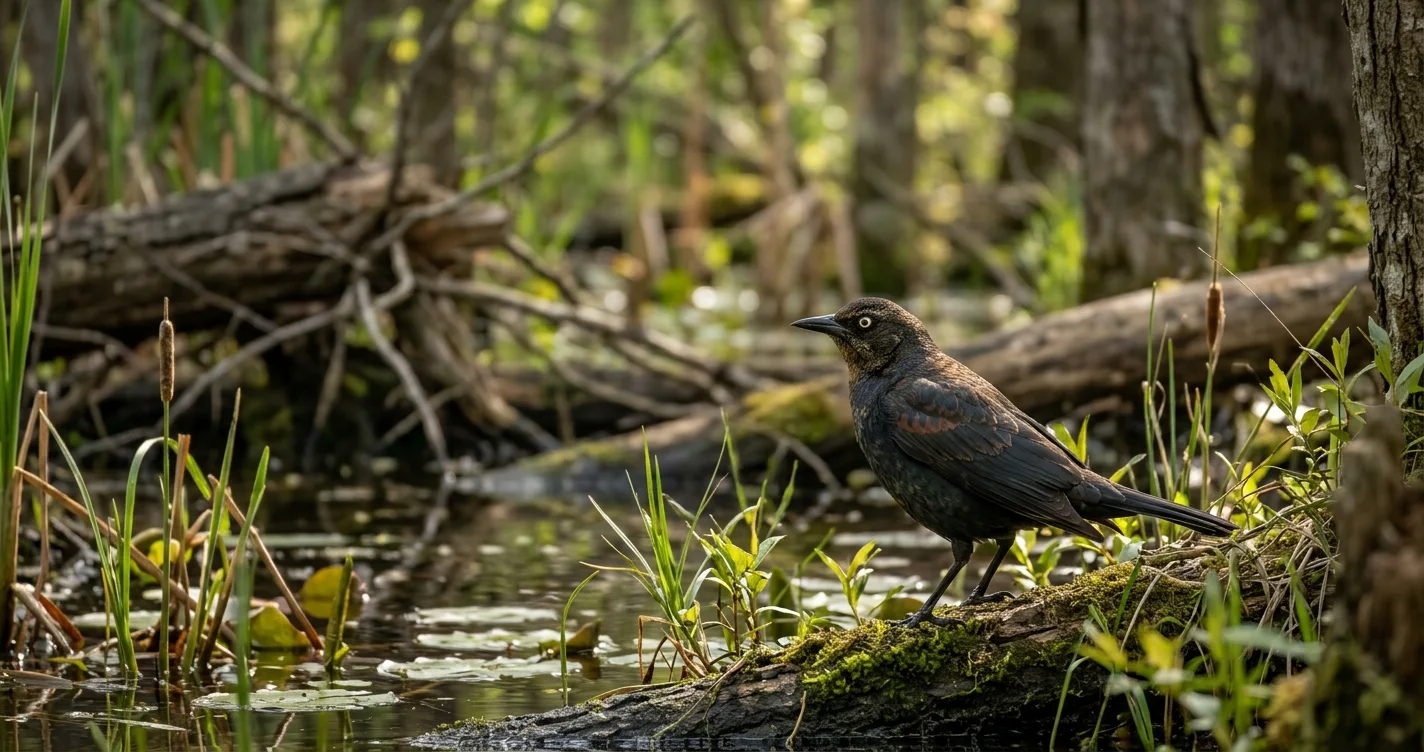
A dark bird steps quietly through a shallow woodland puddle, turning over wet leaves with its bill. At first glance, it looks like an ordinary blackbird. But when the sunlight catches its feathers, something unexpected appears: delicate rusty-brown edges scattered across its dark plumage.
This mysterious visitor is the rusty blackbird (Euphagus carolinus), one of North America’s most intriguing and increasingly uncommon wetland birds.
Unlike the familiar red-winged blackbird that announces its presence from roadside cattails, the rusty blackbird often moves quietly through wooded swamps, flooded forests, and damp leaf litter.
Its subtle appearance makes it easy to overlook. Yet behind those understated colors lies a remarkable conservation story.
Rusty blackbird populations have declined dramatically over recent decades, making the species a growing concern for ornithologists and conservation organizations.
Learning to recognize this bird during fall migration and winter can turn an ordinary walk through a wet woodland into a meaningful wildlife observation.
And sometimes, the most important bird in the forest is the one that almost escapes notice.
Table of Contents
- Meet the Rusty Blackbird: A Quiet Wetland Specialist
- Rusty Blackbird Identification: The Science Behind Its Changing Plumage
- Where Rusty Blackbirds Live Throughout the Year
- How to Spot Rusty Blackbirds During Fall Migration
- Finding Rusty Blackbirds in Winter
- What Rusty Blackbirds Eat and How They Forage
- Why Rusty Blackbird Populations Are Declining
- How Rusty Blackbirds Support Wetland Ecosystems
- In Your Own Yard: Helping Wetland Birds
- Frequently Asked Questions
Meet the Rusty Blackbird: A Quiet Wetland Specialist
The rusty blackbird belongs to the family Icteridae, which includes blackbirds, orioles, grackles, and meadowlarks.
Despite its name, the bird is not consistently rusty-colored throughout the year.
Its appearance changes with the seasons, creating one of its most interesting identification challenges.
A Medium-Sized Bird With Subtle Features
Rusty blackbirds are medium-sized songbirds with relatively slender bodies, pointed bills, and moderately long tails.
They are generally smaller and more delicate-looking than common grackles.
Adult males in breeding plumage are largely glossy black, sometimes showing a subtle greenish sheen.
Females are typically more gray-brown, with darker wings and tails.
During fall and winter, both sexes can develop conspicuous rusty or buff-colored feather edges.
These seasonal markings give the species its common name.
A Bird That Prefers Wet Places
Rusty blackbirds are strongly associated with wetland habitats.
They often forage along shallow water, muddy edges, flooded leaf litter, and the margins of wooded pools.
Unlike many blackbirds that gather in open agricultural fields, rusty blackbirds frequently use forested wetlands.
This habitat preference can make them less visible to casual birdwatchers.
A bird moving quietly beneath bare trees may be easier to hear rustling through leaves than to see clearly.
Rusty Blackbird Identification: The Science Behind Its Changing Plumage
One of the most fascinating features of the rusty blackbird is its seasonal transformation.
A bird that appears nearly black in spring may look mottled brown during autumn.
Understanding why this happens makes identification much easier.
Why Rusty Feathers Appear in Fall
Bird feathers grow during molt, when old feathers are replaced with new ones.
In rusty blackbirds, fresh feathers acquired during the postbreeding molt often have pale brown or rusty-colored edges.
These margins create a mottled appearance across the body.
As the feathers gradually wear, some of the lighter edges disappear, exposing darker portions beneath.
Consequently, males often appear increasingly black as the breeding season approaches.
This change is largely caused by feather wear rather than a complete replacement of every feather immediately before spring.
How Male and Female Plumage Differs
Male rusty blackbirds often show darker overall plumage than females.
In fall, males may appear blackish with cinnamon-brown feather edges, especially on the head, back, and breast.
Females tend to have a more subdued gray-brown appearance, sometimes with a pale eyebrow and contrasting darker wings.
Individual birds vary considerably.
Age, feather condition, lighting, and seasonal timing can influence how the colors appear.
For reliable identification, observers should combine plumage with body shape, bill structure, behavior, and habitat.
The Importance of the Pale Eye
Rusty blackbirds have pale yellowish eyes, a useful identification feature when lighting conditions allow a clear view.
However, eye color alone is not enough.
Brewer’s blackbirds and common grackles can also have pale eyes.
The surrounding plumage, tail shape, bill proportions, and feeding behavior provide additional clues.
Rusty Blackbird Versus Common Grackle
Common grackles are often larger and have longer tails, heavier-looking bills, and more obvious iridescence.
Rusty blackbirds generally have shorter tails and slimmer bills.
They also tend to forage more frequently in wet woodland habitats.
These differences can be subtle when birds are distant or partially hidden.
Taking several photographs from different angles may help with later identification.
Rusty Blackbird Versus Brewer’s Blackbird
Brewer’s blackbirds are especially important look-alikes in western North America.
Both species can show pale eyes and dark plumage.
Brewer’s blackbirds are often associated with open habitats, agricultural areas, lawns, and developed landscapes.
Rusty blackbirds are more closely associated with wetlands and damp forested areas.
Habitat is helpful, but it should never be used as the only identification criterion.
Birds can appear outside their typical environments, particularly during migration.
Where Rusty Blackbirds Live Throughout the Year
Rusty blackbirds have a broad seasonal distribution across North America.
Their annual movements connect northern breeding habitats with more southerly wintering areas.
Breeding in Northern Wetlands
During the breeding season, rusty blackbirds inhabit boreal forests and wetlands across much of Canada and Alaska.
They are particularly associated with wet coniferous and mixed forests, bogs, muskegs, and areas near shallow water.
These habitats provide nesting locations and access to aquatic and terrestrial invertebrates.
Because many breeding sites are remote, studying the species can be challenging.
Migration Through North America
As autumn approaches, rusty blackbirds begin moving south from their northern breeding areas.
Migration timing varies with geography and weather.
Some birds travel through the Great Lakes region, northeastern states, and central North America.
Others follow routes that connect northern forests with wintering habitats farther south.
During migration, birds may pause in suitable wetlands to rest and feed.
These temporary stopover habitats can be important for completing long seasonal journeys.
Wintering in the Eastern and Southeastern United States
Many rusty blackbirds spend winter in the eastern and southeastern United States.
Suitable habitats include forested wetlands, bottomland hardwood forests, flooded woodlands, and shallow wetland margins.
The Mississippi Alluvial Valley and other wetland-rich regions can provide important winter habitat.
However, winter distribution is not uniform.
Local abundance varies with habitat conditions, weather, and annual movements.
How to Spot Rusty Blackbirds During Fall Migration
Autumn is an especially interesting season for identifying rusty blackbirds.
Fresh plumage often makes their namesake rusty markings easier to recognize.
Look Along Wet Woodland Edges
Shallow pools, damp forest trails, and flooded woodland margins are promising places to search.
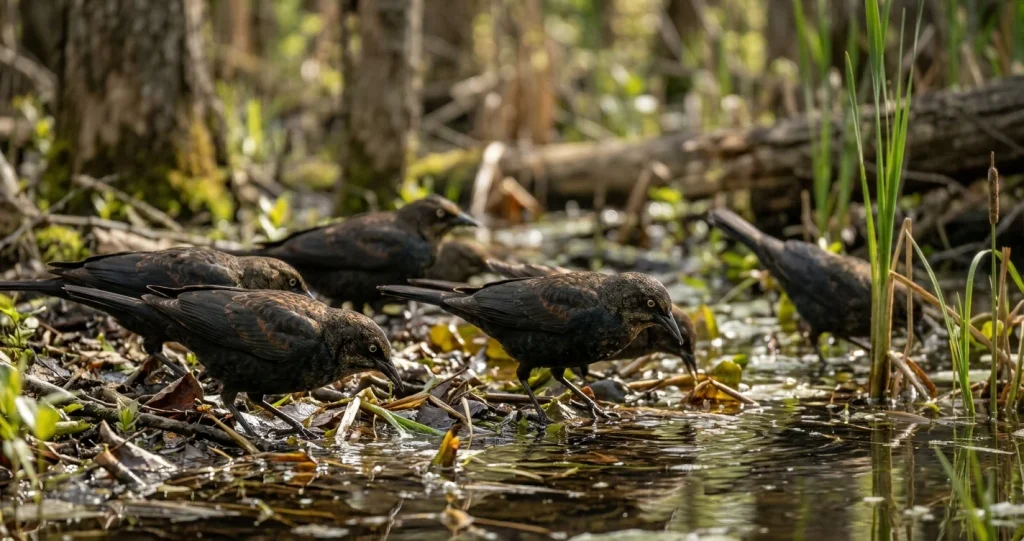
Rusty blackbirds frequently walk through wet leaf litter while searching for food.
They may appear singly or in small groups.
At times, they also associate with other blackbird species.
Watch for birds moving deliberately along the water’s edge rather than remaining high in the canopy.
Pay Attention to Their Feeding Behavior
Rusty blackbirds often investigate leaves, mud, and shallow water with their bills.
They may flip leaves or probe among wet debris to uncover small prey.
This behavior can be especially noticeable when fallen leaves cover the forest floor.
A quiet bird repeatedly searching through damp leaf litter deserves a closer look.
Listen for Their Calls
Rusty blackbirds produce several vocalizations, including relatively sharp calls that birdwatchers sometimes describe as creaky or squeaky.
Their vocal repertoire is not always easy to distinguish from that of related blackbirds.
Listening to verified recordings can help observers become familiar with the species.
The Cornell Lab of Ornithology’s Rusty Blackbird guide provides identification information and recordings useful for comparison.
Finding Rusty Blackbirds in Winter
Winter can offer another opportunity to observe these elusive birds.
Deciduous trees have lost their leaves, making some wetland habitats easier to scan.
However, rusty blackbirds can still be surprisingly difficult to detect.
Search Shallow Water and Muddy Ground
Wintering birds often forage in areas where shallow water remains accessible.
Flooded woodland depressions, muddy stream margins, and wet leaf litter can attract feeding birds.
They may also use nearby agricultural or open habitats when suitable food is available.
The most productive locations depend on local conditions.
Watch for Small, Moving Groups
Rusty blackbirds may gather in flocks during the nonbreeding season.
Some groups remain relatively small, while larger aggregations can occur in suitable habitats.
Birds may move between feeding areas and roosting locations.
Their presence can change quickly as water levels, temperatures, and food availability shift.
Use Binoculars Before Approaching
A pair of binoculars can reveal subtle rusty feather edges and pale eyes without disturbing the birds.
Move slowly and remain on established trails where possible.
Avoid entering sensitive wetland areas or approaching birds so closely that they abandon feeding.
Quiet observation often produces better results than trying to follow every movement.
What Rusty Blackbirds Eat and How They Forage
Rusty blackbirds have a varied diet that changes with season and habitat.
They consume both animal and plant material.
Aquatic and Terrestrial Invertebrates
During the breeding season, insects and other invertebrates are important food sources.
Rusty blackbirds may feed on aquatic insect larvae, adult insects, and other small organisms associated with wetlands.
These prey provide nutrients needed during reproduction and chick development.
Seeds and Other Plant Foods
During fall and winter, plant foods can become more important.
Rusty blackbirds may consume seeds and other available vegetation-derived foods alongside invertebrates.
The balance varies with habitat and seasonal food availability.
A Specialized Foraging Strategy
Their habit of searching through wet leaves and shallow water allows them to exploit food resources that may be less accessible to birds feeding primarily in open fields.
This specialization helps explain their strong association with wetland habitats.
It also raises concerns about the effects of wetland alteration on food availability.
Why Rusty Blackbird Populations Are Declining
Rusty blackbirds have experienced one of the most concerning long-term declines among North American blackbirds.
Monitoring programs and scientific studies indicate substantial population reductions over recent decades.
However, identifying the exact causes has proven difficult.
Researchers increasingly recognize that several factors may be involved.
Loss and Alteration of Wetland Habitat
Forested wetlands have been drained, cleared, or altered in many parts of North America.
These changes can reduce the availability of suitable feeding and resting areas.
Wintering habitats in particular have experienced extensive historical transformation.
Because rusty blackbirds rely heavily on wet environments, habitat changes may affect their ability to find food and shelter.
Changes in Northern Breeding Habitats
Boreal wetlands are influenced by climate, hydrology, vegetation, and natural disturbance.
Changes in these conditions may affect nesting habitat and food availability.
Climate-related shifts are a concern, although their effects vary across the species’ large breeding range.
Researchers continue investigating how environmental changes influence breeding success and population trends.
Possible Environmental Contaminants
Scientists have examined whether contaminants, including mercury, may contribute to rusty blackbird declines.
Wetland food webs can expose birds to environmental pollutants under certain conditions.
However, contaminant exposure alone has not been established as a universal explanation for the population decline.
The relationship between exposure, health, reproduction, and survival requires careful interpretation.
Why Conservation Is Complicated
Rusty blackbirds depend on different habitats during breeding, migration, and winter.
A population may therefore be affected by environmental changes occurring hundreds or thousands of miles apart.
Protecting only one part of the annual cycle may be insufficient.
Effective conservation requires understanding how conditions across the species’ full range influence survival and reproduction.
How Rusty Blackbirds Support Wetland Ecosystems
Rusty blackbirds are part of complex wetland food webs.
Their feeding behavior connects aquatic and terrestrial environments.
Insect Consumption
By consuming insects and other invertebrates, rusty blackbirds participate in the movement of energy through wetland ecosystems.
Their ecological role varies with season and prey availability.
Connections Between Water and Forest
Wetlands are transition zones where water, soil, vegetation, and wildlife interact.
Rusty blackbirds often forage at these boundaries.
Their presence illustrates the importance of maintaining connections between flooded habitats and surrounding forests.
Indicators of Habitat Concern
A declining wetland-associated bird can draw attention to broader environmental pressures.
However, the presence or absence of rusty blackbirds alone cannot determine whether a wetland is healthy.
Habitat assessment requires considering water conditions, vegetation, wildlife communities, and other ecological factors.
In Your Own Yard: Helping Wetland Birds
Even gardeners living far from boreal forests can support bird-friendly landscapes.
The most useful actions often involve protecting natural habitat and reducing unnecessary disturbance.
Preserve Native Vegetation
Native shrubs, trees, and herbaceous plants can provide food and shelter for many bird species.
Where conditions permit, maintaining a diverse planting structure can support insects and other organisms that birds use as food.
Choose species appropriate to your region and growing conditions.
Protect Wet Areas
Small seasonal wet spots can have ecological value.
Where safe and appropriate, consider preserving natural drainage patterns rather than automatically filling or draining every damp area.
Avoid creating stagnant water near buildings or infrastructure.
Local environmental conditions and regulations should guide any wetland-related changes.
Reduce Pesticide Use
Insect-eating birds depend on available invertebrates.
Reducing unnecessary pesticide applications can help preserve these food resources.
Use integrated pest management practices and prioritize nonchemical methods when practical.
Observe and Record Bird Sightings
If you encounter a possible rusty blackbird, document the observation carefully.
Record the date, location, habitat, number of birds, and distinguishing features.
Photographs can be particularly useful when identification is uncertain.
Birdwatchers can contribute observations through eBird, a citizen-science platform managed by the Cornell Lab of Ornithology.
Reliable sightings help improve knowledge of bird distribution and seasonal occurrence.
Frequently Asked Questions
1. Why is the rusty blackbird considered a declining species?
Long-term monitoring indicates that rusty blackbird populations have fallen substantially. Scientists are investigating several possible contributing factors, including wetland habitat alteration, environmental contaminants, and changes in breeding and wintering conditions. The decline is complex, and no single explanation accounts for every population.
2. What is the easiest way to identify a rusty blackbird in winter?
Look for a medium-sized blackbird with a relatively slender bill, pale eyes, and rusty or buff-colored feather edges. Wet woodland habitat and ground-level foraging behavior provide additional clues. Comparing several features is more reliable than relying on one characteristic.
3. Where are rusty blackbirds most likely to be seen during winter?
Rusty blackbirds often use forested wetlands, flooded bottomland forests, shallow pools, and muddy woodland edges in the eastern and southeastern United States. Their local presence varies with weather, water levels, and food availability. Regional bird reports can help identify suitable observation areas.
Conclusion
Return to that quiet woodland puddle where a dark bird moves through wet leaves.
At first, it seems ordinary.
Then the light reveals rusty feather edges, a pale eye, and the deliberate movements of a bird searching for food along the water.
The rusty blackbird may lack the brilliant colors of many familiar songbirds, but its story is extraordinary.
Its seasonal plumage, wetland feeding habits, long-distance movements, and troubling population decline make it an important species for birdwatchers and conservationists alike.
Learning to recognize rusty blackbirds during fall and winter can help bring attention to the habitats they depend on.
Protecting forested wetlands, supporting responsible habitat management, and contributing accurate bird observations are meaningful ways to support broader conservation efforts.
And sometimes, an ordinary-looking bird in a muddy woodland pool can remind us that nature’s most important stories are not always the easiest to see.
External Sources
1. Cornell Lab — Rusty Blackbird Life History
The historical disappearance of beaver ponds may have contributed to rusty blackbird declines by reducing wetland habitat. Recovering beaver populations could help restore some of these environments.
2. Scientific Study — Mercury Exposure in Rusty Blackbirds
Researchers found that rusty blackbirds breeding in northeastern North America had blood mercury concentrations more than three times those of sampled birds in Alaska. Mercury exposure is a possible contributor to their decline, although causation remains uncertain.
3. International Rusty Blackbird Working Group — Migration
Rusty blackbirds can spend approximately 10–12 weeks on their southward autumn migration, including stopovers, but complete their northward spring migration in just 2–4 weeks.