
Two logs can look almost identical, yet behave very differently when placed in a wood stove. One catches fire readily and produces steady heat. The other hisses, smokes, and struggles to burn, even though its bark looks dry.
The difference often comes down to moisture.
Knowing how to recognize seasoned firewood is one of the most useful skills for anyone who heats a home with wood or enjoys an outdoor fire. Drying changes the weight, appearance, sound, and burning characteristics of a log, but not every familiar test is equally reliable.
A hollow sound and cracked ends can offer clues. A moisture meter, used correctly, provides much stronger evidence.
Understanding these differences can help you choose better firewood, store it properly, and avoid burning wood that still contains too much water.
Table of Contents
- What Is Seasoned Firewood?
- Why Firewood Needs to Dry Before Burning
- How to Tell if Firewood Is Seasoned by Looking at It
- The Sound Test: What Two Logs Can Reveal
- Why Cracks Appear in Drying Firewood
- The Moisture Meter Test: The Most Reliable Home Method
- How Much Moisture Should Seasoned Firewood Contain?
- How Long Does Firewood Take to Season?
- Seasoned Firewood vs. Kiln-Dried Firewood
- Common Mistakes When Checking Firewood
- How to Store Firewood So It Dries Properly
- In Your Own Yard: A Simple Firewood Testing Routine
- Frequently Asked Questions
What Is Seasoned Firewood?
Seasoned firewood is wood that has been allowed to dry until its moisture content is suitable for burning.
Freshly cut wood, often called green wood, contains substantial water within its cells and internal structures.
As it dries, moisture gradually leaves the wood.
This process changes its weight, dimensions, and combustion performance.
Seasoning is about moisture, not appearance
A log does not become seasoned simply because it has been stored outdoors for several months.
Drying depends on the wood species, split size, airflow, weather, and storage conditions.
Some pieces may dry considerably faster than others, even within the same stack.
For practical home heating, firewood with a moisture content of approximately 20% or less, measured on a dry-weight basis, is commonly recommended.
That target is more meaningful than the age of the wood alone.
Why Firewood Needs to Dry Before Burning
When wood burns, some of the energy released is used to heat and evaporate the water it contains.
The wetter the wood, the more energy must be spent removing that moisture.
Why wet wood burns poorly
Excess moisture can make ignition difficult and lower combustion temperatures.
Wet logs may produce visible steam, hissing sounds, and more smoke, particularly when the fire is starting or burning inefficiently.
Incomplete combustion can increase the release of particulate pollution and contribute to creosote accumulation in chimneys.
Creosote is combustible, and excessive buildup increases chimney-fire risk.
Dry wood is only part of safe burning
Even properly seasoned wood can produce smoke and creosote when burned in a poorly operated appliance.
Adequate combustion air, correct stove operation, suitable fuel size, and regular chimney maintenance remain essential.
Seasoning improves fuel quality, but it does not replace safe burning practices.
How to Tell if Firewood Is Seasoned by Looking at It
Visual inspection is often the first step when evaluating a stack of firewood.
Several characteristics can suggest that drying has occurred.
Darker or weathered surfaces
As firewood ages, its exposed surfaces may become duller or darker.
Fresh-cut wood often looks brighter, particularly on newly exposed surfaces.
However, color varies naturally among species, and weathering does not prove that the interior is dry.
Loose bark
Bark sometimes loosens as logs dry and shrink.
This can be a useful clue, especially when combined with other signs.
Still, some species retain bark firmly after drying, while others shed it relatively early.
Lighter weight
As water evaporates, a piece of firewood becomes lighter.
Comparing similarly sized pieces of the same species can reveal a noticeable difference.
Comparing different species is less useful because their natural densities vary.
Visible end cracks
Cracks radiating from the center of a log are another familiar sign.
They often indicate that the wood has lost moisture and undergone shrinkage.
But cracks alone cannot establish whether the center has reached an appropriate moisture level.
The Sound Test: What Two Logs Can Reveal
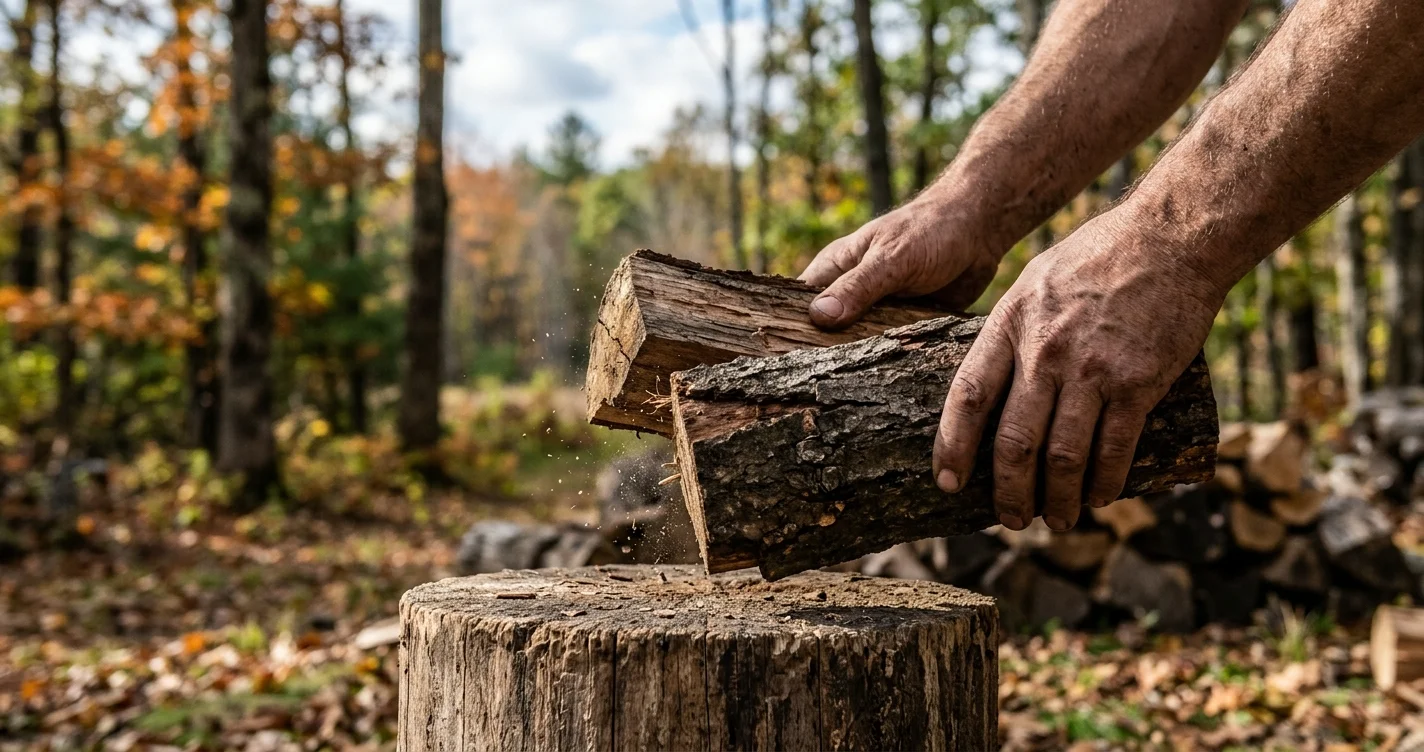
One traditional way to evaluate firewood is to strike two pieces together.
Dry logs sometimes produce a sharper, more resonant sound.
Wetter pieces may produce a duller thud.
Why the sound changes
Water affects how wood responds to vibration.
Moisture content, density, internal structure, and the shape of the pieces can all influence the sound produced by an impact.
As wood dries, its mechanical properties change, which may alter the sound.
However, this is not a standardized moisture measurement.
A cracked, hollow, or irregular piece can sound different from a solid piece even when their moisture contents are similar.
The sound test is best treated as a quick clue rather than a final verdict.
Why Cracks Appear in Drying Firewood
The cracks seen on the ends of logs are commonly called checks.
They develop because wood does not shrink equally in every direction.
The science of wood shrinkage
Wood contains elongated cells arranged along the grain.
As bound water leaves the cell walls during drying, the wood begins to shrink.
Shrinkage across the grain is much greater than shrinkage along its length.
Wood also shrinks differently in the radial and tangential directions.
These uneven dimensional changes create internal stresses.
When the stresses exceed the wood’s strength, cracks may form.
Why cracked wood can still be wet
The outer layers of a log often dry before its interior.
This creates a moisture gradient.
The surface may shrink and develop checks while the center still contains substantial moisture.
For this reason, deeply cracked ends do not guarantee that the entire log is ready to burn.
A freshly split surface provides a better place to investigate internal moisture.
The Moisture Meter Test: The Most Reliable Home Method
For homeowners, a suitable wood moisture meter is generally the most dependable practical way to check whether firewood is ready.
Pin-type meters estimate moisture by measuring electrical resistance between two metal probes.
Because electrical resistance changes with moisture content, the instrument can provide an estimated reading.
How to test firewood correctly
- Select a representative log from the stack, preferably one of the larger pieces.
- Split the log to expose a fresh interior surface.
- Place the meter’s probes into the newly exposed wood, following the manufacturer’s instructions.
- Check the reading and repeat the process on several pieces from different locations in the stack.
- Compare the results with the recommended moisture level for burning.
Testing only the outside surface can give a misleading impression because it may be considerably drier than the interior.
Understand the meter’s limitations
Moisture meters estimate rather than directly measure the water content of wood.
Readings can be affected by species, temperature, probe placement, and instrument calibration.
Some meters include species settings or correction guidance.
Follow the manufacturer’s instructions and interpret borderline readings cautiously.
For home use, however, a properly used moisture meter is much more informative than appearance or sound alone.
How Much Moisture Should Seasoned Firewood Contain?
A commonly recommended target is 20% moisture content or less.
Wood moisture content is normally expressed relative to the weight of the completely dry wood, not the total wet weight.
For example, wood containing 20 pounds of water for every 100 pounds of oven-dry wood has a moisture content of 20%.
Why the measurement matters
Firewood above the recommended moisture level may be harder to ignite and burn efficiently.
Wood that has reached an appropriate moisture level generally performs better when used in a properly operated stove.
A reading slightly below 20% is not a guarantee of safe combustion, just as a single high reading may not represent every log in a stack.
Testing multiple pieces provides a more useful picture.
How Long Does Firewood Take to Season?
There is no universal seasoning period.
Some split firewood may reach suitable moisture levels within several months under favorable conditions.
Dense hardwoods, large pieces, humid climates, and poorly ventilated storage can require considerably longer.
Factors that influence drying
Wood species: Different species vary in density, structure, and initial moisture content.
Split size: Smaller pieces generally dry faster because they expose more surface area.
Air circulation: Moving air helps remove moisture from wood surfaces.
Sunlight and temperature: Warm, sunny conditions can encourage drying when airflow is adequate.
Rain exposure: Repeated wetting can slow the process, particularly when water remains trapped in a poorly arranged stack.
The most reliable approach is to measure moisture rather than assume that a particular number of months is sufficient.
Seasoned Firewood vs. Kiln-Dried Firewood
Both seasoned and kiln-dried firewood are intended to have reduced moisture content.
The main difference is how drying occurs.
Air-seasoned firewood
Air-seasoned wood dries naturally through exposure to suitable outdoor conditions.
The process is influenced by climate, airflow, and storage design.
Kiln-dried firewood
Kiln drying uses controlled heat and airflow to reduce moisture more quickly.
Commercial kiln-dried firewood may also undergo treatment processes designed to meet particular pest-control or transport requirements.
However, not every product labeled kiln-dried has undergone the same treatment.
For pest-related assurances, look for appropriate certification rather than relying on the label alone.
Common Mistakes When Checking Firewood
Several familiar assumptions can lead homeowners to burn wood before it is ready.
Trusting cracked ends alone
Surface checking indicates shrinkage but does not confirm that the center is dry.
Testing only the outside
The exterior may have a much lower moisture content than the interior.
Always test a freshly split face when possible.
Assuming all hardwood dries slowly
Drying rates vary by species and conditions.
Wood density is only one factor.
Keeping wood in a sealed pile
A tightly enclosed stack with poor ventilation can trap moisture.
Covering the entire pile with impermeable material may slow drying.
Assuming dry wood is automatically clean-burning
Combustion quality also depends on the appliance, airflow, operating practices, and maintenance.
Properly seasoned fuel is important, but it is not the only factor.
How to Store Firewood So It Dries Properly
Good storage can make a significant difference in firewood quality.
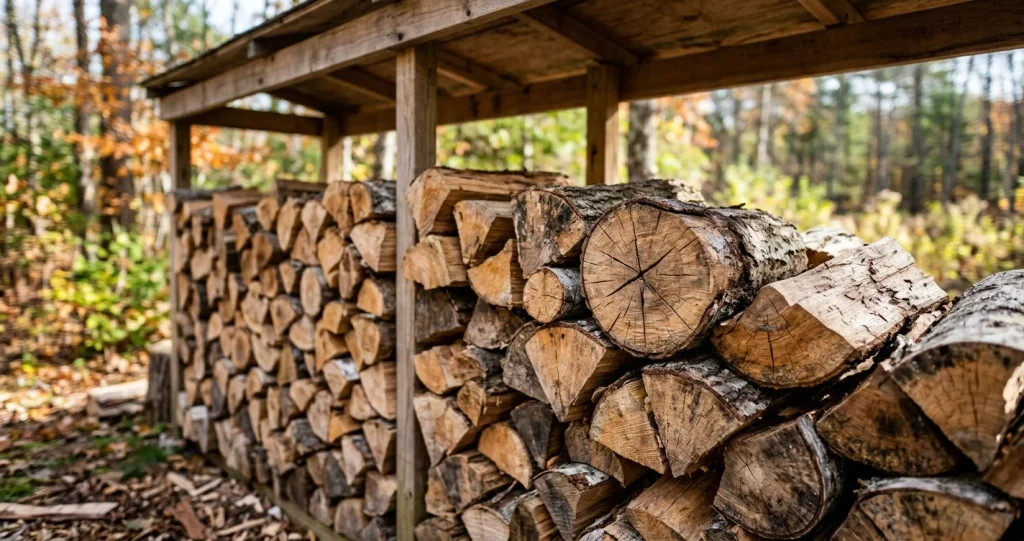
Keep logs off the ground
Use a suitable rack or other stable support to separate the wood from damp soil.
This helps reduce moisture exposure and improves airflow.
Stack loosely and securely
Arrange split pieces so air can move between them.
Avoid unstable stacks that could collapse.
Protect the top
A roof or top cover can reduce direct rainfall.
Where practical, leave the sides open for ventilation.
Choose a suitable location
A sunny, breezy outdoor area is often preferable to a damp, enclosed space.
Keep stacks away from buildings as required by local fire-safety guidance.
Avoid storing large quantities indoors, where firewood may introduce insects, debris, or excess moisture.
In Your Own Yard: A Simple Firewood Testing Routine
A practical testing routine can help you evaluate firewood before the heating season.
Start by selecting several logs from different parts of the stack.
Include pieces from the top, middle, and lower sections.
Step 1: Examine the wood
Look for signs of drying, including weathered surfaces, loose bark, and end checks.
Treat these observations as preliminary clues.
Step 2: Compare similar pieces
Lift two similarly sized logs of the same species.
A noticeably lighter piece may have lost more moisture.
Step 3: Try the sound test
Strike two pieces together carefully.
Listen for differences, but remember that sound is not a reliable moisture measurement by itself.
Step 4: Split and measure
Use a moisture meter on freshly exposed interior surfaces.
Repeat the test across several logs.
Step 5: Keep drying if necessary
If readings remain above the recommended level, return the wood to a properly ventilated outdoor stack.
Recheck it periodically rather than relying on a fixed deadline.
This simple routine combines traditional observations with a more objective measurement.
Frequently Asked Questions
Can firewood look dry but still be wet inside?
Yes. The outer surface often dries before the center. A log may have gray bark, visible cracks, and a dry exterior while retaining substantial internal moisture. Splitting the log and measuring the fresh surface provides a more reliable assessment.
Does seasoned firewood always make a hollow sound?
No. Dry firewood may produce a sharper sound when struck, but species, shape, cracks, and density affect the result. Sound alone cannot confirm an acceptable moisture level.
What moisture level is best for burning firewood?
For many residential wood-burning applications, approximately 20% moisture content or less is a commonly recommended target. Measure freshly split wood with a suitable moisture meter and follow the appliance manufacturer’s fuel guidance.
Conclusion
Return to those two logs that looked almost identical.
One may burn readily while the other struggles because appearance alone cannot reveal how much water remains inside.
Learning to recognize seasoned firewood means combining visual clues, the sound test, an understanding of drying cracks, and careful moisture measurements.
The most useful lesson is simple: when the goal is cleaner, more efficient wood burning, a reliable moisture reading tells you far more than a weathered surface ever could.
External Sources
1. U.S. Environmental Protection Agency — Burn Wise
Dry firewood, efficient wood burning, smoke reduction, and safe residential wood heating.
2. University of New Hampshire Extension — How to Tell if Firewood Is Seasoned
Explains the sound test, cracked log ends, weight differences, and moisture meter testing.
3. Don’t Move Firewood — Invasive Pest Prevention
Firewood transportation, invasive insects, and responsible sourcing.